Question
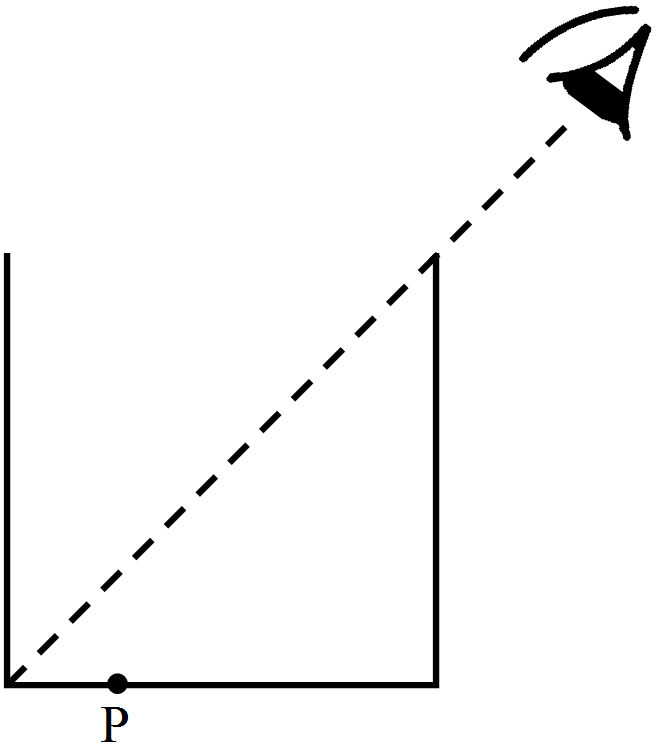
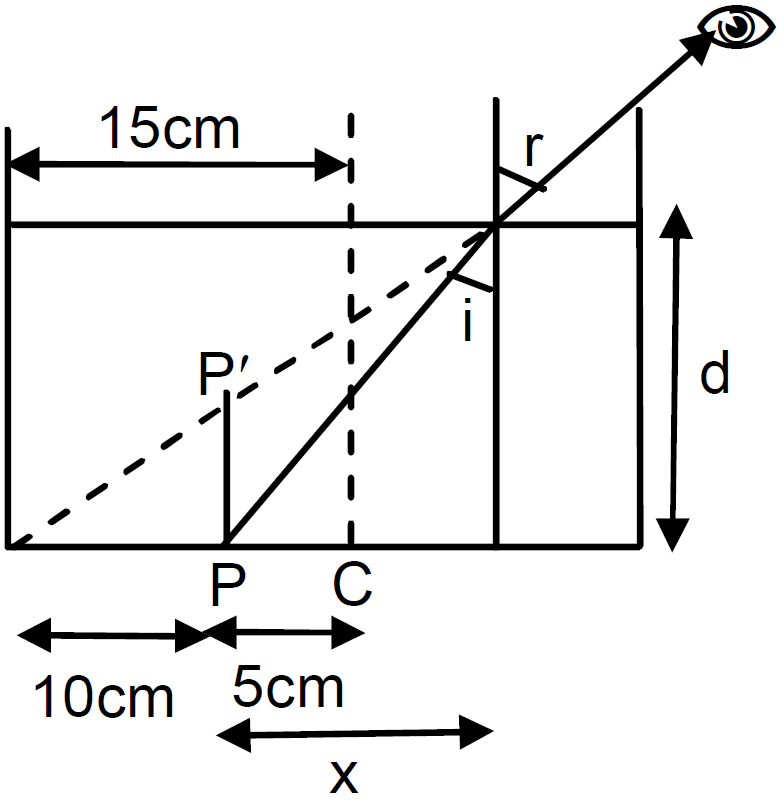
A cylindrical vessel, whose diameter and height both are equal to 30cm, is placed on a horizontal surface and a small particle P is placed in it at a distance of 5.0cm from the centre. An eye is placed at a position such that the edge of the bottom is just visible. The particle P is in the plane of drawing. Up to what minimum height should water be poured in the vessel to make the particle P visible?
Answer

For the given cylindrical vessel, dimetre = 30cm

⇒ r = 15cm and h = 30cm

Now, $\frac{\sin\text{i}}{\sin\text{r}}=\frac{3}{4}\Big[\mu_{\text{w}}=1.33=\frac{4}{3}\Big]$
$\Rightarrow\sin\text{i}=\frac{3}{4\sqrt{2}} \ \big[\because \text{r}=45^{\circ}\big]$

The point P will be visible when the refracted ray makes angle 45° at point of refraction.

Let x = distance of point P from X.

Now, $\tan45^{\circ}=\frac{\text{x}+10}{\text{d}}$

$\Rightarrow\text{d}=\text{x}+10 \ ...(1)$

Again, $\tan\text{i}=\frac{\text{x}}{\text{d}}$

$\Rightarrow\frac{3}{\sqrt{23}}=\frac{\text{d}-10}{\text{d}} \ \Big[\text{Since,} \ \sin\text{i}=\frac{3}{4\sqrt{2}}\Rightarrow\tan\text{i}=\frac{3}{4\sqrt{2}}\Big]$

$\Rightarrow\frac{3}{\sqrt{23}}-1=-\frac{10}{\text{d}}\Rightarrow\text{d}=\frac{\sqrt{23}\times10}{\sqrt{23}-3}=26.7\text{cm}$

Need a full question paper?

Generate a complete, print-ready paper with questions like this in minutes — across 16+ boards, with answer keys.

Start Generating Free

Similar questions

Write the law of force for simple harmonic motion and prove that $T=2 \pi \sqrt{\frac{m}{ k }}$.
An ornament weighing 36g in air, weighs only 34g in water. Assuming that some copper is mixed with gold to prepare the ornament, find the amount of copper in it. Specific gravity of gold is 19.3 and that of copper is 8.9.
The volume of a glass vessel is 1000 cc at 20°C. What volume of mercury should be poured into it at this temperature so that the volume of the remaining space does not change with temperature? Coefficients of cubical expansion of mercury and glass are 1.8 × 10-4 °C and 9·0 × 10-6 °C-1 respectively.
A bat is flitting about in a cave, navigating via ultrasonic beeps. Assume that the sound emission frequency of the bat is 40 kHz. During one fast swoop directly toward a flat wall surface, the bat is moving at 0.03 times the speed of sound in air. What frequency does the bat hear reflected off the wall?
Figure 5.17 shows the position-time graph of a body of mass 0.04kg. Suggest a suitable physical context for this motion. What is the time between two consecutive impulses received by the body? What is the magnitude of each impulse?

A glass vessel measures exactly 10cm × 10cm × 10cm at 0°C. It is filled completely with mercury at this temperature. When the temperature is raised to 10°C, 1.6cm3 of mercury overflows. Calculate the coefficient of volume expansion of mercury. Coefficient of linear expansion of glass = 6.5 × 10⁻⁶ °C.
Obtain an expression for the escape velocity of an object of mass m from the surface of a planet of mass M and radius R. For planet earth, escape velocity is known to have a value of 11.2km/s. How fast will an object be moving when at infinity if it is launched with a speed of 22.4km/s from the surface of the earth?
A hollow sphere of radius 2cm is attached to an 18cm long thread to make a pendulum. Find the time period of oscillation of this pendulum. How does it differ from the time period calculated using the formula for a simple pendulum?
Particles of masses 1g, 2g, 3g, ........, 100g are kept at the marks 1cm, 2cm, 3cm, ........, 100cm respectively on a metre scale. Find the moment of inertia of the system of particles about a perpendicular bisector of the metre scale.
What is acceleration due to gravity? How does it depend on latitude due to the rotation and shape of the Earth?