Question types

Geometrical Optics question types

124 questions across 6 question groups — pick any mix to generate a Physics paper with step-by-step answer keys.

124
Questions
6
Question groups
5
Question types
Sample Questions

Geometrical Optics questions

One sample from each question group in this chapter. Select any group above to see the full set with answer keys.

Four modifications are suggested in the lens formula to include the effect of the thickness t of the lens. Which one is likely to be correct?

  1. $\frac{1}{\text{v}}-\frac{1}{\text{u}}=\frac{1}{\text{uf}}$

  2. $\frac{1}{\text{v}^2}-\frac{1}{\text{u}}=\frac{1}{\text{f}}$

  3. $\frac{1}{\text{v}-\text{t}}-\frac{1}{\text{u}+\text{t}}=\frac{1}{\text{f}}$

  4. $\frac{1}{\text{v}}-\frac{1}{\text{u}}+\frac{\text{t}}{\text{uv}}=\frac{\text{t}}{\text{f}}$
View full solution
A convex lens is made of a material having refractive index 1.2. Both the surfaces of the lens are convex. If it is dipped into water $(\mu=1.33),$ it will behave like:
  1. A convergent lens.
  2. A divergent lens.
  3. A rectangular slab.
  4. A prism.
View full solution
Two concave lenses L1 and L2 are kept in contact with each other. If the space between the two lenses is filled with a material of refractive index $\mu\approx1,$ the magnitude of the focal length of the combination:
  1. Becomes undefined.
  2. Remains unchanged.
  3. Increases.
  4. Decreases.
View full solution
A thin lens is made with a material having refractive index $\mu=1.5.$ Both the sides are convex. It is dipped in water $(\mu=1.33).$ It will behave like:
  1. A convergent lens.
  2. A divergent lens.
  3. A rectangular slab.
  4. A prism.
View full solution
A double convex lens has two surfaces of equal radii R and refractive index $\mu=1.5$ We have,

  1. $\text{f}=\frac{\text{R}}{2}$

  2. $\text{f}=\text{R}$

  3. $\text{f}=-\text{R}$

  4. $\text{f}=2\text{R}$

View full solution
A thin converging lens is formed with one surface convex and the other plane. Does the position of image depend on whether the convex surface or the plane surface faces the object?
View full solution
A converging lens of focal length 12cm and a diverging mirror of focal length 7.5cm are placed 5.0cm apart with their principal axes coinciding. Where should an object be placed so that its image falls on itself?
View full solution
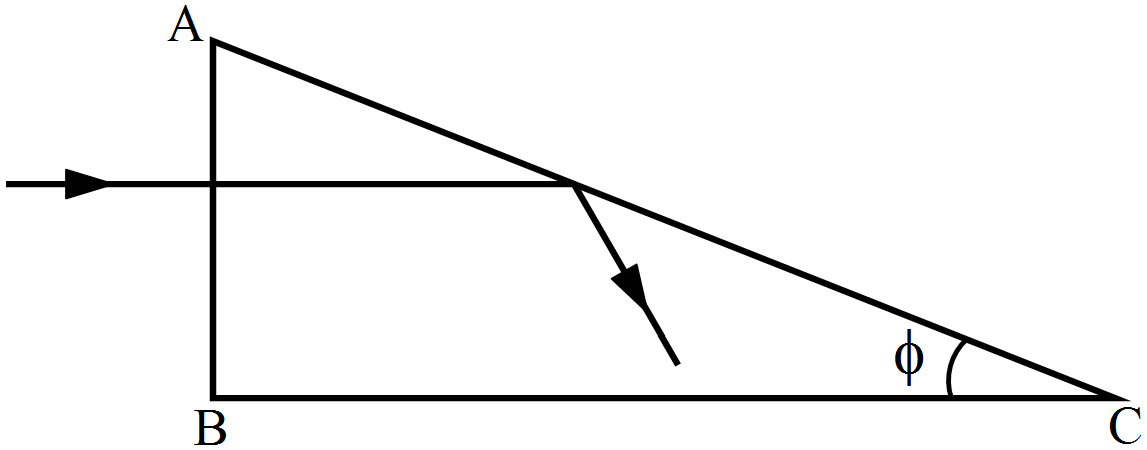
 A light ray is incident normally on the face AB of a right-angled prism ABC $(\mu=1.50)$ as shown in figure. What is the largest angle $\phi$ for which the light ray is totally reflected at the surface AC? 

View full solution
An optical fibre $(\mu=1.72)$ is surrounded by a glass coating $(\mu=1.50).$ Find the critical angle for total internal/ reflection at the fibre-glass interface.
View full solution
Light is incident from glass $(\mu=1.5)$ to air. Sketch the variation of the angle of deviation $\delta$ with the angle of incident i for 0 < i < 90°.
View full solution
Q 163 Marks Question3 Marks
A pole of length 1.00m stands half dipped in a swimming pool with water level 50.0 cm higher than the bed. The refractive index of water is 1.33 and sunlight is coming at an angle of 45° with the vertical. Find the length of the shadow of the pole on the bed.
View full solution
Q 173 Marks Question3 Marks
A light ray is incident at an angle of 45° with the normal to a $\sqrt{2}\text{cm}$ thick plate $(\mu = 2.0)$. Find the shift in the path of the light as it emerges out from the plate.
View full solution
Q 183 Marks Question3 Marks
One end of a cylindrical glass rod $(\mu=1.5)$ of radius 1.0cm is rounded in the shape of a hemisphere. The rod is immersed in water $\Big(\mu=\frac{4}{3}\Big)$ and an object is placed in the water along the axis of the rod at a distance of 8.0cm from the rounded edge. Locate the image of the object.
View full solution
Q 193 Marks Question3 Marks
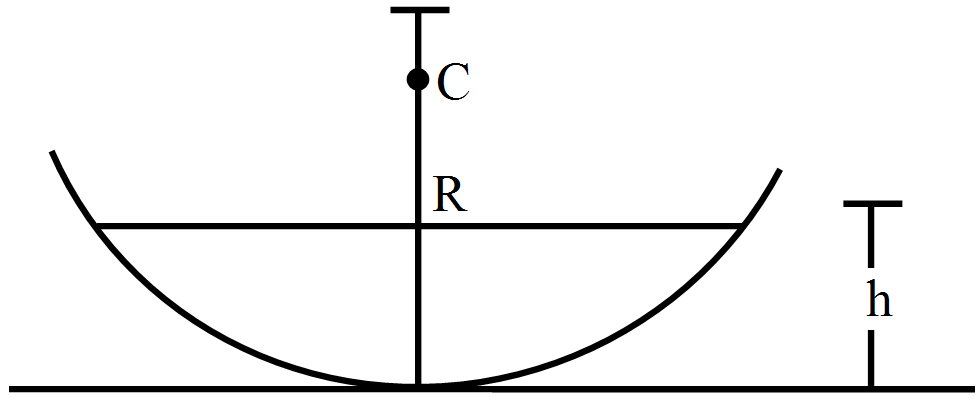
A concave mirror of radius R is kept on a horizontal. Water $\big($refractive index $=\mu\big)$ is poured into it upto a height h. Where should an object be placed so that its image is formed on itself?

View full solution
Q 203 Marks Question3 Marks
A point object is placed on the principal axis of a convex lens (f = 15cm) at a distance of 30cm from it. A glass plate $(\mu=1.50)$ of thickness 1cm is placed on the other side of the lens perpendicular to the axis. Locate the image of the point object.
View full solution
Q 214 Marks Question4 Marks
A container contains water upto a height of 20cm and there is a point source at the centre of the bottom of the container. A rubber ring of radius r floats centrally on the water. The ceiling of the room is 2.0m above the water surface.
  1. Find the radius of the shadow of the ring formed on the ceiling if r = 15cm.
  2. Find the maximum value of r for which the shadow of the ring is formed on the ceiling. Refractive index of water $\frac{4}{3}.$
View full solution
Q 224 Marks Question4 Marks
In motor vehicles, a convex mirror is attached near the driver's seat to give him the view of the traffic behind. What is the special function of this convex mirror which a plane mirror can not do?
View full solution
Q 234 Marks Question4 Marks
A small object is embedded in a glass sphere $(\mu=1.5)$ of radius 5.0cm at a distance 1.5cm left to the centre. Locate the image of the object as seen by an observer standing.
  1. To the left of the sphere.
  2. To the right of the sphere.
View full solution
Q 244 Marks Question4 Marks
A narrow pencil of parallel light is incident normally on a solid transparent sphere of radius r. What should be the refractive index if the pencil is to he focused.
  1. At the surface of the sphere.
  2. At the centre of the sphere.
View full solution
Q 254 Marks Question4 Marks
A slide projector has to project a 35mm slide (35mm × 23mm) on a 2m × 2m screen at a distance of 10m from the lens. What should be the focal length of the lens in the projector?
View full solution
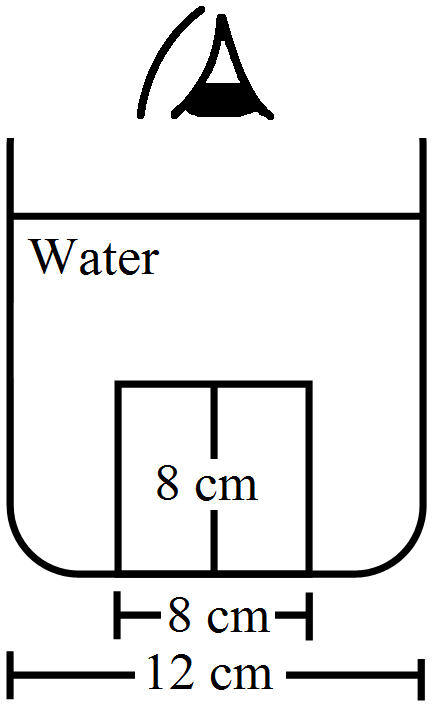
A cylindrical vessel of diameter 12cm contains $800\pi\text{cm}^3$ of water. A cylindrical glass piece of diameter 8.0 cm and height 8.0cm is placed in the vessel. If the bottom of the vessel under the glass piece is seen by the paraxial rays, locate its image. The index of refraction of glass is 1.50 and that of water is 1.33.

View full solution
The radii of curvature of a lens are +20cm and +30cm. The material of the lens has a refracting index 1.6. Find the focal length of the lens.
  1. If it is placed in air.
  2. If it is placed in water $(\mu=1.33).$
View full solution
A ball is kept at a height h above the surface of a heavy transparent sphere made of a material of refractive index $\mu.$ The radius of the sphere is R. At t = 0, the ball is dropped to fall normally on the sphere. Find the speed of the image formed as a function of time for $\text{t}<\sqrt{\frac{2\text{h}}{\text{g}}}.$ Consider only the image by a single refraction.
View full solution
A hemispherical portion of the surface of a solid glass sphere $(\mu=1.5)$ of radius r is silvered to make the inner side reflecting. An object is placed on the axis of the hemisphere at a distance 3r from the centre of the sphere. The light from the object is refracted at the unsilvered part, then reflected from the silvered part and again refracted at the unsilvered part. Locate the final image formed.
View full solution
A thin lens made of a material of refractive index $\mu_2$ has a medium of refractive index $\mu_1$ on one side and a medium of refractive index $\mu_3$ on the other side. The lens is biconvex and the two radii of curvature have equal magnitude R. A beam of light travelling parallel to the principal axis is incident on the lens. Where will the image be formed if the beam is incident from:
  1. The medium $\mu_1$
  2. From the medium $\mu_3?$
View full solution

Generate a Geometrical Optics paper free

Pick question groups from the list above, set marks and difficulty, and export a branded PDF with step-by-step answer keys. First 3 chapters free — no signup.

Download App