Question
A dbuteron and an alpha particle are accelerated with the same accelerating potential. Which one of the two has:
  1. Greater value of de-Broglie wavelength, associated with it and
  2. Less kinetic energy? Explain.

Answer

  1. deutron
$\lambda = \frac{\text{h}}{\sqrt{2\text{mqV}}}$

$\frac{\lambda_d}{\lambda_{\alpha}}=\sqrt{\frac{m_\alpha{q_\alpha}}{m_d{q_d}}}=\sqrt{\frac{{2m_d}\times{2q_d}}{m_d{q_d}}}$

$=\frac{2}{1}$

$\Rightarrow\lambda_{d} > \lambda_{\alpha}$
  1. deuteron
KE = qV

$\therefore$ $q_{\alpha}>q_{d}$

for the same accelerating potential, we have

$(KE)_d>(KE){\alpha}$

Need a full question paper?

Generate a complete, print-ready paper with questions like this in minutes — across 16+ boards, with answer keys.

Start Generating Free

Similar questions

Write the formula to find the Rydberg's constant and what is the value of their constant?
What is rms value $($root mean square$)$?
Derive the equation of rms values of voltage and current?
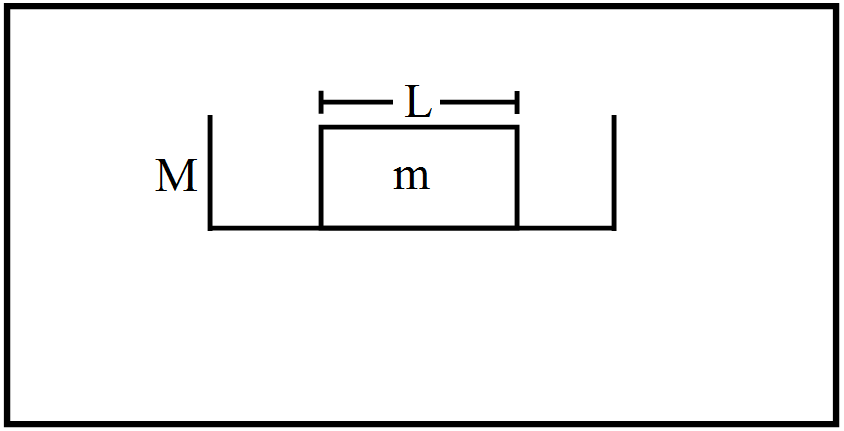
Consider a gravity-free hall in which a tray of mass M, carrying a cubical block of ice of mass m and edge L, is at rest in the middle. If the ice melts, by what distance does the centre of mass of "the tray plus the ice" system descend?
A slab of material of dielectric constant $K$ has the same area as the plates of a parallel$-$plate capacitor but has a thickness $(3 / 4) d$, where $d$ is the separation of the plates. How is the capacitance changed when the slab is inserted between the plates?
Two metallic wires P and Q of the same material and same length but different cross-sectional areas A1 and A2 are joined together and then connected to a source of emf. Find the ratio of the drift velocities of free electrons in the wires P and Q, if the wires are connected (i) in series, and (ii) in parallel.
Find the angular separation between the consecutive bright fringes in a Young's double slit experiment with blue-green light of wavelength 500nm. The separation between the slits is $2.0 × 10^{-3}$m.
The electric current existing in a discharge tube is $2.0\mu\text{A}.$ How much charge is transferred across a cross-section of the tube in 5 minutes?
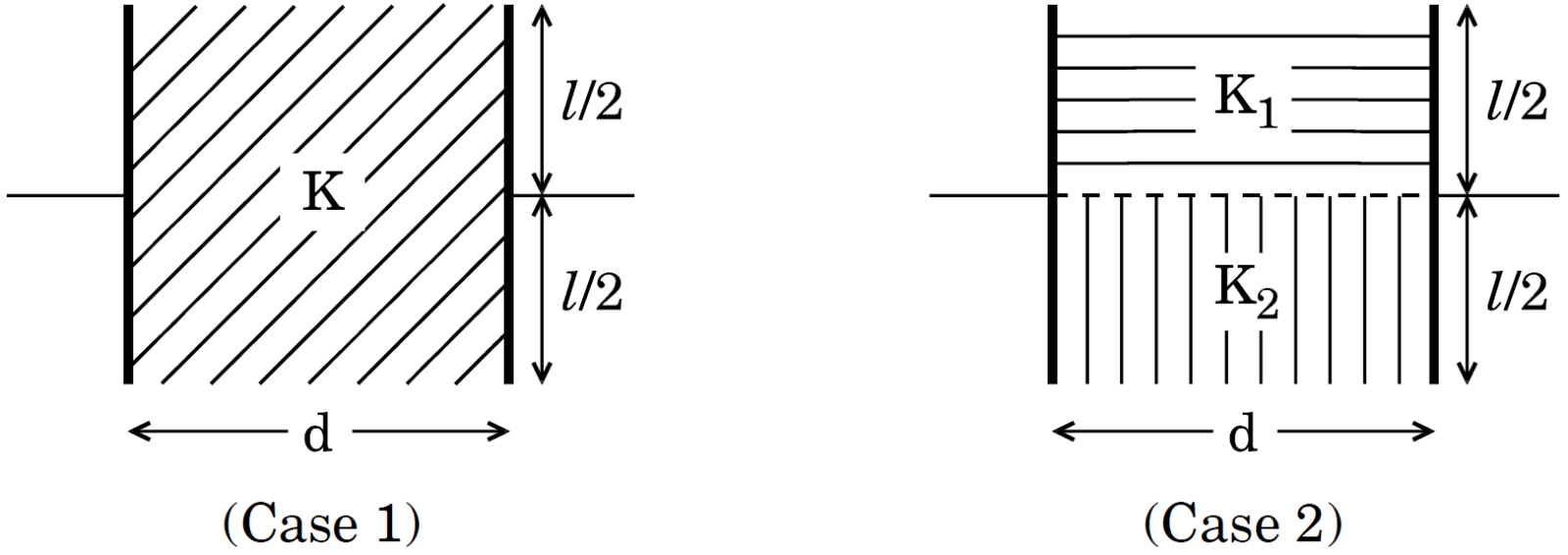
The space between the plates of a parallel plate capacitor is completely filled in two ways. In the first case, it is filled with a slab of dielectric constant K. In the second case, it is filled with two slabs of equal thickness and dielectric constants $\mathrm{K}_1$ and $\mathrm{K}_2$ respectively as shown in the figure. The capacitance of the capacitor is same in the two cases. Obtain the relationship between $\mathrm{K}, \mathrm{K}_1$ and $\mathrm{K}_2$.
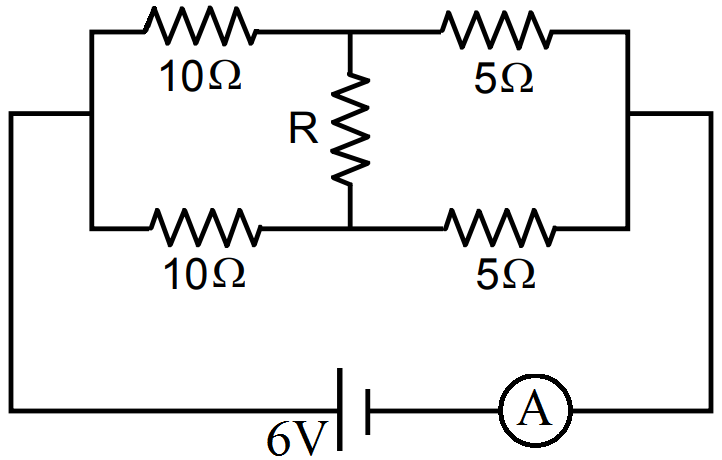
What should be the value of R in the figure. for which the current in it is zero?
The magnetic force depends on v which depends on the inertial frame of reference. Does then the magnetic force differ from inertial frame to frame? Is it reasonable that the net acceleration has a different value in different frames of reference?