Find the angular separation between the consecutive bright fringes in a Young's double slit experiment with blue-green light of wavelength 500nm. The separation between the slits is $2.0 × 10^{-3}$m.
Download our app for free and get startedPlay store
Given that, $\lambda=500\text{nm}=500\times10^{-9}\text{m}$ and $d = 2 × 10^{-3}m$

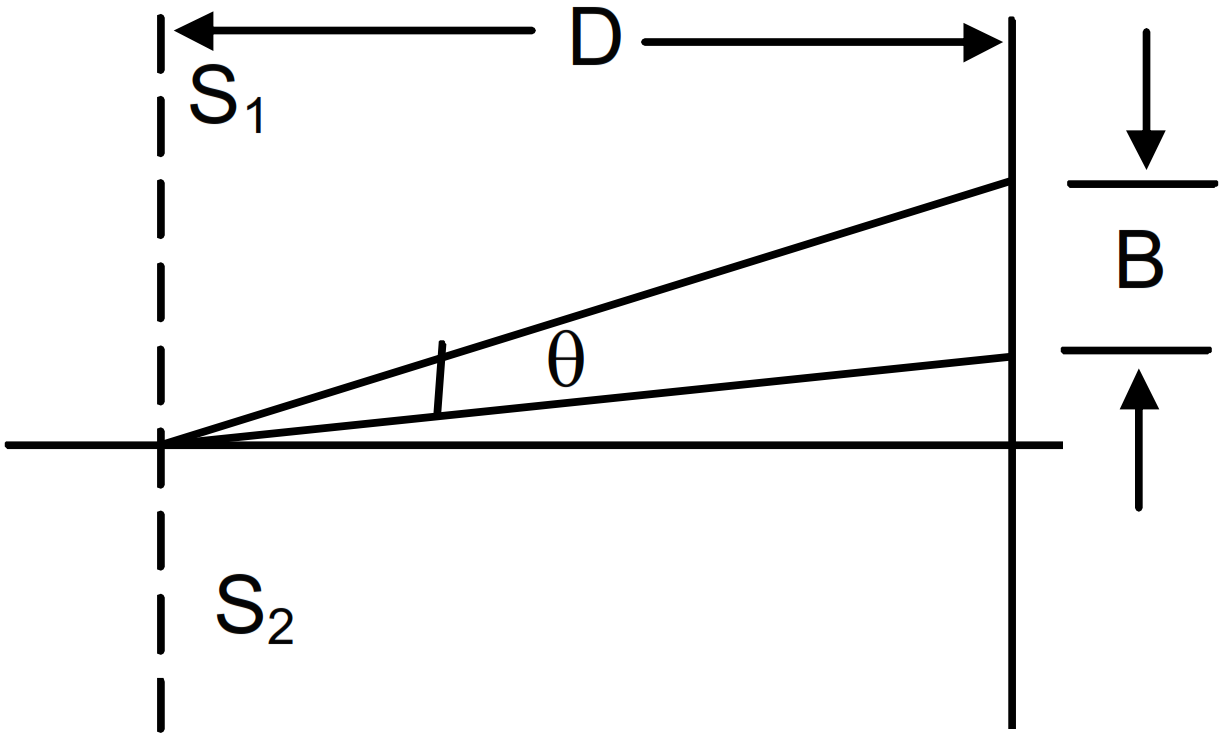
As shown in the figure, angular separation $\theta=\frac{\beta}{\text{D}}=\frac{\lambda\text{D}}{\text{dD}}=\frac{\lambda}{\text{d}}$
So, $\theta=\frac{\beta}{\text{D}}=\frac{\lambda}{\text{d}}=\frac{500\times10^{-9}}{2\times10^{-3}}=250\times10^{-6}$
$= 25 × 10^{-5}$ radian $= 0.014$ degree.
art

Download our app
and get started for free

Experience the future of education. Simply download our apps or reach out to us for more information. Let's shape the future of learning together!No signup needed.*

Similar Questions

  • 1
    When are two objects just resolved? Explain. How can the resolving power of a compound microscope be increased? Use relevant formula to support your answer.
    View Solution
  • 2
    In a double-slit experiment the angular width of a fringe is found to be 0.2° on a screen placed 1 m away. The wavelength of light used is 600 nm. What will be the angular width of the fringe if the entire experimental apparatus is immersed in water? Take refractive index of water to be 4/3.
    View Solution
  • 3
    Draw the output waveform at X, using the given inputs A and B for the logic circuit shown below. Also, identify the logic operation performed by this circuit.
    View Solution
  • 4
    State the importance of coherent sources in the phenomenon of interference.
    View Solution
  • 5
    A parallel beam of light of wavelength 560nm falls on a thin film of oil (refractive index = 1.4). What should be the minimum thickness of the film so that it strongly reflects the light?
    View Solution
  • 6
    In a double slit interference experiment, the separation between the slits is 1.0mm, the wavelength of light used is $5.0 × 10^{-7}m$ and the distance of the screen from the slits is 1.0m.
    1. Find the distance of the centre of the first minimum from the centre of the central maximum.
    2. How many bright fringes are formed in one centimeter width on the screen?
    View Solution
  • 7
    In a Young's double slit experiment, two narrow vertical slits placed 0.800mm apart are illuminated by the same source of yellow light of wavelength 589nm. How far are the adjacent bright bands in the interference pattern observed on a screen 2.00m away?
    View Solution
  • 8
    Distinguish between polarised and unpolarized light. Does the intensity of polarised light emitted by a Polaroid depend on its orientation? Explain briefly.
    The vibrations in a beam of polarised light make an angle of 60° with the axis of the polaroid sheet. What percentage of light is transmitted through the sheet?
    View Solution
  • 9
    Answer the following question:
    Ray optics is based on the assumption that light travels in a straight line. Diffraction effects (observed when light propagates through small apertures/slits or around small obstacles) disprove this assumption. Yet the ray optics assumption is so commonly used in understanding location and several other properties of images in optical instruments. What is the justification?
    View Solution
  • 10
    State one feature by which the phenomenon of interference can be distinguished from that of diffraction.
    A parallel beam of light of wavelength 600 nm is incident normally on a slit of width ‘a’. If the distance between the slit and the screen is 0.8 m and the distance of 2nd order maximum from the centre of the screen is 15 mm, calculate the width of the slit.
    View Solution