MCQ
A defective eye cannot see close objects clearly because their image is formed
  • A
    On the eye lens
  • B
    Between eye lens and retina
  • C
    On the retina
  • Beyond retina

Answer

Correct option: D.
Beyond retina
d
( d)This is the defect of hypermetropia.

Need a full question paper?

Generate a complete, print-ready paper with questions like this in minutes — across 16+ boards, with answer keys.
Start Generating Free

Similar questions

When an object is kept at a distance of $30\, cm$ from a concave mirror, the image is formed at a distance of $10\, cm$ from the mirror. If the object is moved with a speed of $9\, cms ^{-1}$, the speed (in $cms ^{-1}$ ) with which image moves at that instant is$....m/s$
$5.6$ $liter$ of helium gas at $STP$ is adiabatically compressed to $0.7$ $liter$. Taking the initial temperature to be $T_1$, the work done in the process is
Two forces $P + Q$ and $P -Q$ make angle $2 \alpha$ with each other and their  resultant make $\theta$ angle with bisector of angle between them. Then :
In an experiment to measure the internal resistance of a cell by potentiometer, it is found that the balance point is at a length of $2\,m$ when the cell is shunted by a $5\,\Omega $ resistance; and is at a length of $3\,m$ when the cell is shunted by a $10\,\Omega $ resistance. The internal resistance of the cell is, then ................ $\Omega $
A body in one dimensional motion has zero speed at an instant. At that instant, it must have
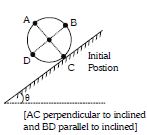
A solid sphere of mass $m$ , radius $R$ is released from rest on sufficient rough long inclined plane of inclination $\theta $ . Consider four points $A$ , $B$ , $C$ and $D$ on the sphere. After one revolution
For any $S.H.M.$, amplitude is $6\, cm$. If instantaneous potential energy is half the total energy then distance of particle from its mean position is .... $cm$
The change in the value of acceleration of earth towards sun, when the moon comes from the position of solar eclipse to the position on the other side of earth in line with sun is: (mass of the moon $= 7.36 \times 10^{22}\,kg,$ radius of the moon's orbit $= 3 .8 \times 10^8\,m$ ).
Compound $(A)$ will be

$\mathop {(A)}\limits_{{C_{11}}{H_8}O}  \to $ does not under go self aldol condensation

$\mathop {(A)}\limits_{{C_{11}}{H_8}O} \xrightarrow{{{O_3}}}ph\, - \,CHO\, + \,2B\,\xrightarrow{{A{g^ + }}}$ Oxalic acid

The decay constant of a radio isotope is $\lambda$. If  $A_1$ and $A_2$ are its activities at times $t_1$ and $t_2$  respectively, the number of nuclei which have decayed during the time $(t_1 - t_2)$