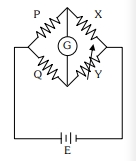
In an experiment to measure the internal resistance of a cell by potentiometer, it is found that the balance point is at a length of $2\,m$ when the cell is shunted by a $5\,\Omega $ resistance; and is at a length of $3\,m$ when the cell is shunted by a $10\,\Omega $ resistance. The internal resistance of the cell is, then ................ $\Omega $
Medium
Download our app for free and get started
$r = \left( {\frac{{{l_1} - {l_2}}}{{{l_2}}}} \right) \times R'$$ = \left( {\frac{{{l_1} - 2}}{2}} \right) \times 5$ ... $(i)$
and $r = \left( {\frac{{{l_1} - 3}}{3}} \right) \times 10$ ... $(ii)$
On solving $(i)$ and $(ii)$
$r = 10 \,\Omega$

Download our appand get started for free
Experience the future of education. Simply download our apps or reach out to us for more information. Let's shape the future of learning together!No signup needed.*
Similar Questions
- 1The equivalent resistance of a group of resistances is $R$. If another resistance is connected in parallel to the group , its new equivalent becomes $R_1$ and if it is connected in series to the group , its new equivalent becomes $R_2$ we have :View Solution
- 2Two bulbs of $500\, watt$ and $200\, watt$ are manufactured to operate on $220\, volt$ line. The ratio of heat produced in $500\, W$ and $200\, W$, in two cases, when firstly they are joined in parallel and secondly in series, will beView Solution
- 3An electric heater of resistance $6 \,ohm$ is run for $10$ minutes on a $120\, volt$ line. The energy liberated in this period of time isView Solution
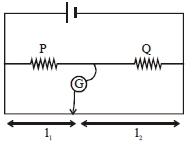
- 4The meter bridge shown is in balanced position with $\frac{\mathrm{P}}{\mathrm{Q}}=\frac{\mathrm{l}_{1}}{\mathrm{l}_{2}}$. If we now litterchange the positions of gavanometer and cell, will the bridge work? If yes, what will be balance condition?View Solution
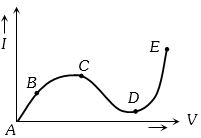
- 5From the graph between current $I$ and voltage $V$ shown below, identify the portion corresponding to negative resistanceView Solution
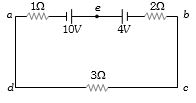
- 6View SolutionThe magnitude and direction of the current in the circuit shown will be
- 7A $50\,V$ battery is connected across a $10\, ohm$ resistor. The current is $4.5\, amperes$. The internal resistance of the battery is ............. $ohm$View Solution
- 8Thousand cells of same emf $E$ and same internal resistance $r$ are connected in series in same order without an external resistance. The potential drop across $399$ cells is found to be ......... $E$View Solution
- 9In the given circuit diagram, find the current passing through wire $CD$ (in ampere)View Solution
- 10A wheatstone bridge is used to determine the value of unknown resistance $X$ by adjusting the variable resistance $Y$ as shown in the figure. For the most precise measurement of $X$, the resistances $P$ and $Q$:View Solution