MCQ
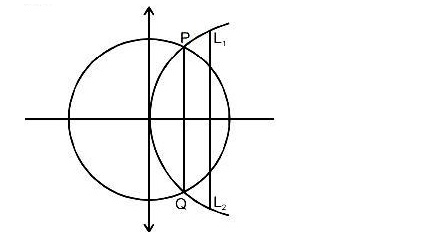
A circle is described whose centre is the vertex and whose diameter is three-quarters of the latus rectum of the parabola $ y^2 = 4ax.$  If $PQ$  is the common chord of the circle and the parabola and $ L_1 L_2$  is the latus rectum, then the area of the trapezium $PL_1 L_2Q$ is :
  • A
    $3\ \sqrt 2\  a^2$
  • B
    $\left( {\frac{{\sqrt 2 \, + 1}}{2}} \right)\,{a^2}\,$
  • C
    $4 a^2$
  • $\left( {\frac{{2\,\, + \,\,\sqrt 2 }}{2}} \right) a^2$
Answer

Correct option: D.
$\left( {\frac{{2\,\, + \,\,\sqrt 2 }}{2}} \right) a^2$
d
Centre $(0,0),$ radius $=\frac{1}{2} \cdot \frac{3}{4} \cdot 4 a=\frac{3 a}{2}$

Equation of the circle is $4\left(x^{2}+y^{2}\right)=9 a^{2} \ldots \ldots \ldots$ (i) Equation of the parabola is $y^{2}=4 a x$ $\ldots \ldots$

(ii)

Solving (i) and

(ii) $x^{2}+4 a x-\frac{9 a^{2}}{4}$

$x=\frac{-4 a \pm \sqrt{16 a^{2}+9 a^{2}}}{2}=\frac{-4 a \pm 5 a}{2}$

$\therefore \quad x=a / 2$

$x=a / 2 \quad y^{2}=4 a x=4 a a / 2=2 a^{2}$

$\Rightarrow \quad y=\pm \sqrt{2} a$

$\therefore=2 \sqrt{2} a$

$\therefore \quad=\frac{1}{2}\left(a-\frac{a}{2}\right)(4 a+2 \sqrt{2} \quad a)=\left(\frac{2+\sqrt{2}}{2}\right) a^{2}$

Need a full question paper?

Generate a complete, print-ready paper with questions like this in minutes — across 16+ boards, with answer keys.

Start Generating Free

Similar questions

A line passes through P (1, 2) such that its intercept between the axes is bisected at P. The equation of the line is:
In a $\triangle\text{ABC}$ if A is the point (1, 2) and equations of the median through B and C are respectively x + y = 5 and x = 4, then B is:
If two vertices of a triangle are (3, -2) and (-2, 3) and its orthocenter is (-6, 1) then its third vertex is:
If ${x_1},\;{x_2},\;{x_3}$ as well as ${y_1},\;{y_2},\;{y_3}$ are in G.P. with the same common ratio, then the points $({x_1},\;{y_1}),\;({x_2},\;{y_2})$ and $({x_3},{y_3})$
Equation of the circle through origin which cuts intercepts of length a and b on axes is:
The equation of the circle which passes through the origin, has its centre on the line $x + y = 4$ and cuts the circle ${x^2} + {y^2} - 4x + 2y + 4 = 0$ orthogonally, is
A variable circle passes through the fixed point $(2,0)$ and touches the $y$-axis . Then the locus of its centre is
Let $a_1, a_2, \ldots, a_n$ be $n$ non-zero real numbers, of which $p$ are positive and remaining are negative. The number of ordered pairs $(j, k), j < k$, for which $a_j a_k$ is positive, is $55$ . Similarly, the number of ordered pairs $(j, k), j < k$, for which $a_j a_k$ is negative, is $50$ . Then, the value of $p^2+(n-p)^2$ is
Let $\theta \in [0, 4\pi ]$ satisfy the equation $(sin\, \theta + 2) (sin\, \theta + 3) (sin\, \theta + 4) = 6$ . If the sum of all the values of $\theta $ is of the form $k\pi $, then the value of $k$ is
Let,$S=\left\{\theta \in[0,2 \pi]: 8^{2 \sin ^{2} \theta}+8^{2 \cos ^{2} \theta}=16\right\}$. Then $n ( S )+\sum_{\theta \in S}\left(\sec \left(\frac{\pi}{4}+2 \theta\right) \operatorname{cosec}\left(\frac{\pi}{4}+2 \theta\right)\right)$ is equal to.