MCQ 11 Mark
The centre of the conic represented by the equation $2{x^2} - 72xy + 23{y^2} - 4x - 28y - 48 = 0$ is
- A
$\left( {\frac{{11}}{{15}},\;\frac{2}{{25}}} \right)$
- B
$\left( {\frac{2}{{25}},\;\frac{{11}}{{25}}} \right)$
- C
$\left( {\frac{{11}}{{15}},\; - \frac{2}{{25}}} \right)$
- ✓
$\left( { - \frac{{11}}{{25}},\; - \frac{2}{{25}}} \right)$
AnswerCorrect option: D. $\left( { - \frac{{11}}{{25}},\; - \frac{2}{{25}}} \right)$
d
(d) Centre of conic is $\left( {\frac{{hf - bg}}{{ab - {h^2}}},\,\frac{{gh - af}}{{ab - {h^2}}}} \right)$
$ = \frac{{( - 36)( - 14) - (23)( - 2)}}{{(2)(23) - {{(36)}^2}}},\;\frac{{( - 2)( - 36) - (2)( - 14)}}{{(2)(23) - {{( - 36)}^2}}}$
$ = \left( { - \frac{{11}}{{25}},\, - \frac{2}{{25}}} \right)$.
View full question & answer→MCQ 21 Mark
The centre of $14{x^2} - 4xy + 11{y^2} - 44x - 58y + 71 = 0$
- ✓
$(2, 3)$
- B
$(2, -3)$
- C
$(-2, 3)$
- D
$(-2, -3)$
AnswerCorrect option: A. $(2, 3)$
a
(a) Use formula of centre of conic
$i.e.$, $\left( {\frac{{hf - bg}}{{ab - {h^2}}},\,\frac{{gh - af}}{{ab - {h^2}}}} \right)$.
View full question & answer→MCQ 31 Mark
The equation of the conic with focus at $(1, -1)$, directrix along $x - y + 1 = 0$ and with eccentricity $\sqrt 2 $ is
- A
${x^2} - {y^2} = 1$
- B
$xy = 1$
- ✓
$2xy - 4x + 4y + 1 = 0$
- D
$2xy + 4x - 4y - 1 = 0$
AnswerCorrect option: C. $2xy - 4x + 4y + 1 = 0$
c
(c) Let $P (x, y)$ be any point on the conic.
Then $\sqrt {{{(x - 1)}^2} + {{(y + 1)}^2}} = \sqrt 2 \left( {\frac{{x - y + 1}}{{\sqrt 2 }}} \right)$,
[Using $SP = e.PM]$
$ \Rightarrow 2xy - 4x + 4y + 1 = 0$.
View full question & answer→MCQ 41 Mark
If a point $(x,\;y) \equiv (\tan \theta + \sin \theta ,\;\tan \theta - \sin \theta )$, then locus of $(x, y)$ is
AnswerCorrect option: C. ${({x^2} - {y^2})^2} = 16xy$
c
(c) Trick : Put the value of $(x, y)$ $ \equiv $ ($\tan \theta + \sin \theta ,\,\tan \theta - \sin \theta )$ in option $(c)$, which satisfies the equation.
View full question & answer→MCQ 51 Mark
Equation $\sqrt {{{(x - 2)}^2} + {y^2}} + \sqrt {{{(x + 2)}^2} + {y^2}} = 4$ represents
Answerd
(d) Given equation is , $\sqrt {{{(x - 2)}^2} + {y^2}} + \sqrt {{{(x + 2)}^2} + {y^2}} = 4$
$\sqrt {{{(x - 2)}^2} + {y^2}} = 4 - \sqrt {{{(x - 2)}^2} + {y^2}} $
Squaring both sides, we get $\sqrt {{{(x + 2)}^2} + {y^2}} = x + 2$
Again squaring both sides, we get ${y^2} = 0$, which is the equation of pair of straight lines.
View full question & answer→MCQ 61 Mark
The equation ${y^2} - {x^2} + 2x - 1 = 0$ represents
Answerc
(c) Given equation is ${y^2} - {x^2} + 2x - 1 = 0$
Comparing the given equation with
$a{x^2} + 2hxy + b{y^2} + 2gx + 2fy + c = 0$
We get, $a = 1$, $h = 0$, $b = 1$, $g = 1$, $f = 0$, $c = - 1$
$\therefore $ $\Delta = abc + 2fgh - a{f^2} - b{g^2} - c{h^2}$
$\Delta = 1 + 0 + 0 - 1 = 0$
Hence, the given equation represents two straight lines.
View full question & answer→MCQ 71 Mark
The equation ${x^2} - 2xy + {y^2} + 3x + 2 = 0$ represents
Answera
(a) $\Delta = (1)\,(1)\,(2) + 2\,\left( {\frac{3}{2}} \right)\,(0)( - 1) - (1)\,{(0)^2} - $$(1)\,{\left( {\frac{3}{2}} \right)^2} - 2{( - 1)^2}$
$ = 2 - \frac{9}{4} - 2 < 0$ and ${h^2} - ab = 1 - 1 = 0$.
i.e., ${h^2} = ab$ ==> a parabola.
View full question & answer→MCQ 81 Mark
Curve $16{x^2} + 8xy + {y^2} - 74x - 78y + 212 = 0$ represents
Answera
(a) $\Delta \ne 0,\,{h^2} = ab$ $i.e.$, parabola.
View full question & answer→MCQ 91 Mark
The points of intersection of the curves whose parametric equations are $x = {t^2} + 1,\;y = 2t$ and $x = 2s,\;y = \frac{2}{s}$ is given by
- A
$(1,\; - 3)$
- ✓
$(2, 2)$
- C
$(-2, 4)$
- D
$(1, 2)$
AnswerCorrect option: B. $(2, 2)$
b
(b) Eliminating $t$ from $x = {t^2} + 1,\,\,y = 2t,$ we obtain ${y^2} = 4x - 4$
Similarly eliminating s from $x = 2s,\,y = \frac{2}{s},$
we get $xy = 4.$
Hence point of intersection is $(2, 2).$
View full question & answer→MCQ 101 Mark
The equation $14{x^2} - 4xy + 11{y^2} - 44x - 58y + 71 = 0$ represents
Answerb
(b) Check $\Delta \ne 0$ and ${h^2} < ab$.
View full question & answer→MCQ 111 Mark
The eccentricity of the curve represented by the equation ${x^2} + 2{y^2} - 2x + 3y + 2 = 0$ is
- A
$0$
- B
$1/2$
- ✓
$1/\sqrt 2 $
- D
$\sqrt 2 $
AnswerCorrect option: C. $1/\sqrt 2 $
c
(c) Equation ${x^2} + 2{y^2} - 2x + 3y + 2 = 0$ can be written as
$\frac{{{{(x - 1)}^2}}}{2} + {\left( {y + \frac{3}{4}} \right)^2} = \frac{1}{{16}}$
==> $\frac{{{{(x - 1)}^2}}}{{(1/8)}} + \frac{{{{\left( {y + \frac{3}{4}} \right)}^2}}}{{(1/16)}} = 1$,
which is an ellipse with ${a^2} = \frac{1}{8}$ and ${b^2} = \frac{1}{{16}}$
$\therefore \frac{1}{{16}} = \frac{1}{8}(1 - {e^2})$
==>${e^2} = 1 - \frac{1}{2}$
==> $e = \frac{1}{{\sqrt 2 }}$.
View full question & answer→MCQ 121 Mark
The eccentricity of the conic $4{x^2} + 16{y^2} - 24x - 3y = 1$ is
- ✓
$\frac{{\sqrt 3 }}{2}$
- B
$\frac{1}{2}$
- C
$\frac{{\sqrt 3 }}{4}$
- D
$\sqrt 3 $
AnswerCorrect option: A. $\frac{{\sqrt 3 }}{2}$
a
(a) Given equation of conic is $4{x^2} + 16{y^2} - 24x - 3y = 1$
$ \Rightarrow $ ${(2x - 6)^2} + {(4y - 4)^2} = 53$
$ \Rightarrow $ $4\,{(x - 3)^2} + 16\,{(y - 1)^2} = 53$
$ \Rightarrow $ $\frac{{{{(x - 3)}^2}}}{{53/4}} + \frac{{{{(y - 1)}^2}}}{{53/16}} = 1$
$\therefore $ $e = \sqrt {1 - \frac{{{b^2}}}{{{a^2}}}} = \sqrt {1 - \frac{{53/16}}{{53/4}}}$
$= \sqrt {1 - \frac{1}{4}} = \frac{{\sqrt 3 }}{2}$.
View full question & answer→MCQ 131 Mark
A point ratio of whose distance from a fixed point and line $x = 9/2$ is always $2 : 3$. Then locus of the point will be
Answerb
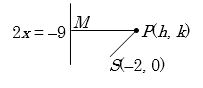
(b) In question, $PS = \frac{2}{3}PM$ (Given)
Focus $S( - 2,\,0)$,
Equation of directrix $2x - 9 = 0$
${(PS)^2} = \frac{4}{9}{(PM)^2}$
==> ${(h + 2)^2} + {(k)^2} = \frac{4}{9}{\left( {\frac{{2h - 9}}{2}} \right)^2}$
==> $9[{(h + 2)^2} + {(k)^2}] = \frac{{4{{(2h - 9)}^2}}}{4}$
==> $9{h^2} + 9{k^2} + 36h + 36 = 4{h^2} + 81 + 36h$
==> $\frac{{5{h^2}}}{{45}} + \frac{{9{k^2}}}{{45}} = 1$
==> $\frac{{{h^2}}}{9} + \frac{{{k^2}}}{5} = 1$
Locus of point $P(h, k)$ is $\frac{{{x^2}}}{9} + \frac{{{y^2}}}{5} = 1$, which is an ellipse
View full question & answer→MCQ 141 Mark
The equation $13[{(x - 1)^2} + {(y - 2)^2}] = 3{(2x + 3y - 2)^2}$ represents
Answerc
(c) Here coefficient of ${x^2}$ is $+ve$ and that of ${y^2}$ is $-ve$
$i.e.$, a hyperbola.
View full question & answer→MCQ 151 Mark
The equation ${x^2} + 4xy + {y^2} + 2x + 4y + 2 = 0$ represents
Answerc
(c) Obviously ${h^2} > ab$ and
$\Delta = (1)\,(1)\,(2) + 2(2)\,(1)\,(2) - (1)\,{(2)^2} - (1)\,{(1)^2} - 2{(2)^2} < 0$
Hence it is a hyperbola.
View full question & answer→MCQ 161 Mark
The equation of the directrices of the conic ${x^2} + 2x - {y^2} + 5 = 0$ are
- A
$x = \pm 1$
- B
$y = \pm 2$
- ✓
$y = \pm \sqrt 2 $
- D
$x = \pm \sqrt 3 $
AnswerCorrect option: C. $y = \pm \sqrt 2 $
c
(c) ${(x + 1)^2} - {y^2} - 1 + 5 = 0$
$⇒$ $ - \frac{{{{(x + 1)}^2}}}{4} + \frac{{{y^2}}}{4} = 1$
Equation of directrices of $\frac{{{y^2}}}{{{b^2}}} - \frac{{{x^2}}}{{{a^2}}} = 1$ are $y = \pm \frac{b}{e}$
Here $b = 2,\;e = \sqrt {1 + 1} = \sqrt 2 $
Hence $y = \pm \frac{2}{{\sqrt 2 }}$
$⇒$ $y = \pm \sqrt 2 $.
View full question & answer→MCQ 171 Mark
The equation ${x^2} - 16xy - 11{y^2} - 12x + 6y + 21 = 0$ represents
Answerc
(c) $\Delta \ne 0,\,{h^2} > ab$.
View full question & answer→MCQ 181 Mark
The equation of the hyperbola whose directrix is $2x + y = 1$, focus $(1, 1)$ and eccentricity $ = \sqrt 3 $, is
- ✓
$7{x^2} + 12xy - 2{y^2} - 2x + 4y - 7 = 0$
- B
$11{x^2} + 12xy + 2{y^2} - 10x - 4y + 1 = 0$
- C
$11{x^2} + 12xy + 2{y^2} - 14x - 14y + 1 = 0$
- D
AnswerCorrect option: A. $7{x^2} + 12xy - 2{y^2} - 2x + 4y - 7 = 0$
a
(a) $S\,(1,\,1)$, directrix is $2x + y = 1$ and $e = \sqrt 3 $.
Now let the various point be $(h,k)$,
then accordingly $\frac{{\sqrt {{{(h - 1)}^2} + {{(k - 1)}^2}} }}{{\frac{{2h + k - 1}}{{\sqrt 5 }}}} = \sqrt 3 $
Squaring both the sides, we get
$5[{(h - 1)^2} + {(k - 1)^2}] = 3{(2h + k - 1)^2}$
On simplification, the required locus is
$7{x^2} + 12xy - 2{y^2} - 2x + 4y - 7 = 0$.
View full question & answer→MCQ 191 Mark
${x^2} - 4{y^2} - 2x + 16y - 40 = 0$ represents
Answerc
(c) ${x^2} - 2x - 4{y^2} + 16y - 40 = 0$
==> $({x^2} - 2x) - 4({y^2} - 4y) - 40 = 0$
==> ${(x - 1)^2} - 1 - 4[{(y - 2)^2} - 4] - 40 = 0$
==> ${(x - 1)^2} - 4{(y - 2)^2} = 25$
==> $\frac{{{{(x - 1)}^2}}}{{25}} - \frac{{{{(y - 2)}^2}}}{{25/4}} = 1$, which is a hyperbola.
View full question & answer→MCQ 201 Mark
The locus of the intersection point of $x\cos \alpha - y\sin \alpha = a$ and $x\sin \alpha - y\cos \alpha = b$ is
Answerd
(d) $x\,\cos \alpha - y\sin \alpha = a,$ $x\,\sin \alpha - y\cos \alpha = b$ Intersection points are
$h = \frac{{a\,\cos \alpha - b\,\sin \alpha }}{{\cos 2\alpha }}$, $k = \,\frac{{a\,\sin \alpha - \,b\cos \alpha }}{{\cos 2\alpha }}$
Then the locus of point $(h,\,k)$ is ${x^4} + {y^4} - 2{x^2}{y^2}$ $ = ({a^2} + {b^2})$ $({x^2} + {y^2}) + 4abxy$, which is not a locus of any given curves.
View full question & answer→MCQ 211 Mark
${y^2} - 2x - 2y + 5 = 0$ represents
- A
A circle whose centre is $(1, 1)$
- B
A parabola whose focus is $(1, 2)$
- ✓
A parabola whose directrix is $x = \frac{3}{2}$
- D
A parabola whose directrix is $x = - \frac{1}{2}$
AnswerCorrect option: C. A parabola whose directrix is $x = \frac{3}{2}$
c
(c)The equation can be written as ${(y - 1)^2} = 2(x - 2)$.
Obviously, it is a parabola whose focus is $\left( {\frac{5}{2},1} \right)$ and directrix
is $x = \frac{3}{2}$.
View full question & answer→MCQ 221 Mark
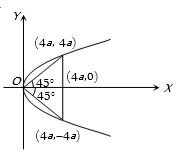
If a double ordinate of the parabola ${y^2} = 4ax$ be of length $8a$, then the angle between the lines joining the vertex of the parabola to the ends of this double ordinate is ............... $^\circ$
Answerc
(c) It is clear from figure.
View full question & answer→MCQ 231 Mark
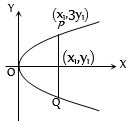
$PQ$ is a double ordinate of the parabola ${y^2} = 4ax$. The locus of the points of trisection of $PQ$ is
- ✓
$9{y^2} = 4ax$
- B
$9{x^2} = 4ay$
- C
$9{y^2} + 4ax = 0$
- D
$9{x^2} + 4ay = 0$
AnswerCorrect option: A. $9{y^2} = 4ax$
a
(a) Required locus is ${(3y)^2} = 4ax$
==> $9{y^2} = 4ax$.
View full question & answer→MCQ 241 Mark
Vertex of the parabola ${y^2} + 2y + x = 0$ lies in the quadrant
Answerd
(d) Given parabola can be written as ${(y + 1)^2} = - (x - 1)$.
Hence vertex is $(1, -1)$, which lies in $IV$ quadrant.
View full question & answer→MCQ 251 Mark
Vertex of the parabola $9{x^2} - 6x + 36y + 9 = 0$ is
- ✓
$(1/3,\; - 2/9)$
- B
$( - 1/3,\; - 1/2)$
- C
$( - 1/3,\;1/2)$
- D
$(1/3,\;1/2)$
AnswerCorrect option: A. $(1/3,\; - 2/9)$
a
(a) The equation can be written as ${(3x - 1)^2} = - 4(9y + 2)$.
Hence the vertex is $\left( {\frac{1}{3},\, - \frac{2}{9}} \right)$.
View full question & answer→MCQ 261 Mark
The equation of the parabola whose axis is vertical and passes through the points $(0, 0), (3, 0)$ and $(-1, 4)$ is
- ✓
${x^2} - 3x - y = 0$
- B
${x^2} + 3x + y = 0$
- C
${x^2} - 4x + 2y = 0$
- D
${x^2} - 4x - 2y = 0$
AnswerCorrect option: A. ${x^2} - 3x - y = 0$
a
(a) Check the equation of parabola for the given points.
View full question & answer→MCQ 271 Mark
The equation of the parabola whose vertex is $(-1, -2)$, axis is vertical and which passes through the point $(3, 6)$, is
AnswerCorrect option: A. ${x^2} + 2x - 2y - 3 = 0$
a
(a) ${(x + 1)^2} = 4a(y + 2)$
Passes through $(3, 6)$
==> $16 = 4a.8$
==> $a = \frac{1}{2}$
==> ${(x + 1)^2} = 2(y + 2)$
==> ${x^2} + 2x - 2y - 3 = 0$.
View full question & answer→MCQ 281 Mark
Axis of the parabola ${x^2} - 4x - 3y + 10 = 0$ is
- A
$y + 2 = 0$
- B
$x + 2 = 0$
- C
$y - 2 = 0$
- ✓
$x - 2 = 0$
AnswerCorrect option: D. $x - 2 = 0$
d
(d) The parabola is ${(x - 2)^2} = (3y - 6)$. Hence axis is $x - 2 = 0$.
View full question & answer→MCQ 291 Mark
Equation of the parabola whose directrix is $y = 2x - 9$ and focus $(-8, -2)$ is
- A
${x^2} + 4{y^2} + 4xy + 16x + 2y + 259 = 0$
- ✓
${x^2} + 4{y^2} + 4xy + 116x + 2y + 259 = 0$
- C
${x^2} + {y^2} + 4xy + 116x + 2y + 259 = 0$
- D
AnswerCorrect option: B. ${x^2} + 4{y^2} + 4xy + 116x + 2y + 259 = 0$
b
(b) Let any point on it be $(x, y)$, then from definition of parabola, we get
$\frac{{\sqrt {{{(x + 8)}^2} + {{(y + 2)}^2}} }}{{\left| {\frac{{2x - y - 9}}{{\sqrt 5 }}} \right|}} = 1$
Squaring and after simplification, we get
${x^2} + 4{y^2} + 4xy + 116x + 2y + 259 = 0$.
View full question & answer→MCQ 301 Mark
The equation of the parabola with $(-3, 0)$ as focus and $x + 5 = 0$ as directirx, is
- A
${x^2} = 4(y + 4)$
- B
${x^2} = 4(y - 4)$
- ✓
${y^2} = 4(x + 4)$
- D
${y^2} = 4(x - 4)$
AnswerCorrect option: C. ${y^2} = 4(x + 4)$
c
(c) Directrix $ = x + 5 = 0$
Focus is $(-3, 0)$
$⇒$ $2a = ( - 5 + 3) = 2$ $⇒$ $a = 1$
Vertex is $\left( {\frac{{ - 3 + ( - 5)}}{2},\,0} \right) = ( - 4,\,0)$
Therefore, equation is ${(y - 0)^2} = 4(x + 4)$.
View full question & answer→MCQ 311 Mark
The equation of the parabola whose vertex and focus lies on the $x$ - axis at distance $a$ and $a’$ from the origin, is
- ✓
${y^2} = 4(a' - a)(x - a)$
- B
${y^2} = 4(a' - a)(x + a)$
- C
${y^2} = 4(a' + a)(x - a)$
- D
${y^2} = 4(a' + a)(x + a)$
AnswerCorrect option: A. ${y^2} = 4(a' - a)(x - a)$
a
(a) Equation will be of the form ${y^2} = 4A(x - a)$,
where $A = (a' - a)$ or ${y^2} = 4(a' - a)(x - a)$.
View full question & answer→MCQ 321 Mark
The focus of the parabola ${y^2} = 4y - 4x$ is
- ✓
$(0, 2)$
- B
$(1, 2)$
- C
$(2, 0)$
- D
$(2, 1)$
AnswerCorrect option: A. $(0, 2)$
a
(a) ${(y - 2)^2} = - 4x + 4$
==> ${(y - 2)^2} = - 4(x - 1)$
Vertex is $(1,2)$ and focus = $(0,2)$.
View full question & answer→MCQ 331 Mark
Vertex of the parabola ${x^2} + 4x + 2y - 7 = 0$ is
- ✓
$(-2, 11/2)$
- B
$(-2, 2)$
- C
$(-2, 11)$
- D
$(2, 11)$
AnswerCorrect option: A. $(-2, 11/2)$
a
(a) ${(x + 2)^2} = - 2y + 7 + 4$
==> ${(x + 2)^2} = - 2\left( {y - \frac{{11}}{2}} \right)$
Hence vertex is $\left( { - 2,\frac{{11}}{2}} \right)$.
View full question & answer→MCQ 341 Mark
If the axis of a parabola is horizontal and it passes through the points $(0, 0), (0, -1)$ and $(6, 1)$, then its equation is
- A
${y^2} + 3y - x - 4 = 0$
- B
${y^2} - 3y + x - 4 = 0$
- C
${y^2} - 3y - x - 4 = 0$
- ✓
Answerd
(d) Trick : There will be no constant term in a curve which passes through $(0,0)$.
So none is correct.
View full question & answer→MCQ 351 Mark
The equation of the latus rectum of the parabola represented by equation ${y^2} + 2Ax + 2By + C = 0$ is
- A
$x = \frac{{{B^2} + {A^2} - C}}{{2A}}$
- B
$x = \frac{{{B^2} - {A^2} + C}}{{2A}}$
- ✓
$x = \frac{{{B^2} - {A^2} - C}}{{2A}}$
- D
$x = \frac{{{A^2} - {B^2} - C}}{{2A}}$
AnswerCorrect option: C. $x = \frac{{{B^2} - {A^2} - C}}{{2A}}$
c
(c) ${(y + B)^2} = - 2Ax - C + {B^2} = - 2A\left( {x + \frac{C}{{2A}} - \frac{{{B^2}}}{{2A}}} \right)$
Equation of latus rectum $x + \lambda = 0$
Vertex $ = \left( {\frac{{ - C + {B^2}}}{{2A}},B} \right)$, focus $ \equiv \left( {\frac{{ - C + {B^2}}}{{2A}} - \frac{A}{2},B} \right)$
Equation of $L.R.$ is $x = \frac{{ - C + {B^2}}}{{2A}} - \frac{A}{2} = \frac{{{B^2} - {A^2} - C}}{{2A}}$.
View full question & answer→MCQ 361 Mark
The equation of parabola whose vertex and focus are (0, 4) and (0, 2) respectively, is
- A
${y^2} - 8x = 32$
- B
${y^2} + 8x = 32$
- ✓
${x^2} + 8y = 32$
- D
${x^2} - 8y = 32$
AnswerCorrect option: C. ${x^2} + 8y = 32$
c
(c)Vertex $(0,4)$; focus $(0,2)$;
$\therefore $ $a = 2$
Hence parabola is ${(x - 0)^2} = - 4.2(y - 4)$
$i.e.$,${x^2} + 8y = 32$.
View full question & answer→MCQ 371 Mark
The length of the latus rectum of the parabola $9{x^2} - 6x + 36y + 19 = 0$
Answerd
(d) $9{x^2} - 6x + 19 = - 36y$
==> ${(3x - 1)^2} = - 36y - 18 = - 36\left( {y + \frac{1}{2}} \right)$
==> $9{\left( {x - \frac{1}{3}} \right)^2} = - 36\left( {y + \frac{1}{2}} \right)$
Hence length of latus rectum is $4$.
View full question & answer→MCQ 381 Mark
The axis of the parabola $9{y^2} - 16x - 12y - 57 = 0$ is
- ✓
$3y = 2$
- B
$x + 3y = 3$
- C
$2x = 3$
- D
$y = 3$
AnswerCorrect option: A. $3y = 2$
a
(a) Since $9{y^2} - 16x - 12y - 57 = 0$
==> ${\left( {y - \frac{2}{3}} \right)^2} = \frac{{16}}{9}\left( {x + \frac{{61}}{{16}}} \right)$
Put $y - \frac{2}{3} = Y$and $x + \frac{{61}}{{16}} = X$
==> ${Y^2} = 4\left( {\frac{4}{9}} \right)\,X$
Axis of this parabola is $Y = 0$
==> $y - \frac{2}{3} = 0$
==> $3y = 2$.
View full question & answer→MCQ 391 Mark
The vertex of a parabola is the point $(a, b)$ and latus rectum is of length $l$. If the axis of the parabola is along the positive direction of $y$ - axis, then its equation is
- A
${(x + a)^2} = \frac{l}{2}(2y - 2b)$
- ✓
${(x - a)^2} = \frac{l}{2}(2y - 2b)$
- C
${(x + a)^2} = \frac{l}{4}(2y - 2b)$
- D
${(x - a)^2} = \frac{l}{8}(2y - 2b)$
AnswerCorrect option: B. ${(x - a)^2} = \frac{l}{2}(2y - 2b)$
b
(b) The equation of the parabola referred to its vertex as the origin is ${X^2} = lY,$
where $x = X + a,\,\,y = Y + b$.
Therefore the equation of the parabola referred to the point $(a,b)$ as the vertex is
${(x - a)^2} = l(y - b)$ or ${(x - a)^2} = \frac{l}{2}(2y - 2b)$.
View full question & answer→MCQ 401 Mark
The latus rectum of the parabola ${y^2} = 5x + 4y + 1$ is
- A
$\frac{5}{4}$
- B
$10$
- ✓
$5$
- D
$\frac{5}{2}$
Answerc
(c) ${y^2} - 4y + 4 = 5x + 5$
${(y - 2)^2} = 5(x + 1)$
Obviously, latus rectum is $5$.
View full question & answer→MCQ 411 Mark
The focus of the parabola ${x^2} = 2x + 2y$ is
- A
$\left( {\frac{3}{2},\;\frac{{ - 1}}{2}} \right)$
- B
$\left( {1,\;\frac{{ - 1}}{2}} \right)$
- ✓
$(1, 0)$
- D
$(0, 1)$
AnswerCorrect option: C. $(1, 0)$
c
(c) The parabola is ${x^2} - 2x = 2y$
or ${x^2} - 2x + 1 = 2y + 1$
==> ${(x - 1)^2} = 2\left( {y + \frac{1}{2}} \right)$
Here $4a = 2 $
$\Rightarrow a = \frac{1}{2}$
Now focus is $\left( {x - 1 = 0,\,y + \frac{1}{2} = \frac{1}{2}} \right)\,\,i.e.,\,(1,\,0)$.
View full question & answer→MCQ 421 Mark
Latus rectum of the parabola ${y^2} - 4y - 2x - 8 = 0$ is
Answera
(a) Given equation,
${y^2} - 4y - 2x - 8 = 0$
==> ${(y - 2)^2} = 2(x + 6)$
$\therefore $Length of latus rectum = $2$.
View full question & answer→MCQ 431 Mark
The equation of the parabola with focus $(a, b)$ and directrix $\frac{x}{a} + \frac{y}{b} = 1$ is given by
- ✓
${(ax - by)^2} - 2{a^3}x - 2{b^3}y + {a^4} + {a^2}{b^2} + {b^4} = 0$
- B
${(ax + by)^2} - 2{a^3}x - 2{b^3}y - {a^4} + {a^2}{b^2} - {b^4} = 0$
- C
${(ax - by)^2} + {a^4} + {b^4} - 2{a^3}x = 0$
- D
${(ax - by)^2} - 2{a^3}x = 0$
AnswerCorrect option: A. ${(ax - by)^2} - 2{a^3}x - 2{b^3}y + {a^4} + {a^2}{b^2} + {b^4} = 0$
a
(a) ${(x - a)^2} + {(y - b)^2} = {\left( {\frac{{bx + ay - ab}}{{\sqrt {{a^2} + {b^2}} }}} \right)^2}$
On solving we get
${(ax - by)^2} - 2{a^3}x - 2{b^3}y + {a^4} + {a^2}{b^2} + {b^4} = 0$.
View full question & answer→MCQ 441 Mark
The length of latus rectum of the parabola $4{y^2} + 2x - 20y + 17 = 0$ is
Answerc
(c) $4{y^2} + 2x - 20y + 17 = 0$
$2{\left( {y - \frac{5}{2}} \right)^2} = - (x - 4)$
==> $4a = \frac{1}{2}$.
View full question & answer→MCQ 451 Mark
The vertex of the parabola $3x - 2{y^2} - 4y + 7 = 0$ is
- A
$(3, 1)$
- ✓
$(-3, -1)$
- C
$(-3, 1)$
- D
AnswerCorrect option: B. $(-3, -1)$
b
(b) Given equation can be written as,
${(y + 1)^2} = \frac{3}{2}(x + 3).$
So, vertex is $( - 3, - 1)$.
View full question & answer→MCQ 461 Mark
The focus of the parabola $4{y^2} - 6x - 4y = 5$ is
- A
$(-8/5, 2)$
- ✓
$(-5/8, 1/2)$
- C
$(1/2, 5/8)$
- D
$(5/8, -1/2)$
AnswerCorrect option: B. $(-5/8, 1/2)$
b
(b) Given equation of parabola written in standard form, we get
$4{\left( {y - \frac{1}{2}} \right)^2} = 6(x + 1)$
$\Rightarrow {\left( {y - \frac{1}{2}} \right)^2} = \frac{3}{2}(x + 1) $
$\Rightarrow {Y^2} = \frac{3}{2}X$
where, $Y = y - \frac{1}{2},\,\,X = x + 1$
$\therefore y = Y + \frac{1}{2},\,\,\,x = X - 1$…..$(i)$
For focus $X = a,\,\,Y = 0$
$\because 4a = \frac{3}{2} \Rightarrow a = \frac{3}{8} \Rightarrow x = \frac{3}{8} - 1 = - \frac{5}{8}$
$y = 0 + \frac{1}{2} = \frac{1}{2}$, Focus$ = \left( { - \frac{5}{8},\frac{1}{2}} \right)$.
View full question & answer→MCQ 471 Mark
The vertex of the parabola ${x^2} + 8x + 12y + 4 = 0$ is
- ✓
$(-4, 1)$
- B
$(4, -1)$
- C
$(-4, -1)$
- D
$(4, 1)$
AnswerCorrect option: A. $(-4, 1)$
a
(a) Given parabola is ${x^2} + 8x + 12y + 4 = 0$
It can be written as ${(x + 4)^2} = - 12y + 12$
$ \Rightarrow \,{(x + 4)^2} = - 12(y - 1)$, vertex is $( - \,4,\,1).$
View full question & answer→MCQ 481 Mark
Focus of the parabola ${(y - 2)^2} = 20(x + 3)$ is
- A
$(3, -2)$
- B
$(2, -3)$
- ✓
$(2, 2)$
- D
$(3, 3)$
AnswerCorrect option: C. $(2, 2)$
c
(c) We know that the standard equation of a parabola is ${(y - \beta )^2} = 4a(x - \alpha ).$
Comparing the given equation with the standard equation, we get vertex $(\alpha ,\,\beta ) = ( - 3,\,2)$ and $a = 5.$
Therefore focus of the parabola $(\alpha + a,\,\beta ) = (2,\,2)$.
View full question & answer→MCQ 491 Mark
The length of the latus rectum of the parabola ${x^2} - 4x - 8y + 12 = 0$ is
Answerc
(c) The given equation of parabola is ${x^2} - 4x - 8y + 12 = 0$
$ \Rightarrow $${x^2} - 4x = 8y - 12$
$ \Rightarrow $${(x - 2)^2} = 8(y - 1)$
Hence the length of latus rectum =$4a = 8$.
View full question & answer→MCQ 501 Mark
The focus of the parabola $y = 2{x^2} + x$ is
- A
$(0, 0)$
- B
$\left( {\frac{1}{2},\;\frac{1}{4}} \right)$
- ✓
$\left( { - \frac{1}{4},\;0} \right)$
- D
$\left( { - \frac{1}{4},\;\frac{1}{8}} \right)$
AnswerCorrect option: C. $\left( { - \frac{1}{4},\;0} \right)$
c
(c) The given equation of parabola is
$y = 2{x^2} + x$
$ \Rightarrow \,{x^2} + \frac{x}{2} = \frac{y}{2}$
$ \Rightarrow \,{\left( {x + \frac{1}{4}} \right)^2} = \frac{y}{2} + \frac{1}{{16}}$
$ \Rightarrow \,{\left( {x + \frac{1}{4}} \right)^2} = \frac{1}{2}\left( {y + \frac{1}{8}} \right)$
It can be written as, ${X^2} = \frac{1}{2}Y$.....$(i)$
Here $A = \frac{1}{8}$, focus of $(i)$ is $\left( {0,\frac{1}{8}} \right)$
$i.e.$ $X = 0$, $Y = \frac{1}{8}$
==> $x + \frac{1}{4} = 0$, $y + \frac{1}{8} = \frac{1}{8}$
$ \Rightarrow \,x = - \frac{1}{4},$ $y = 0$
$i.e.$ focus of given parabola is $\left( { - \frac{1}{4},\,0} \right)$.
View full question & answer→MCQ 511 Mark
The focus of the parabola ${y^2} - x - 2y + 2 = 0$ is
- A
$(1/4,0)$
- B
$(1, 2)$
- C
$(3/4, 1)$
- ✓
$(5/4, 1)$
AnswerCorrect option: D. $(5/4, 1)$
d
(d) Equation of parabola
${y^2} - 2y - x + 2 = 0$
${(y - 1)^2} = (x - 1)$
Let $y - 1 = Y$ and $x - 1 = X$
${Y^2} = X,\,a = 1/4$, focus $ = (1/4,\,0)$
Required focus = $\left( {\frac{1}{4} + 1,\,0 + 1} \right) = (5/4,\,1)$.
View full question & answer→MCQ 521 Mark
The vertex of parabola ${(y - 2)^2} = 16(x - 1)$ is
- A
$(2, 1)$
- B
$(1, -2)$
- C
$(-1, 2)$
- ✓
$(1, 2)$
AnswerCorrect option: D. $(1, 2)$
d
(d) We know that the standard equation of parabola is ${(y - k)^2} = 4a(x - h).$
Comparing the given equation with the standard equation, we get $h = 1,\,k = 2$ and $4a = 16$ or $a = 4.$
Therefore vertex of the parabola $ \equiv \,(h,\,k) \equiv (1,\,2)$.
View full question & answer→MCQ 531 Mark
Equation of the parabola with its vertex at $(1, 1)$ and focus $(3, 1)$ is
- A
${(x - 1)^2} = 8(y - 1)$
- B
${(y - 1)^2} = 8(x - 3)$
- ✓
${(y - 1)^2} = 8(x - 1)$
- D
${(x - 3)^2} = 8(y - 1)$
AnswerCorrect option: C. ${(y - 1)^2} = 8(x - 1)$
c
(c) Given, vertex of parabola $(h, k)$ $ \equiv $ $(1,1)$ and its focus $(a + h,\,k) \equiv \,(3,\,1)$ or $a + h = 3$ or $a = 2.$
We know that as the $y$ - coordinates of vertex and focus are same,
therefore axis of parabola is parallel to $x$ - axis.
Thus equation of the parabola is
${(y - \,k)^2} = 4a\,(x - h)$ or ${(y - 1)^2}$ $ = 4 \times 2(x - 1)$ or ${(y - 1)^2} = 8(x - 1).$
View full question & answer→MCQ 541 Mark
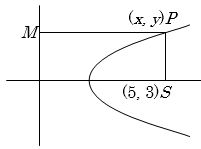
The equation of parabola whose focus is $(5, 3)$ and directrix is $3x - 4y + 1 = 0$, is
- ✓
${(4x + 3y)^2} - 256x - 142y + 849 = 0$
- B
${(4x - 3y)^2} - 256x - 142y + 849 = 0$
- C
${(3x + 4y)^2} - 142x - 256y + 849 = 0$
- D
${(3x - 4y)^2} - 256x - 142y + 849 = 0$
AnswerCorrect option: A. ${(4x + 3y)^2} - 256x - 142y + 849 = 0$
a
(a) $P{M^2} = P{S^2}$
$ \Rightarrow $ ${(x - 5)^2} + {(y - 3)^2} = {\left( {\frac{{3x - 4y + 1}}{{\sqrt {9 + 16} }}} \right)^2}$
==> $25({x^2} + 25 - 10x + {y^2} + 9 - 6x)$
$ = 9{x^2} + 16{y^2} + 1 - 12xy + 6x - 8y - 12xy$
==> $16{x^2} + 9{y^2} - 256x - 142y + 24xy + 849 = 0$
$ \Rightarrow $ ${(4x + 3y)^2} - 256x - 142y + 849 = 0.$
View full question & answer→MCQ 551 Mark
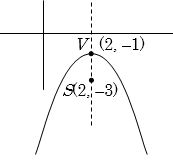
The equation of the parabola whose vertex is at $(2, -1)$ and focus at $(2, -3)$ is
AnswerCorrect option: B. ${x^2} - 4x + 8y + 12 = 0$
b
(b) $VS = \sqrt {{{(2 - 2)}^2} + {{( - 3 + 1)}^2}} = 2$.
From ${(x - h)^2} = - 4a(y - k)$
Parabola is,
${(x - 2)^2} = - 4.2(y + 1)$
==> ${(x - 2)^2} = - \,8(y + 1)$
==> ${x^2} + 4 - 4x = - 8y - 8$
==> ${x^2} - 4x + 8y + 12 = 0.$
View full question & answer→MCQ 561 Mark
The directrix of the parabola ${x^2} - 4x - 8y + 12 = 0$ is
- A
$x = 1$
- B
$y = 0$
- C
$x = - 1$
- ✓
$y = - 1$
AnswerCorrect option: D. $y = - 1$
d
(d) Equation of parabola is ${x^2} - 4x - 8y + 12 = 0$
==> ${x^2} - 4x + 4 = 8y - 8$
==> ${(x - 2)^2} = 8(y - 1)$
==> ${X^2} = 8Y$
Comparing with ${X^2} = 4aY$, we get $a = 2$
Directrix is $Y = - a$
==> $y - 1 = - 2$
==> $y = - 1$.
View full question & answer→MCQ 571 Mark
The equation of the parabola with focus $(0, 0)$ and directrix $x + y = 4$ is
- ✓
${x^2} + {y^2} - 2xy + 8x + 8y - 16 = 0$
- B
${x^2} + {y^2} - 2xy + 8x + 8y = 0$
- C
${x^2} + {y^2} + 8x + 8y - 16 = 0$
- D
${x^2} - {y^2} + 8x + 8y - 16 = 0$
AnswerCorrect option: A. ${x^2} + {y^2} - 2xy + 8x + 8y - 16 = 0$
a
(a) $SP\, = PM \Rightarrow \,S{P^2} = P{M^2}$
==> ${x^2} + {y^2} = {\left( {\frac{{x + y - 4}}{{\sqrt 2 }}} \right)^2}$
==> ${x^2} + {y^2} - 2xy + 8x + 8y - 16 = 0.$
View full question & answer→MCQ 581 Mark
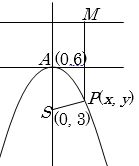
If $(0, 6)$ and $(0, 3)$ are respectively the vertex and focus of a parabola, then its equation is
- ✓
${x^2} + 12y = 72$
- B
${x^2} - 12y = 72$
- C
${y^2} - 12x = 72$
- D
${y^2} + 12x = 72$
AnswerCorrect option: A. ${x^2} + 12y = 72$
a
(a) Here vertex $ \equiv $ $(0, 6)$ and focus $ \equiv $ $(0, 3)$
then $Z \equiv (0,\,9)$ $i.e.$, $y = 9$
$\therefore $ Equation of parabola, $SP = PM$
$ \Rightarrow $ $\sqrt {{{(x - 0)}^2} + {{(y - 3)}^2}} = |y - 9|$
$ \Rightarrow $ ${x^2} + {y^2} - 6y + 9 = {y^2} - 18y + 81$
or ${x^2} + 12y = 72$.
View full question & answer→MCQ 591 Mark
The equation of the directrix of the parabola ${x^2} + 8y - 2x = 7$ is
- ✓
$y = 3$
- B
$y = - 3$
- C
$y = 2$
- D
$y = 0$
AnswerCorrect option: A. $y = 3$
a
(a) Given, equation of parabola is ${x^2} + 8y - 2x = 7$ $ \Rightarrow $ ${x^2} - 2x + 8y - 7 = 0$
$ \Rightarrow $${x^2} - 2x + 1 + 8y - 7 - 1 = 0$ $ \Rightarrow $ ${(x - 1)^2} + 8y = 8$
$ \Rightarrow $ ${(x - 1)^2} = - 8(y - 1)$ $ \Rightarrow $${(x - 1)^2} = - 4.2(y - 1)$
Here, $a = 2$.
$\therefore $ Equation of directrix is $y - 1 = 2 $ $i.e.$, $y = 3$.
View full question & answer→MCQ 601 Mark
The equation of axis of the parabola $2{x^2} + 5y - 3x + 4 = 0$ is
- ✓
$x = \frac{3}{4}$
- B
$y = \frac{3}{4}$
- C
$x = - \frac{1}{2}$
- D
$x - 3y = 5$
AnswerCorrect option: A. $x = \frac{3}{4}$
a
(a) Given equation of parabola is $2{x^2} + 5y - 3x + 4 = 0$
$ \Rightarrow $ ${x^2} - \frac{3}{2}x = - \frac{5}{2}y - 2$
$ \Rightarrow $ ${\left( {x - \frac{3}{4}} \right)^2} = - \frac{5}{2}y - \frac{{23}}{{16}}$
$\therefore $ Equation of axis is, $x - \frac{3}{4} = 0$
$ \Rightarrow $ $x = \frac{3}{4}$.
View full question & answer→MCQ 611 Mark
If ${x^2} + 6x + 20y - 51 = 0$, then axis of parabola is
- ✓
$x + 3 = 0$
- B
$x - 3 = 0$
- C
$x = 1$
- D
$x + 1 = 0$
AnswerCorrect option: A. $x + 3 = 0$
a
(a) Given equation of parabola is ${x^2} + 6x + 20y - 51 = 0$
$ \Rightarrow $${x^2} + 6x = - 20y + 51$
$ \Rightarrow $${(x + 3)^2} = - 20y + 60$
$\Rightarrow {(x + 3)^2} = - 20(y - 3)$
$ \Rightarrow $${(x + 3)^2} = - 4.5(y - 3)$
$\therefore $ Axis of parabola is $x + 3 = 0$.
View full question & answer→MCQ 621 Mark
The equation of the tangent to the parabola $y = {x^2} - x$ at the point where $x = 1$, is
- A
$y = - x - 1$
- B
$y = - x + 1$
- C
$y = x + 1$
- ✓
$y = x - 1$
AnswerCorrect option: D. $y = x - 1$
d
(d) Point $(1, 0)$
==> ${\left( {\frac{{dy}}{{dx}}} \right)_{(1,\,0)}} = 2 - 1 = 1$
Hence the tangent is $y - 0 = x - 1$.
View full question & answer→MCQ 631 Mark
The point of intersection of the latus rectum and axis of the parabola ${y^2} + 4x + 2y - 8 = 0$
- ✓
$(5/4, -1)$
- B
$(9/4, -1)$
- C
$(7/2, 5/2)$
- D
AnswerCorrect option: A. $(5/4, -1)$
a
(a) The required point is nothing but the focus of the parabola.
Therefore ${(y + 1)^2} = - (4x - 9) = - 4\left( {x - \frac{9}{4}} \right)$
$S \equiv \left( { - 1 + \frac{9}{4},\, - 1} \right)$ or $\left( {\frac{5}{4},\, - 1} \right)$.
View full question & answer→MCQ 641 Mark
The point of contact of the tangent $18x - 6y + 1 = 0$ to the parabola ${y^2} = 2x$ is
- A
$\left( {\frac{{ - 1}}{{18}},\;\frac{{ - 1}}{3}} \right)$
- B
$\left( {\frac{{ - 1}}{{18}},\;\frac{1}{3}} \right)$
- C
$\left( {\frac{1}{{18}},\;\frac{{ - 1}}{3}} \right)$
- ✓
$\left( {\frac{1}{{18}},\;\frac{1}{3}} \right)$
AnswerCorrect option: D. $\left( {\frac{1}{{18}},\;\frac{1}{3}} \right)$
d
(d) Let point of contact be $(h, k)$,
then tangent at this point is $ky = x + h$.
$x - ky + h = 0 \equiv 18x - 6y + 1 = 0$
or $\frac{1}{{18}} = \frac{k}{6} = \frac{h}{1}$
or $k = \frac{1}{3}$, $h = \frac{1}{{18}}$.
View full question & answer→MCQ 651 Mark
The equation of the tangent to the parabola ${y^2} = 4x + 5$ parallel to the line $y = 2x + 7$ is
- A
$2x - y - 3 = 0$
- ✓
$2x - y + 3 = 0$
- C
$2x + y + 3 = 0$
- D
AnswerCorrect option: B. $2x - y + 3 = 0$
b
(b) Equation of parabola is ${Y^2} = 4X$, where $X = x + \frac{5}{4}$
Tangent parallel to $Y = 2X + 7$ is $Y = 2X + \frac{a}{m}$
==> $y = 2\left( {x + \frac{5}{4}} \right) + \frac{1}{2}$
==> $y = 2x + 3$ $i.e.$, $2x - y + 3 = 0$.
View full question & answer→MCQ 661 Mark
The angle of intersection between the curves ${y^2} = 4x$ and ${x^2} = 32y$ at point $(16, 8)$, is
AnswerCorrect option: A. ${\tan ^{ - 1}}\left( {\frac{3}{5}} \right)$
a
(a) Tangent at $(16,8)$ to both are
$8y = 2(x + 16)$.....$(i)$ and $16x = 16(y + 8)$.....$(ii)$
${m_1} = \frac{1}{4},\,\,{m_2} = 1$
$\tan \theta = \frac{{{m_2} - {m_1}}}{{1 + {m_2}{m_1}}} = \left( {\frac{3}{5}} \right)$
==> $\theta = {\tan ^{ - 1}}\left( {\frac{3}{5}} \right)$.
Aliter : Using direct formula
$\theta = {\tan ^{ - 1}}\frac{{3{a^{1/3}}{b^{1/3}}}}{{2({a^{2/3}} + {b^{2/3}})}},$
where $a = 1$ and $b = 8$
$ = {\tan ^{ - 1}}\frac{6}{{2(1 + 4)}} = {\tan ^{ - 1}}\frac{3}{5}$.
View full question & answer→MCQ 671 Mark
If the straight line $x + y = 1$ touches the parabola ${y^2} - y + x = 0$, then the co-ordinates of the point of contact are
AnswerCorrect option: C. $(0, 1)$
c
(c) $m$ of tangent $ = - 1$.
Also from equation of parabola, we get gradient at $(h,k)$ as the slope of parabola
$ = \frac{{dy}}{{dx}} = \frac{{ - 1}}{{2y - 1}} = \frac{{ - 1}}{{2k - 1}}$
Since line and parabola touch at $(h,k)$
==> $\frac{{ - 1}}{{2k - 1}} = - 1$
==> $ - 2k + 1 = - 1$
==> $k = 1$
Putting this value in $x + y = 1$, we have $h = 0,$
so the point of contact is $(0,\,1).$
View full question & answer→MCQ 681 Mark
If the line $y = mx + c$ is a tangent to the parabola ${y^2} = 4a(x + a)$ then $ma + \frac{a}{m}$ is equal to
Answera
(a) Tangent at ${y^2} = 4ax$ is $y = mx + \frac{a}{m}$
Therefore, tangent at ${y^2} = 4a(x + a)$ is,
$y = m(x + a) + \frac{a}{m}$
or $y = mx + ma + \frac{a}{m}$
==> $ma + \frac{a}{m} = c$.
View full question & answer→MCQ 691 Mark
A tangent to the parabola ${y^2} = 8x$ makes an angle of ${45^o}$ with the straight line $y = 3x + 5$, then the equation of tangent is
- A
$2x + y - 1 = 0$
- B
$x + 2y - 1 = 0$
- ✓
$2x + y + 1 = 0$
- D
AnswerCorrect option: C. $2x + y + 1 = 0$
c
(c) ${m_1} = \tan 45^\circ = 1,$ ${m_2} = 3$
Slope of tangent $ = \frac{{3 \pm 1}}{{1 \mp 3}} = - 2$ or $\frac{1}{2}$
Tangent is $y = - 2x + \frac{2}{{ - 2}}$ or $2x + y + 1 = 0$.
View full question & answer→MCQ 701 Mark
The angle between the tangents drawn from the origin to the parabola ${y^2} = 4a(x - a)$ is ............... $^\circ$
Answera
(a) Any line through origin is $y = mx.$
Since it is a tangent to ${y^2} = 4a(x - a),$ it will cut it in two coincident points.
Roots of ${m^2}{x^2} - 4ax + 4{a^2} = 0$ are equal.
$16{a^2} - 16{a^2}{m^2} = 0$ or ${m^2} = 1$ or $m = 1, - 1$
Product of slopes $ = - 1$.
Hence it is a right angled triangle.
View full question & answer→MCQ 711 Mark
The two parabolas ${y^2} = 4x$ and ${x^2} = 4y$ intersect at a point $P$, whose abscissa is not zero, such that
- A
They both touch each other at $P$
- B
They cut at right angles at $P$
- ✓
The tangents to each curve at $P$ make complementary angles with the $x$ - axis
- D
AnswerCorrect option: C. The tangents to each curve at $P$ make complementary angles with the $x$ - axis
c
(c) Solving ${x^2} = 4y$and ${y^2} = 4x,$we get $x = 0,\,\,y = 0$ and $x = 4,\,y = 4$.
Therefore the co-ordinates of $P$ are $(4,4)$.
The equations of the tangents to the two parabolas at $(4,4)$ are $2x - y - 4 = 0$.....$(i)$
$x - 2y + 4 = 0$.....$(ii)$
Now, ${m_1} = $Slope of $(i)$ $ = 2,$${m_2} = $Slope of $(ii)$ $ = \frac{1}{2}$
${m_1}{m_2} = 1\,\,\,i.e.,\,\,\,\tan {\theta _1}\tan {\theta _2} = 1$.
View full question & answer→MCQ 721 Mark
If the line $lx + my + n = 0$ is a tangent to the parabola ${y^2} = 4ax$, then locus of its point of contact is
Answerc
(c) Equation of tangent to parabola
$ty = x + a{t^2}$ .....$(i)$
Clearly, $lx + my + n = 0$ is also a chord of contact of tangents.
Therefore $ty = x + a{t^2}$ and $lx + my + n = 0$ represents the same line.
Hence, $\frac{1}{l} = - \frac{t}{m} = \frac{{a{t^2}}}{n}$
==> $t = \frac{{ - m}}{l},\,\,{t^2} = \frac{n}{{la}}$
Eliminating $t$, we get, ${m^2} = \frac{{nl}}{a}$
$i.e.$, an equation of parabola.
View full question & answer→MCQ 731 Mark
Two perpendicular tangents to ${y^2} = 4ax$ always intersect on the line, if
- A
$x = a$
- ✓
$x + a = 0$
- C
$x + 2a = 0$
- D
$x + 4a = 0$
AnswerCorrect option: B. $x + a = 0$
b
(b) We know that tangent to the parabola at points ${t_1}$ and ${t_2}$ are ${t_1}y = x + at_1^2$ and ${t_2}y = x + at_2^2.$
Since tangents are perpendicular to the parabola,
therefore, $\frac{1}{{{t_1}}}.\frac{1}{{{t_2}}} = - 1$ or ${t_1}{t_2} = - 1$.
We also know that their point of intersection $ = (a{t_1}{t_2},\,a({t_1} + {t_2}))$ $ = \,( - a,\,a({t_1} + {t_2})).$
Thus these points lie on directrix $x = - \,a$ or $x + a = 0$.
View full question & answer→MCQ 741 Mark
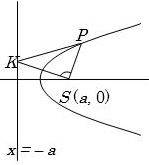
The tangent drawn at any point $P$ to the parabola ${y^2} = 4ax$ meets the directrix at the point $K$, then the angle which $KP$ subtends at its focus is ............. $^\circ$
Answerd
(d) Here, $P(a{t^2},\,2at)$ and $S(a, 0).$
If the tangent at $P$, $ty = x + a{t^2},$ meets the directrix
$x = - a\,\,{\rm{at}}\,\,k,$ then $k = \left( { - a,\,\frac{{a{t^2} - a}}{t}} \right)$
${m_1} = $ slope of $SP = \frac{{2at}}{{a({t^2} - 1)}}$
${m_2} = $ slope of $SK = \frac{{a({t^2} - 1)}}{{ - 2at}}$
Clearly ${m_1}{m_2} = - 1$,
$\therefore \,\angle \,PSK = {90^o}.$
View full question & answer→MCQ 751 Mark
The angle of intersection between the curves ${x^2} = 4(y + 1)$ and ${x^2} = - 4(y + 1)$ is
- A
$\frac{\pi }{6}$
- B
$\frac{\pi }{4}$
- ✓
$0$
- D
$\frac{\pi }{2}$
Answerc
(c) Point of intersection $ = (0,\, - 1)$;
$\frac{{dy}}{{dx}} = \frac{{2x}}{4}$ and $\frac{{ - 2x}}{4}$
${m_1} = 0,\,\,{m_2} = 0$
==> $\theta = {0^o}.$
View full question & answer→MCQ 761 Mark
Angle between two curves ${y^2} = 4(x + 1)$ and ${x^2} = 4(y + 1)$ is .............. $^\circ$
Answerb
(b) Principal axes of parabolas are $x$ - axis and $y$ - axis,
therefore angle between them is ${90^o}$.
View full question & answer→MCQ 771 Mark
If The tangent to the parabola ${y^2} = ax$ makes an angle of $45^\circ$ with $x$ - axis, then the point of contact is
- A
$\left( {\frac{a}{2},\;\frac{a}{2}} \right)$
- B
$\left( {\frac{a}{4},\;\frac{a}{4}} \right)$
- C
$\left( {\frac{a}{2},\;\frac{a}{4}} \right)$
- ✓
$\left( {\frac{a}{4},\;\frac{a}{2}} \right)$
AnswerCorrect option: D. $\left( {\frac{a}{4},\;\frac{a}{2}} \right)$
d
(d) Parabola is ${y^2} = ax$
$i.e.$, ${y^2} = 4\left( {\frac{a}{4}} \right)\,x$.....(i)
Let point of contact is $({x_1},\,{y_1})$
Equation of tangent is $y - {y_1} = \frac{{2\left( {\frac{a}{4}} \right)}}{{{y_1}}}\,(x - {x_1})$
$⇒$ $y = \frac{a}{{2{y_1}}}(x)\, - \frac{{a{x_1}}}{{2{y_1}}} + {y_1}$
Here, $m = \frac{a}{{2{y_1}}} = \,\tan \,{45^o}$$ \Rightarrow \,$$\frac{a}{{2{y_1}}} = 1$
$⇒$ ${y_1} = \frac{a}{2}$
From (i), ${x_1} = \frac{a}{4}$.
Point is $\left( {\frac{a}{4},\,\frac{a}{2}} \right)$.
View full question & answer→MCQ 781 Mark
The locus of the middle points of the chords of the parabola ${y^2} = 4ax$ which passes through the origin
- A
${y^2} = ax$
- ✓
${y^2} = 2ax$
- C
${y^2} = 4ax$
- D
${x^2} = 4ay$
AnswerCorrect option: B. ${y^2} = 2ax$
b
(b) Any line through origin $(0,0)$ is $y = mx$.
It intersects ${y^2} = 4ax$ in $\left( {\frac{{4a}}{{{m^2}}},\frac{{4a}}{m}} \right)$.
Mid point of the chord is $\left( {\frac{{2a}}{{{m^2}}},\frac{{2a}}{m}} \right)$
$x = \frac{{2a}}{{{m^2}}},$$y = \frac{{2a}}{m}$
==> $\frac{{2a}}{x} = \frac{{4{a^2}}}{{{y^2}}}$ or ${y^2} = 2ax$, which is a parabola.
View full question & answer→MCQ 791 Mark
The point on the parabola ${y^2} = 8x$ at which the normal is parallel to the line $x - 2y + 5 = 0$ is
- A
$( - 1/2,\;2)$
- ✓
$(1/2,\; - 2)$
- C
$(2,\; - 1/2)$
- D
$( - 2,\;1/2)$
AnswerCorrect option: B. $(1/2,\; - 2)$
b
(b) Let point be $(h,k).$
Normal is $y - k = \frac{{ - k}}{4}(x - h)$ or $ - kx - 4y + kh + 4k = 0$
Gradient $ = - \frac{k}{4} = \frac{1}{2}$
==> $k = - 2$
Substituting $(h,k)$ and $k = - 2$, we get $h = \frac{1}{2}$
Hence point is $\left( {\frac{1}{2}, - 2} \right)$.
Trick : Here only point $\left( {\frac{1}{2}, - 2} \right)$ satisfies the parabola ${y^2} = 8x$.
View full question & answer→MCQ 801 Mark
The point on the parabola ${y^2} = 8x$ at which the normal is inclined at $60^o$ to the $x$ - axis has the co-ordinates
- ✓
$(6,\; - 4\sqrt 3 )$
- B
$(6,\;4\sqrt 3 )$
- C
$( - 6,\; - 4\sqrt 3 )$
- D
$( - 6,\;4\sqrt 3 )$
AnswerCorrect option: A. $(6,\; - 4\sqrt 3 )$
a
(a) Normal at $(h,k)$ to the parabola ${y^2} = 8x$ is
$y - k = - \frac{k}{4}(x - h)$
Gradient$ = \tan 60^\circ = \sqrt 3 = - \frac{k}{4}$
==> $k = - 4\sqrt 3 $ and $h = 6$
Hence required point is $(6, - 4\sqrt 3 )$.
View full question & answer→MCQ 811 Mark
The equation of the normal at the point $\left( {\frac{a}{4},\;a} \right)$ to the parabola ${y^2} = 4ax$, is
- A
$4x + 8y + 9a = 0$
- ✓
$4x + 8y - 9a = 0$
- C
$4x + y - a = 0$
- D
$4x - y + a = 0$
AnswerCorrect option: B. $4x + 8y - 9a = 0$
b
(b) $y - a =$$ -a\over{2a}$$(x - {a\over4})$
=> $2y + x = 2a + \frac{a}{4} = \frac{{9a}}{4}$
=> $2y + x - \frac{{9a}}{4} = 0$
$i.e.$, $4x + 8y - 9a = 0$.
View full question & answer→MCQ 821 Mark
If the line $2x + y + k = 0$ is normal to the parabola ${y^2} = - 8x$, then the value of $k$ will be
- A
$ - 16$
- B
$ - 8$
- C
$ - 24$
- ✓
$24$
Answerd
(d) $y = - 2x - k$is normal to ${y^2} = - 8x$
or $ - k = - \{ - 4( - 2) - 2{( - 2)^3}\} = - (8 + 16)$
==> $k = 24$
View full question & answer→MCQ 831 Mark
In the parabola ${y^2} = 6x$, the equation of the chord through vertex and negative end of latus rectum, is
- A
$y = 2x$
- ✓
$y + 2x = 0$
- C
$x = 2y$
- D
$x + 2y = 0$
AnswerCorrect option: B. $y + 2x = 0$
b
(b) Vertex $ \equiv (0,0),$ End points of latus rectum are $(a,\,\, \pm \,\,2a)$.
Here $a = \frac{6}{4}$
Therefore, $ - ve$end of latus rectum is $\left( {\frac{3}{2},\, - 3} \right)$
Line through the point is $y = \frac{{ - 3}}{{3/2}}x$or $y + 2x = 0$.
View full question & answer→MCQ 841 Mark
If ‘$a$’ and ‘$c$’ are the segments of a focal chord of a parabola and b the semi-latus rectum, then
- A
$a, b, c$ are in $A.P.$
- B
$a, b, c$ are in $G.P.$
- ✓
$a, b, c$ are in $H.P.$
- D
AnswerCorrect option: C. $a, b, c$ are in $H.P.$
c
(c) Semi latus rectum is harmonic mean between segments of focal chords of a parabola.
$b = \frac{{2ac}}{{a + c}}$
==> $a, b, c$ are in $H.P.$
View full question & answer→MCQ 851 Mark
If the segment intercepted by the parabola ${y^2} = 4ax$ with the line $lx + my + n = 0$ subtends a right angle at the vertex, then
- ✓
$4al + n = 0$
- B
$4al + 4am + n = 0$
- C
$4am + n = 0$
- D
$al + n = 0$
AnswerCorrect option: A. $4al + n = 0$
a
(a) The combined equation of the lines joining the vertex to the points of intersection of the line $lx + my + n = 0$ and the parabola ${y^2} = 4ax$, is
${y^2} = 4ax\left( {\frac{{lx + my}}{{ - n}}} \right)$ or $4al{x^2} + 4amxy + n{y^2} = 0$
This represents a pair of perpendicular lines, if $4al + n = 0$.
View full question & answer→MCQ 861 Mark
At what point on the parabola ${y^2} = 4x$, the normal makes equal angles with the co-ordinate axes
- A
$(4, 4)$
- B
$(9, 6)$
- C
$(4, -4)$
- ✓
$(1, -2)$
AnswerCorrect option: D. $(1, -2)$
d
(d) The equation of a normal to ${y^2} = 4x$ at $({m^2}, - 2m)$ is $y = mx - 2m - {m^3}.$
If the normal makes equal angles with the coordinates axes, then $m = \tan \frac{\pi }{4} = 1.$
Thus, the required point is $(1, -2).$
View full question & answer→MCQ 871 Mark
Tangents drawn at the ends of any focal chord of a parabola ${y^2} = 4ax$ intersect in the line
- A
$y - a = 0$
- B
$y + a = 0$
- C
$x - a = 0$
- ✓
$x + a = 0$
AnswerCorrect option: D. $x + a = 0$
d
(d) The tangents (at the end points of focal chord) cut orthogonally at the directrix
$i.e.$, $x = - a$ or $x + a = 0$.
View full question & answer→MCQ 881 Mark
The centroid of the triangle formed by joining the feet of the normals drawn from any point to the parabola ${y^2} = 4ax$, lies on
Answera
(a) Normal to parabola will be, $y = mx - 2am - a{m^3}$
For three values of $m$.
Three normal can be drawn on parabola ${y^2} = 4ax$.
So three feet of normals can be obtained, hence centroid of triangle lies on axis of parabola.
View full question & answer→MCQ 891 Mark
The normal to the parabola ${y^2} = 8x$ at the point $(2, 4)$ meets the parabola again at the point
- A
$\{-18, -12\}$
- B
$\{-18, 12\}$
- C
$\{18, 12\}$
- ✓
$\{18, -12\}$
AnswerCorrect option: D. $\{18, -12\}$
d
(d) We have ${t_2} = - {t_1} - \frac{2}{{{t_1}}}$
Since $a = 2,\,\,{t_1} = 1$;
$\therefore $ ${t_2} = - 3$
$\therefore $The other end will be $(at_2^2,\,2a{t_2})$ $i.e.$, $(18, -12).$
View full question & answer→MCQ 901 Mark
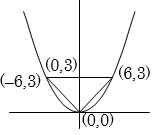
The area of the triangle formed by the lines joining the vertex of the parabola ${x^2} = 12y$ to the ends of its latus rectum is .................. $\mathrm{sq.\,unit}$
Answerc
(c) $\Delta = \frac{1}{2}(12 \times 3) = 18\ sq.\ unit$
View full question & answer→MCQ 911 Mark
The area of triangle formed inside the parabola ${y^2} = 4x$ and whose ordinates of vertices are $1, 2$ and $4$ will be
- A
$\frac{7}{2}$
- B
$\frac{5}{2}$
- C
$\frac{3}{2}$
- ✓
$\frac{3}{4}$
AnswerCorrect option: D. $\frac{3}{4}$
d
(d) Let co-ordinates of vertices $ = (a,\,1),\,\,(b,\,2),\,\,(c,\,4)$
$a = \frac{1}{4},$$b = 1,\,\,c = 4$. Area of triangle formed by
$\left( {\frac{1}{4},\,1} \right)\,,\,\,(1,\,2),\,\,(4,\,4)$ is $\frac{1}{2}\left| {\begin{array}{*{20}{c}}{1/4}&1&1\\1&2&1\\4&4&1\end{array}} \right| = \frac{3}{4}$.
View full question & answer→MCQ 921 Mark
The ordinates of the triangle inscribed in parabola ${y^2} = 4ax$ are ${y_1},\;{y_2},\;{y_3}$, then the area of triangle is
- A
$\frac{1}{{8a}}({y_1} + {y_2})({y_2} + {y_3})({y_3} + {y_1})$
- B
$\frac{1}{{4a}}({y_1} + {y_2})({y_2} + {y_3})({y_3} + {y_1})$
- ✓
$\frac{1}{{8a}}({y_1} - {y_2})({y_2} - {y_3})({y_3} - {y_1})$
- D
$\frac{1}{{4a}}({y_1} - {y_2})({y_2} - {y_3})({y_3} - {y_1})$
AnswerCorrect option: C. $\frac{1}{{8a}}({y_1} - {y_2})({y_2} - {y_3})({y_3} - {y_1})$
c
(c) Points $\left( {\frac{{y_1^2}}{{4a}},{y_1}} \right),\,\left( {\frac{{y_2^2}}{{4a}},{y_2}} \right),\,\,\left( {\frac{{y_3^2}}{{4a}},{y_3}} \right)$
Use area formula and get $\Delta = \frac{1}{{8a}}({y_1} - {y_2})({y_2} - {y_3})({y_3} - {y_1})$.
View full question & answer→MCQ 931 Mark
From the point $(-1, 2)$ tangent lines are drawn to the parabola ${y^2} = 4x$, the area of triangle formed by chord of contact and the tangents is given by
- A
$8$
- B
$8\sqrt 3 $
- ✓
$8\sqrt 2 $
- D
AnswerCorrect option: C. $8\sqrt 2 $
c
(c) Solving above equation with parabola ${y^2} = 4x,$ we get the points $P(3 + 2\sqrt 2 ,\,2 + 2\sqrt 2 ),\,\,Q(3 - 2\sqrt 2 ,2 - 2\sqrt 2 )$.
$P{Q^2} = 32 + 32 = 64$
==> $PQ = 8$
Also, if $p$ be perpendicular from $(-1,2)$ on $PQ$, then area of triangle is $\frac{1}{2}PQ.\,\,p $
$= \frac{1}{2}.8.\left( {\frac{4}{{\sqrt 2 }}} \right) = 8\sqrt 2 $.
View full question & answer→MCQ 941 Mark
From the point $(-1, -60)$ two tangents are drawn to the parabola ${y^2} = 4x$. Then the angle between the two tangents is .................. $^o$
Answerd
(d) The given point $(-1, -60) $ lies on the directrix $x = - 1$ of the parabola ${y^2} = 4x$.
Thus the tangents are at right angle.
View full question & answer→MCQ 951 Mark
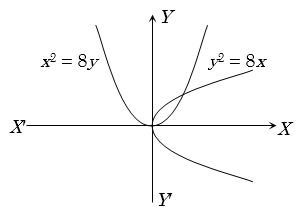
The angle of intersection between the curves ${x^2} = 8y$ and ${y^2} = 8x$ at origin is
- A
$\pi$ $/4$
- B
$\pi$ $/3$
- C
$\pi$ $/6$
- ✓
$\pi$ $/2$
AnswerCorrect option: D. $\pi$ $/2$
d
(d) From figure
It is clear that angle between the curve
= angle between the $x$ - axis and $y$ - axis $ = \pi /2$.
View full question & answer→MCQ 961 Mark
The equation to a parabola which passes through the intersection of a straight line $x + y = 0$ and the circle ${x^2} + {y^2} + 4y = 0$ is
- A
${y^2} = 4x$
- B
${y^2} = x$
- ✓
${y^2} = 2x$
- D
AnswerCorrect option: C. ${y^2} = 2x$
c
(c) Given $x + y = 0$ …..$(i);$
${x^2} + {y^2} + 4y = 0$ …..$(ii)$
Solving $(i)$ and $(ii),$ $x = 0$, $y = 0$;
$x = 2$, $y = - 2$
which means parabola pass through $(0, 0)$ and $(2, -2)$ these points satisfy the parabola ${y^2} = 2x$.
View full question & answer→MCQ 971 Mark
The length intercepted by the curve ${y^2} = 4x$ on the line satisfying $dy/dx = 1$ and passing through point $(0, 1)$ is given by
Answerc
(c) Let equation of line is $y = ax + b$;
$\frac{{dy}}{{dx}} = a = 1$ given
Also $y = ax + b$ passing through $(0, 1)$, $b = 1$
So required line be $y = x + 1$
Now point of intersection of the line and parabola gives ${x^2} + 2x + 1 = 4x$
==> ${x^2} - 2x + 1$
==> $x = 1$ , $y = 2$
Line touch that parabola.
Length intercepted is equal to $0$.
View full question & answer→MCQ 981 Mark
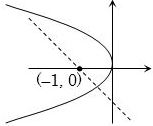
The equation of a straight line drawn through the focus of the parabola ${y^2} = - 4x$ at an angle of $120^o $ to the $x$ - axis is
- A
$y + \sqrt 3 (x - 1) = 0$
- B
$y - \sqrt 3 (x - 1) = 0$
- ✓
$y + \sqrt 3 (x + 1) = 0$
- D
$y - \sqrt 3 (x + 1) = 0$
AnswerCorrect option: C. $y + \sqrt 3 (x + 1) = 0$
c
(c) $m = \tan (120^\circ ) = - \sqrt 3 $
= Slope of the line which passes through $(-1, 0).$
Required equation, $y - 0 = - \sqrt 3 (x + 1)$
$y + \sqrt 3 (x + 1) = 0$.
View full question & answer→MCQ 991 Mark
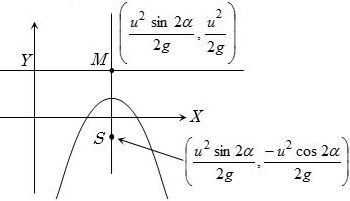
The length of the latus-rectum of the parabola whose focus is $\left( {\frac{{{u^2}}}{{2g}}\sin 2\alpha ,\; - \frac{{{u^2}}}{{2g}}\cos 2\alpha } \right)$ and directrix is $y = \frac{{{u^2}}}{{2g}}$, is
- A
$\frac{{{u^2}}}{g}{\cos ^2}\alpha $
- B
$\frac{{{u^2}}}{g}\cos 2\alpha $
- C
$\frac{{2{u^2}}}{g}{\cos ^2}2\alpha $
- ✓
$\frac{{2{u^2}}}{g}{\cos ^2}\alpha $
AnswerCorrect option: D. $\frac{{2{u^2}}}{g}{\cos ^2}\alpha $
d
(d) According to the figure, the length of latus rectum is
$2(SM) = 2 \times \frac{{{u^2}}}{{2g}}(1 + \cos 2\alpha ) = \frac{{2{u^2}{{\cos }^2}\alpha }}{g}$.
View full question & answer→MCQ 1001 Mark
The length of the latus rectum of the parabola whose focus is $(3, 3)$ and directrix is $3x - 4y - 2 = 0$ is
Answera
(a) Since the distance between the focus and directrix of the parabola is half of the length of the latus rectum $(L.R.)$.
Therefore, $L.R. = 2$ (Length of the perpendicular from $(3,\,3)$ on
$3x - 4y - 2 = 0)$ i.e., $\left| {\frac{{9 - 12 - 2}}{{\sqrt {9 + 16} }}} \right|$= 2.
View full question & answer→MCQ 1011 Mark
The angle between tangents to the parabola ${y^2} = 4ax$ at the points where it intersects with the line $x - y - a = 0$, is
- A
$\frac{\pi }{3}$
- B
$\frac{\pi }{4}$
- C
$\frac{\pi }{6}$
- ✓
$\frac{\pi }{2}$
AnswerCorrect option: D. $\frac{\pi }{2}$
d
(d) The co-ordinates of the focus of the parabola ${y^2} = 4ax$ are $(a,0)$. The line $x - y - a = 0$ passes through this point. Therefore, it is a focal chord of the parabola. Hence the tangents intersect at right angle.
View full question & answer→MCQ 1021 Mark
The tangents drawn from the ends of latus rectum of ${y^2} = 12x$ meets at
Answera
(a) The co-ordinates of ends of $L.R.$ are $(a,\,2a)$ and $(a,\, - 2a)$. In the given parabola, these points are $(3,\,6)$ and $(3,\, - 6)$ the equation of tangents are $6y = 6(x + 3)$
and $ - 6y = 6(x + 3)$ ==> $x - y + 3 = 0$ and $x + y + 3 = 0$.
The intersection of these tangents are $x = - 6$, which is the equation of directrix.
View full question & answer→MCQ 1031 Mark
If the points $(a{u^2},\;2au)$ and $(a{v^2},\;2av)$ are the extremities of a focal chord of the parabola ${y^2} = 4ax$, then
- A
$uv - 1 = 0$
- ✓
$uv + 1 = 0$
- C
$u + v = 0$
- D
$u - v = 0$
AnswerCorrect option: B. $uv + 1 = 0$
b
(b) Equation of focal chord for the parabola ${y^2} = 4ax,$ passes through the point $(a{u^2},\,2au)$ and $(a{v^2},2av)$
==> $y - 2au = \frac{{2av - 2au}}{{a{v^2} - a{u^2}}}(x - a{u^2})$
==> $y - 2au = \frac{{2a(v - u)}}{{a(v - u)(v + u)}}(x - a{u^2})$
==> $y - 2au = \frac{2}{{(v + u)}}(x - a{u^2})$
If this is focal chord, so it would passes through focus $(a,0)$.
==>$0 - 2au = \frac{2}{{v + u}}(a - a{u^2})$ ==>$ - uv - {u^2} = 1 - {u^2}$, $\therefore $ $uv+1=0.$
View full question & answer→MCQ 1041 Mark
The length of the subnormal to the parabola ${y^2} = 4ax$ at any point is equal to
- A
$\sqrt 2 a$
- B
$2\sqrt 2 $
- C
$a/\sqrt 2 $
- ✓
$2a$
Answerd
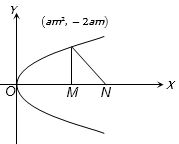
(d) Let co-ordinates of $P$ is $(a{m^2},\, - 2am)$
$\therefore $ Equation of normal at point P is $y = mx - 2am - a{m^3}$
This normal cuts $x$ - axis at $N$ Putting $y = 0$; we get,
$0 = mx - 2am - a{m^3}$
or $mx = am + a{m^3}$
or $x = \frac{{m(2a + a{m^2})}}{m}$
or $x = 2a + a{m^2}$
So, ON = $2a + a{m^2}$ and $OM = a{m^2}$
Length of subnormal = MN
$\therefore $ MN = ON -OM $ = 2a + a{m^2} - a{m^2} = 2a$.
View full question & answer→MCQ 1051 Mark
The conditions that $ax + by + c = 0$ is tangent to the parabola $y^2 = 4ax$, is
- A
$a^2 = b^2 = c^2$
- B
$a = b$
- ✓
$b^2 = c$
- D
$b^2 = a$
AnswerCorrect option: C. $b^2 = c$
c
Since, the line $\mathrm{y}=-\frac{\mathrm{a}}{\mathrm{b}} \mathrm{x}-\frac{\mathrm{c}}{\mathrm{b}}$ is tangent to the
parabola $\mathrm{y}^{2}=4 \mathrm{ax},$ then
$-\frac{c}{b}=\frac{a}{-\frac{a}{b}} \Rightarrow c=b^{2}$
View full question & answer→MCQ 1061 Mark
The equation of the ellipse whose centre is at origin and which passes through the points $(-3, 1)$ and $(2, -2)$ is
AnswerCorrect option: B. $3{x^2} + 5{y^2} = 32$
b
(b) $\frac{{{x^2}}}{{{a^2}}} + \frac{{{y^2}}}{{{b^2}}} = 1$.
Since it passes through $(-3, 1)$ and $(2, -2)$,
so $\frac{9}{{{a^2}}} + \frac{1}{{{b^2}}} = 1$ and $\frac{1}{{{a^2}}} + \frac{1}{{{b^2}}} = \frac{1}{4}$
==>${a^2} = \frac{{32}}{3}$, ${b^2} = \frac{{32}}{5}$
Hence required equation of ellipse is $3{x^2} + 5{y^2} = 32$.
Trick : Since only equation $3{x^2} + 5{y^2} = 32$ passes through $(-3, 1)$ and $(2, -2)$. Hence the result.
View full question & answer→MCQ 1071 Mark
An ellipse is described by using an endless string which is passed over two pins. If the axes are $6\ cm$ and $4\ cm$, the necessary length of the string and the distance between the pins respectively in $cm$, are
- A
$6,\;2\sqrt 5 $
- B
$6,\;\sqrt 5 $
- C
$4,\;2\sqrt 5 $
- ✓
Answerd
(d) Given $2a = 6,\,\,2b = 4$ $i.e.$ ,$a = 3,\,\,b = 2$
${e^2} = 1 - \frac{{{b^2}}}{{{a^2}}} = \frac{5}{9}$
==> $e = \frac{{\sqrt 5 }}{3}$
Distance between the pins $ = 2ae = 2\sqrt 5\ cm$
Length of string $ = 2a + 2ae = 6 + 2\sqrt 5\ cm$.
View full question & answer→MCQ 1081 Mark
The locus of the point of intersection of perpendicular tangents to the ellipse $\frac{{{x^2}}}{{{a^2}}} + \frac{{{y^2}}}{{{b^2}}} = 1$, is
- A
${x^2} + {y^2} = {a^2} - {b^2}$
- B
${x^2} - {y^2} = {a^2} - {b^2}$
- ✓
${x^2} + {y^2} = {a^2} + {b^2}$
- D
${x^2} - {y^2} = {a^2} + {b^2}$
AnswerCorrect option: C. ${x^2} + {y^2} = {a^2} + {b^2}$
c
(c) Let point be $(h,k)$ their pair of tangent will be
$\left( {\frac{{{x^2}}}{{{a^2}}} + \frac{{{y^2}}}{{{b^2}}} - 1} \right)\,\left( {\frac{{{h^2}}}{{{a^2}}} + \frac{{{k^2}}}{{{b^2}}} - 1} \right) = {\left( {\frac{{hx}}{{{a^2}}} + \frac{{yk}}{{{b^2}}} - 1} \right)^2}$
Pair of tangents will be perpendicular, if
coefficient of ${x^2}$ + coefficient of ${y^2} = 0$
==>$\frac{{{k^2}}}{{{a^2}{b^2}}} + \frac{{{h^2}}}{{{a^2}{b^2}}} = \frac{1}{{{a^2}}} + \frac{1}{{{b^2}}}$
==> ${h^2} + {k^2} = {a^2} + {b^2}$
Replace $(h,k)$ by $(x,y)$
==> ${x^2} + {y^2} = {a^2} + {b^2}$.
View full question & answer→MCQ 1091 Mark
If the eccentricity of the two ellipse $\frac{{{x^2}}}{{169}} + \frac{{{y^2}}}{{25}} = 1$ and $\frac{{{x^2}}}{{{a^2}}} + \frac{{{y^2}}}{{{b^2}}} = 1$ are equal, then the value of $a/b$ is
- A
$5\over{13}$
- B
$6\over{13}$
- ✓
$13\over5$
- D
$13\over6$
AnswerCorrect option: C. $13\over5$
c
(c) In the first case, eccentricity $e = \sqrt {1 - (25/169)} $
In the second case, $e'\, = \sqrt {1 - ({b^2}/{a^2})} $
According to the given condition,
$\sqrt {1 - {b^2}/{a^2}} = \sqrt {1 - (25/169)} $
$ \Rightarrow \,b/a = 5/13$, $(\because \,\,a > 0,\,b > 0)$
$⇒ a/b = 13/5.$
View full question & answer→MCQ 1101 Mark
The centre of the ellipse $4{x^2} + 9{y^2} - 16x - 54y + 61 = 0$ is
- A
$(1,3)$
- ✓
$(2, 3)$
- C
$(3, 2)$
- D
$(3, 1)$
AnswerCorrect option: B. $(2, 3)$
b
(b) $4{(x - 2)^2} + 9{(y - 3)^2} = 36$
Hence the centre is $(2, 3).$
View full question & answer→MCQ 1111 Mark
Latus rectum of ellipse $4{x^2} + 9{y^2} - 8x - 36y + 4 = 0$ is
- ✓
$8\over3$
- B
$4\over3$
- C
$\frac{{\sqrt 5 }}{3}$
- D
$16\over3$
AnswerCorrect option: A. $8\over3$
a
(a) The ellipse is $4{(x - 1)^2} + 9{(y - 2)^2} = 36$
Therefore, latus rectum$ = \frac{{2{b^2}}}{a} = \frac{{2.4}}{3} = \frac{8}{3}$.
View full question & answer→MCQ 1121 Mark
Eccentricity of the ellipse $4{x^2} + {y^2} - 8x + 2y + 1 = 0$ is
- A
$1/\sqrt 3 $
- ✓
$\sqrt 3 /2$
- C
$1/2$
- D
AnswerCorrect option: B. $\sqrt 3 /2$
b
(b) $4{x^2} - 8x + {y^2} + 2y + 1 = 0$
==> ${(2x - 2)^2} + {(y + 1)^2} = - 1 + 4 + 1$
==> $\frac{{{{(x - 1)}^2}}}{1} + \frac{{{{(y + 1)}^2}}}{4} = 1$
==> $e = \sqrt {1 - \frac{1}{4}} $
==> $e = \frac{{\sqrt 3 }}{2}$.
View full question & answer→MCQ 1131 Mark
The equation of an ellipse whose eccentricity is $1/2$ and the vertices are $(4, 0)$ and $(10, 0)$ is
- ✓
$3{x^2} + 4{y^2} - 42x + 120 = 0$
- B
$3{x^2} + 4{y^2} + 42x + 120 = 0$
- C
$3{x^2} + 4{y^2} + 42x - 120 = 0$
- D
$3{x^2} + 4{y^2} - 42x - 120 = 0$
AnswerCorrect option: A. $3{x^2} + 4{y^2} - 42x + 120 = 0$
a
(a) Major axis $ = 6 = 2a$ $⇒$ $a = 3$
$e = \frac{1}{2}$ $⇒$ $b = 3\sqrt {1 - \frac{1}{4}} = \frac{{3\sqrt 3 }}{2}$.
Also centre is $(7, 0)$
Equation is $\frac{{{{(x - 7)}^2}}}{9} + \frac{{{y^2}}}{{(27/4)}} = 1$
$3{x^2} + 4{y^2} - 42x + 120 = 0$.
View full question & answer→MCQ 1141 Mark
The equation of the ellipse whose centre is $(2, -3)$, one of the foci is $(3, -3)$ and the corresponding vertex is $(4, -3)$ is
- A
$\frac{{{{(x - 2)}^2}}}{3} + \frac{{{{(y + 3)}^2}}}{4} = 1$
- ✓
$\frac{{{{(x - 2)}^2}}}{4} + \frac{{{{(y + 3)}^2}}}{3} = 1$
- C
$\frac{{{x^2}}}{3} + \frac{{{y^2}}}{4} = 1$
- D
AnswerCorrect option: B. $\frac{{{{(x - 2)}^2}}}{4} + \frac{{{{(y + 3)}^2}}}{3} = 1$
b
(b) Foci $ = (3, - 3)$ $⇒$ $ae = 3 - 2 = 1$
Vertex $ = (4, - 3)$ $⇒$ $a = 4 - 2 = 2$
$⇒$ $e = \frac{1}{2}$
$⇒$ $b = a\sqrt {\left( {1 - \frac{1}{4}} \right)} = \frac{2}{2}\sqrt 3 = \sqrt 3 $
Therefore, equation of ellipse with centre $(2, - 3)$ is
$\frac{{{{(x - 2)}^2}}}{4} + \frac{{{{(y + 3)}^2}}}{3} = 1$.
View full question & answer→MCQ 1151 Mark
The centre of the ellipse$\frac{{{{(x + y - 2)}^2}}}{9} + \frac{{{{(x - y)}^2}}}{{16}} = 1$ is
- A
$(0, 0)$
- ✓
$(1, 1)$
- C
$(1, 0)$
- D
$(0, 1)$
AnswerCorrect option: B. $(1, 1)$
b
(b) The centre of the given ellipse is the point of intersection of the lines $x + y - 2 = 0$ and $x - y = 0$ $i.e.$,$(1,1).$
View full question & answer→MCQ 1161 Mark
The equation of an ellipse whose focus $(-1, 1)$, whose directrix is $x - y + 3 = 0$ and whose eccentricity is $\frac{1}{2}$, is given by
- ✓
$7{x^2} + 2xy + 7{y^2} + 10x - 10y + 7 = 0$
- B
$7{x^2} - 2xy + 7{y^2} - 10x + 10y + 7 = 0$
- C
$7{x^2} - 2xy + 7{y^2} - 10x - 10y - 7 = 0$
- D
$7{x^2} - 2xy + 7{y^2} + 10x + 10y - 7 = 0$
AnswerCorrect option: A. $7{x^2} + 2xy + 7{y^2} + 10x - 10y + 7 = 0$
a
(a) Let any point on it be $(x,y)$, then $\frac{{\sqrt {{{(x + 1)}^2}} + \sqrt {{{(y - 1)}^2}} }}{{\left| {\frac{{x - y + 3}}{{\sqrt 2 }}} \right|}} = \frac{1}{2}$
Squaring and simplifying, we get
$7{x^2} + 2xy + 7{y^2} + 10x - 10y + 7 = 0$.
View full question & answer→MCQ 1171 Mark
The eccentricity of the ellipse $9{x^2} + 5{y^2} - 30y = 0$, is
- A
$1\over3$
- ✓
$2\over3$
- C
$3\over4$
- D
AnswerCorrect option: B. $2\over3$
b
(b) $9{x^2} + {(\sqrt 5 y - 3\sqrt 5 )^2} = 45$ or $\frac{{{x^2}}}{5} + \frac{{{{(y - 3)}^2}}}{9} = 0$
==> ${a^2} = 5,$ ${b^2} = 9$.
Therefore $e = \frac{2}{3}$.
View full question & answer→MCQ 1181 Mark
The eccentricity of the ellipse $4{x^2} + 9{y^2} + 8x + 36y + 4 = 0$ is
- A
$\frac{5}{6}$
- B
$\frac{3}{5}$
- C
$\frac{{\sqrt 2 }}{3}$
- ✓
$\frac{{\sqrt 5 }}{3}$
AnswerCorrect option: D. $\frac{{\sqrt 5 }}{3}$
d
(d) $4{x^2} + 8x + 4 + 9{y^2} + 36y + 36 = 36$
$ \Rightarrow \frac{{{{(x + 1)}^2}}}{9} + \frac{{{{(y + 2)}^2}}}{4} = 1$;
$e = \sqrt {1 - \frac{4}{9}} = \frac{{\sqrt 5 }}{3}$.
View full question & answer→MCQ 1191 Mark
The co-ordinates of the foci of the ellipse $3{x^2} + 4{y^2} - 12x - 8y + 4 = 0$ are
- A
$(1, 2), (3, 4)$
- B
$(1, 4), (3, 1)$
- ✓
$(1, 1), (3, 1)$
- D
$(2, 3), (5, 4)$
AnswerCorrect option: C. $(1, 1), (3, 1)$
c
(c) $3{x^2} - 12x + 4{y^2} - 8y = - 4$==>$3{(x - 2)^2} + 4{(y - 1)^2} = 12$
==> $\frac{{{{(x - 2)}^2}}}{4} + \frac{{{{(y - 1)}^2}}}{3} = 1$
==> $\frac{{{X^2}}}{4} + \frac{{{Y^2}}}{3} = 1$
$e = \sqrt {1 - \frac{3}{4}} = \frac{1}{2}$.
Foci are $\left( {X = \pm 2 \times \frac{1}{2},\,Y = 0} \right)$
$i.e.$, $(x - 2 = \pm 1,\,\,y - 1 = 0)$$ = (3,\,1)$ and $(1,\,1)$.
View full question & answer→MCQ 1201 Mark
For the ellipse $25{x^2} + 9{y^2} - 150x - 90y + 225 = 0$ the eccentricity $e = $
- A
$2\over5$
- B
$3\over5$
- ✓
$4\over5$
- D
$1\over5$
AnswerCorrect option: C. $4\over5$
c
(c) Given equation of ellipse is ,
$25{x^2} + 9{y^2} - 150x - 90y + 225 = 0$
$ \Rightarrow $$25\,{(x - 3)^2} + 9{(y - 5)^2} = 225$
$ \Rightarrow $$\frac{{{{(x - 3)}^2}}}{9} + \frac{{{{(y - 5)}^2}}}{{25}}$ = 1. Here $b > a$
$\therefore $ Eccentricity $e = \sqrt {1 - \frac{{{a^2}}}{{{b^2}}}} = \sqrt {1 - \frac{9}{{25}}} $
$ = \sqrt {\frac{{16}}{{25}}} = \frac{4}{5}$.
View full question & answer→MCQ 1211 Mark
The eccentricity of the ellipse $\frac{{{{(x - 1)}^2}}}{9} + \frac{{{{(y + 1)}^2}}}{{25}} = 1$ is
- ✓
$4\over5$
- B
$3\over5$
- C
$5\over4$
- D
AnswerCorrect option: A. $4\over5$
a
(a) ${a^2} = {b^2}(1 - {e^2})$ , $\{ \because \,\,a < b\} $
$9 = 25(1 - {e^2})$
==> $\frac{9}{{25}} = 1 - {e^2}$
==> ${e^2} = \frac{{16}}{{25}}$
==> $e = \frac{4}{5}$.
View full question & answer→MCQ 1221 Mark
The length of the axes of the conic $9{x^2} + 4{y^2} - 6x + 4y + 1 = 0$, are
- A
$\frac{1}{2},\;9$
- B
$3,\;\frac{2}{5}$
- ✓
$1,\;\frac{2}{3}$
- D
$3, \;2$
AnswerCorrect option: C. $1,\;\frac{2}{3}$
c
(c) Given that, the equation of conic
$9{x^2} + 4{y^2} - 6x + 4y + 1 = 0$
==>${(3x - 1)^2} + {(2y + 1)^2} = 1$
==> $\frac{{{{\left( {x - \frac{1}{3}} \right)}^2}}}{{\frac{1}{9}}} + \frac{{{{(y + 1)}^2}}}{{\frac{1}{2}}} = 1$.
Here $a = \frac{1}{3}$, $b = \frac{1}{2}$; $2a = \frac{2}{3}$, $2b = 1.$
Length of axes are $\left( {1,\,\frac{2}{3}} \right)$.
View full question & answer→MCQ 1231 Mark
If the line $y = 2x + c$ be a tangent to the ellipse $\frac{{{x^2}}}{8} + \frac{{{y^2}}}{4} = 1$, then $c = $
- A
$ \pm 4$
- ✓
$ \pm 6$
- C
$ \pm 1$
- D
$ \pm 8$
AnswerCorrect option: B. $ \pm 6$
b
(b) $c = \pm \sqrt {{b^2} + {a^2}{m^2}} = \pm \sqrt {4 + 8.4} = \pm 6$.
View full question & answer→MCQ 1241 Mark
The equation of the tangent to the ellipse ${x^2} + 16{y^2} = 16$ making an angle of ${60^o}$ with $x$ - axis is
AnswerCorrect option: C. $\sqrt 3 x - y \pm 7 = 0$
c
(c) $m = \tan 60^\circ = \sqrt 3 $.
Therefore, equation of tangent is $y = \sqrt 3 x \pm \sqrt {1 + 3 \cdot 16} $
==> $y = \sqrt 3 x \pm 7$.
View full question & answer→MCQ 1251 Mark
The equations of the tangents of the ellipse $9{x^2} + 16{y^2} = 144$ which passes through the point $(2, 3)$ is
- ✓
$y = 3,\;x + y = 5$
- B
$y = - 3,\;x - y = 5$
- C
$y = 4,\;x + y = 3$
- D
$y = - 4,\;x - y = 3$
AnswerCorrect option: A. $y = 3,\;x + y = 5$
a
(a) The tangent will be $y - 3 = m(x - 2)$ ==> $y - mx = 3 - 2m.$
But it is tangent to the given ellipse, therefore $m = 0,\, - 1$.
Hence tangents are $y = 3$ and $x + y = 5$.
View full question & answer→MCQ 1261 Mark
The locus of the point of intersection of the perpendicular tangents to the ellipse $\frac{{{x^2}}}{9} + \frac{{{y^2}}}{4} = 1$ is
- A
${x^2} + {y^2} = 9$
- B
${x^2} + {y^2} = 4$
- ✓
${x^2} + {y^2} = 13$
- D
${x^2} + {y^2} = 5$
AnswerCorrect option: C. ${x^2} + {y^2} = 13$
c
(c) The locus of point of intersection of two perpendicular tangents drawn on the ellipse is ${x^2} + {y^2} = {a^2} + {b^2},$ which is called ‘director- circle’.
Given ellipse is $\frac{{{x^2}}}{9} + \frac{{{y^2}}}{4} = 1$,
Locus is ${x^2} + {y^2} = 13.$
View full question & answer→MCQ 1271 Mark
The equation of the tangents drawn at the ends of the major axis of the ellipse $9{x^2} + 5{y^2} - 30y = 0$, are
- A
$y = \pm 3$
- B
$x = \pm \sqrt 5 $
- ✓
$y = 0,\;y = 6$
- D
AnswerCorrect option: C. $y = 0,\;y = 6$
c
(c) Change the equation $9{x^2} + 5{y^2} - 30y = 0$ in standard form $9{x^2} + 5({y^2} - 6y) = 0$
==> $9{x^2} + 5({y^2} - 6y + 9) = 45$
==> $\frac{{{x^2}}}{5} + \frac{{{{(y - 3)}^2}}}{9} = 1$
$\because {a^2} < {b^2},$ so axis of ellipse on $y$ - axis.
At $y$ axis, put $x = 0$, so we can obtained vertex.
Then $0 + 5{y^2} - 30y = 0$
$y = 0,\,\,y = 6$
Therefore, tangents of vertex $y = 0,\,\,\,y = 6$.
View full question & answer→MCQ 1281 Mark
The equation of the normal to the ellipse $\frac{{{x^2}}}{{{a^2}}} + \frac{{{y^2}}}{{{b^2}}} = 1$ at the point $(a\cos \theta ,\;b\sin \theta )$ is
- A
$\frac{{ax}}{{\sin \theta }} - \frac{{by}}{{\cos \theta }} = {a^2} - {b^2}$
- B
$\frac{{ax}}{{\sin \theta }} - \frac{{by}}{{\cos \theta }} = {a^2} + {b^2}$
- ✓
$\frac{{ax}}{{\cos \theta }} - \frac{{by}}{{\sin \theta }} = {a^2} - {b^2}$
- D
$\frac{{ax}}{{\cos \theta }} - \frac{{by}}{{\sin \theta }} = {a^2} + {b^2}$
AnswerCorrect option: C. $\frac{{ax}}{{\cos \theta }} - \frac{{by}}{{\sin \theta }} = {a^2} - {b^2}$
c
(c) $ax\sec \theta - by{\rm{ cosec}}\theta = {a^2} - {b^2}$.
View full question & answer→MCQ 1291 Mark
The equation of normal at the point $(0, 3)$ of the ellipse $9{x^2} + 5{y^2} = 45$ is
- A
$y - 3 = 0$
- B
$y + 3 = 0$
- C
$x$ - axis
- ✓
$y$ - axis
AnswerCorrect option: D. $y$ - axis
d
(d) For $\frac{{{x^2}}}{{{a^2}}} + \frac{{{y^2}}}{{{b^2}}} = 1,$ equation of normal at point $({x_1},{y_1})$,
==> $\frac{{(x - {x_1}){a^2}}}{{{x_1}}} = \frac{{(y - {y_1}){b^2}}}{{{y_1}}}$;
$({x_1},{y_1}) \equiv (0,3),\,\,{a^2} = 5,\,\,{b^2} = 9$
$ \Rightarrow \frac{{(x - 0)}}{0}\,\,\,5 = \frac{{(y - 3).9}}{3}$ or $x = 0$ $i.e.$, $y$ - axis.
View full question & answer→MCQ 1301 Mark
The equation of the normal at the point $(2, 3)$ on the ellipse $9{x^2} + 16{y^2} = 180$, is
- A
$3y = 8x - 10$
- ✓
$3y - 8x + 7 = 0$
- C
$8y + 3x + 7 = 0$
- D
$3x + 2y + 7 = 0$
AnswerCorrect option: B. $3y - 8x + 7 = 0$
b
(b) $\frac{{x - {x_1}}}{{{x_1}/{a^2}}} = \frac{{y - {y_1}}}{{{y_1}/{b^2}}}$,
which is the standard equation of normal at point $({x_1},\,{y_1})$.
In the given ellipse, ${a^2} = 20,\,{b^2} = \frac{{180}}{{16}}$.
Hence the equation of normal at the point $(2,\,3)$ is
$\frac{{x - 2}}{{2/20}} = \frac{{y - 3}}{{48/180}}$ ==> $40\,(x - 2) = 15(y - 3)$
==> $8x - 3y = 7$
==> $3y - 8x + 7 = 0$.
View full question & answer→MCQ 1311 Mark
The equation of tangent and normal at point $(3, -2)$ of ellipse $4{x^2} + 9{y^2} = 36$ are
- ✓
$\frac{x}{3} - \frac{y}{2} = 1,\;\frac{x}{2} + \frac{y}{3} = \frac{5}{6}$
- B
$\frac{x}{3} + \frac{y}{2} = 1,\;\frac{x}{2} - \frac{y}{3} = \frac{5}{6}$
- C
$\frac{x}{2} + \frac{y}{3} = 1,\;\frac{x}{3} - \frac{y}{2} = \frac{5}{6}$
- D
AnswerCorrect option: A. $\frac{x}{3} - \frac{y}{2} = 1,\;\frac{x}{2} + \frac{y}{3} = \frac{5}{6}$
a
(a) Given, equation of ellipse is $4{x^2} + 9{y^2} = 36$
Tangent at point $(3,-2)$ is $\frac{{(3)x}}{9} + \frac{{( - 2)y}}{4} = 1$ or $\frac{x}{3} - \frac{y}{2} = 1$
$\therefore $Normal is $\frac{x}{2} + \frac{y}{3} = k$ and it passes through point $(3,-2)$
$\therefore $$\frac{3}{2} - \frac{2}{3} = k $
$\Rightarrow k = \frac{5}{6}$
$\therefore $Normal is, $\frac{x}{2} + \frac{y}{3} = \frac{5}{6}$.
View full question & answer→MCQ 1321 Mark
The value of $\lambda $, for which the line $2x - \frac{8}{3}\lambda y = - 3$ is a normal to the conic ${x^2} + \frac{{{y^2}}}{4} = 1$ is
AnswerCorrect option: D. $\frac{3}{8}$
d
(d) We know that the equation of the normal at point $(a\cos \theta ,\,b\sin \theta )$ on the curve ${x^2} + \frac{{{y^2}}}{4} = 1$ is given by
$ax\sin \theta - by{\rm{cosec }}\theta = {a^2} - {b^2}$.....$(i)$
Comparing equation $(i)$ with $2x - \frac{8}{3}\lambda y = - 3$. We get,
$a\sin \theta = 2$, $b{\rm{ cosec}}\theta = \frac{8}{3}\lambda $ or $ab = \frac{{16}}{3}\lambda $.....$(ii)$
$\because \,a = 1,\,b = 2$; $2 = \frac{{16}}{3}\lambda $ or $\lambda = 3/8$
View full question & answer→MCQ 1331 Mark
If the foci of an ellipse are $( \pm \sqrt 5 ,\,0)$ and its eccentricity is $\frac{{\sqrt 5 }}{3}$, then the equation of the ellipse is
- A
$9{x^2} + 4{y^2} = 36$
- ✓
$4{x^2} + 9{y^2} = 36$
- C
$36{x^2} + 9{y^2} = 4$
- D
$9{x^2} + 36{y^2} = 4$
AnswerCorrect option: B. $4{x^2} + 9{y^2} = 36$
b
(b) $\because \,ae = \pm \sqrt 5 $
==> $a = \pm \sqrt 5 \left( {\frac{3}{{\sqrt 5 }}} \right) = \pm 3$
==> ${a^2} = 9$
${b^2} = {a^2}(1 - {e^2}) = 9\left( {1 - \frac{5}{9}} \right) = 4$
Hence, equation of ellipse $\frac{{{x^2}}}{9} + \frac{{{y^2}}}{4} = 1$
==> $4{x^2} + 9{y^2} = 36$.
View full question & answer→MCQ 1341 Mark
The eccentricity of the ellipse $25{x^2} + 16{y^2} - 150x - 175 = 0$ is
- A
$2\over5$
- B
$2\over3$
- C
$4\over5$
- ✓
$3\over 5$
AnswerCorrect option: D. $3\over 5$
d
(D) $25{(x - 3)^2} + 16{y^2} = 400$
$\frac{{{{(x - 3)}^2}}}{{16}} + \frac{{{y^2}}}{{25}} = 1$
$e = \sqrt {1 - \frac{{16}}{{25}}} = \frac{3}{5}$
View full question & answer→MCQ 1351 Mark
If the normal at any point $P$ on the ellipse cuts the major and minor axes in $G$ and $g$ respectively and $C$ be the centre of the ellipse, then
- ✓
${a^2}{(CG)^2} + {b^2}{(Cg)^2} = {({a^2} - {b^2})^2}$
- B
${a^2}{(CG)^2} - {b^2}{(Cg)^2} = {({a^2} - {b^2})^2}$
- C
${a^2}{(CG)^2} - {b^2}{(Cg)^2} = {({a^2} + {b^2})^2}$
- D
AnswerCorrect option: A. ${a^2}{(CG)^2} + {b^2}{(Cg)^2} = {({a^2} - {b^2})^2}$
a
(a) Let at a point $({x_1},{y_1})$ normal will be
$\frac{{(x - {x_1}){a^2}}}{{{x_1}}} = \frac{{(y - {y_1}){b^2}}}{{{y_1}}}$
At $G,\,\,y = 0$
==> $x = CG = \frac{{{x_1}({a^2} - {b^2})}}{{{a^2}}}$
At $g,\,\,\,x = 0$
==> $y = Cg = \frac{{{y_1}({b^2} - {a^2})}}{{{b^2}}}$
$\frac{{x_1^2}}{{{a^2}}} + \frac{{y_1^2}}{{{b^2}}} = 1$
==> ${a^2}{(CG)^2} + {b^2}{(Cg)^2} = {({a^2} - {b^2})^2}.$
View full question & answer→MCQ 1361 Mark
The equation of the ellipse referred to its axes as the axes of coordinates with latus rectum of length $4$ and distance between foci $4 \sqrt 2$ is-
- A
$x^2 + 2y^2 = 24$
- B
$2x^2 + y^2 = 24$
- ✓
$x^2 + 2y^2 = 16$
- D
$2x^2 + y^2 = 16$
AnswerCorrect option: C. $x^2 + 2y^2 = 16$
c
$2 \mathrm{ae}=4 \sqrt{2}$ .......$(1)$
$\frac{2 b^{2}}{a}=4$ .....$(2)$
$b^{2}=a^{2}\left(1-e^{2}\right)$ .....$(3)$
From $(1),(2)$ and $( 3)$
$a=4, b=2 \sqrt{2}$
So, $a^{2}=16, b^{2}=8$
Equation of ellipse $\frac{x^{2}}{16}+\frac{y^{2}}{8}=1$
$\Rightarrow x^{2}+2 y^{2}=16$
View full question & answer→MCQ 1371 Mark
If the eccentricities of the hyperbolas $\frac{{{x^2}}}{{{a^2}}} - \frac{{{y^2}}}{{{b^2}}} = 1$ and $\frac{{{y^2}}}{{{b^2}}} - \frac{{{x^2}}}{{{a^2}}} = 1$ be e and ${e_1}$, then $\frac{1}{{{e^2}}} + \frac{1}{{e_1^2}} = $
Answera
(a) $e = \sqrt {1 + \frac{{{b^2}}}{{{a^2}}}} $
==> ${e^2} = \frac{{{a^2} + {b^2}}}{{{a^2}}}$
==> ${e_1} = \sqrt {1 + \frac{{{a^2}}}{{{b^2}}}} $
==> $e_1^2 = \frac{{{b^2} + {a^2}}}{{{b^2}}}$
==> $\frac{1}{{e_1^2}} + \frac{1}{{{e^2}}} = 1$.
View full question & answer→MCQ 1381 Mark
If the latus rectum of an hyperbola be 8 and eccentricity be $3/\sqrt 5 $, then the equation of the hyperbola is
- ✓
$4{x^2} - 5{y^2} = 100$
- B
$5{x^2} - 4{y^2} = 100$
- C
$4{x^2} + 5{y^2} = 100$
- D
$5{x^2} + 4{y^2} = 100$
AnswerCorrect option: A. $4{x^2} - 5{y^2} = 100$
a
(a) $\frac{{2{b^2}}}{a} = 8$ and $\frac{3}{{\sqrt 5 }} = \sqrt {1 + \frac{{{b^2}}}{{{a^2}}}} $ or $\frac{4}{5} = \frac{{{b^2}}}{{{a^2}}}$
==> $a = 5$, $b = 2\sqrt 5 $.
Hence the required equation of hyperbola is $\frac{{{x^2}}}{{25}} - \frac{{{y^2}}}{{20}} = 1$
==> $4{x^2} - 5{y^2} = 100$.
View full question & answer→MCQ 1391 Mark
The eccentricity of a hyperbola passing through the points $(3, 0)$, $(3\sqrt 2 ,\;2)$ will be
- A
$\sqrt {13} $
- ✓
$\frac{{\sqrt {13} }}{3}$
- C
$\frac{{\sqrt {13} }}{4}$
- D
$\frac{{\sqrt {13} }}{2}$
AnswerCorrect option: B. $\frac{{\sqrt {13} }}{3}$
b
(b) $\frac{9}{{{a^2}}} = 1$
==> $a = 3$ and $\frac{{18}}{{{a^2}}} - \frac{4}{{{b^2}}} = 1$
==> ${b^2} = 4$
Therefore, $e = \sqrt {1 + \frac{4}{9}} = \frac{{\sqrt {13} }}{3}$.
View full question & answer→MCQ 1401 Mark
The one which does not represent a hyperbola is
- A
$xy = 1$
- B
${x^2} - {y^2} = 5$
- C
$(x - 1)(y - 3) = 3$
- ✓
${x^2} - {y^2} = 0$
AnswerCorrect option: D. ${x^2} - {y^2} = 0$
d
(d) For hyperbola $\Delta \ne 0$ and ${h^2} > ab$.
Here $\Delta = 0$.
View full question & answer→MCQ 1411 Mark
The equation of the hyperbola whose conjugate axis is $5$ and the distance between the foci is $13$, is
- ✓
$25{x^2} - 144{y^2} = 900$
- B
$144{x^2} - 25{y^2} = 900$
- C
$144{x^2} + 25{y^2} = 900$
- D
$25{x^2} + 144{y^2} = 900$
AnswerCorrect option: A. $25{x^2} - 144{y^2} = 900$
a
(a) Conjugate axis is $5$ and distance between foci = $13$
==> $2b = 5$ and $2ae = 13$.
Now, also we know for hyperbola
${b^2} = {a^2}({e^2} - 1)$
==> $\frac{{25}}{4} = \frac{{{{(13)}^2}}}{{4{e^2}}}({e^2} - 1)$
==> $\frac{{25}}{4} = \frac{{169}}{4} - \frac{{169}}{{4{e^2}}}$ or ${e^2} = \frac{{169}}{{144}}$
==> $e = \frac{{13}}{{12}}$
or $a = 6,\,b = \frac{5}{2}$ or hyperbola is $\frac{{{x^2}}}{{36}} - \frac{{{y^2}}}{{25/4}} = 1$
==> $25{x^2} - 144{y^2} = 900$.
View full question & answer→MCQ 1421 Mark
The length of the transverse axis of a hyperbola is $7$ and it passes through the point $(5, -2)$. The equation of the hyperbola is
- A
$\frac{4}{{49}}{x^2} - \frac{{196}}{{51}}{y^2} = 1$
- B
$\frac{{49}}{4}{x^2} - \frac{{51}}{{196}}{y^2} = 1$
- ✓
$\frac{4}{{49}}{x^2} - \frac{{51}}{{196}}{y^2} = 1$
- D
AnswerCorrect option: C. $\frac{4}{{49}}{x^2} - \frac{{51}}{{196}}{y^2} = 1$
c
(c) Trick : $2a = 7$ or $a = \frac{7}{2}$
Also $(5, -2)$ satisfies it, so $\frac{4}{{49}}(25) - \frac{{51}}{{196}}(4) = 1$
and ${a^2} = \frac{{49}}{4}$
==> $a = \frac{7}{2}$.
View full question & answer→MCQ 1431 Mark
The equation of the transverse and conjugate axis of the hyperbola $16{x^2} - {y^2} + 64x + 4y + 44 = 0$ are
- A
$x = 2,\;y + 2 = 0$
- B
$x = 2,\;y = 2$
- ✓
$y = 2,\;x + 2 = 0$
- D
AnswerCorrect option: C. $y = 2,\;x + 2 = 0$
c
(c) ${(4x + 8)^2} - {(y - 2)^2} = - 44 + 64 - 4$
==> $\frac{{16{{(x + 2)}^2}}}{{16}} - \frac{{{{(y - 2)}^2}}}{{16}} = 1$
Transverse and conjugate axes are $y = 2$, $x = - 2$.
View full question & answer→MCQ 1441 Mark
If the centre, vertex and focus of a hyperbola be $(0, 0), (4, 0)$ and $(6, 0)$ respectively, then the equation of the hyperbola is
- A
$4{x^2} - 5{y^2} = 8$
- B
$4{x^2} - 5{y^2} = 80$
- ✓
$5{x^2} - 4{y^2} = 80$
- D
$5{x^2} - 4{y^2} = 8$
AnswerCorrect option: C. $5{x^2} - 4{y^2} = 80$
c
(c) Centre $(0, 0)$, vertex $(4,0)$
==> $a = 4$and focus $(6,0)$
==> $ae = 4$
==> $e = \frac{3}{2}$.
Therefore $b = 2\sqrt5$
Hence required equation is $\frac{{{x^2}}}{{16}} - \frac{{{y^2}}}{{20}} = 1$
$i.e.$, $5{x^2} - 4{y^2} = 80$.
View full question & answer→MCQ 1451 Mark
A hyperbola passes through the points $(3, 2)$ and $(-17, 12)$ and has its centre at origin and transverse axis is along $x$ - axis. The length of its transverse axis is
Answera
(a) Let the equation of hyperbola is $\frac{{{x^2}}}{{{a^2}}} - \frac{{{y^2}}}{{{b^2}}} = 1$
But it passes through $(3, 2)$
==> $\frac{9}{{{a^2}}} - \frac{4}{{{b^2}}} = 1$.....$(i)$
Also its passes through $(-17, 12)$
==> $\frac{{{{( - 17)}^2}}}{{{a^2}}} - \frac{{{{(12)}^2}}}{{{b^2}}} = 1$ .....$(ii)$
Solving these, we get $a = 1$ and $b = \sqrt 2 $
Hence length of transverse axis $ = 2a = 2$.
View full question & answer→MCQ 1461 Mark
Locus of the point of intersection of straight lines $\frac{x}{a} - \frac{y}{b} = m$ and $\frac{x}{a} + \frac{y}{b} = \frac{1}{m}$ is
Answerc
(c) $\frac{x}{a} - \frac{y}{b} = m$ .....$(i)$
$\frac{x}{a} + \frac{y}{b} = \frac{1}{m}$ .....$(ii)$
Multiplying equation $(i)$ and $(ii),$
$\left( {\frac{x}{a} - \frac{y}{b}} \right)\,\left( {\frac{x}{a} + \frac{y}{b}} \right) = m.\frac{1}{m}$
$\frac{{{x^2}}}{{{a^2}}} - \frac{{{y^2}}}{{{b^2}}} = 1$, which is the equation of hyperbola.
View full question & answer→MCQ 1471 Mark
The distance between the foci of a hyperbola is double the distance between its vertices and the length of its conjugate axis is $6$. The equation of the hyperbola referred to its axes as axes of co-ordinates is
- A
$3{x^2} - {y^2} = 3$
- B
${x^2} - 3{y^2} = 3$
- ✓
$3{x^2} - {y^2} = 9$
- D
${x^2} - 3{y^2} = 9$
AnswerCorrect option: C. $3{x^2} - {y^2} = 9$
c
(c) According to given conditions, $2ae = 2.2a$ or $e = 2 $ and $2b = 6 ⇒ b = 3.$
Hence, $a = \frac{3}{{\sqrt 3 }} = \sqrt 3 $
Therefore, equation is $\frac{{{x^2}}}{3} - \frac{{{y^2}}}{9} = 1$
$i.e.$, $3{x^2} - {y^2} = 9$.
View full question & answer→MCQ 1481 Mark
The equation of the hyperbola whose directrix is $x + 2y = 1$, focus $(2, 1)$ and eccentricity $2$ will be
- ✓
${x^2} - 16xy - 11{y^2} - 12x + 6y + 21 = 0$
- B
$3{x^2} + 16xy + 15{y^2} - 4x - 14y - 1 = 0$
- C
${x^2} + 16xy + 11{y^2} - 12x - 6y + 21 = 0$
- D
AnswerCorrect option: A. ${x^2} - 16xy - 11{y^2} - 12x + 6y + 21 = 0$
a
(a) ${(x - 2)^2} + {(y - 1)^2} = 4\left[ {\frac{{{{(x + 2y - 1)}^2}}}{5}} \right]$
==> $5[{x^2} + {y^2} - 4x - 2y + 5]$
$ = 4[{x^2} + 4{y^2} + 1 + 4xy - 2x - 4y]$
==> ${x^2} - 11{y^2} - 16xy - 12x + 6y + 21 = 0$.
View full question & answer→MCQ 1491 Mark
The vertices of a hyperbola are at $(0, 0)$ and $(10, 0)$ and one of its foci is at $(18, 0)$. The equation of the hyperbola is
- A
$\frac{{{x^2}}}{{25}} - \frac{{{y^2}}}{{144}} = 1$
- ✓
$\frac{{{{(x - 5)}^2}}}{{25}} - \frac{{{y^2}}}{{144}} = 1$
- C
$\frac{{{x^2}}}{{25}} - \frac{{{{(y - 5)}^2}}}{{144}} = 1$
- D
$\frac{{{{(x - 5)}^2}}}{{25}} - \frac{{{{(y - 5)}^2}}}{{144}} = 1$
AnswerCorrect option: B. $\frac{{{{(x - 5)}^2}}}{{25}} - \frac{{{y^2}}}{{144}} = 1$
b
(b) $2a = 10$, $a = 5$
$ae - a = 8$ or $e = 1 + \frac{8}{5} = \frac{{13}}{5}$
$b = 5\sqrt {\frac{{{{13}^2}}}{{{5^2}}} - 1} = 5 \times \frac{{12}}{5} = 12$
and centre of hyperbola$ \equiv (5,\,0)$
$\frac{{{{(x - 5)}^2}}}{{{5^2}}} - \frac{{{{(y - 0)}^2}}}{{{{12}^2}}} = 1$.
View full question & answer→MCQ 1501 Mark
Foci of the hyperbola $\frac{{{x^2}}}{{16}} - \frac{{{{(y - 2)}^2}}}{9} = 1$ are
- ✓
$(5, 2) (-5, 2)$
- B
$(5, 2) (5, -2)$
- C
$(5, 2) (-5, -2)$
- D
AnswerCorrect option: A. $(5, 2) (-5, 2)$
a
(a) $a = 4,\,b = 3$
$⇒$ $\frac{9}{{16}} = ({e^2} - 1)$
$⇒$ $e = \frac{5}{4}$
Vertex is $(0, 2)$.
Hence focus is $( \pm ae,\,2) = ( \pm 5,\,2)$.
View full question & answer→MCQ 1511 Mark
Centre of hyperbola $9{x^2} - 16{y^2} + 18x + 32y - 151 = 0$ is
- A
$(1, -1)$
- ✓
$(-1, 1)$
- C
$(-1, -1)$
- D
$(1, 1)$
AnswerCorrect option: B. $(-1, 1)$
b
(b) Centre is given by
$\left( {\frac{{hf - bg}}{{ab - {h^2}}},\,\frac{{gh - af}}{{ab - {h^2}}}} \right)$
$= \left( {\frac{{ + 16.9}}{{ - 9.16}},\,\frac{{ - 9(16)}}{{ - 9(16)}}} \right) = ( - 1,\,1)$.
View full question & answer→MCQ 1521 Mark
The equation of the hyperbola whose foci are $(6, 4)$ and $(-4, 4)$ and eccentricity $2$ is given by
- ✓
$12{x^2} - 4{y^2} - 24x + 32y - 127 = 0$
- B
$12{x^2} + 4{y^2} + 24x - 32y - 127 = 0$
- C
$12{x^2} - 4{y^2} - 24x - 32y + 127 = 0$
- D
$12{x^2} - 4{y^2} + 24x + 32y + 127 = 0$
AnswerCorrect option: A. $12{x^2} - 4{y^2} - 24x + 32y - 127 = 0$
a
(a) Foci are $(6,4)$ and $(-4,4)$,
$e = 2$ and centre is $\left( {\frac{{6 - 4}}{2},4} \right) = (1,4)$
$⇒$ $6 = 1 + ae$
$⇒$ $ae = 5$
$⇒$ $a = \frac{5}{2}$and $b = \frac{5}{2}(\sqrt 3 )$
Hence the required equation is $\frac{{{{(x - 1)}^2}}}{{(25/4)}} - \frac{{{{(y - 4)}^2}}}{{(75/4)}} = 1$
or $12{x^2} - 4{y^2} - 24x + 32y - 127 = 0$.
View full question & answer→MCQ 1531 Mark
The latus rectum of the hyperbola $9{x^2} - 16{y^2} - 18x - 32y - 151 = 0$ is
- A
$\frac{9}{4}$
- B
$9$
- C
$\frac{3}{2}$
- ✓
$\frac{9}{2}$
AnswerCorrect option: D. $\frac{9}{2}$
d
(d) $9{x^2} - 18x + 9 - 16{y^2} - 32y - 16 = 144$
$ \Rightarrow \frac{{{{(x - 1)}^2}}}{{16}} - \frac{{{{(y + 1)}^2}}}{9} = 1$
==> Latus rectum $ = \frac{{2{b^2}}}{a} = \frac{{2 \times 9}}{4} = \frac{9}{2}$.
View full question & answer→MCQ 1541 Mark
The eccentricity of the hyperbola $5{x^2} - 4{y^2} + 20x + 8y = 4$ is
- A
$\sqrt 2 $
- ✓
$\frac{3}{2}$
- C
$2$
- D
$3$
AnswerCorrect option: B. $\frac{3}{2}$
b
(b) Given equation of hyperbola is $5{x^2} - 4{y^2} + 20x + 8y = 4$
$5{(x + 2)^2} - 4\,{(y - 1)^2} = 20$ ==> $\frac{{{{(x + 2)}^2}}}{4} - \frac{{{{(y - 1)}^2}}}{5} = 1$
From ${b^2} = {a^2}({e^2} - 1)$, $5 = 4({e^2} - 1)$
$ \Rightarrow {e^2} = 9/4 $
$\Rightarrow e = 3/2$.
View full question & answer→MCQ 1551 Mark
The equation of the tangent to the conic ${x^2} - {y^2} - 8x + 2y + 11 = 0$ at $(2, 1)$ is
- A
$x + 2 = 0$
- B
$2x + 1 = 0$
- ✓
$x - 2 = 0$
- D
$x + y + 1 = 0$
AnswerCorrect option: C. $x - 2 = 0$
c
(c) Equation of the tangent to ${x^2} - {y^2} - 8x + 2y + 11 = 0$ at $(2, 1)$ is $2x - y - 4(x + 2) + $$(y + 1) + 11 = 0$ or $x = 2$.
View full question & answer→MCQ 1561 Mark
If the tangent on the point $(2\sec \phi ,\;3\tan \phi )$ of the hyperbola $\frac{{{x^2}}}{4} - \frac{{{y^2}}}{9} = 1$ is parallel to $3x - y + 4 = 0$, then the value of $\phi$ is ............ $^o$
Answerc
(c) Differentiation of $x = 2\sec \phi $
==> $\frac{{dx}}{{d\phi }} = 2\sec \phi \tan \phi $
Differentiate, $y = 3\tan \phi $ w.r.t. $\theta$,
we get $\frac{{dy}}{{d\phi }} = 3{\sec ^2}\phi $
$\therefore $Gradient of tangent $\frac{{dy}}{{dx}} = \frac{{dy/d\phi }}{{dx/d\phi }} = \frac{{3{{\sec }^2}\phi }}{{2\sec \phi \tan \phi }}$
$\frac{{dy}}{{dx}} = \frac{3}{2}\,{\rm{cosec}}\phi $ .....$(i)$
But, tangent is parallel to $3x - y + 4 = 0$
$\therefore $Gradient $ m = 3$ .....$(ii)$
By $(i)$ and $(ii),$ $\frac{3}{2}{\rm{cosec}}\phi = 3$
==> ${\rm{cosec}}\phi = 2$,
$\therefore \phi = 30^\circ $.
View full question & answer→MCQ 1571 Mark
The equation of the normal at the point $(a\sec \theta ,\;b\tan \theta )$ of the curve ${b^2}{x^2} - {a^2}{y^2} = {a^2}{b^2}$ is
- A
$\frac{{ax}}{{\cos \theta }} + \frac{{by}}{{\sin \theta }} = {a^2} + {b^2}$
- B
$\frac{{ax}}{{\tan \theta }} + \frac{{by}}{{\sec \theta }} = {a^2} + {b^2}$
- ✓
$\frac{{ax}}{{\sec \theta }} + \frac{{by}}{{\tan \theta }} = {a^2} + {b^2}$
- D
$\frac{{ax}}{{\sec \theta }} + \frac{{by}}{{\tan \theta }} = {a^2} - {b^2}$
AnswerCorrect option: C. $\frac{{ax}}{{\sec \theta }} + \frac{{by}}{{\tan \theta }} = {a^2} + {b^2}$
c
(c) Equation of normal to hyperbola $\frac{{{x^2}}}{{{a^2}}} - \frac{{{y^2}}}{{{b^2}}} = 1$ at $(a\sec \theta ,b\tan \theta )$ is
$\frac{{{a^2}x}}{{a\sec \theta }} + \frac{{{b^2}y}}{{b\tan \theta }} = {a^2} + {b^2}$.
View full question & answer→MCQ 1581 Mark
The condition that the straight line $lx + my = n$ may be a normal to the hyperbola ${b^2}{x^2} - {a^2}{y^2} = {a^2}{b^2}$ is given by
- ✓
$\frac{{{a^2}}}{{{l^2}}} - \frac{{{b^2}}}{{{m^2}}} = \frac{{{{({a^2} + {b^2})}^2}}}{{{n^2}}}$
- B
$\frac{{{l^2}}}{{{a^2}}} - \frac{{{m^2}}}{{{b^2}}} = \frac{{{{({a^2} + {b^2})}^2}}}{{{n^2}}}$
- C
$\frac{{{a^2}}}{{{l^2}}} + \frac{{{b^2}}}{{{m^2}}} = \frac{{{{({a^2} - {b^2})}^2}}}{{{n^2}}}$
- D
$\frac{{{l^2}}}{{{a^2}}} + \frac{{{m^2}}}{{{b^2}}} = \frac{{{{({a^2} - {b^2})}^2}}}{{{n^2}}}$
AnswerCorrect option: A. $\frac{{{a^2}}}{{{l^2}}} - \frac{{{b^2}}}{{{m^2}}} = \frac{{{{({a^2} + {b^2})}^2}}}{{{n^2}}}$
a
(a) Any normal to the hyperbola is
$\frac{{ax}}{{\sec \theta }} + \frac{{by}}{{\tan \theta }} = {a^2} + {b^2}$ .....$(i)$
But it is given by $lx + my - n = 0$.....$(ii)$
Comparing $(i)$ and $(ii),$ we get
$\sec \theta = \frac{a}{l}\left( {\frac{{ - n}}{{{a^2} + {b^2}}}} \right)$
and $\tan \theta = \frac{b}{m}\left( {\frac{{ - n}}{{{a^2} + {b^2}}}} \right)$
Hence eliminating $\theta $, we get
$\frac{{{a^2}}}{{{l^2}}} - \frac{{{b^2}}}{{{m^2}}} = \frac{{{{({a^2} + {b^2})}^2}}}{{{n^2}}}$.
View full question & answer→MCQ 1591 Mark
The equation of the normal to the hyperbola $\frac{{{x^2}}}{{16}} - \frac{{{y^2}}}{9} = 1$ at the point $(8,\;3\sqrt 3 )$ is
- A
$\sqrt 3 x + 2y = 25$
- B
$x + y = 25$
- C
$y + 2x = 25$
- ✓
$2x + \sqrt 3 y = 25$
AnswerCorrect option: D. $2x + \sqrt 3 y = 25$
d
(d) Applying the formula, the required normal is
$\frac{{16x}}{8} + \frac{{9y}}{{3\sqrt 3 }} = 16 + 9\,\,$
$i.e.,$$2x + \sqrt 3 y = 25$
Trick : This is the only equation among the given options at which the point $(8,\,3\sqrt 3 )$ is located.
View full question & answer→MCQ 1601 Mark
The equation of the normal at the point $(6, 4)$ on the hyperbola $\frac{{{x^2}}}{9} - \frac{{{y^2}}}{{16}} = 3$, is
- ✓
$3x + 8y = 50$
- B
$3x - 8y = 50$
- C
$8x + 3y = 50$
- D
$8x - 3y = 50$
AnswerCorrect option: A. $3x + 8y = 50$
a
(a) Equation of normal at any point $({x_1},{y_1})$ on hyperbola is,
$\frac{{{a^2}(x - {x_1})}}{{{x_1}}} = \frac{{{b^2}(y - {y_1})}}{{ - {y_1}}}$
Here, ${a^2} = 267,\,{b^2} = 48$ and $({x_1},{y_1}) = (6,4)$
$\therefore \frac{{27(x - 6)}}{6} = - \frac{{48(y - 4)}}{4}$
==> $3(x - 6) = - 8(y - 4)$
==> $3x + 8y = 50$.
View full question & answer→MCQ 1611 Mark
The value of $m$, for which the line $y = mx + \frac{{25\sqrt 3 }}{3}$, is a normal to the conic $\frac{{{x^2}}}{{16}} - \frac{{{y^2}}}{9} = 1$, is
AnswerCorrect option: B. $ - \frac{2}{{\sqrt 3 }}$
b
(b) We know that the equation of the normal of the conic ,
$\frac{{{x^2}}}{{{a^2}}} - \frac{{{y^2}}}{{{b^2}}} = 1$ at point $(a\sec \theta ,\,b\tan \theta )$
is $ax\sec \theta + by\cot \theta = {a^2} + {b^2}$
or $y = \frac{{ - a}}{b}\sin \theta \,x + \frac{{{a^2} + {b^2}}}{{b\cot \theta }}$
Comparing above equation with equation $y = mx + \frac{{25\sqrt 3 }}{3}$ and taking $a = 4,\,b = 3$
we get, $\frac{{{a^2} + {b^2}}}{{b\cot \theta }} = \frac{{25\sqrt 3 }}{3}$
$ \Rightarrow $ $\tan \theta = \sqrt 3$
$\Rightarrow \theta = {60^o}$
and $m = - \frac{a}{b}\sin \theta = \frac{{ - 4}}{3}\sin {60^o}$
= $\frac{{ - 4}}{3} \times \frac{{\sqrt 3 }}{2} = \frac{{ - 2}}{{\sqrt 3 }}$.
View full question & answer→MCQ 1621 Mark
The equation of the normal to the hyperbola $\frac{{{x^2}}}{{16}} - \frac{{{y^2}}}{9} = 1$ at $( - 4,\;0)$ is
- ✓
$y = 0$
- B
$y = x$
- C
$x = 0$
- D
$x = - y$
AnswerCorrect option: A. $y = 0$
a
(a) $\frac{{{x^2}}}{{16}} - \frac{{{y^2}}}{9} = 1$
$ \Rightarrow $$\frac{{2x}}{{16}} - \frac{{2y}}{9}\frac{{dy}}{{dx}} = 0$
==> $\frac{{dy}}{{dx}} = \frac{{2x \times 9}}{{16 \times 2y}}$
$ = \frac{9}{{16}}\frac{x}{y}$
==> ${\left( {\frac{{ - dx}}{{dy}}} \right)_{( - 4,0)}}$
$= \frac{{ - 16}}{9}\frac{y}{x} = 0$
Hence, equation of normal
==> $(y - 0)\, = 0(x + 4)$
==> $y = 0.$
View full question & answer→MCQ 1631 Mark
If $e$ and $e’$ are eccentricities of hyperbola and its conjugate respectively, then
- ✓
${\left( {\frac{1}{e}} \right)^2} + {\left( {\frac{1}{{e'}}} \right)^2} = 1$
- B
$\frac{1}{e} + \frac{1}{{e'}} = 1$
- C
${\left( {\frac{1}{e}} \right)^2} + {\left( {\frac{1}{{e'}}} \right)^2} = 0$
- D
$\frac{1}{e} + \frac{1}{{e'}} = 2$
AnswerCorrect option: A. ${\left( {\frac{1}{e}} \right)^2} + {\left( {\frac{1}{{e'}}} \right)^2} = 1$
a
(a) Let hyperbola is $\frac{{{x^2}}}{{{a^2}}} - \frac{{{y^2}}}{{{b^2}}} = 1$.....$(i)$
Then its conjugate will be, $\frac{{{x^2}}}{{{a^2}}} - \frac{{{y^2}}}{{{b^2}}} = - 1$.....$(ii)$
If $e$ is eccentricity of hyperbola $(i),$ then ${b^2} = {a^2}({e^2} - 1)$
or $\frac{1}{{{e^2}}} = \frac{{{a^2}}}{{({a^2} + {b^2})}}$ .....$(iii)$
Similarly if e' is eccentricity of conjugate $(ii),$ then ${a^2} = {b^2}(e{'^2} - 1)$ or
$\frac{1}{{e{'^2}}} = \frac{{{b^2}}}{{({a^2} + {b^2})}}$.....$(iv)$
Adding $(iii)$ and $(iv),$
$\frac{1}{{{{(e')}^2}}} + \frac{1}{{{e^2}}}$
$= \frac{{{a^2}}}{{{a^2} + {b^2}}} + \frac{{{b^2}}}{{{a^2} + {b^2}}} = 1.$
View full question & answer→MCQ 1641 Mark
The product of the lengths of perpendiculars drawn from any point on the hyperbola ${x^2} - 2{y^2} - 2 = 0$ to its asymptotes is
- A
$1\over2$
- ✓
$2\over3$
- C
$3\over2$
- D
$2$
AnswerCorrect option: B. $2\over3$
b
(b) Given equation is $\frac{{{x^2}}}{2} - \frac{{{y^2}}}{1} = 1$.....$(i)$
Product of length of perpendiculars drawn from any point on the hyperbola $(i)$ to the asymptotes is
$\frac{{{a^2}{b^2}}}{{{a^2} + {b^2}}}= \frac{{2 \times 1}}{{2 + 1}} = \frac{2}{3}$.
View full question & answer→MCQ 1651 Mark
The equation of the hyperbola whose foci are the foci of the ellipse $\frac{{{x^2}}}{{25}} + \frac{{{y^2}}}{9} = 1$ and the eccentricity is $2$, is
- A
$\frac{{{x^2}}}{4} + \frac{{{y^2}}}{{12}} = 1$
- ✓
$\frac{{{x^2}}}{4} - \frac{{{y^2}}}{{12}} = 1$
- C
$\frac{{{x^2}}}{{12}} + \frac{{{y^2}}}{4} = 1$
- D
$\frac{{{x^2}}}{{12}} - \frac{{{y^2}}}{4} = 1$
AnswerCorrect option: B. $\frac{{{x^2}}}{4} - \frac{{{y^2}}}{{12}} = 1$
b
(b) Here for given ellipse $a = 5,\;b = 3,\;{b^2} = {a^2}(1 - {e^2})$
==> $e = \frac{4}{5}$
Therefore, focus is $(-4, 0), (4, 0).$
Given eccentricity of hyperbola = $2$
$a = \frac{{ae}}{e} = \frac{4}{2} = 2$ and $b = 2\sqrt {(4 - 1)} = 2\sqrt 3 $
Hence hyperbola is $\frac{{{x^2}}}{4} - \frac{{{y^2}}}{{12}} = 1$.
View full question & answer→MCQ 1661 Mark
The coordinates of the foci of the rectangular hyperbola $xy = {c^2}$ are
- A
$( \pm c,\; \pm c)$
- ✓
$( \pm c\sqrt 2 ,\; \pm c\sqrt 2 )$
- C
$\left( { \pm \frac{c}{{\sqrt 2 }},\; \pm \frac{c}{{\sqrt 2 }}} \right)$
- D
AnswerCorrect option: B. $( \pm c\sqrt 2 ,\; \pm c\sqrt 2 )$
b
(b) $xy = {c^2}$ as ${c^2} = \frac{{{a^2}}}{2}$.
Here, co-ordinates of focus are
$(ae\cos 45^\circ ,\,ae\sin 45^\circ ) \equiv (c\sqrt 2 ,c\sqrt 2 )$,
$\{ \because e = \sqrt 2 $,$a = c\sqrt 2 \} $
Similarly other focus is $( - c\sqrt 2 , - c\sqrt 2 )$
View full question & answer→MCQ 1671 Mark
A tangent to a hyperbola $\frac{{{x^2}}}{{{a^2}}} - \frac{{{y^2}}}{{{b^2}}} = 1$ intercepts a length of unity from each of the co-ordinate axes, then the point $(a, b)$ lies on the rectangular hyperbola
- A
${x^2} - {y^2} = 2$
- ✓
${x^2} - {y^2} = 1$
- C
${x^2} - {y^2} = - 1$
- D
AnswerCorrect option: B. ${x^2} - {y^2} = 1$
b
(b) Tangent at $(a\sec \theta ,b\tan \theta )$ is,
$\frac{x}{{(a/\sec \theta )}} - \frac{y}{{(b/\tan \theta )}} = 1$
or $\frac{a}{{\sec \theta }} = 1,\,\,\frac{b}{{\tan \theta }} = 1$
==> $a = \sec \theta $, $b = \tan \theta $
or $(a,b)$ lies on ${x^2} - {y^2} = 1$.
View full question & answer→MCQ 1681 Mark
If $e$ and $e’$ are the eccentricities of the ellipse $5{x^2} + 9{y^2} = 45$ and the hyperbola $5{x^2} - 4{y^2} = 45$ respectively, then $ee' = $
Answerd
(d) Clearly $e = \frac{2}{3}$ and $e' = \frac{3}{2}$,
$\therefore $ $ee'\, = 1.$
View full question & answer→MCQ 1691 Mark
The eccentricity of the hyperbola conjugate to ${x^2} - 3{y^2} = 2x + 8$ is
- A
$\frac{2}{{\sqrt 3 }}$
- B
$\sqrt 3 $
- ✓
$2$
- D
Answerc
(c) Given, equation of hyperbola is ${x^2} - 3{y^2} = 2x + 8$
==> ${x^2} - 2x - 3{y^2} = 8$
==> ${(x - 1)^2} - 3{y^2} = 9$
==> $\frac{{{{(x - 1)}^2}}}{9} - \frac{{{y^2}}}{3} = 1$
Conjugate of this hyperbola is $ - \frac{{{{(x - 1)}^2}}}{9} + \frac{{{y^2}}}{3} = 1$
and its eccentricity $(e) = \sqrt {\left( {\frac{{{a^2} + {b^2}}}{{{b^2}}}} \right)} $
Here, ${a^2} = 9$, ${b^2} = 3$;
$\therefore $ $e = \sqrt {\frac{{9 + 3}}{3}} = 2$.
View full question & answer→MCQ 1701 Mark
The equation of the hyperbola in the standard form (with transverse axis along the $x$ - axis) having the length of the latus rectum = $9$ units and eccentricity = $5/4$ is
- A
$\frac{{{x^2}}}{{16}} - \frac{{{y^2}}}{{18}} = 1$
- B
$\frac{{{x^2}}}{{36}} - \frac{{{y^2}}}{{27}} = 1$
- ✓
$\frac{{{x^2}}}{{64}} - \frac{{{y^2}}}{{36}} = 1$
- D
$\frac{{{x^2}}}{{36}} - \frac{{{y^2}}}{{64}} = 1$
AnswerCorrect option: C. $\frac{{{x^2}}}{{64}} - \frac{{{y^2}}}{{36}} = 1$
c
(c) $\because \frac{{2{b^2}}}{{{a^2}}} = 9$
==> $2{b^2} = 9a$…..$(i)$
Now ${b^2} = {a^2}({e^2} - 1) = \frac{9}{{16}}{a^2}$
==> $a = \frac{4}{3}b$…..$(ii),$ ($e = \frac{5}{4}$)
From $(i)$ and $(ii),$ $b = 6$, $a = 8$
Hence, equation of hyperbola $\frac{{{x^2}}}{{64}} - \frac{{{y^2}}}{{36}} = 1$.
View full question & answer→MCQ 1711 Mark
Find the equation of axis of the given hyperbola $\frac{{{x^2}}}{3} - \frac{{{y^2}}}{2} = 1$ which is equally inclined to the axes
- ✓
$y = x + 1$
- B
$y = x - 1$
- C
$y = x + 2$
- D
$y = x - 2$
AnswerCorrect option: A. $y = x + 1$
a
(a) $\frac{{{x^2}}}{3} - \frac{{{y^2}}}{2} = 1$
Equation of tangent are equally inclined to the axis
$i.e.$, $\tan \theta = 1 = m$.
Eq. of tangent $y = mx + \sqrt {{a^2}{m^2} - {b^2}} $
Given eq. $\frac{{{x^2}}}{3} - \frac{{{y^2}}}{2} = 1$ is a eq. of hyperbola
which is of form $\frac{{{x^2}}}{{{a^2}}} - \frac{{{y^2}}}{{{b^2}}} = 1$.
Now, on comparing ${a^2} = 3$, ${b^2} = 2$
$y = 1.x + \sqrt {3 \times {{(1)}^2} - 2} $
==> $y = x + 1$.
View full question & answer→MCQ 1721 Mark
The locus of the middle points of the chords of hyperbola $3{x^2} - 2{y^2} + 4x - 6y = 0$ parallel to $y = 2x$ is
- ✓
$3x - 4y = 4$
- B
$3y - 4x + 4 = 0$
- C
$4x - 4y = 3$
- D
$3x - 4y = 2$
AnswerCorrect option: A. $3x - 4y = 4$
a
(a) Let $P({x_1},{y_1})$be the middle point of the chord of the
hyperbola $3{x^2} - 2{y^2} + 4x - 6y = 0$
$\therefore$ Equation of the chord is $T = {S_1}$
i.e. $3x{x_1} - 2y{y_1} + 2(x + {x_1}) - 3(y + {y_1}) = 0$
or $(3{x_1} + 2)x - (2{y_1} + 3)y + (2{x_1} - 3{y_1}) = 0$
If this chord is parallel to line $y = 2x,$ then
${m_1} = {m_2}$==> $ - \frac{{3{x_1} + 2}}{{ - (2{y_1} + 3)}} = 2$ ==>$3{x_1} - 4{y_1} = 4$
Hence the locus of the middle point $({x_1},{y_1})$ is $3x -4y=4$.
View full question & answer→MCQ 1731 Mark
The product of the perpendiculars drawn from any point on a hyperbola to its asymptotes is
- ✓
$\frac{{{a^2}{b^2}}}{{{a^2} + {b^2}}}$
- B
$\frac{{{a^2} + {b^2}}}{{{a^2}{b^2}}}$
- C
$\frac{{ab}}{{\sqrt a + \sqrt b }}$
- D
$\frac{{ab}}{{{a^2} + {b^2}}}$
AnswerCorrect option: A. $\frac{{{a^2}{b^2}}}{{{a^2} + {b^2}}}$
a
(a) We know that equation of hyperbola is $\frac{{{x^2}}}{{{a^2}}} - \frac{{{y^2}}}{{{b^2}}} = 1$. Let
$({x_1},\,{y_1})$ be any point on hyperbola, $\therefore \,\frac{{x_1^2}}{{{a^2}}} - \frac{{y_1^2}}{{{b^2}}} = 1$ or
${b^2}x_1^2 - {a^2}y_1^2 = {a^2}{b^2}$.
We also know that asymptotes of given hyperbola are
$\frac{{{x^2}}}{{{a^2}}}$$ - \frac{{{y^2}}}{{{b^2}}} = 0$
$\therefore \,$ Product of $ \bot $ from $({x_1},{y_1})$ to pair of lines $\frac{{{x^2}}}{{{a^2}}} - \frac{{{y^2}}}{{{b^2}}} = 0$ is
$\frac{{|Ax_1^2 + 2H{x_1}{y_1} + By_1^2|}}{{\sqrt {{{(A - B)}^2} + 4{H^2}} }}$; $\frac{{{b^2}x_1^2 - {a^2}y_1^2}}{{\sqrt {{{({b^2} + {a^2})}^2}} }} = \frac{{{a^2}{b^2}}}{{{a^2} + {b^2}}}$.
View full question & answer→MCQ 1741 Mark
Eccentricity of conjugate hyperbola of $16x^2 - 9y^2 - 32x - 36y - 164 = 0$ will be-
- A
$\frac{5}{3}$
- ✓
$\frac{5}{4}$
- C
$\frac{12}{5}$
- D
$\frac{13}{12}$
AnswerCorrect option: B. $\frac{5}{4}$
View full question & answer→MCQ 1751 Mark
Let $E$ denote the set of all integers a such that the point of intersection of the parabola $y = x ^2+2 ax +2021$ with $x$-axis has rational coordinates. The largest element of $E$ is
- A
$45$
- B
$1010$
- ✓
$1011$
- D
$2021$
AnswerCorrect option: C. $1011$
c
(c)
Point of intersection of $y=x^2+2 a x+2021$ and $y=0$ is
$x ^2+2 ax +2021=0$, has rational roots
$D =4 a ^2-4 \times 2021=4\left( a ^2-2021\right)$
$\Rightarrow a ^2-2021$ is perfect square
$a^2-2021=\lambda^2 \Rightarrow(a-\lambda)(a+\lambda)=2021$
$(a-\lambda)(a+\lambda)=1.2021$
$=43.47$
$=47.43$
$=2021.1$
for max,
$a+\lambda=2021$
$a-\lambda=1$
$a=1011, \lambda=1010$
max value of $a=1011$
View full question & answer→MCQ 1761 Mark
An ellipse $\frac{\left(x-x_0\right)^2}{a^2}+\frac{\left(y-y_0\right)^2}{b^2}=1$, $a > b$, is tangent to both $x$ and $y$ axes and is placed in the first quadrant. Let $F_1$ and $F_2$ be two foci of the ellipse and $O$ be the origin with $OF _1 < OF _2$. Suppose the triangle $OF _1 F _2$ is an isosceles triangle with $\angle OF _1 F _2=120^{\circ}$. Then the eccentricity of the ellipse is
- A
$\frac{1}{2 \sqrt{3}}$
- B
$\frac{2}{3}$
- ✓
$\frac{1}{2}$
- D
$\frac{1}{\sqrt{2}}$
AnswerCorrect option: C. $\frac{1}{2}$
c
(c)
$F _1 F _2= OF _1=2 ae$
$OC =\sqrt{ a ^2+ b ^2}$
$\cos 120^{\circ}=\frac{( ae )^2+4( ae )^2- a ^2- b ^2}{2 \cdot ae \cdot 2 ae }$
$\Rightarrow-\frac{1}{2}=\frac{5( ae )^2- a ^2- a ^2\left(1- e ^2\right)}{4 a ^2 e ^2}$
$\Rightarrow 8 e ^2=2$
$e =\frac{1}{2}$
View full question & answer→MCQ 1771 Mark
Let $\frac{x^2}{a^2}+\frac{y^2}{b^2}=1(b < a)$, be a ellipse with major axis $A B$ and minor axis $C D$. Let $F_1$ and $F_2$ be its two foci, with $A, F_1, F_2, B$ in that order on the segment $A B$. Suppose $\angle F_1 C B=90^{\circ}$. The eccentricity of the ellipse is
- A
$\frac{\sqrt{3}-1}{2}$
- B
$\frac{1}{\sqrt{3}}$
- ✓
$\frac{\sqrt{5}-1}{2}$
- D
$\frac{1}{\sqrt{5}}$
AnswerCorrect option: C. $\frac{\sqrt{5}-1}{2}$
c
(c)
Here, $\angle F_1 C B=90^{\circ}$
$\frac{-b}{a} \cdot \frac{b}{a e}=-1 \Rightarrow \frac{b^2}{a^2}=e \Rightarrow e=1-e^2$
$e^2+e-1=0$
$e=\frac{-1 \pm \sqrt{5}}{2} \stackrel{\overline{5}}{2} \Rightarrow e=\frac{\sqrt{5}-1}{}$
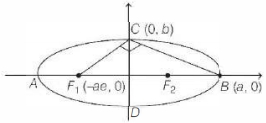
View full question & answer→MCQ 1781 Mark
A rectangle with its sides parallel to the $X$-axis and $Y$-axis is inscribed in the region bounded by the curves $y=x^2-4$ and $2 y=4-x^2$. The maximum possible area of such a rectangle is closest to the integer.
Answerb
(b)
Equation of parabola
$y=x^2-4$ and $2 y=4-x^2$
Let point $B=\left(h, \frac{4-h^2}{2}\right)$
$A=\left(-h, \frac{4-h^2}{2}\right)$
$C=\left(h_1 h^2-4\right)$
$D=\left(-h, h^2-4\right)$
Area of rectangle
$A B C D=A B \times B C=2 h \times\left(\frac{4-h^2}{2}-h^2+4\right)$
$\Rightarrow A=12 h-3 h^3 \Rightarrow \frac{d A}{d h}=12-9 h^2$
For maxima or minima
$\frac{d A}{d h}=0 \Rightarrow 12-9 h^2=0$
$h=\pm \frac{2}{\sqrt{3}}$ maximum at $h=\frac{2}{\sqrt{3}}$
$A=12\left(\frac{2}{\sqrt{3}}\right)-3\left(\frac{2}{\sqrt{3}}\right)^3=\frac{24}{\sqrt{3}}-\frac{8}{\sqrt{3}}$
$=\frac{16}{\sqrt{3}}=\frac{16 \sqrt{3}}{3}$
$A-\frac{16 \times 173}{3}-9.22$
${[A]=[9.22]=9 }$
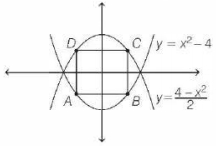
View full question & answer→MCQ 1791 Mark
For $0 < \theta < \frac{\pi}{2}$, four tangents are drawn at the four points $(\pm 3 \cos \theta, \pm 2 \sin \theta)$ to the ellipse $\frac{x^2}{9}+\frac{y^2}{4}=1$. If $A(\theta)$ denotes the area of the quadrilateral formed by these four tangents, the minimum value of $A(\theta)$ is
Answerb
(b)
We have,
Equation of ellipse
$\frac{x^2}{9}+\frac{y^2}{4}=1$
Equation of $\operatorname{tangent}$ at $(3 \cos \theta, 2 \sin \theta)$ is
$\frac{x}{3} \cos \theta+\frac{y}{2} \sin \theta=1$
Intercept of tangent is $(3 \sec \theta, 0)$ and $(0,2 \operatorname{cosec} \theta)$.
Area of quadrilateral
$=4 \times \cdot \frac{1}{2} 3 \sec \theta \times 2 \operatorname{cosec} \theta$
$=12 \sec \theta \operatorname{cosec} \theta=\frac{24}{\sin 2 \theta}$
Minimum area $=24$
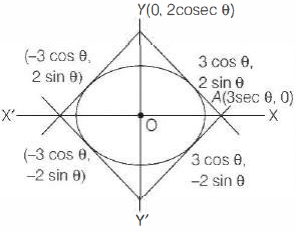
View full question & answer→MCQ 1801 Mark
Let $\frac{x^2}{a^2}+\frac{y^2}{b^2}=1, a>b$ be an ellipse with foci $F_1$ and $F_2$. Let $AO$ be its semi-minor axis, where $O$ is the centre of the ellipse. The lines $A F_1$ and $A F_2$, when extended, cut the ellipse again at points $B$ and $C$ respectively. Suppose that the $\triangle A B C$ is equilateral. Then, the eccentricity of the ellipse is
- A
$\frac{1}{\sqrt{2}}$
- B
$\frac{1}{\sqrt{3}}$
- C
$\frac{1}{3}$
- ✓
$\frac{1}{2}$
AnswerCorrect option: D. $\frac{1}{2}$
d
(d)
Given, $\frac{x^2}{a^2}+\frac{y^2}{b^2}=1$
$A B C$ is an equilateral traingles.
$\ln \Delta A O F_2^1$
$\tan 30^{\circ}=\frac{O F_2}{O A}$
$\frac{1}{\sqrt{3}} =\frac{a e}{b}$
$b =\sqrt{3} a e$
$b^2 =3 a^2 e^2$
$\frac{b^2}{a^2} =3 e^2$
$4 e^2 =1$
$e^2 =\frac{1}{4} \Rightarrow e=\frac{1}{2}$
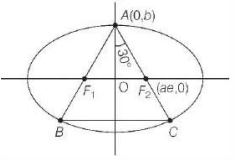
View full question & answer→MCQ 1811 Mark
Let $x^2=4 k y, k>0$ be a parabola with vertex $A$. Let $B C$ be its latusrectum. An ellipse with centre on $B C$ touches the parabola at $A$, and cuts $B C$ at points $D$ and $E$ such that $B D=D E=E C(B, D, E, C$ in that order). The eccentricity of the ellipse is
- A
$\frac{1}{\sqrt{2}}$
- B
$\frac{1}{\sqrt{3}}$
- ✓
$\frac{\sqrt{5}}{3}$
- D
$\frac{\sqrt{3}}{2}$
AnswerCorrect option: C. $\frac{\sqrt{5}}{3}$
c
(c)
Given, $x^2=4 k y$
$B C$ is latusrectum.
$B C=4 k$
$B D=D E=E C$
$D E=\frac{B C}{3}=\frac{4 k}{3}$
$P$ is centre of ellipse.
$P E=\frac{2 k}{3}$
$O P^2=k$
$\because$ Eccentricity of ellipse
$\sqrt{1-\frac{P E^2}{O P^2}}=\sqrt{1-\frac{4 k^2}{9 k^2}}$
$e=\sqrt{\frac{9-4}{9}}=\frac{\sqrt{5}}{3}$
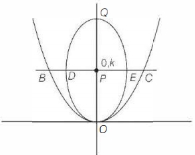
View full question & answer→MCQ 1821 Mark
On a rectangular hy perbola $x^2-y^2= a ^2, a >0$, three points $A, B, C$ are taken as follows: $A=(-a, 0) ; B$ and $C$ are placed symmetrically with respect to the $X$-axis on the branch of the hyperbola not containing $A$. Suppose that the $\triangle A B C$ is equilateral. If the side length of the $\triangle A B C$ is $k a$, then $k$ lies in the interval
- A
$(0,2]$
- ✓
$(2,4]$
- C
$(4,6]$
- D
$(6,8]$
AnswerCorrect option: B. $(2,4]$
b
(b)
We have rectangular hyperbola
$x^2-y^2=a^2$
Given $A B C$ is an equilateral triangle.
$A B =B C=A C$
$A B^2 =B C^2$
$a^2(\sec \theta+1)^2+a^2 \tan ^2 \theta=4 a^2 \tan ^2 \theta$
$\begin{aligned}(\sec \theta+1)^2 &=3 \tan ^2 \theta \$\sec \theta+1)^2 &=3\left(\sec ^2 \theta-1\right) \$\sec \theta+1)^2 &=3(\sec \theta+1)(\sec \theta-1) \end{aligned}$
$\sec \theta+1=3 \sec \theta-3$
$\sec \theta=2$
$\theta=60^{\circ}$
$\because$ Side $B C=2 a \tan \theta$
$=2 a \tan 6 \theta^{\circ}=2 a \sqrt{3}$
But side of triangle is $k a$.
$k a =2 a \sqrt{3}$
$k =2 \sqrt{3}$
Hence, $k \in(2,4]$.
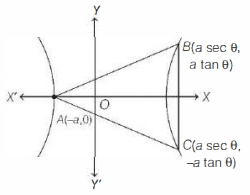
View full question & answer→MCQ 1831 Mark
An ellipse with its minor and major axis parallel to the coordinate axes passes through $(0,0),(1,0)$ and $(0,2)$. One of its foci lies on the $Y$-axis. The eccentricity of the ellipse is
- A
$\sqrt{3}-1$
- B
$\sqrt{5}-2$
- ✓
$\sqrt{2}-1$
- D
$\frac{\sqrt{3}-1}{2}$
AnswerCorrect option: C. $\sqrt{2}-1$
c
(c)
An ellipse passes through $(0,0)$, $(1,0)$ and $(2,0)$. Its minor and major axis are parallel to coordinates axes. One of its foci lies on $Y$-axis.
Let one foci is $(0, k)$.
$\therefore O B$ is the latusrectum of ellipse $F_1(0, k)$ is mid-point of $O B$
$F_1(0,1) \quad\left[\because k=\frac{2+0}{2}=1\right]$
Now $F_2(h, k)=F_2(h, 1)$
Now by definition of ellipse
$B F_1+B F_2=2 a =O F_1+O F_2$
$\therefore \quad B F_1+B F_2 =O F_1+O F_24$
$\sqrt{1+1}+\sqrt{(h-1)^2+1} =\sqrt{0+1}+\sqrt{h^2+1}$
$\sqrt{2}+\sqrt{(h-1)^2+1} =1+\sqrt{h^2+1}$
$\Rightarrow \quad h =1$
$\therefore F_1(0,1) \text { and } F_2(1,1)$
$F_1 F_2=2 a e =1$
$\therefore \quad O F_1+O F_2=2 a =1+\sqrt{2}$
$\Rightarrow \quad e=\frac{1}{\sqrt{2}+1} \Rightarrow e =\frac{\sqrt{2}-1}{2-1}$
$e =\sqrt{2}-1$
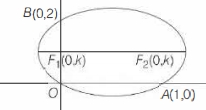
View full question & answer→MCQ 1841 Mark
An ellipse $\frac{x^2}{a^2}+\frac{y^2}{b^2}=1, a>b$ and the parabola $x^2=4(y+b)$ are such that the two foci of the ellipse and the end points of the latusrectum of parabola are the vertices of a square. The eccentricity of the ellipse is
- A
$\frac{1}{\sqrt{13}}$
- ✓
$\frac{2}{\sqrt{13}}$
- C
$\frac{1}{\sqrt{11}}$
- D
$-\frac{2}{\sqrt{11}}$
AnswerCorrect option: B. $\frac{2}{\sqrt{13}}$
b
(b)
Equation of ellipse
$\frac{x^2}{a^2}+\frac{y^2}{b^2}=1, a > b$
Equation of parabola $x^2=4(y+b)$
Foci of ellipse $(\pm a e, 0)$.
End of latusrectum of parabola
$=(\pm 2,1-b)$
$A B C D$ is a square
$A B=C D \Rightarrow 2 a e=4 \Rightarrow a e=2$
$B C=C D \Rightarrow B C^2=C D^2$
$(2-a e)^2+(1-b)^2=4^2$
$(2-a e)^2+(1-b)^2=4^2$
$0+(1-b)^2=4^2$
$1-b=\pm 4$
$b=5, b=-3 \Rightarrow a=\sqrt{29}$ or $\sqrt{13}$
$e=\sqrt{1-\frac{b^2}{a^2}}$
$e=\sqrt{1-\frac{9}{13}}=\frac{2}{\sqrt{13}}$ or $2$
View full question & answer→MCQ 1851 Mark
The sound of a cannon firing is heard one second later at a position $B$ that at position $A$. If the speed of sound is uniform, then
- ✓
the positions $A$ and $B$ are foci of a hyperbola, with cannon's position on one branch of the hyperbola
- B
the position $A$ and $B$ are foci of an ellipse with cannon's position on the ellipse
- C
one of the positions $A, B$ is focus of a parabola with cannon's position on the parabola
- D
it is not possible to describe the positions of $A, B$ and the cannon with the given in formation
AnswerCorrect option: A. the positions $A$ and $B$ are foci of a hyperbola, with cannon's position on one branch of the hyperbola
a
(a)
Let the position of cannon $=P$ speed of sound $=S$
Time of heard of sound of cannon firing of at $A=t$
$\therefore$ at $B=t+1$
Hence, $P A=$ Speed $\times$ Time
$P A=S t$
$and\,P B=S(t+1)=S t+S$
$P B-P A=S t+S-S t$
$P B-P A=S$
$P B-P A=$ constant
$\therefore A$ and $B$ are foci of hyperbola.
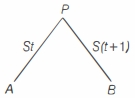
View full question & answer→MCQ 1861 Mark
Suppose the parabola $(y-h)^2=4(x-h)$, with vertex $A$, passes through $O=(0,0)$ and $L=(0,2)$. Let $D$ be an end point of the latusrectum. Let the $Y$-axis intersect the axis of the parabola at $P$. Then, $\angle P D A$ is equal to
- A
$\tan ^{-1} \frac{1}{19}$
- ✓
$\tan ^{-1} \frac{2}{19}$
- C
$\tan ^{-1} \frac{4}{19}$
- D
$\tan ^{-1} \frac{8}{19}$
AnswerCorrect option: B. $\tan ^{-1} \frac{2}{19}$
b
(b)
Given parabola $(y-k)^2=4(x-h)$
This is passes through $(0,0)$ and $(0,2)$.
$\therefore k^2=-4\,h$
and $(2-k)^2=-4\,h$
From Eqs. $(i)$ and $(ii)$, we get
$k=1, h=-\frac{1}{4}$
$\therefore$ Equation of parabola becomes
$(y-1)^2=4 x+1$
Focus of parabola $=\left(\frac{3}{4}, 1\right)$
End of latusrectum $D=\left(\frac{3}{4}, 3\right)$
Axis of parabola is $y-1=0$
Point $P$ intersection of axis of parabola and $Y$-axis.
$P(0,1)$
$D\left(\frac{3}{4}, 3\right)$
$A\left(-\frac{1}{4}, 1\right) \quad[\because A$ is vertex of parabola $]$ Slope of $P D=\frac{3-1}{3 / 4-0}=8 / 3=m_1$
Slope of $D A=\frac{3-1}{\frac{3}{4}+\frac{1}{4}}=2=m_2$
$\therefore \quad \angle P D A=\theta=\tan ^{-1}\left(\frac{m_1-m_2}{1+m_1 m_2}\right)$
$=\tan ^{-1}\left(\frac{8 / 3-2}{1+\frac{16}{3}}\right)=\tan ^{-1}\left(\frac{2}{19}\right)$
View full question & answer→MCQ 1871 Mark
A wall is inclined to the floor at an angle of $135^{\circ}$. A ladder of length $l$ is resting on the wall. As the ladder slides down, its mid-point traces an arc of an ellipse. Then, the area of the ellipse is
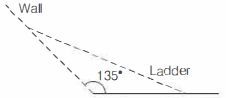
- ✓
$\frac{\pi l^2}{4}$
- B
$\pi l^2$
- C
$4 \pi l^2$
- D
$2 \pi l^2$
AnswerCorrect option: A. $\frac{\pi l^2}{4}$
a
(a)
Mid-point $(h, k)=\left(\frac{x-x_1}{2}, \frac{x_1}{2}\right)$
$A B =l$
$A B^2 =l^2$
$\Rightarrow\left(x+x_1\right)^2+x_1^2=l^2$
$\frac{x-x_1}{2} =h \Rightarrow x-x_1=2 h$
$\frac{x_1}{2} =k \Rightarrow x_1=2 k$
$x+x_1 =2 h+4 k$
Hence, locus of mid-point $(h, k)$ is
$(2 h+4 k)^2+4 k^2 =l^2$
$\Rightarrow \quad x^2+5 y^2+4 x y =\frac{l^2}{4}$
$\text { Area of ellipse } =\frac{\pi l^2}{4}$
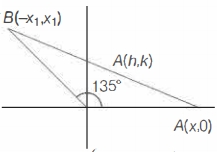
View full question & answer→MCQ 1881 Mark
Suppose $B O A C$ is a rectangle in the $X Y$-plane where $O$ is the origin and $A, B$ lie on the parabola $y=x^2$. Then, $C$ must lie on the curve
- ✓
$y=x^2+2$
- B
$y=2 x^2+1$
- C
$y=-x^2+2$
- D
$y=-2 x^2+1$
AnswerCorrect option: A. $y=x^2+2$
a
(a)
Given,
$B O A C$ is a rectangle in the $X Y$-plane where $O$ is the origin and $A, B$ lie on $y=x^2$
Point $A=\left(t_1, t_1^2\right)$
$B=\left(t_2, t_2^2\right)$
Slope of $O A=t_1$
Slope of $O B=t_2$
$O A$ is perpendicular to $O B$.
$\therefore \quad t_1 t_2=-1$
$h=t_1+t_2$ and $k=t_1^2+t_2^2$
$k=\left(t_1+t_2\right)^2-2 t_1 t_2$
$k=h^2+2$
$\therefore$ Locus of $C$ is $y=x^2+2$
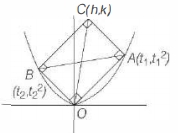
View full question & answer→MCQ 1891 Mark
Suppose a parabola $y=a x^2+b x+c$ has two $x$ intercepts, one positive and one negative, and its vertex is $(2,-2)$. Then, which of the following is true?
- A
$a b > 0$
- ✓
$b c > 0$
- C
$c a > 0$
- D
$a+b+c > 0$
AnswerCorrect option: B. $b c > 0$
b
(b)
We have, $y=a x^2+b x+c$
Parabola has two roots one is positive and one is negative.
Clearly, $c$ is negative
$a > 0$
$-\frac{b}{a} =2$
$\therefore \quad-\frac{b}{a} > 0$
$\therefore \quad b < 0$
$\therefore > 0$
Hence, option $(b)$ is correct.
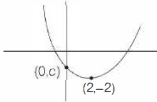
View full question & answer→MCQ 1901 Mark
In an ellipse, its foci and ends of its major axis are equally spaced. If the length of its semi-minor axis is $2 \sqrt{2}$, then the length of its semi-major axis is
- A
$4$
- B
$2 \sqrt{3}$
- C
$\sqrt{10}$
- ✓
$3$
Answerd
(d)
Given, in cllipse
$A^{\prime} S^{\prime}=S S^{\prime}=S A$
$\therefore \quad S S^{\prime} =\frac{1}{3} A A^{\prime}$
$\Rightarrow \quad 2 a e =\frac{1}{3}(2 a)$
$\Rightarrow \quad =\frac{1}{3}$
$\text { Also given, } b =2 \sqrt{2}$
$\Rightarrow \quad \frac{1}{9} =1-\frac{b^2}{a^2}$
$\Rightarrow \quad \frac{8}{a^2} =1-\frac{1}{9}=\frac{8}{9}$
$\Rightarrow \quad a^2 =9$
$\therefore \quad a =3$
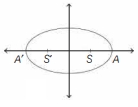
View full question & answer→MCQ 1911 Mark
An ellipse inscribed in a semi-circle touches the circular arc at two distinct points and also touches the bounding diameter. Its major axis is parallel to the bounding diameter. When the ellipse has the maximum possible area, its eccentricity is
AnswerCorrect option: D. $\sqrt{\frac{2}{3}}$
d
(d)
Let equation of ellipse is
$\frac{x^2}{a^2}+\frac{y^2}{b^2}=1$
$\therefore$ Equation of circle is
$x^2+(y+b)^2=r^2$
Put $x^2=a^2-\frac{a^2 y^2}{b^2}$ in circle
$a^2-\frac{a^2 y^2}{b^2}+(y+b)^2=r^2$
$\Rightarrow\left(1-\frac{a^2}{b^2}\right) y^2+2 b y+\left(a^2+b^2-r^2\right)=0$
$D=0 \Rightarrow r^2=\frac{a^4}{a^2-b^2} \Rightarrow b=a \sqrt{1-\frac{a^2}{r^2}}$
Area of ellipse $=\pi a b$
$A=\pi a^2 \sqrt{1-\frac{a^2}{r^2}}$
$\frac{d A}{d a}=0 \Rightarrow a^2=\frac{2 r^2}{3} \Rightarrow a=\sqrt{\frac{2}{3} r}$
$\therefore \quad b=a \sqrt{1-\frac{2}{3}}=\frac{a}{\sqrt{3}}$
$\Rightarrow \quad e=\sqrt{1-\frac{b^2}{a^2}}=\sqrt{1-\frac{1}{3}}=\sqrt{\frac{2}{3}}$
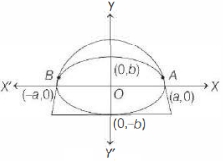
View full question & answer→MCQ 1921 Mark
The vertices of the base of an isosceles triangle lie on a parabola $y^2=4 x$ and the base is a part of the line $y=2 x-4$. If the third vertex of the triangle lies on the $X$-axis, its coordinates are
- A
$\left(\frac{5}{2}, 0\right)$
- B
$\left(\frac{7}{2}, 0\right)$
- ✓
$\left(\frac{9}{2}, 0\right)$
- D
$\left(\frac{11}{2}, 0\right)$
AnswerCorrect option: C. $\left(\frac{9}{2}, 0\right)$
c
(c)
We have,
Equation of parabola
On solving Eqs. $(i)$ and $(ii)$, we get $(1,-2)$ and $(4,4)$
Now, $A B C$ is an isosceles triangle $A B=A C$
$\therefore \quad(x-1)^2+(2)^2=(x-4)^2+(4)^2$
$\Rightarrow x^2-2 x+1+4=x^2-8 x+16+16$
$\Rightarrow \quad 6 x=27$
$\Rightarrow \quad x=\frac{27}{6}=\frac{9}{2}$
$\therefore \quad$ Coordinate $=\left(\frac{9}{2}, 0\right) .$
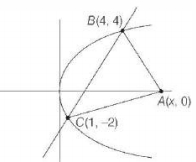
View full question & answer→MCQ 1931 Mark
Consider the conic $e x^2+\pi y^2-2 e^2 x-2 \pi^2 y +e^3+\pi^3=\pi e$.
Suppose $P$ is any point on the conic and $S_1, S_2$ are the foci of the conic, then the maximum value of $\left(P S_1+P S_2\right)$ is
- A
$\pi e$
- B
$\sqrt{\pi e}$
- ✓
$2 \sqrt{\pi}$
- D
$2 \sqrt{e}$
AnswerCorrect option: C. $2 \sqrt{\pi}$
c
(c)
We have,
$e x^2+\pi y^2-2 e^2 x-2 \pi^2 y+e^3+\pi^3=\pi e$
$\Rightarrow e x^2-2 e^2 x+\pi y^2-2 \pi^2 y=\pi e-e^3-\pi^3$
$\Rightarrow e\left(x^2-2 e x+e^2\right)+\pi\left(y^2-2 \pi y+\pi^2\right)$
$=\pi e-e^3-\pi^3+e^3+\pi^3$
$\Rightarrow e(x-e)^2+\pi(y-\pi)^2=\pi e$
$\Rightarrow \frac{(x-e)^2}{(\sqrt{\pi})^2}+\frac{(y-\pi)^2}{(\sqrt{e})^2}=1$
$\therefore \quad \sqrt{\pi}>\sqrt{e}$
$\therefore \quad P S_1+P S_2=2 a$
$\therefore \quad P S_1+P S_2=2 \sqrt{\pi}$
View full question & answer→MCQ 1941 Mark
Let $(x, y)$ be a variable point on the curve $4 x^2+9 y^2-8 x-36 y+15=0$. Then, min $\left(x^2-2 x+y^2-4 y+5\right)+\max \left(x^2-2 x+y^2-4 y+5\right)$ is
- ✓
$\frac{325}{36}$
- B
$\frac{36}{325}$
- C
$\frac{13}{25}$
- D
$\frac{25}{13}$
AnswerCorrect option: A. $\frac{325}{36}$
a
(a)
We have,
$4 x^2+9 y^2-8 x-36 y+15=0$
$\Rightarrow 4\left(x^2-2 x+1\right)+9\left(y^2-4 y+4\right)$
$=-15+4+36$
$\Rightarrow \quad 4(x-1)^2+9(y-2)^2=25$
$\Rightarrow \quad \frac{(x-1)^2}{25 / 4}+\frac{(y-2)^2}{25 / 9}=1$
Now, $\min \left(x^2-2 x+y^2-4 y+5\right)$
$+\max \left(x^2-2 x+y^2-4 y+5\right)$
$=\min \left[(x-1)^2+(y-2)^2\right]$
$+\max \left[(x-1)^2+(y-2)^2\right]$
$=\frac{25}{9}+\frac{25}{4}$
$=25\left(\frac{4+9}{36}\right)=\frac{25 \times 13}{36}=\frac{325}{36}$
View full question & answer→MCQ 1951 Mark
In the $X Y$-plane, three distinct lines $l_1, l_2, l_3$ concur at a point $(\lambda, 0)$. Further the lines $l_1, l_2, l_3$ are normals to the parabola $y^2=6 x$ at the points $A=\left(x_1, y_1\right)$, $B=\left(x_2, y_2\right), C=\left(x_3, y_3\right)$ respectively. Then, we have
- A
$\lambda < -5$
- ✓
$\lambda > 3$
- C
$-5 < \lambda < -3$
- D
$0 < \lambda < 3$
AnswerCorrect option: B. $\lambda > 3$
b
(b)
We have, $y^2=6 x$
Equation of normal of parabola $y^2=4 a x$ is $y=m x-2 a m-a m^3$
$\therefore$ Equation of normal of parabola $y^2=6 x$ is
$y=m x-3 m-\frac{3}{2} m^3$
Normal is passes through $(\lambda, 0)$.
$\therefore \quad 0=\lambda m-3 m-\frac{3}{2} m^3$
$\Rightarrow \quad \lambda=3+\frac{3}{2} m^2 \Rightarrow m^2=\frac{2}{3}(\lambda-3)$
$\Rightarrow \quad m=\sqrt{\frac{2}{3}(\lambda-3)}$
$\therefore m$ is real.
$\therefore \quad \lambda-3 > 0 \Rightarrow \lambda > 3$
View full question & answer→MCQ 1961 Mark
The smallest possible positive slope of a line whose $y$-intercept is $5$ and which has a common point with the ellipse $9 x^2+16 y^2=144$ is
- A
$\frac{3}{4}$
- ✓
$1$
- C
$\frac{4}{3}$
- D
$\frac{9}{16}$
Answerb
(b)
We have equation of ellipse
$9 x^2+16 y^2 =144$
$\Rightarrow \quad \frac{x^2}{16}+\frac{y^2}{9} =1$
Equation of tangent of ellipse is
$y =m x \pm \sqrt{a^2 m^2+b^2}$
$\therefore \quad y =m x \pm \sqrt{16 m^2+9}$
Now, given $y$-intercept $=5$
$\therefore \sqrt{16 m^2+9}=5 \Rightarrow 16 m^2+9=25$
$\Rightarrow \quad 16 m^2=16 \Rightarrow m=\pm 1$
$\therefore \text { Positive slope }=1$
View full question & answer→MCQ 1971 Mark
Suppose $a, b$ are real numbers such that $a b \neq 0$. Which of the following four figures represent the curve $(y-a x-b)\left(b x^2+a y^2-a b\right)=0$ ?
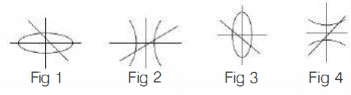
- A
Fig $1$
- ✓
Fig $2$
- C
Fig $3$
- D
Fig $4$
AnswerCorrect option: B. Fig $2$
b
(b)
We have,
$(y-a x-b)\left(b x^2+a y^2-a b\right)=0$
$\Rightarrow y-a x-b=0 \text { or } b x^2+a y^2-a b=0$
$\Rightarrow y=a x+b \text { or } b x^2+a y^2=a b$
$\Rightarrow y=a x+b \text { or } \frac{x^2}{a}+\frac{y^2}{b}=1$
Case $I$ When $a,b > 0$
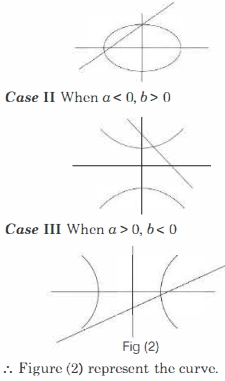
View full question & answer→MCQ 1981 Mark
A circle touches the parabola $y^2=4 x$ at $(1,2)$ and also touches its directrix. The $y$-coordinate of the point of contact of the circle and the directrix is
- A
$\sqrt{2}$
- B
$2$
- ✓
$2 \sqrt{2}$
- D
$4$
AnswerCorrect option: C. $2 \sqrt{2}$
c
(c)
We have,
Equation of parabola
$y^2=4 x$
Equation of tangent of parabola at $(1,2)$, is
$2 y=4 \frac{(x+1)}{2} \Rightarrow y=x+1$
The tangent of parabola $y=x+1$ intersect the dircctrix of parabola at $A(-1,0)$
Now, $A B$ and $A C$ are tangent of circle
$\begin{array}{lc}\because & A B=A C \\ \Rightarrow \sqrt{(1+1)^2+(2-0)^2}\end{array}$
$=\sqrt{(-1+1)^2+(0-k)^2}$
$\Rightarrow \quad 4+4=k^2 \Rightarrow k^2=8 \Rightarrow k=2 \sqrt{2}$
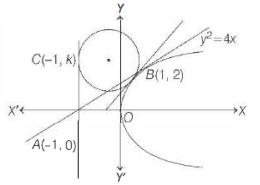
View full question & answer→MCQ 1991 Mark
Let $P$ be an arbitrary point on the ellipse $\frac{x^2}{a^2}+\frac{y^2}{b^2}=1$ $a > b > 0$. Suppose $F_1$ and $F_2$ are the foci of the ellipse. The locus of the centroid of the $\Delta P F_1 F_2$ as $P$ moves on the ellipse is
Answerc
(c)
We have, equation of ellipse
$\frac{x^2}{a^2}+\frac{y^2}{b^2}=1$
Point $P(a \cos \theta, b \sin \theta)$ lie on ellipse
Foci of ellipse $\left(F_1\right)(a e, 0)$ and $F_2(-a e, 0)$
$\therefore$ Centroid of $\triangle P F_1 F_2=\left(\frac{a \cos \theta}{3}, \frac{b \sin \theta}{3}\right)$
$\therefore \quad h=\frac{a \cos \theta}{3}, K=\frac{b \sin \theta}{3}$
$\begin{array}{l}\Rightarrow\left(\frac{3 h}{a}\right)^2+\left(\frac{3 k}{b}\right)^2=\cos ^2 \theta+\sin ^2 \theta \\\Rightarrow \quad \frac{9 x^2}{a^2}+\frac{9 y^2}{b^2}=1\end{array}$
which represent the locus of ellipse.
View full question & answer→MCQ 2001 Mark
The shortest distance from $(0,3)$ to the parabola $y^2=4 x$ is
- A
$2$
- ✓
$\sqrt{2}$
- C
$5$
- D
$\sqrt{5}$
AnswerCorrect option: B. $\sqrt{2}$
b
(b)
Let a point $B$ on parabola is $B\left(\frac{K^2}{4}, K\right)$ and $A(0,3)$
$A B=\sqrt{\left(\frac{K^2}{4}\right)^2+(K-3)^2}$
$\Rightarrow \quad A B^2=\frac{K^4}{16}+K^2-6 K+9$
$A B$ is shortest.
$\therefore A B^2$ is also shortest.
Let $A B=Z$
$\therefore \quad Z=\frac{K^4}{16}+K^2-6 K+9$
$\Rightarrow \quad \frac{d Z}{d K}=\frac{K^3}{4}+2 K-6$
For maxima or minima
put $\frac{d Z}{d K}=0 \Rightarrow \frac{K^2}{4}+2 K-6=0$
$\Rightarrow \quad K^2+8 K-24=0$
$\Rightarrow \quad(K-2)\left(K^2+2 K+12\right)=0$
$K=2 \Rightarrow \frac{d^2 z}{d K^2}=\frac{3 K^2}{4}+2$
$\Rightarrow \quad\left(\frac{d^2 Z}{d K^2}\right)_{K=2}>0$
$\because Z$ is minimum at $K=2$
$\therefore \quad A B=\sqrt{\frac{16}{16}+(1)^2}=\sqrt{2}$
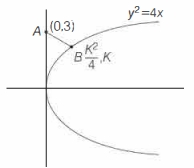
View full question & answer→MCQ 2011 Mark
Consider an ellipse with foci at $(5,15)$ and $(21,15)$. If the $X$-axis is a tangent to the ellipse, then the length of its major axis equals
- A
$17$
- ✓
$34$
- C
$13$
- D
$\sqrt{416}$
Answerb
(b)
Given, $(5,15)$ and $(21,15)$
are foci of parabola and $X$-axis is tangent of ellipse.
$2 a e =16 \text { and } b=15$
$a e =8 \text { and } b=15$
$a e^2 =a^2-b^2$
$16 =a^2-225$
$a^2 =289$
$a =17$
$\therefore$ Length of major axis $=34$
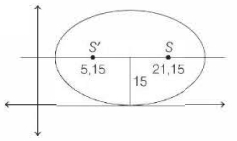
View full question & answer→MCQ 2021 Mark
Let $P Q$ be a chord of the parabola $y^2=12 x$ and the midpoint of $PQ$ be at $(4,1)$. Then, which of the following point lies on the line passing through the points $\mathrm{P}$ and $\mathrm{Q}$ ?
- A
$(3,-3)$
- B
$\left(\frac{3}{2},-16\right)$
- C
$(2,-9)$
- ✓
$\left(\frac{1}{2},-20\right)$
AnswerCorrect option: D. $\left(\frac{1}{2},-20\right)$
d
$Image$
$ T=S_1 $
$ y-6(x+4) $
$ =1-48 $
$ 6 x-y=23$
Option $4\left(\frac{1}{2},-20\right)$ will satisfy
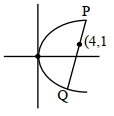
View full question & answer→MCQ 2031 Mark
Suppose $A B$ is a focal chord of the parabola $\mathrm{y}^2=12 \mathrm{x}$ of length $l$ and slope $\mathrm{m}<\sqrt{3}$. If the distance of the chord $\mathrm{AB}$ from the origin is $\mathrm{d}$, then $l \mathrm{~d}^2$ is equal to ....................
Answerb
$Image$
$ \ell=4 \mathrm{a} \operatorname{cosec}^2 \theta $
$ \ell=12 \times \frac{9}{\mathrm{~d}^2} $
$ \ell \mathrm{d}^2=108$
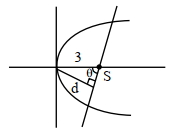
View full question & answer→MCQ 2041 Mark
Let $\frac{x^2}{a^2}+\frac{y^2}{b^2}=1, a>b$ be an ellipse, whose eccentricity is $\frac{1}{\sqrt{2}}$ and the length of the latus rectum is $\sqrt{14}$. Then the square of the eccentricity of $\frac{x^2}{a^2}-\frac{y^2}{b^2}=1$ is :
- A
$3$
- B
$7 / 2$
- ✓
$3 / 2$
- D
$5 / 2$
AnswerCorrect option: C. $3 / 2$
c
$e=\frac{1}{\sqrt{2}}=\sqrt{1-\frac{b^2}{a^2}} \Rightarrow \frac{1}{2}=1-\frac{b^2}{a^2}$
$\frac{2 b^2}{a}=14$
$e_H=\sqrt{1+\frac{b^2}{a^2}}=\sqrt{1+\frac{1}{2}}=\sqrt{\frac{3}{2}}$
$\left(e_H\right)^2=\frac{3}{2}$
View full question & answer→MCQ 2051 Mark
Let $P$ be a point on the ellipse $\frac{x^2}{9}+\frac{y^2}{4}=1$. Let the line passing through $P$ and parallel to $y$-axis meet the circle $x^2+y^2=9$ at point $Q$ such that $P$ and $Q$ are on the same side of the $x$-axis. Then, the eccentricity of the locus of the point $R$ on $P Q$ such that $P R: R Q=4: 3$ as $P$ moves on the ellipse, is :
- A
$\frac{11}{19}$
- B
$\frac{13}{21}$
- C
$\frac{\sqrt{139}}{23}$
- ✓
$\frac{\sqrt{13}}{7}$
AnswerCorrect option: D. $\frac{\sqrt{13}}{7}$
d
$ \mathrm{h}=3 \cos \theta $
$ \mathrm{k}=\frac{18}{7} \sin \theta $
$ \therefore \text { locus }=\frac{\mathrm{x}^2}{9}+\frac{49 \mathrm{y}^2}{324}=1 $
$ \mathrm{e}=\sqrt{1-\frac{324}{49 \times 9}}=\frac{\sqrt{117}}{21}=\frac{\sqrt{13}}{7}$
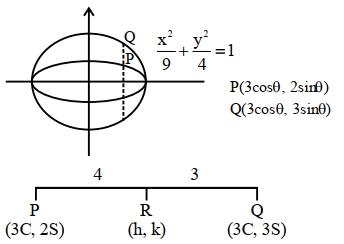
View full question & answer→MCQ 2061 Mark
For $0<\theta<\pi / 2$, if the eccentricity of the hyperbola $\mathrm{x}^2-\mathrm{y}^2 \operatorname{cosec}^2 \theta=5$ is $\sqrt{7}$ times eccentricity of the ellipse $x^2 \operatorname{cosec}^2 \theta+y^2=5$, then the value of $\theta$ is :
- A
$\frac{\pi}{6}$
- B
$\frac{5 \pi}{12}$
- ✓
$\frac{\pi}{3}$
- D
$\frac{\pi}{4}$
AnswerCorrect option: C. $\frac{\pi}{3}$
c
$e_h=\sqrt{1+\sin ^2 \theta}$
$e_c=\sqrt{1-\sin ^2 \theta}$
$e_h=\sqrt{7} e_c$
$1+\sin ^2 \theta=7\left(1-\sin ^2 \theta\right)$
$1+\sin ^2 \theta=7\left(1-\sin ^2 \theta\right)$
$\sin ^2 \theta=\frac{6}{8}=\frac{3}{4}$
$\sin \theta=\frac{\sqrt{3}}{2}$
$\theta=\frac{\pi}{3}$
View full question & answer→MCQ 2071 Mark
If the shortest distance of the parabola $y^2=4 x$ from document security settings le $x^2+y^2-4 x-16 y+64=0$ is $\mathrm{d}$, then $\mathrm{d}^2$ is equal to :
Answerc
Equation of normal to parabola
$y=m x-2 m-m^3$
this normal passing through center of circle $(2,8)$
$ 8=2 \mathrm{~m}-2 \mathrm{~m}-\mathrm{m}^3$
$ \mathrm{~m}=-2$
So point $P$ on parabola $\Rightarrow\left(\mathrm{am}^2,-2 \mathrm{am}\right)=(4,4)$
And $\mathrm{C}=(2,8)$
$\mathrm{PC}=\sqrt{4+16}=\sqrt{20}$
$\mathrm{d}^2=20$
View full question & answer→MCQ 2081 Mark
Let $\mathrm{P}(\alpha, \beta)$ be a point on the parabola $\mathrm{y}^2=4 \mathrm{x}$. If $\mathrm{P}$ also lies on the chord of the parabola $x^2=8 y$ whose mid point is $\left(1, \frac{5}{4}\right)$. Then $(\alpha-28)(\beta-8)$ is equal to...................
Answerc
Parabola is $x^2=8 y$
Chord with mid point $\left(\mathrm{x}_1, \mathrm{y}_1\right)$ is $\mathrm{T}=\mathrm{S}_1$
$ \therefore \mathrm{xx}_1-4\left(\mathrm{y}_1 \mathrm{y}_1\right)=\mathrm{x}_1^2-8 \mathrm{y}_1$
$ \therefore\left(\mathrm{x}_1, \mathrm{y}_1\right)=\left(1, \frac{5}{4}\right) $
$ \Rightarrow \mathrm{x}-4\left(\mathrm{y}+\frac{5}{4}\right)=1-8 \times \frac{5}{4}=-9 $
$ \therefore \mathrm{x}-4 \mathrm{y}+4=0$ $.......(i)$
$(\alpha, \beta)$ lies on $(i)$ also on $y^2=4 x$
$\therefore \alpha-4 \beta+4=0 \text {. }$ $.......(ii)$
$ \beta^2=4 \alpha$ $........(iii)$
Solving $(ii)$ $(iii)$
$ \beta^2=4(4 \beta-4) \Rightarrow \beta^2-16 \beta+16=0 $
$ \therefore \beta=8 \pm 4 \sqrt{3} \text { and } \alpha=4 \beta-4=28 \pm 16 \sqrt{3} $
$ \therefore(\alpha, \quad \beta) \quad=\quad(28+16 \sqrt{3}, 8+4 \sqrt{3}) \quad $
$ (28-16 \sqrt{3}, 8-4 \sqrt{3}) $
$ \therefore(\alpha-28)(\beta-8)=( \pm 16 \sqrt{3})( \pm 4 \sqrt{3}) $
$ =192$
View full question & answer→MCQ 2091 Mark
Let $\mathrm{P}$ be a parabola with vertex $(2,3)$ and directrix $2 x+y=6$. Let an ellipse $E: \frac{x^2}{a^2}+\frac{y^2}{b^2}=1, a>b$ of eccentricity $\frac{1}{\sqrt{2}}$ pass through the focus of the parabola $\mathrm{P}$. Then the square of the length of the latus rectum of $\mathrm{E}$, is
- A
$\frac{385}{8}$
- B
$\frac{347}{8}$
- C
$\frac{512}{25}$
- ✓
$\frac{656}{25}$
AnswerCorrect option: D. $\frac{656}{25}$
d
$\text { Slope of axis }=\frac{1}{2}$
$y-3=\frac{1}{2}(x-2)$
$\Rightarrow 2 y-6=x-2$
$\Rightarrow 2 y-x-4=0$
$2 x+y-6=0$
$4 x+2 y-12=0$
$\alpha+1.6=4 \Rightarrow \alpha=2.4$
$\beta+2.8=6 \Rightarrow \beta=3.2$
Ellipse passes through $(2.4,3.2)$
$\Rightarrow \frac{\left(\frac{24}{10}\right)^2}{a^2}+\frac{\left(\frac{32}{10}\right)^2}{b^2}=1$
Also $1-\frac{\mathrm{b}^2}{\mathrm{a}^2}=\frac{1}{2}=\frac{\mathrm{b}^2}{\mathrm{a}^2}=\frac{1}{2}$
$\Rightarrow \mathrm{a}^2=2 \mathrm{~b}^2$
Put in $(1)$ $\Rightarrow b^2=\frac{328}{25}$
$\Rightarrow\left(\frac{2 b^2}{a}\right)^2=\frac{4 b^2}{a^2} \times b^2=4 \times \frac{1}{2} \times \frac{328}{25}=\frac{656}{25}$
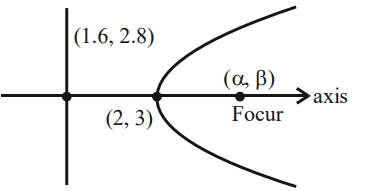
View full question & answer→MCQ 2101 Mark
Let the line $\mathrm{L}: \sqrt{2} \mathrm{x}+\mathrm{y}=\alpha$ pass through the point of the intersection $\mathrm{P}$ (in the first quadrant) of the circle $x^2+y^2=3$ and the parabola $x^2=2 y$. Let the line $L$ touch two circles $C_1$ and $C_2$ of equal radius $2 \sqrt{3}$. If the centres $Q_1$ and $Q_2$ of the circles $C_1$ and $C_2$ lie on the $y$-axis, then the square of the area of the triangle $\mathrm{PQ}_1 \mathrm{Q}_2$ is equal to........................
Answerb
$x^2+y^2=3 \text { and } x^2=2 y$
$y^2+2 y-3=0 \Rightarrow(y+3)(y-1)=0$
$y=-3 \text { or } y=1$
$\mathrm{y}=1 \mathrm{x}=\sqrt{2} \Rightarrow P(\sqrt{2}, 1)$
$\mathrm{p}$ lies on the line
$\sqrt{2} x+y=\alpha$
$\sqrt{2}(\sqrt{2})+1=\alpha$
$\alpha=3$
For circle $\mathrm{C}_1$
$\mathrm{Q}_1$ lies on $\mathrm{y}$ axis
Let $\mathrm{Q}_1(0, \alpha)$ coordinates
$\mathrm{R}_1=2 \sqrt{3} \text { (Given }$
Line $\mathrm{L}$ act as tangent
Apply $P=r$ (condition of tangency)
$\Rightarrow\left|\frac{\alpha-3}{\sqrt{3}}\right|=2 \sqrt{3}$
$\Rightarrow|\alpha-3|=6$
$\begin{aligned} & \alpha-3=6 \quad \text { or } \quad \alpha-3=-6 \\ & \Rightarrow \alpha=9 \quad \alpha=-3 \\ & \Delta P Q_1 Q_2=\frac{1}{2}\left|\begin{array}{ccc}\sqrt{2} & 1 & 1 \\ 0 & 9 & 1 \\ 0 & -3 & 1\end{array}\right| \\ & =\frac{1}{2}(\sqrt{2}(12))=6 \sqrt{2} \\ & \left(\triangle P Q_1 Q_2\right)^2=72 \\ & \end{aligned}$
View full question & answer→MCQ 2111 Mark
Three points $\mathrm{O}(0,0), \mathrm{P}\left(\mathrm{a}, \mathrm{a}^2\right), \mathrm{Q}\left(-\mathrm{b}, \mathrm{b}^2\right), \mathrm{a}>0, \mathrm{~b}>0$, are on the parabola $y=x^2$. Let $S_1$ be the area of the region bounded by the line $P Q$ and the parabola, and $S_2$ be the area of the triangle $O P Q$. If the minimum value of $\frac{\mathrm{S}_1}{\mathrm{~S}_2}$ is $\frac{\mathrm{m}}{\mathrm{n}}, \operatorname{gcd}(\mathrm{m}, \mathrm{n})=1$, then $\mathrm{m}+\mathrm{n}$ is equal to :
Answerc
$\left.\mathrm{S}_2=1 / 2\left|\begin{array}{ccc}0 & 0 & 1 \\ \mathrm{a} & \mathrm{a}^2 & 1 \\ -\mathrm{b} & \mathrm{b}^2 & 1\end{array}\right | \right \rvert \,=1 / 2\left(a \mathrm{~b}^2+\mathrm{a}^2 \mathrm{~b}\right)$
$ P Q:-y-a^2=\frac{a^2-b^2}{a+b}(x-a) $
$ y-a^2=(a-b) x-(a-b) a $
$ y=(a-b) x+a b $
$ S_1=\int_{-b}^a\left((a-b) x+a b-x^2\right) d x $
$ =(a-b) \frac{x^2}{2}+(a b) x-\left.\frac{x^3}{3}\right|_{-b} ^a $
$=\frac{(a-b)^2(a+b)}{2}+a b(a+b)-\frac{\left(a^3+b^3\right)}{3} $
$ \frac{\mathrm{S}_1}{\mathrm{~S}_2}=\frac{\frac{(\mathrm{a}-\mathrm{b})^2}{2}+\mathrm{ab}-\frac{\left(\mathrm{a}^2+\mathrm{b}^2-\mathrm{ab}\right)}{3}}{\frac{\mathrm{ab}}{2}} $
$ =\frac{3(a-b)^2+6 a b-2\left(a^2+b^2-a b\right)}{3 a b} $
$ =\frac{1}{3}\left[\frac{\mathrm{a}}{\mathrm{b}}+\frac{\mathrm{b}}{\mathrm{a}}+2\right] $
$ =\frac{4}{3}=\frac{\mathrm{m}}{\mathrm{n}} \quad \mathrm{m}+\mathrm{n}=7 $
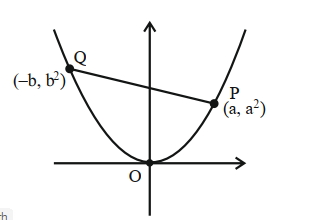
View full question & answer→MCQ 2121 Mark
Let the length of the focal chord $P Q$ of the parabola $y^2=12 x$ be $15$ units. If the distance of $P Q$ from the origin is $\mathrm{p}$, then $10 \mathrm{p}^2$ is equal to....................
Answerd
$ \text { length of focal chord }=4 a \operatorname{cosec}^2 \theta=15 $
$ 12 \operatorname{cosec}^2 \theta=15 $
$ \sin ^2 \theta=\frac{4}{5} $
$ \tan ^2 \theta=4 $
$ \tan \theta=2 $
$ \text { equation } \frac{y-0}{x-3}=2 $
$ y=2 x-6 $
$ 2 x-y-6=0 $
$ P=\frac{6}{\sqrt{5}} $
$ 10 p^2=10 \cdot \frac{36}{5}=72$
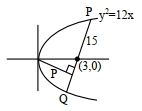
View full question & answer→MCQ 2131 Mark
Let a line perpendicular to the line $2 x-y=10$ touch the parabola $y^2=4(x-9)$ at the point $P$. The distance of the point $\mathrm{P}$ from the centre of the circle $x^2+y^2-14 x-8 y+56=0$ is ...........
Answera
$ y^2=4(x-9) $
slope of tangent $=\frac{-1}{2}$
Point of contact $\mathrm{P}\left(9+\frac{1}{\left(-\frac{1}{2}\right)^2}, \frac{2 \times 1}{\frac{-1}{2}}\right)$
$ P(13,-4) $
$ \text { center of circle } C(7,4) $
$ \text { distance } C P=\sqrt{(13-7)^2+(-4-4)^2} $
$ =10$
View full question & answer→MCQ 2141 Mark
Let $\mathrm{C}$ be the circle of minimum area touching the parabola $y=6-x^2$ and the lines $y=\sqrt{3}|x|$. Then, which one of the following points lies on the circle $C$?
- ✓
$(2,4)$
- B
$(1,2)$
- C
$(2,2)$
- D
$(1,1)$
AnswerCorrect option: A. $(2,4)$
a
Equation of circle
$x^2+(y-(6-r))^2=r^2$
touches $\sqrt{3} \mathrm{x}-\mathrm{y}=0$
$ p=r $
$ \frac{|0-(6-r)|}{2}=r $
$ |r-6|=2 r $
$ r=2$
$\therefore$ Circle $\mathrm{x}^2+(\mathrm{y}-4)^2=4$
$(2,4)$ Satisfies this equation
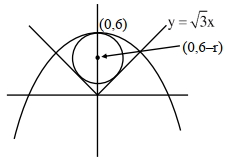
View full question & answer→MCQ 2151 Mark
Let $L_1, L_2$ be the lines passing through the point $\mathrm{P}(0,1)$ and touching the parabola $9 x^2+12 x+18 y-14=0$. Let $Q$ and $R$ be the points on the lines $\mathrm{L}_1$ and $\mathrm{L}_2$ such that the $\triangle \mathrm{PQR}$ is an isosceles triangle with base $\mathrm{QR}$. If the slopes of the lines $Q R$ are $m_1$ and $m_2$. then $16\left(m_1^2+m_2^2\right)$ is equal to ..............
Answera
$ 9 x^2+12 x+4=-18(y-1) $
$ (3 x+2)^2=-18(y-1) $
$ \left(x+\frac{2}{3}\right)^2=-2(y-1)$
$Image$
$ (0,1) $
$ y=m x+1 $
$ \left(x+\frac{2}{3}\right)^2=-2(y-1) $
$ (3 x+2)^2=-18 m x $
$ 9 x^2+(12+18 m) x+4=0 $
$ 4(6+9 m)^2=4(36) $
$ 6+9 m=6,-6 $
$ m=0, \frac{-4}{3}$
$Image$
$ \tan \theta=-\frac{4}{3} $
$ \frac{2 \tan \frac{\theta}{2}}{1-\tan ^2 \frac{\theta}{2}}=\frac{-4}{3} $
$ \left(\tan \frac{\theta}{2}-2\right)\left(2 \tan \frac{\theta}{2}+1\right)=0 $
$ \tan \frac{\theta}{2}=2, \frac{-1}{2} $
$ \mathrm{~m}_{\mathrm{QR}}=\tan \left(90+\frac{\theta}{2}\right)$
$ =-\cot \frac{\theta}{2} $
$ \mathrm{~m}_1=\frac{-1}{2} \quad \mathrm{~m}_2=\frac{-1}{-1 / 2}=2 $
$ 16\left(\mathrm{~m}_1^2+\mathrm{m}_2^2\right)=16\left(\frac{1}{4}+4\right) $
$ =4+64=68$
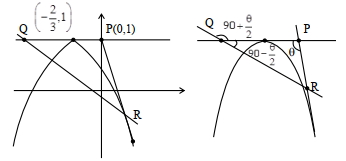
View full question & answer→MCQ 2161 Mark
Consider the circle $\mathrm{C}: \mathrm{x}^2+\mathrm{y}^2=4$ and the parabola $P: y^2=8 x$. If the set of all values of $\alpha$, for which three chords of the circle $\mathrm{C}$ on three distinct lines passing through the point $(\alpha, 0)$ are bisected by the parabola $P$ is the interval $(p, q)$, then $(2 q-p)^2$ is equal to.............
Answera
$Image$
$ T=S_1 $
$ x_1+y y_1=x_1^2+y_1^2 $
$ \alpha x_1=x_1^2+y_1^2 $
$ \alpha\left(2 t^2\right)=4 t^4+16 t^2 $
$ \alpha=2 t^2+8 $
$ \frac{\alpha-8}{2}=t^2$
Also, $4 \mathrm{t}^4+16 \mathrm{t}^2-4<0$
$ \mathrm{t}^2=-2+\sqrt{5} $
$ \alpha=4+2 \sqrt{5} $
$ \therefore \alpha \in(8,4+2 \sqrt{5}) $
$ \therefore(2 \mathrm{q}-\mathrm{p})^2=80$
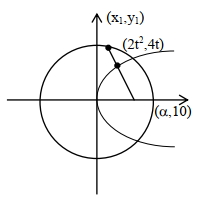
View full question & answer→MCQ 2171 Mark
Let $\mathrm{A}, \mathrm{B}$ and $\mathrm{C}$ be three points on the parabola $y^2=6 x$ and let the line segment $A B$ meet the line $L$ through $\mathrm{C}$ parallel to the $\mathrm{x}$-axis at the point $\mathrm{D}$. Let $\mathrm{M}$ and $\mathrm{N}$ respectively be the feet of the perpendiculars from $\mathrm{A}$ and $\mathrm{B}$ on $\mathrm{L}$.
Then $\left(\frac{\mathrm{AM} \cdot \mathrm{BN}}{\mathrm{CD}}\right)^2$ is equal to...........
Answerb
$ \mathrm{m}_{\mathrm{AB}}=\mathrm{m}_{\mathrm{AD}} $
$ \Rightarrow \quad \frac{2}{\mathrm{t}_1+\mathrm{t}_2}=\frac{2 \mathrm{a}\left(\mathrm{t}_1-\mathrm{t}_3\right)}{\mathrm{at}_1^2-\alpha} $
$ \Rightarrow \quad \mathrm{at}_1^2-\alpha=\mathrm{a}\left\{\mathrm{t}_1^2-\mathrm{t}_1 \mathrm{t}_3+\mathrm{t}_1 \mathrm{t}_2-\mathrm{t}_2 \mathrm{t}_3\right\} $
$ \Rightarrow \quad \alpha=\mathrm{a}\left(\mathrm{t}_1 \mathrm{t}_3+\mathrm{t}_2 \mathrm{t}_3-\mathrm{t}_1 \mathrm{t}_2\right) $
$ \mathrm{AM}=\left|2 \mathrm{a}\left(\mathrm{t}_1-\mathrm{t}_3\right)\right|, \mathrm{BN}=\left|2 \mathrm{a}\left(\mathrm{t}_2-\mathrm{t}_3\right)\right|, $
$ \mathrm{CD}=\left|\mathrm{at}_3^2-\alpha\right|$
$ \mathrm{CD}=\left|\mathrm{at}_3^2-\mathrm{a}\left(\mathrm{t}_1 \mathrm{t}_3+\mathrm{t}_2 \mathrm{t}_3-\mathrm{t}_1 \mathrm{t}_2\right)\right| $
$=\mathrm{a}\left|\mathrm{t}_3^2-\mathrm{t}_1 \mathrm{t}_3-\mathrm{t}_2 \mathrm{t}_3+\mathrm{t}_1 \mathrm{t}_2\right| $
$=\mathrm{a}\left|\mathrm{t}_3\left(\mathrm{t}_3-\mathrm{t}_1\right)-\mathrm{t}_2\left(\mathrm{t}_3-\mathrm{t}_1\right)\right| $
$ \mathrm{CD}=\mathrm{a}\left|\left(\mathrm{t}_3-\mathrm{t}_2\right)\left(\mathrm{t}_3-\mathrm{t}_1\right)\right| $
$\left(\frac{\mathrm{AM} \cdot \mathrm{BN}}{\mathrm{CD}}\right)^2=\left\{\frac{2 \mathrm{a}\left(\mathrm{t}_1-\mathrm{t}_3\right) \cdot 2 \mathrm{a}\left(\mathrm{t}_2-\mathrm{t}_3\right)}{\mathrm{a}\left(\mathrm{t}_3-\mathrm{t}_2\right)\left(\mathrm{t}_3-\mathrm{t}_1\right)}\right\}^2 $
$ 16 \mathrm{a}^2=16 \times \frac{9}{4}=36$
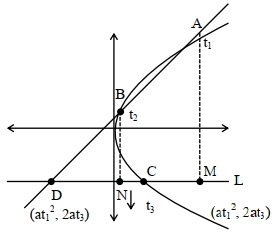
View full question & answer→MCQ 2181 Mark
The length of the chord of the ellipse $\frac{x^2}{25}+\frac{y^2}{16}=1$, whose mid point is $\left(1, \frac{2}{5}\right)$, is equal to:
- ✓
$\frac{\sqrt{1691}}{5}$
- B
$\frac{\sqrt{2009}}{5}$
- C
$\frac{\sqrt{1741}}{5}$
- D
$\frac{\sqrt{1541}}{5}$
AnswerCorrect option: A. $\frac{\sqrt{1691}}{5}$
a
Equation of chord with given middle point.
$\mathrm{T}=\mathrm{S}_1$
$ \frac{x}{25}+\frac{y}{40}=\frac{1}{25}+\frac{1}{100} $
$ \frac{8 x+5 y}{200}=\frac{8+2}{200}$
$y=\frac{10-8 x}{5}$ $.......(i)$
$\frac{x^2}{25}+\frac{(10-8 x)^2}{400}=1$ (put in original equation)
$\frac{16 \mathrm{x}^2+100+64 \mathrm{x}^2-160 \mathrm{x}}{400}=1$
$ 4 x^2-8 x-15=0 $
$ x=\frac{8 \pm \sqrt{304}}{8} $
$x_1=\frac{8+\sqrt{304}}{8} ; x_2=\frac{8-\sqrt{304}}{8}$
$\mathrm{x}_1=\frac{8+\sqrt{304}}{8} ; \mathrm{x}_2=\frac{8-\sqrt{304}}{8}$
Similarly, $y=\frac{10-18 \pm \sqrt{304}}{5}=\frac{2 \pm \sqrt{304}}{5}$
$\mathrm{y}_1=\frac{2-\sqrt{304}}{5} ; \mathrm{y}_2=\frac{2+\sqrt{304}}{5}$
Distance =$\sqrt{\left(\mathrm{x}_1-\mathrm{x}_2\right)^2+\left(\mathrm{y}_1-\mathrm{y}_2\right)^2}$
$=\sqrt{\frac{4 \times 304}{64}+\frac{4 \times 304}{25}}=\frac{\sqrt{1691}}{5}$
View full question & answer→MCQ 2191 Mark
If the points of intersection of two distinct conics $x^2+y^2=4 b$ and $\frac{x^2}{16}+\frac{y^2}{b^2}=1$ lie on the curve $y^2=3 x^2$, then $3 \sqrt{3}$ times the area of the rectangle formed by the intersection points is............................
Answera
Putting $y^2=3 x^2$ in both the conics
We get $x^2=b$ and $\frac{b}{16}+\frac{3}{b}=1$
$\Rightarrow b=4,12$ (b $=4$ is rejected because curves
coincide)
$\therefore \mathrm{b}=12$
Hence points of intersection are
$( \pm \sqrt{12}, \pm 6) \Rightarrow \text { area of rectangle }=432$
View full question & answer→MCQ 2201 Mark
If the length of the minor axis of ellipse is equal to half of the distance between the foci, then the eccentricity of the ellipse is :
- A
$\frac{\sqrt{5}}{3}$
- B
$\frac{\sqrt{3}}{2}$
- C
$\frac{1}{\sqrt{3}}$
- ✓
$\frac{2}{\sqrt{5}}$
AnswerCorrect option: D. $\frac{2}{\sqrt{5}}$
d
$ 2 \mathrm{~b}=\mathrm{ae} $
$ \frac{\mathrm{b}}{\mathrm{a}}=\frac{\mathrm{e}}{2} $
$ \mathrm{e}=\sqrt{1-\frac{\mathrm{e}^2}{4}}$
$ \mathrm{e}=\frac{2}{\sqrt{5}}$
View full question & answer→MCQ 2211 Mark
Let $\mathrm{A}(\alpha, 0)$ and $\mathrm{B}(0, \beta)$ be the points on the line $5 x+7 y=50$. Let the point $P$ divide the line segment $A B$ internally in the ratio $7: 3$. Let $3 x-$ $25=0$ be a directrix of the ellipse $E: \frac{x^2}{a^2}+\frac{y^2}{b^2}=1$ and the corresponding focus be $S$. If from $S$, the perpendicular on the $\mathrm{x}$-axis passes through $\mathrm{P}$, then the length of the latus rectum of $\mathrm{E}$ is equal to
- A
$\frac{25}{3}$
- B
$\frac{32}{9}$
- C
$\frac{25}{9}$
- ✓
$\frac{32}{5}$
AnswerCorrect option: D. $\frac{32}{5}$
d
$\left.\begin{array}{l}\mathrm{A}=(10,0) \\ \mathrm{B}=\left(0, \frac{50}{7}\right)\end{array}\right\} \mathrm{P}=(3,5)$
$\mathrm{ae}=3$
$\frac{\mathrm{a}}{\mathrm{e}}=\frac{25}{3}$
$\mathrm{a}=5$
$\mathrm{~b}=4$
Length of $L R=\frac{2 b^2}{a}=\frac{32}{5}$
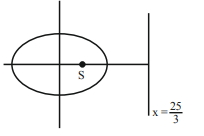
View full question & answer→MCQ 2221 Mark
Let the foci and length of the latus rectum of an ellipse $\frac{\mathrm{x}^2}{\mathrm{a}^2}+\frac{\mathrm{y}^2}{\mathrm{~b}^2}=1, \mathrm{a}>\mathrm{b}$ be $( \pm 5,0)$ and $\sqrt{50}$, respectively. Then, the square of the eccentricity of the hyperbola $\frac{\mathrm{x}^2}{\mathrm{~b}^2}-\frac{\mathrm{y}^2}{\mathrm{a}^2 \mathrm{~b}^2}=1$ equals
Answerc
$\text { focii } \equiv( \pm 5,0) ; \frac{2 b^2}{a}=\sqrt{50} $
$ae=5 \quad b^2=\frac{5 \sqrt{2} a}{2} $
$b^2=a^2\left(1-e^2\right)=\frac{5 \sqrt{2} a}{2}$
$ \Rightarrow \mathrm{a}\left(1-\mathrm{e}^2\right)=\frac{5 \sqrt{2}}{2}$
$\Rightarrow \frac{5}{\mathrm{e}}\left(1-\mathrm{e}^2\right)=\frac{5 \sqrt{2}}{2} $
$\Rightarrow \sqrt{2}-\sqrt{2} \mathrm{e}^2=\mathrm{e} $
$ \Rightarrow \sqrt{2} \mathrm{e}^2+\mathrm{e}-\sqrt{2}=0 $
$ \Rightarrow \sqrt{2} \mathrm{e}^2+2 \mathrm{e}-\mathrm{e}-\sqrt{2}=0$
$ \Rightarrow \sqrt{2} \mathrm{e}(\mathrm{e}+\sqrt{2})-1(1+\sqrt{2})=0 $
$\Rightarrow(\mathrm{e}+\sqrt{2})(\sqrt{2} \mathrm{e}-1)=0 $
$ \therefore \mathrm{e} \neq-\sqrt{2} $
$\mathrm{e}=\frac{1}{\sqrt{2}}$
$\frac{x^2}{b^2}-\frac{y^2}{a^2 b^2}=1 \quad a=5 \sqrt{2} $
$ b=5$
$ a^2 b^2=b^2\left(e_1^2-1\right) \Rightarrow e_1^2= 51$
View full question & answer→MCQ 2231 Mark
Let the line $2 \mathrm{x}+3 \mathrm{y}-\mathrm{k}=0, \mathrm{k}>0$, intersect the $\mathrm{x}$-axis and $\mathrm{y}$-axis at the points $\mathrm{A}$ and $\mathrm{B}$, respectively. If the equation of the circle having the line segment $\mathrm{AB}$ as a diameter is $\mathrm{x}^2+\mathrm{y}^2-3 \mathrm{x}-2 \mathrm{y}=0$ and the length of the latus rectum of the ellipse $\mathrm{x}^2+9 \mathrm{y}^2=\mathrm{k}^2$ is $\frac{\mathrm{m}}{\mathrm{n}}$, where $\mathrm{m}$ and $\mathrm{n}$ are coprime, then $2 \mathrm{~m}+\mathrm{n}$ is equal to
Answerb
Centre of the circle $=\left(\frac{3}{2}, 1\right) $
Equation of diameter $=2 \mathrm{x}+3 \mathrm{y}-\mathrm{k}=0 $
$ 2\left(\frac{3}{2}\right)+3(1)-\mathrm{k}=0 $
$ \Rightarrow \mathrm{k}=6$
Now, Equation of ellipse becomes
$ x^2+9 y^2=36 $
$ \frac{x^2}{6^2}+\frac{y^2}{2^2}=1$
length of $L R=\frac{2 b^2}{a}=\frac{2 \cdot 2^2}{6}=\frac{8}{6}=\frac{4}{3}=\frac{m}{n} $
$ \therefore 2 m+n=2(4)+3=11$
View full question & answer→MCQ 2241 Mark
Let $f(x)=x^2+9, g(x)=\frac{x}{x-9}$ and $\mathrm{a}=\mathrm{fog}(10), \mathrm{b}=\operatorname{gof}(3)$. If $\mathrm{e}$ and $1$ denote the eccentricity and the length of the latus rectum of the ellipse $\frac{x^2}{a}+\frac{y^2}{b}=1$, then $8 e^2+1^2$ is equal to.
Answerb
$ f(x)=x^2+9 \quad g(x)=\frac{x}{x-9} $
$ a=f(g(10))=f\left(\frac{10}{10-9}\right) $
$ =f(10)=109 $
$ b=g(f(3))=g(9+9) $
$ =g(18)=\frac{18}{9}=2 $
$ E: \frac{x^2}{109}+\frac{y^2}{2}=1 $
$ e^2=1-\frac{2}{109}=\frac{107}{109} $
$ \ell=\frac{2(2)}{\sqrt{109}}=\frac{4}{\sqrt{109}} $
$ 8 e^2+\ell^2=\frac{8(107)}{109}+\frac{16}{109} $
$ =8$
View full question & answer→MCQ 2251 Mark
Let $e_1$ be the eccentricity of the hyperbola $\frac{x^2}{16}-\frac{y^2}{9}=1$ and $e_2$ be the eccentricity of the ellipse $\frac{x^2}{a^2}+\frac{y^2}{b^2}=1, a>b$, which passes through the foci of the hyperbola. If $e_1 e_2=1$, then the length of the chord of the ellipse parallel to the $\mathrm{x}$-axis and passing through $(0,2)$ is :
- A
$4 \sqrt{5}$
- B
$\frac{8 \sqrt{5}}{3}$
- ✓
$\frac{10 \sqrt{5}}{3}$
- D
$3 \sqrt{5}$
AnswerCorrect option: C. $\frac{10 \sqrt{5}}{3}$
c
$ H: \frac{x^2}{16}-\frac{y^2}{9}=1 \quad e_1=\frac{5}{4} $
$\therefore e_1 e_2=1 \Rightarrow e_2=\frac{4}{5}$
Also, ellipse is passing through $( \pm 5,0)$
$ \therefore a=5 \text { and } b=3 $
$ E: \frac{x^2}{25}+\frac{y^2}{9}=1$
End point of chord are $\left( \pm \frac{5 \sqrt{5}}{3}, 2\right)$
$\therefore \mathrm{L}_{\mathrm{PQ}}=\frac{10 \sqrt{5}}{3}$
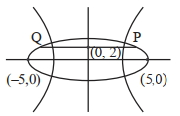
View full question & answer→MCQ 2261 Mark
Let the latus rectum of the hyperbola $\frac{x^2}{9}-\frac{y^2}{b^2}=1$ subtend an angle of $\frac{\pi}{3}$ at the centre of the hyperbola. If $\mathrm{b}^2$ is equal to $\frac{l}{\mathrm{~m}}(1+\sqrt{\mathrm{n}})$, where $l$ and $\mathrm{m}$ are co-prime numbers, then $l^2+\mathrm{m}^2+\mathrm{n}^2$ is equal to______________.
Answerc
$ LR$ subtends $60^{\circ}$ at centre
$ \Rightarrow \tan 30^{\circ}=\frac{b^2 / a}{a e}=\frac{b^2}{a^2 e}=\frac{1}{\sqrt{3}} $
$ \Rightarrow \mathrm{e}=\frac{\sqrt{3}^2}{9}$
Also, $e^2=1+\frac{b^2}{9} \Rightarrow 1+\frac{b^2}{9}=\frac{3 b^4}{81}$
$ \Rightarrow b^4=3 b^2+27 $
$ \Rightarrow b^4-3 b^2-27=0$
$ \Rightarrow b^2=\frac{3}{2}(1+\sqrt{13})$
$ \Rightarrow \ell=3, m=2, n=13 $
$ \Rightarrow \ell^2+m^2+n^2=182$
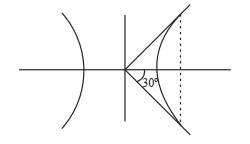
View full question & answer→MCQ 2271 Mark
Let $\mathrm{P}$ be a point on the hyperbola $\mathrm{H}: \frac{\mathrm{x}^2}{9}-\frac{\mathrm{y}^2}{4}=1$, in the first quadrant such that the area of triangle formed by $\mathrm{P}$ and the two foci of $\mathrm{H}$ is $2 \sqrt{13}$. Then, the square of the distance of $\mathrm{P}$ from the origin is
Answerc
$\frac{\mathrm{x}^2}{9}-\frac{\mathrm{y}^2}{4}=1$
$\mathrm{a}^2=9, \mathrm{~b}^2=4$
$\mathrm{~b}^2=\mathrm{a}^2\left(\mathrm{e}^2-1\right) \Rightarrow \mathrm{e}^2=1+\frac{\mathrm{b}^2}{\mathrm{a}^2}$
$\mathrm{e}^2=1+\frac{4}{9}=\frac{13}{9} $
$\mathrm{e}=\frac{\sqrt{13}}{3} \Rightarrow \mathrm{s}_1 \mathrm{~s}_2=2 \mathrm{ae}=2 \times 3 \times \sqrt{\frac{13}{3}}=2 \sqrt{13}$
Area of $\Delta \mathrm{PS}_1 \mathrm{~S}_2=\frac{1}{2} \times \beta \times \mathrm{s}_1 \mathrm{~S}_2=2 \sqrt{13}$
$\Rightarrow \frac{1}{2} \times \beta \times(2 \sqrt{13})=2 \sqrt{13} \Rightarrow \beta=2 $
$\frac{\alpha^2}{9}-\frac{\beta^2}{4}=1 \Rightarrow \frac{\alpha^2}{9}-1=1 \Rightarrow \alpha^2=18 \Rightarrow \alpha=3 \sqrt{2}$
Distance of $\mathrm{P}$ from origin $=\sqrt{\alpha^2+\beta^2}$
$=\sqrt{18+4}=\sqrt{22}$
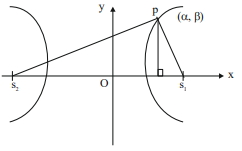
View full question & answer→MCQ 2281 Mark
If the foci of a hyperbola are same as that of the ellipse $\frac{x^2}{9}+\frac{y^2}{25}=1$ and the eccentricity of the hyperbola is $\frac{15}{8}$ times the eccentricity of the ellipse, then the smaller focal distance of the point $\left(\sqrt{2}, \frac{14}{3} \sqrt{\frac{2}{5}}\right)$ on the hyperbola, is equal to
- ✓
$7 \sqrt{\frac{2}{5}}-\frac{8}{3}$
- B
$14 \sqrt{\frac{2}{5}}-\frac{4}{3}$
- C
$14 \sqrt{\frac{2}{5}}-\frac{16}{3}$
- D
$7 \sqrt{\frac{2}{5}}+\frac{8}{3}$
AnswerCorrect option: A. $7 \sqrt{\frac{2}{5}}-\frac{8}{3}$
a
$\frac{x^2}{9}+\frac{y^2}{25}=1$
$a=3, b=5 $
$e=\sqrt{1-\frac{9}{25}}=\frac{4}{5} \therefore \text { foci }=(0, \pm b e)=(0, \pm 4)$
$\therefore e_H=\frac{4}{5} \times \frac{15}{8}=\frac{3}{2}$
Let equation hyperbola
$\frac{\mathrm{x}^2}{\mathrm{~A}^2}-\frac{\mathrm{y}^2}{\mathrm{~B}^2}=-1$
$\therefore \mathrm{B} \cdot \mathrm{e}_{\mathrm{H}}=4 \quad \therefore \mathrm{B}=\frac{8}{3}$
$\therefore \mathrm{A}^2=\mathrm{B}^2\left(\mathrm{e}_{\mathrm{H}}^2-1\right)=\frac{64}{9}\left(\frac{9}{4}-1\right) \therefore \mathrm{A}^2=\frac{80}{9}$
$\therefore \frac{\mathrm{x}^2}{\frac{80}{9}}-\frac{\mathrm{y}^2}{\frac{64}{9}}=-1$
Directrix : $y= \pm \frac{B}{e_H}= \pm \frac{16}{9}$
$\mathrm{PS}=\mathrm{e} \cdot \mathrm{PM}=\frac{3}{2}\left|\frac{14}{3} \cdot \sqrt{\frac{2}{5}}-\frac{16}{9}\right|$
$=7 \sqrt{\frac{2}{5}}-\frac{8}{3}$
View full question & answer→MCQ 2291 Mark
Consider a hyperbola $\mathrm{H}$ having centre at the origin and foci and the $\mathrm{x}$-axis. Let $\mathrm{C}_1$ be the circle touching the hyperbola $\mathrm{H}$ and having the centre at the origin. Let $\mathrm{C}_2$ be the circle touching the hyperbola $\mathrm{H}$ at its vertex and having the centre at one of its foci. If areas (in sq. units) of $\mathrm{C}_1$ and $\mathrm{C}_2$ are $36 \pi$ and $4 \pi$, respectively, then the length (in units) of latus rectum of $\mathrm{H}$ is
- ✓
$\frac{28}{3}$
- B
$\frac{14}{3}$
- C
$\frac{10}{3}$
- D
$\frac{11}{3}$
AnswerCorrect option: A. $\frac{28}{3}$
a
$ \text { Let } \mathrm{H}: \frac{\mathrm{x}^2}{\mathrm{a}^2}-\frac{\mathrm{y}^2}{\mathrm{~b}^2}=1 \quad\left(\mathrm{~b}^2=\mathrm{a}^2\left(\mathrm{e}^2-1\right)\right) $
$ \therefore \mathrm{eq}^{\mathrm{n}} \text { of } \mathrm{C}_1=\mathrm{x}^2+\mathrm{y}^2=\mathrm{a}^2 $
$ \text { Ar. }=36 \pi $
$ \pi \mathrm{a}^2=36 \pi $
$ \mathrm{a}=6 $
$ \text { Now radius of } \mathrm{C}_2 \text { can be } \mathrm{a}(\mathrm{e}-1) \text { or } \mathrm{a}(\mathrm{e}+1) $
$ \text { for } \mathrm{r}=\mathrm{a}(\mathrm{e}-1) \quad \text { for } \mathrm{r}=\mathrm{a}(\mathrm{e}+1) $
$ \text { Ar. }=4 \pi \quad \pi \mathrm{r}^2=4 \pi $
$ \pi \mathrm{a}^2(\mathrm{e}-1)^2=4 \pi \quad \mathrm{a}^2(\mathrm{e}+1)^2=4 $
$ 36 \pi(\mathrm{e}-1)^2=4 \pi \quad 36(\mathrm{e}+1)^2=4 $
$ \mathrm{e}-1=\frac{1}{3} \quad \mathrm{e}+1=\frac{1}{3} $
$ \mathrm{e}=\frac{4}{3} \quad-\frac{2}{3} $
$ \text { Not possible } $
$ \therefore \mathrm{b}^2=36\left(\frac{16}{9}-1\right)=28 $
$ \therefore \mathrm{LR}=\frac{2 \mathrm{~b}^2}{\mathrm{a}}=\frac{2 \times 28}{6}=\frac{28}{3} $
View full question & answer→MCQ 2301 Mark
The length of the latus rectum and directrices of a hyperbola with eccentricity e are 9 and $\mathrm{x}= \pm \frac{4}{\sqrt{3}}$, respectively. Let the line $y-\sqrt{3} \mathrm{x}+\sqrt{3}=0$ touch this hyperbola at $\left(\mathrm{x}_0, \mathrm{y}_0\right)$. If $\mathrm{m}$ is the product of the focal distances of the point $\left(\mathrm{x}_0, \mathrm{y}_0\right)$, then $4 \mathrm{e}^2+\mathrm{m}$ is equal to ...........
Answerb
Given $\frac{2 \mathrm{~b}^2}{\mathrm{a}}=9$ and $\frac{\mathrm{a}}{\mathrm{e}}= \pm \frac{4}{\sqrt{3}}$
equation of tangent $y-\sqrt{3} x+\sqrt{3}=0$
by equation of tangent
Let slope $=\mathrm{S}=\sqrt{3}$
Constant $=-\sqrt{3}$
By condition of tangency
$ \Rightarrow 6=6 \mathrm{a}^2-9 \mathrm{a} $
$ \Rightarrow \mathrm{a}=2, \mathrm{~b}^2=9$
Equation of Hyperbola is
$\frac{x^2}{4}-\frac{y^2}{9}=1$ and for tangent
Point of contact is $(4,3 \sqrt{3})=\left(\mathrm{x}_0, \mathrm{y}_0\right)$
Now $\mathrm{e}=\sqrt{1+\frac{9}{4}}=\frac{\sqrt{13}}{2}$
Again product of focal distances
$\mathrm{m}=\left(\mathrm{x}_0 \mathrm{e}\right. $$ +\mathrm{a})\left(\mathrm{x}_0 \mathrm{e}-\mathrm{a}\right) $
$\mathrm{m}+4 \mathrm{e}^2 $$ =20 \mathrm{e}^2-\mathrm{a}^2 $
$ =20 \times \frac{13}{4}-4=61$
(There is a printing mistake in the equation of directrix $x= \pm \frac{4}{\sqrt{3}}$.
Corrected equation is $\mathrm{x}= \pm \frac{4}{\sqrt{13}}$ for directrix, as eccentricity must be greater than one, so question must be bonus)
View full question & answer→MCQ 2311 Mark
Let $H: \frac{-x^2}{a^2}+\frac{y^2}{b^2}=1$ be the hyperbola, whose eccentricity is $\sqrt{3}$ and the length of the latus rectum is $4 \sqrt{3}$. Suppose the point $(\alpha, 6), \alpha>0$ lies on $H$. If $\beta$ is the product of the focal distances of the point $(\alpha, 6)$, then $\alpha^2+\beta$ is equal to :
Answerb
$ \mathrm{H}: \frac{\mathrm{y}^2}{\mathrm{~b}^2}-\frac{\mathrm{x}^2}{\mathrm{a}^2}=1, \mathrm{e}=\sqrt{3} $
$ \mathrm{e}=\sqrt{1+\frac{\mathrm{a}^2}{\mathrm{~b}^2}}=\sqrt{3} \quad \Rightarrow \frac{\mathrm{a}^2}{\mathrm{~b}^2}=2 $
$ a^2=2 b^2 $
$ \text { length of L.R. }=\frac{2 a^2}{b}=4 \sqrt{3} $
$ \mathrm{a}=\sqrt{6} $
$ P(\alpha, 6) \text { lie on } \frac{y^2}{3}-\frac{x^2}{6}=1 $
$ 12-\frac{\alpha^2}{6}=1 \Rightarrow \alpha^2=66 $
$ \text { Foci }=(0, \pm \mathrm{be})=(0,3) \&(0,-3) $
Let $d_1 \& d_2$ be focal distances of $\mathrm{P}(\alpha, 6)$
$ d_1=\sqrt{\alpha^2+(6+b e)^2}, d_2=\sqrt{\alpha^2+(6-b e)^2} $
$ d_1=\sqrt{66+81}, d_2=\sqrt{66+9} $
$ \beta=d_1 d_2=\sqrt{147 \times 75}=105 $
$ \alpha^2+\beta=66+105=171$
View full question & answer→MCQ 2321 Mark
Let $S$ be the focus of the hyperbola $\frac{x^2}{3}-\frac{y^2}{5}=1$, on the positive $\mathrm{x}$-axis. Let $\mathrm{C}$ be the circle with its centre at $\mathrm{A}(\sqrt{6}, \sqrt{5})$ and passing through the point $\mathrm{S}$. if $\mathrm{O}$ is the origin and $\mathrm{SAB}$ is a diameter of $\mathrm{C}$ then the square of the area of the triangle $OSB$ is equal to ....................
Answerc
$Image$
Area $=\frac{1}{2}(\mathrm{OS}) \mathrm{h}=\frac{1}{2} \sqrt{8} 2 \sqrt{5}=\sqrt{40}$
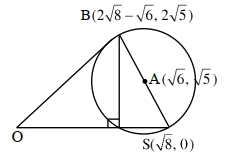
View full question & answer→MCQ 2331 Mark
Let the foci of a hyperbola $\mathrm{H}$ coincide with the foci of the ellipse $E: \frac{(x-1)^2}{100}+\frac{(y-1)^2}{75}=1$ and the eccentricity of the hyperbola $\mathrm{H}$ be the reciprocal of the eccentricity of the ellipse $E$. If the length of the transverse axis of $\mathrm{H}$ is $\alpha$ and the length of its conjugate axis is $\beta$, then $3 \alpha^2+2 \beta^2$ is equal to :
Answerb
$ \mathrm{e}_1=\sqrt{1-\frac{75}{100}}=\frac{5}{10}=\frac{1}{2} $
$ \mathrm{e}_2=2 $
$ \mathrm{~F}_1(6,1), \mathrm{F}_2(-4,1) $
$ 2 \mathrm{ae}_2=10 \Rightarrow \mathrm{a}=\frac{5}{2} \Rightarrow 2 \mathrm{a}=5 $
$ \Rightarrow \alpha=5 $
$ 4=1+\frac{\mathrm{b}^2}{\mathrm{a}^2} \Rightarrow \mathrm{b}^2=3 \mathrm{a}^2 $
$ \mathrm{~b}=\sqrt{3} \times \frac{5}{2} $
$ \beta=5 \sqrt{3} $
$ 3 \alpha^2+2 \beta^2=3 \times 25+2 \times 25 \times 3 $
$ =225$
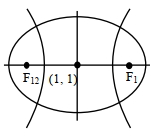
View full question & answer→MCQ 2341 Mark
If the $x$-intercept of a focal chord of the parabola $y^2=8 x+4 y+4$ is $3$ , then the length of this chord is equal to $.............$
Answerb
$y^2=8 x+4 y+4$
$(y-2)^2=8(x+1)$
$y^2=4 a x$
$a=2, X=x+1, Y=y-2$
focus $(1,2)$
$y -2= m ( x -1)$
Put $(3,0)$ in the above line
$m =-1$
Length of focal chord $=16$
View full question & answer→MCQ 2351 Mark
In a group of $100$ persons $75$ speak English and $40$ speak Hindi. Each person speaks at least one of the two languages. If the number of persons, who speak only English is $\alpha$ and the number of persons who speak only Hindi is $\beta$, then the eccentricity of the ellipse $25\left(\beta^2 x^2+\alpha^2 y^2\right)=\alpha^2 \beta^2$ is $.......$
- A
$\frac{3 \sqrt{15}}{12}$
- B
$\frac{\sqrt{117}}{12}$
- ✓
$\frac{\sqrt{119}}{12}$
- D
$\frac{\sqrt{129}}{12}$
AnswerCorrect option: C. $\frac{\sqrt{119}}{12}$
c
$\alpha+ p =75$
$\beta+ p =40$
$\alpha+\beta+ p =100$
$\text { From }(1),(2) \text { and (3) }$
$P =15, \alpha=60 \text { and } \beta=25$
$\text { Now equation of ellipse: } 25\left(\frac{ x ^2}{\alpha^2}+\frac{ y ^2}{\beta^2}\right)=1$
$\frac{ x ^2}{144}+\frac{ y ^2}{25}=1$
$\Rightarrow e=\frac{\sqrt{119}}{12}$
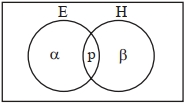
View full question & answer→MCQ 2361 Mark
Let a tangent to the curve $y^2=24 x$ meet the curve $xy =2$ at the points $A$ and $B$. Then the mid points of such line segments $A B$ lie on a parabola with the
AnswerCorrect option: A. directrix $4 x=3$
a
$y^2=24 x$
$a=6$
$x y=2$
$AB \equiv ty = x +6 t ^2$
$AB \equiv T = S _1$
$kx + hy =2 hk \ldots$
From $(1)$ and $(2)$
$\frac{ k }{1}=\frac{ h }{- t }=\frac{2 hk }{-6 t ^2}$
$\Rightarrow$ then locus is $y^2=-3 x$
Therefore directrix is $4 x=3$
View full question & answer→MCQ 2371 Mark
The equations of the sides $AB$ and $AC$ of a triangle $ABC$ are $(\lambda+1) x +\lambda y =4 \text { and } \lambda x +(1-\lambda) y +\lambda=0$ respectively. Its vertex $A$ is on the $y$-axis and its orthocentre is $(1,2)$. The length of the tangent from the point $C$ to the part of the parabola $y^2=6 x$ in the first quadrant is
- A
$\sqrt{6}$
- ✓
$2 \sqrt{2}$
- C
$2$
- D
$4$
AnswerCorrect option: B. $2 \sqrt{2}$
b
$AB :(\lambda+1) x +\lambda y =4$
$AC : \lambda x +(1-\lambda) y +\lambda=0$
Vertex $A$ is on $y$-axis
$\Rightarrow x=0$
So $y =\frac{4}{\lambda}, y =\frac{\lambda}{\lambda-1}$
$\Rightarrow \frac{4}{\lambda}=\frac{\lambda}{\lambda-1}$
$\Rightarrow \lambda=2$
$AB : 3 x +2 y =4$
$AC : 2 x - y +2=0$
$\Rightarrow A (0,2) \text { Let } C (\alpha, 2 \alpha+2)$
Now (Slope of Altitude through C) $\left(-\frac{3}{2}\right)=-1$
$\left(\frac{2 \alpha}{\alpha-1}\right)\left(-\frac{3}{2}\right)=-1 \Rightarrow \alpha=-\frac{1}{2}$
So $C \left(-\frac{1}{2}, 1\right)$
Let Equation of tangent be $y=m x+\frac{3}{2 m}$
$m ^2+2 m -3=0$
$\Rightarrow m =1,-3$
So tangent which touches in first quadrant at $T$ is
$T \equiv\left(\frac{ a }{ m ^2}, \frac{2 a }{ m }\right)$
$\equiv\left(\frac{3}{2}, 3\right)$
$\Rightarrow CT =\sqrt{4+4}=2 \sqrt{2}$
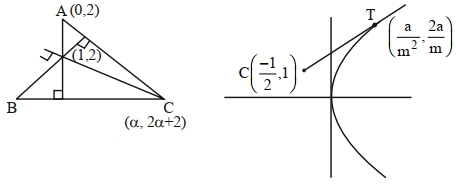
View full question & answer→MCQ 2381 Mark
The urns $A, B$ and $C$ contain $4$ red, $6$ black;$5$ red,$5$ black and $\lambda$ red,$4$ black balls respectively. One of the urns is selected at random and a ball is drawn. If the ball drawn is red and the probability that it is drawn from urn $C$ is $0.4$ then the square of the length of the side of the largest equilateral triangle, inscribed in the parabola $y^2=\lambda x$ with one vertex at the vertex of the parabola is
Answerd
$P\left(\frac{C}{R}\right)=\frac{P(C) P\left(\frac{R}{C}\right)}{P(A) P\left(\frac{R}{A}\right)+P(B) P\left(\frac{R}{B}\right)+P(C) P\left(\frac{R}{C}\right)}$
$0.4=\frac{\frac{1}{3} \times \frac{\lambda}{(\lambda+4)}}{\frac{1}{3} \times \frac{4}{10}+\frac{1}{3} \times \frac{5}{10}+\frac{1}{3} \frac{\lambda}{(\lambda+4)}}$
$\Rightarrow \lambda=6$
$\tan 30^{\circ}=3 t =\frac{3}{2} t ^2$
$\frac{1}{\sqrt{3}}=\frac{2}{ t }$
$t =2 \sqrt{3}$
$\left(\frac{3}{2} t ^2, 3 t \right)=(18,6 \sqrt{3})$
$\ell^2=18^2+(6 \sqrt{3})^2$
$=324+108$
$=432$
View full question & answer→MCQ 2391 Mark
The distance of the point $(6,-2 \sqrt{2})$ from the common tangent $y = mx + c , m > 0$, of the curves $x =2 y ^2$ and $x =1+ y ^2$ is
- A
$\frac{1}{3}$
- ✓
$5$
- C
$\frac{14}{3}$
- D
$5 \sqrt{3}$
Answerb
For
$y ^2=\frac{ x }{2}, T : y = mx +\frac{1}{8 m }$
For tangent to $y ^2+1= x$
$\Rightarrow\left( mx +\frac{1}{8 m }\right)^2+1= x$
$D =0 \Rightarrow m =\frac{1}{2 \sqrt{2}}$
$\therefore T : x -2 \sqrt{2} y +1=0$
$d =\left|\frac{6+8+1}{\sqrt{9}}\right|=5$
View full question & answer→MCQ 2401 Mark
The equations of two sides of a variable triangle are $x =0$ and $y =3$, and its third side is a tangent to the parabola $y^2=6 x$. The locus of its circumcentre is :
- A
$4 y^2-18 y-3 x-18=0$
- B
$4 y^2+18 y+3 x+18=0$
- ✓
$4 y^2-18 y+3 x+18=0$
- D
$4 y^2-18 y-3 x+18=0$
AnswerCorrect option: C. $4 y^2-18 y+3 x+18=0$
c
$y^2=6 x \quad y^2=4 a x $
$\Rightarrow 4 a=6 \Rightarrow a=\frac{3}{2}$
$y = mx +\frac{3}{2 m } ;( m \neq 0)$
$h =\frac{6 m -3}{4 m ^2}, k =\frac{6 m +3}{4 m }$, Now eliminating $m$ and
we get
$\Rightarrow 3 h=2\left(-2 k^2+9 k-9\right)$
$\Rightarrow 4 y^2-18 y+3 x+18=0$
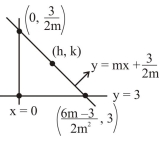
View full question & answer→MCQ 2411 Mark
If $P ( h , k )$ be point on the parabola $x =4 y ^2$, which is nearest to the point $Q(0,33)$, then the distance of $P$ from the directrix of the parabola $y ^2=4( x + y )$ is equal to :
Answerd
Equation of normal
$y=-t x+2 a t+a t^3$
$y=-t x+\frac{2}{16} t+\frac{1}{16} t^3$
It passes through $(0,33)$
$33=\frac{ t }{8}+\frac{ t ^3}{16}$
$t ^3+2 t -528=0$
$( t -8)\left( t ^2+8 t +66\right)=0$
$t =8$
$P \left( at ^2, 2 at \right)=\left(\frac{1}{16} \times 64,2 \times \frac{1}{16} \times 8\right)=(4,1)$
Parabola :
$y^2=4(x+y)$
$\Rightarrow y^2-4 y=4 x$
$\Rightarrow(y-2)^2=4(x+1)$
Equation of directix :-
$x+1=-1$
$x=-2$
Distance of point $=6$
View full question & answer→MCQ 2421 Mark
The parabolas : $a^2+2 b x+c y=0$ and $d x^2+2 ex + fy =0$ intersect on the line $y=1$. If $a, b, c, d, e, f$ are positive real numbers and $a , b , c$ are in $G.P.$, then
- A
$d, e, f$ are in $A.P.$
- B
$\frac{ d }{ a }, \frac{ e }{ b }, \frac{ f }{ c }$ are in $G.P.$
- ✓
$\frac{ d }{ a }, \frac{ e }{ b }, \frac{ f }{ c }$ are in $A.P.$
- D
$d, e, f$ are in $G.P. $
AnswerCorrect option: C. $\frac{ d }{ a }, \frac{ e }{ b }, \frac{ f }{ c }$ are in $A.P.$
c
$a x^2+2 b x+c=0$
$\Rightarrow ax ^2+2 \sqrt{ ac } c + c =0\left(\because b ^2= ac \right)$
$\Rightarrow( x \sqrt{ a }+\sqrt{ c })^2=0$
$x^2-\frac{\sqrt{c}}{\sqrt{a}}$
Now, $dx ^2+2 ex + f =0$
$\Rightarrow d\left(\frac{ c }{ a }\right)+2 e \left[-\frac{\sqrt{ c }}{\sqrt{ a }}\right]+ f =0$
$\Rightarrow \frac{d c}{ a }+ f =2 e \sqrt{\frac{ c }{ a }}$
$\Rightarrow \frac{ d }{ a }+\frac{ f }{ c }=2 e \sqrt{\frac{1}{ ac }}$
$\Rightarrow \frac{ d }{ a }+\frac{ f }{ c }=\frac{2 e }{ b }[\text { as } b =\sqrt{ ae }]$
$\therefore \frac{ d }{ a }, \frac{ e }{ b }, \frac{ f }{ c } \text { are in A.P.}$
View full question & answer→MCQ 2431 Mark
Let $S$ be the set of all $a \in N$ such that the area of the triangle formed by the tangent at the point $P ( b , c ), b , c \in N$, on the parabola $y ^2=2 ax$ and the lines $x=b, y=0$ is $16$ unit $^2$, then $\sum_{\text {aes }} a$ is equal to $..........$.
Answerd
As $P ( b , c )$ lies on parabola so $c ^2=2 ab$
Now equation of tangent to parabola $y ^2=2 ax$ in point
$\text { form is } y_1=2 a \frac{\left(x+x_1\right)}{2},\left(x_1, y_1\right)=(b, c)$
$\Rightarrow y c=a(x+b)$
For point $B$, put $y =0$, now $x =- b$
So, area of $\triangle PBA , \frac{1}{2} \times AB \times AP =16$
$\Rightarrow \frac{1}{2} \times 2 b \times c =16$
$\Rightarrow bc =16$
As $b$ and $c$ are natural number so possible values of (b, c) are $(1,16),(2,8),(4,4),(8,2)$ and $(16,1)$
Now from equation (1) $a=\frac{c^2}{2 b}$ and $a \in N$, so values of $(b, c)$ are $(1,16),(2,8)$ and $(4,4)$ now values of are $128,16$ and $2.$
Hence sum of values of a is $146.$
View full question & answer→MCQ 2441 Mark
Let $R$ be the focus of the parabola $y^2=20 x$ and the line $y=m x+c$ intersect the parabola at two points $P$ and $Q$. Let the point $G(10,10)$ be the centroid of the triangle $P Q R$. If $c-m=6$, then $( PQ )^2$ is
Answera
$y^2=20 x, y=m x+c$
$y^2=20\left(\frac{y-c}{m}\right)$
$y^2-\frac{20 y}{m}+\frac{20 c}{m}=0 \quad \frac{y_1+y_2+y_3}{3}=10$
$\frac{20}{ m }=30$
$m =2 / 3$
$\text { and } c-m=6$
$c=\frac{2}{3}+6 \Rightarrow \frac{20}{3}=c$
$y^2-30 y+\frac{20 \times \frac{20}{3}}{2 / 3}=0 \Rightarrow \quad y^2-30 y+200=0$
$y=10, y=20$
$y=20, x=20 \quad P(5,10) ;(20,20) Q$
$\frac{20+5+x}{3}=10 \Rightarrow x=5 \quad P^2=15^2+10^2=225+100=325$
View full question & answer→MCQ 2451 Mark
Let $A (0,1), B (1,1)$ and $C (1,0)$ be the mid - points of the sides of a triangle with incentre at the point D. If the focus of the parabola $y^2=4 a x$ passing through $D$ is $(\alpha+\beta \sqrt{2}, 0)$, where $\alpha$ and $\beta$ are rational numbers, then $\frac{\alpha}{\beta^2}$ is equal to
- A
$6$
- ✓
$8$
- C
$12$
- D
$\frac{9}{2}$
Answerb
$a = OP =2 \quad b = OQ =2 \quad c = PQ =2 \sqrt{2}$
$(2,0)$
$D \left(\frac{4}{2+2+2 \sqrt{2}}, \frac{4}{2+2+2 \sqrt{2}}\right)= D \left(\frac{2}{2+\sqrt{2}}, \frac{2}{2+\sqrt{2}}\right)$
$y ^2=4 ax \Rightarrow\left(\frac{2}{2+\sqrt{2}}\right)^2=4 a \cdot\left(\frac{2}{2+\sqrt{2}}\right)$
$\therefore 4 a =\frac{2}{2+\sqrt{2}} \therefore a =\frac{1}{2} \cdot \frac{2-\sqrt{2}}{4-2}=\frac{1}{4}(2-\sqrt{2})$
$\therefore \alpha=\frac{2}{4}=\frac{1}{2} \quad \beta=\frac{-1}{4}$
$\therefore \frac{\alpha}{\beta^2}=8$
View full question & answer→MCQ 2461 Mark
The ordinates of the points $P$ and $Q$ on the parabola with focus $(3,0)$ and directrix $x =-3$ are in the ratio $3: 1$. If $R (\alpha, \beta)$ is the point of intersection of the tangents to the parabola at $P$ and $Q$, then $\frac{\beta^2}{\alpha}$ is equal to $.............$.
Answera
Parabola is $y^2=12 x$
Let $Q\left(3 t^2, 6 t\right)$
so $P \left(27 t ^2, 18 t \right)$
$R (\alpha, \beta)=\left( at _1 t _2, a \left( t _1+ t _2\right)\right)$
$=(3 t \cdot 3 t , 3( t +3 t ))$
$R (\alpha, \beta)=\left(9 t ^2, 12 t \right)$
$\frac{\beta^2}{\alpha}=\frac{(12 t )^2}{9 t ^2}=\frac{144}{9}=16$
View full question & answer→MCQ 2471 Mark
Let PQ be a focal chord of the parabola $y^2=36 x$ of length $100$, making an acute angle with the positive $x$-axis. Let the ordinate of $P$ be positive and $M$ be the point on the line segment $P Q$ such that $P M: M Q=3: 1$. Then which of the following points does NOT lie on the line passing through $M$ and perpendicular to the line $PQ$ ?
- ✓
$(-3,43)$
- B
$(-6,45)$
- C
$(3,33)$
- D
$(6,29)$
AnswerCorrect option: A. $(-3,43)$
a
$9\left(t+\frac{1}{t}\right)^2=100$
$t=3$
$\Rightarrow P(81,54) \quad Q(1,-6)$
$M(21,9)$
$\Rightarrow L \text { is }(y-9)=\frac{-4}{3}(x-21)$
$3 y-27=-4 x+84$
$4 x+3 y=111$
View full question & answer→MCQ 2481 Mark
Let $C$ be the largest circle centred at $(2,0)$ and inscribed in the ellipse $=\frac{x^2}{36}+\frac{y^2}{16}=1$.If $(1, \alpha)$ lies on $C$, then $10 \alpha^2$ is equal to $.........$
Answerc
Equation of normal of ellipse $\frac{x^2}{36}+\frac{y^2}{16}=1$ at any point $P (6 \cos \theta, 4 \sin \theta)$ is
$3 \sec \theta x-2 \operatorname{cosec} \theta y=10$ this normal is also the normal of the circle passing through the point $(2,0)$ So,
$6 \sec \theta=10$ or $\sin \theta=0$ (Not possible) $\cos \theta=\frac{3}{5}$ and $\sin \theta=\frac{4}{5}$ so point $P=\left(\frac{18}{5}, \frac{16}{5}\right)$
So the largest radius of circle $r=\frac{\sqrt{320}}{5}$
So the equation of circle $(x-2)^2+y^2=\frac{64}{5}$
Passing it through $(1, \alpha)$
Then $\alpha^2=\frac{59}{5}$
$10 \alpha^2=118$
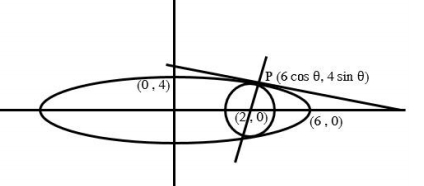
View full question & answer→MCQ 2491 Mark
Let a tangent to the Curve $9 x^2+16 y^2=144$ intersect the coordinate axes at the points $A$ and $B$. Then, the minimum length of the line segment $A B$ is $.........$
Answerc
Equation of tangent at point $P (4 \cos \theta, 3 \sin \theta)$ is $\frac{x \cos \theta}{4}+\frac{y \sin \theta}{3}=1$ So A is $(4 \sec \theta, 0)$ and point $B$ is $(0,3 \operatorname{cosec} \theta)$
Length $A B =\sqrt{16 \sec ^2 \theta+9 \operatorname{cosec}^2 \theta}$ $=\sqrt{25+16 \tan ^2 \theta+9 \cot ^2 \theta} \geq 7$
View full question & answer→MCQ 2501 Mark
A triangle is formed by the tangents at the point $(2,2)$ on the curves $y^2=2 x$ and $x^2+y^2=4 x$, and the line $x+y+2=0$. If $r$ is the radius of its circumcircle, then $r ^2$ is equal to $........$.
Answera
$S_1: y^2=2 x \quad S_2: x^2+y^2=4 x$
$P (2,2)$ is common point on $S _1 \& S _2$
$T_1$ is tangent to $S_1$ at $P \quad \Rightarrow T_1: y \cdot 2=x+2$
$\Rightarrow T_1: x-2 y+2=0$
$T_2$ is tangent to $S_2$ at $P \quad \Rightarrow T_2: x \cdot 2+y \cdot 2=2(x+2)$
$\Rightarrow T_2: y=2$
$L _3: x + y +2=0$ is third line
$PQ = a =\sqrt{20}$
$QR = b =\sqrt{8}$
$RP = c =6$
$\text { Area }(\Delta PQR )=\Delta=\frac{1}{2} \times 6 \times 2=6$
$\therefore r =\frac{ abc }{4 \Delta}=\frac{\sqrt{160}}{4}=\sqrt{10} \Rightarrow r ^2=10$
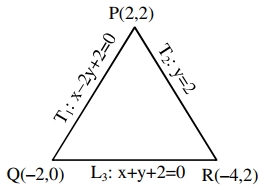
View full question & answer→MCQ 2511 Mark
If the maximum distance of normal to the ellipse $\frac{x^2}{4}+\frac{y^2}{b^2}=1, b < 2$, from the origin is $1$ , then the eccentricity of the ellipse is:
- A
$\frac{1}{\sqrt{2}}$
- ✓
$\frac{\sqrt{3}}{2}$
- C
$\frac{1}{2}$
- D
$\frac{\sqrt{3}}{4}$
AnswerCorrect option: B. $\frac{\sqrt{3}}{2}$
b
Equation of normal is
$2 x \sec \theta-b y \operatorname{cosec} \theta=4-b^2$
Distance from $(0,0)=\frac{4-b^2}{\sqrt{4 \sec ^2 \theta+b^2 \operatorname{cosec}^2 \theta}}$
Distance is maximum if
$4 \sec ^2 \theta+b^2 \operatorname{cosec}^2 \theta$ is minimum
$\Rightarrow \tan ^2 \theta=\frac{b}{2}$
$\Rightarrow \frac{4-b^2}{\sqrt{4 \cdot \frac{b+2}{2}+b^2 \cdot \frac{b+2}{b}}}=1$
$\Rightarrow 4-b^2=b+2 \Rightarrow b=1 \Rightarrow e =\frac{\sqrt{3}}{2}$
View full question & answer→MCQ 2521 Mark
The line $x =8$ is the directrix of the ellipse $E: \frac{x^2}{a^2}+\frac{y^2}{b^2}=1$ with the corresponding focus $(2,0)$. If the tangent to $E$ at the point $P$ in the first quadrant passes through the point $(0,4 \sqrt{3})$ and intersects the $x$-axis at $Q$, then $(3PQ)^2$ is equal to $........$
Answerb
$\frac{ a }{ e }=8 \ldots \ldots \ldots(1) \quad ae =2$
$8 e =\frac{2}{ e }$
$e ^2=\frac{1}{4} \Rightarrow e =\frac{1}{2}$
$a =4$
$b ^2= a ^2\left(1- e ^2\right)$
$=16\left(\frac{3}{4}\right) \quad=12$
$\frac{ x \cos \theta}{4}+\frac{ y \sin \theta}{2 \sqrt{3}}=1$
$\sin \theta=\frac{1}{2}$
$\theta=30^{\circ}$
$P (2 \sqrt{3}, \sqrt{3})$
$Q \left(\frac{8}{\sqrt{3}}, 0\right)$
$(3 PQ )^2=39$
View full question & answer→MCQ 2531 Mark
Let the ellipse $E : x ^2+9 y ^2=9$ intersect the positive $x$ - and $y$-axes at the points $A$ and $B$ respectively Let the major axis of $E$ be a diameter of the circle $C$. Let the line passing through $A$ and $B$ meet the circle $C$ at the point $P$. If the area of the triangle which vertices $A, P$ and the origin $O$ is $\frac{m}{n}$, where $m$ and $n$ are coprime, then $m - n$ is equal to
Answerc
For line $AB x+3 y =3$ and circle is $x ^2+ y ^2=9$
$(3-3 y)^2+y^2=9$
$\Rightarrow 10 y^2-18 y=0$
$\Rightarrow y=0, \frac{9}{5}$
$\therefore \text { Area }=\frac{1}{2} \times 3 \times \frac{9}{5}=\frac{27}{10}$
$m - n =17$
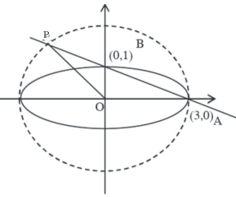
View full question & answer→MCQ 2541 Mark
If the radius of the largest circle with centre $(2,0)$ inscribed in the ellipse $x^2+4 y^2=36$ is $r$, then $12 r^2$ is equal to
Answerc
$(x-2)^2+y^2=r^2$
Solving with ellipse, we get
$(x-2)^2+\frac{36-x^2}{4}=r^2$
$3 x^2-16 x+52-4 r^2=0$
$D=0 \Rightarrow 4 r^2=\frac{92}{3}$
View full question & answer→MCQ 2551 Mark
Let $P \left(\frac{2 \sqrt{3}}{\sqrt{7}}, \frac{6}{\sqrt{7}}\right), Q , R$ and $S$ be four points on the ellipse $9 x^2+4 y^2=36$. Let $P Q$ and $RS$ be mutually perpendicular and pass through the origin. If $\frac{1}{( PQ )^2}+\frac{1}{( RS )^2}=\frac{ p }{ q }$, where $p$ and $q$ are coprime, then $p+q$ is equal to $.........$.
Answerc
Let $R (2 \cos \theta, 3 \sin \theta)$
as $OP \perp OR$
$\text { so } \frac{3 \sin \theta}{2 \cos \theta} \times \frac{\frac{6}{\sqrt{7}}}{\frac{2 \sqrt{3}}{\sqrt{7}}}=-1$
$\Rightarrow \tan \theta=\frac{-2}{3 \sqrt{3}}$
$\Rightarrow R\left(\frac{-6 \sqrt{3}}{\sqrt{31}}, \frac{6}{\sqrt{31}}\right) \text { or } R \left(\frac{6 \sqrt{3}}{\sqrt{31}}, \frac{-6}{\sqrt{31}}\right)$
$\text { Now }=\frac{1}{( PQ )^2}+\frac{1}{( RS )^2}=\frac{1}{4}\left(\frac{1}{( OP )^2}+\frac{1}{( OR )^2}\right)$
$=\frac{1}{4}\left(\frac{1}{\frac{48}{7}}+\frac{1}{\frac{144}{31}}\right)=\frac{1}{4}\left(\frac{7}{48}+\frac{31}{144}\right)$
$=\frac{13}{144}$
$\Rightarrow p+q=157$
View full question & answer→MCQ 2561 Mark
Let the tangent and normal at the point $(3 \sqrt{3}, 1)$ on the ellipse $\frac{x^2}{36}+\frac{y^2}{4}=1$ meet the $y$-axis at the points $A$ and $B$ respectively. Let the circle $C$ be drawn taking $A B$ as a diameter and the line $x =2 \sqrt{5}$ intersect $C$ at the points $P$ and $Q$. If the tangents at the points $P$ and $Q$ on the circle intersect at the point $(\alpha, \beta)$, then $\alpha^2-\beta^2$ is equal to
- A
$\frac{314}{5}$
- ✓
$\frac{304}{5}$
- C
$60$
- D
$61$
AnswerCorrect option: B. $\frac{304}{5}$
b
Given ellipse $\frac{x^2}{36}+\frac{y^2}{4}=1$
$\frac{x}{4 \sqrt{3}}+\frac{y}{4}=1$
$y=4$
$\frac{x}{4}-\frac{4}{4 \sqrt{3}}=\frac{2}{\sqrt{3}}$
$y=-8$
$x^2+y^2+4 y-32=0$
$h x+k y+2(y+k)-32=0$
$k=-2$
$h x+2 k-32=0$
$h x=36$
$\alpha=h=\frac{36}{2 \sqrt{5}}$
$\beta=k=-2$
$\alpha^2-\beta^2=\frac{304}{5}$
View full question & answer→MCQ 2571 Mark
Let an ellipse with centre $(1,0)$ and latus rectum of length $\frac{1}{2}$ have its major axis along $x$-axis. If its minor axis subtends an angle $60^{\circ}$ at the foci, then the square of the sum of the lengths of its minor and major axes is equal to $...........$.
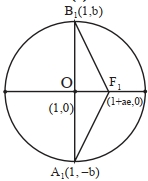
Answera
$\text { L.R. }=\frac{2 b^2}{a}=\frac{1}{2}$
$4 b^2=a.......(i)$
$\text { Ellipse } \frac{(x-1)^2}{a^2}+\frac{y^2}{b^2}=1$
$m_{B_2 F_1}=\frac{1}{\sqrt{3}}$
$\frac{b}{a}=\frac{1}{\sqrt{3}}$
$3 b^2=a^2 e^2=a^2-b^2$
$4 b^2=a^2........(ii)$
$\text { From (i) and (ii) }$
$a=a^2$
$\therefore a=1$
$b^2=\frac{1}{4}$
$((2 a)+(2 b))^2=9$
View full question & answer→MCQ 2581 Mark
The vertices of a hyperbola $H$ are $(\pm 6,0)$ and its eccentricity is $\frac{\sqrt{5}}{2}$. Let $N$ be the normal to $H$ at a point in the first quadrant and parallel to the line $\sqrt{2} x + y =2 \sqrt{2}$. If $d$ is the length of the line segment of $N$ between $H$ and the $y$-axis then $d ^2$ is equal to $............$.
Answerb
$H : \frac{ x ^2}{36}-\frac{y^2}{9}=1$
equation of normal is $6 x \cos \theta+3 y \cot \theta=45$
$\text { slope }=-2 \sin \theta=-\sqrt{2}$
$\Rightarrow \theta=\frac{\pi}{4}$
Equation of normal is $\sqrt{2} x+y=15$
$P:(a \sec \theta, b \tan \theta)$
$\Rightarrow P (6 \sqrt{2}, 3)$ and $K (0,15)$
$d^2=216$
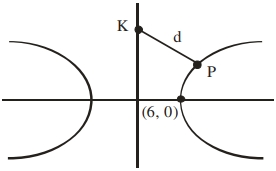
View full question & answer→MCQ 2591 Mark
Let $A$ be a point on the $x$-axis. Common tangents are drawn from $A$ to the curves $x^2+y^2=8$ and $y^2= 16x.$ If one of these tangents touches the two curves at $Q$ and $R$, then $( QR )^2$ is equal to
Answerd
$y = mx +\frac{4}{ m }$
$\frac{\left|\frac{4}{ m }\right|}{\sqrt{1+ m ^2}}=2 \sqrt{2} \therefore m =\pm 1$
$y=\pm x \pm 4$. Point of contact on parabola
Let $m=1,\left(\frac{a}{m^2}, \frac{2 a}{m}\right)$
$R (4,8)$
Point of contact on circle $Q (-2,2)$
$\therefore( QR )^2=36+36=72$
View full question & answer→MCQ 2601 Mark
Let $H$ be the hyperbola, whose foci are $(1 \pm \sqrt{2}, 0)$ and eccentricity is $\sqrt{2}$. Then the length of its latus rectum is
- ✓
$2$
- B
$3$
- C
$\frac{5}{2}$
- D
$\frac{3}{2}$
Answera
$2 ae =|(1+\sqrt{2})-(1+\sqrt{2})|=2 \sqrt{2}$
$ae =\sqrt{2}$
$a =1$
$\Rightarrow b =1 \quad \because e =\sqrt{2} \Rightarrow \text { Hyperbola is rectangular }$
$\Rightarrow \text { L.R }=\frac{2 b ^2}{ a }=2$
View full question & answer→MCQ 2611 Mark
Let $P \left( x _0, y _0\right)$ be the point on the hyperbola $3 x ^2-4 y ^2$ $=36$, which is nearest to the line $3 x+2 y=1$. Then $\sqrt{2}\left( y _0- x _0\right)$ is equal to :
Answerc
$3 x^2-4 y^2=36 \quad 3 x+2 y=1$
$m =-\frac{3}{2}$
$m =+\frac{\sec \theta 3}{\sqrt{12} \cdot \tan \theta}$
$\Rightarrow \frac{3}{\sqrt{12}} \times \frac{1}{\sin \theta}=\frac{-3}{2}$
$\sin \theta=-\frac{1}{\sqrt{3}}$
$(\sqrt{12} \cdot \sec \theta, 3 \tan \theta)$
$\left(\sqrt{12} \cdot \frac{\sqrt{3}}{\sqrt{2}},-3 \times \frac{1}{\sqrt{2}}\right) \Rightarrow\left(\frac{6}{\sqrt{2}}, \frac{-3}{\sqrt{2}}\right)$
View full question & answer→MCQ 2621 Mark
Let the eccentricity of an ellipse $\frac{x^2}{a^2}+\frac{y^2}{b^2}=1$ is reciprocal to that of the hyperbola $2 x^2-2 y^2=1$. If the ellipse intersects the hyperbola at right angles, then square of length of the latus-rectum of the ellipse is $................$.
Answerc
$e _{ H }=\sqrt{2}$
$e _{ E }=\frac{1}{\sqrt{2}}$
Since the curves intersect each other orthogonally The ellipse and the hyperbola are confocal
$H: \frac{x^2}{1 / 2}-\frac{y^2}{1 / 2}=1$
$\Rightarrow \text { foci }=(1,0)$
For ellipse a.e $E _{ E }=1$
$\Rightarrow a =\sqrt{2}$
$\left(e_{ E }\right)^2=\frac{1}{2} \Rightarrow 1-\frac{ b ^2}{ a ^2}=\frac{1}{2} \Rightarrow \frac{ b ^2}{ a ^2}=\frac{1}{2}$
$\Rightarrow b ^2=1$
Length of L.R. $=\frac{2 b^2}{a}=\frac{2}{\sqrt{2}}=\sqrt{2}$
View full question & answer→MCQ 2631 Mark
Let $H _{ n }=\frac{ x ^2}{1+ n }-\frac{ y ^2}{3+ n }=1, n \in N$. Let $k$ be the smallest even value of $n$ such that the eccentricity of $H _{ k }$ is a rational number. If $l$ is length of the latus return of $H _{ k }$, then $21 l$ is equal to $.......$.
Answerb
$Hn \Rightarrow \frac{ x ^2}{1+ n }-\frac{ y ^2}{3+ n }=1$
$e =\sqrt{1+\frac{ b ^2}{ a ^2}}=\sqrt{1+\frac{3+ n }{1+ n }}=\sqrt{\frac{2 n +4}{ n +1}}$
$e =\sqrt{\frac{2 n +4}{ n +1}}$
$n =48(\text { smallest even value for which } e \in Q )$
$e =\frac{10}{7}$
$a ^2 =n+1 \quad b ^2=n+3$
$=49 \quad, \quad=51$
$1 =\text { length of } LR =\frac{2 b ^2}{ a }$
$L =2 \cdot \frac{51}{7}$
$1 =\frac{102}{7}$
$21 \ell=306$
View full question & answer→MCQ 2641 Mark
Let the tangent to the parabola $y^2=12 x$ at the point $(3, \alpha)$ be perpendicular to the line $2 x+2 y=3$.Then the square of distance of the point $(6,-4)$from the normal to the hyperbola $\alpha^2 x^2-9 y^2=9 \alpha^2$at its point $(\alpha-1, \alpha+2)$ is equal to $........$.
Answera
$\because P (3, \alpha)$ lies on $y^2=12 x$
$\Rightarrow \alpha= \pm 6$
But, $\left.\frac{ dy }{ dx }\right|_{(3, \alpha)}=\frac{6}{\alpha}=1 \Rightarrow \alpha=6(\alpha=-6$ reject $)$
Now, hyperbola $\frac{x^2}{9}-\frac{y^2}{36}=1$, normal at
$Q(\alpha-1, \alpha+2) \text { is } \frac{9 x}{5}+\frac{36 y}{8}=45$
$\Rightarrow 2 x +5 y -50=0$
Now, distance of $(6,-4)$ from $2 x+5 y-50=0$ is equal to
$\left|\frac{2(6)-5(4)-50}{\sqrt{2^2+5^2}}\right|=\frac{58}{\sqrt{29}}$
$\Rightarrow \text { Square of distance }=116$
View full question & answer→MCQ 2651 Mark
The foci of a hyperbola are $( \pm 2,0)$ and its eccentricity is $\frac{3}{2}$. A tangent, perpendicular to the line $2 x+3 y=6$, is drawn at a point in the first quadrant on the hyperbola. If the intercepts made by the tangent on the $x$ - and $y$-axes are $a$ and $b$ respectively, then $|6 a|+|5 b|$ is equal to $..........$.
Answerb
$\frac{x^2}{a^2}-\frac{y^2}{b^2}=1$
$ae =2$ and $e =\frac{3}{2} \Rightarrow a =\frac{4}{3}$
also $b ^2= a ^2 e ^2- a ^2 \Rightarrow 4-\frac{16}{9}$
$\Rightarrow b^2=\frac{20}{9}$
$\text { Slope of tangent }=\frac{3}{2}$
So tangent equation will be
$y = mx \pm \sqrt{a^2 m^2-b^2}$
$\Rightarrow y =\frac{3 x}{2} \pm \sqrt{\frac{16}{9} \cdot \frac{9}{4}-\frac{20}{9}}$
$\Rightarrow y =\frac{3 x}{2} \pm \frac{4}{3} \Rightarrow\left| x _{\text {intercept }}\right|=\frac{8}{9}$
$\left|y_{\text {intercept }}\right|=\frac{4}{3}$
$\Rightarrow|6 a|+|5 b|=\frac{48}{9}+\frac{60}{9}=\frac{109}{9}=12$
View full question & answer→MCQ 2661 Mark
Let $y=f(x)$ represent a parabola with focus $\left(-\frac{1}{2}, 0\right)$ and directrix $y =-\frac{1}{2}$. Then $S=\left\{x \in R : \tan ^{-1}\left(\sqrt{f(x)}+\sin ^{-1}(\sqrt{f(x)+1})\right)=\frac{\pi}{2}\right\}:$
- ✓
contains exactly two elements
- B
contains exactly one element
- C
- D
AnswerCorrect option: A. contains exactly two elements
a
$\left( x +\frac{1}{2}\right)^2=\left( y +\frac{1}{4}\right)$
$y=\left(x^2+x\right)$
$\tan ^{-1} \sqrt{ x ( x +1)}+\sin ^{-1} \sqrt{ x ^2+ x +1}=\pi / 2$
$0 \leq x ^2+ x +1 \leq 1$
$x^2+x \leq 0$
$\text { Also } x^2+x \geq 0$
$\therefore x^2+x=0 \Rightarrow x=0,-1$
$S$ contains $2$ element.
View full question & answer→MCQ 2671 Mark
Let the tangent to the curve $x^2+2 x-4 y+9=0$ at the point $P (1,3)$ on it meet the $y$-axis at $A$. Let the line passing through $P$ and parallel to the line $x -$ $3 y=6$ meet the parabola $y^2=4 x$ at $B$. If $B$ lies on the line $2 x-3 y=8$. then $(A B)^2$ is equal to $............$.
Answerd
Equation of tangent at $P(1,3)$ to the curve
$x ^2+2 x -4 y +9=0 \text { is } y - x =2$
Then the point $A$ is $(0,2)$
Equation of line passing through $P$ and parallel to the line $x -3 y =6$.
The possible coordinate of $B$ are $(4,4)$ or $(16,8)$
But $(4,4)$ does not satisfy $2 x-3 y=8$
Thus the point $B$ is $(16,8)$
Then $( AB )^2=292$
View full question & answer→MCQ 2681 Mark
Let a common tangent to the curves $y^2=4 x$ and $(x-4)^2+y^2=16$ touch the curves at the points $P$ and $Q$. Then $( PQ )^2$ is equal to $..........$.
Answerd
General tangent of slope $m$ to the circle $(x-4)^2+$ $y ^2=16$ is given by $y=m(x-4) \pm 4 \sqrt{1+m^2}$
General tangent of slope $m$ to the parabola $y^2=4 x$ is given by $y=m x+\frac{1}{m}$
For common tangent $\frac{1}{m}=-4 m \pm 4 \sqrt{1+m^2}$
$m= \pm \frac{1}{2 \sqrt{2}}$
Point of contact on parabola is $(8,4 \sqrt{2})$
Length of tangent PQ from $(8,4 \sqrt{2})$ on the circle $(x-4)^2+y^2=16$ is equal to $\sqrt{(8-4)^2+(4 \sqrt{2})^2-16}$ is equal to $\sqrt{32}$ $PQ ^2$ is equal to $32$
View full question & answer→MCQ 2691 Mark
Consider ellipses $E _{ k }: kx ^2+ k ^2 y ^2=1, k =1,2, \ldots$,$20$. Let $C _{ k }$ be the circle which touches the four chords joining the end points (one on minor axis and another on major axis) of the ellipse $E_k$, If $r_k$ is the radius of the circle $C _{ k }$, then the value of $\sum \limits_{ k =1}^{20} \frac{1}{ I _{ k }^2}$ is $.......$.
- ✓
$3080$
- B
$3210$
- C
$3320$
- D
$2870$
AnswerCorrect option: A. $3080$
a
$Kx x ^2+ K ^2 y ^2=1$
$\frac{ x ^2}{1 / K }+\frac{ y ^2}{1 / K ^2}=1$
Now
Equation of
$A _1 B _2 ; \frac{ x }{1 / \sqrt{ K }}+\frac{ y }{1 / K }=1 \Rightarrow \sqrt{ K } x + Ky =1$
$r_K=\perp r$ distance of $(0,0)$ from line $A_1 B_1$
$r _{ L }=\left|\frac{(0+0-1)}{\sqrt{ K + K ^2}}\right|=\frac{1}{\sqrt{ K + K ^2}}$
$\frac{1}{ r _{ K }^2}= K + K ^2 \Rightarrow \sum \limits_{ k =1}^{20} \frac{1}{ r _{ K }^2}=\sum \limits_{ K =1}^{20}\left( K + K ^2\right)$
$=\frac{20 \times 21}{2}+\frac{20.21 .41}{6} K +\sum \limits_{ K =1}^{20} K ^2$
$=210+10 \times 7 \times 41$
$=210+2870$
$=3080$
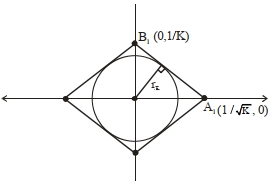
View full question & answer→MCQ 2701 Mark
Let $m_1$ and $m_2$ be the slopes of the tangents drawn from the point $P (4,1)$ to the hyperbola $H: \frac{y^2}{25}-\frac{x^2}{16}=1$. If $Q$ is the point from which the tangents drawn to $H$ have slopes $\left| m _1\right|$ and $\left| m _2\right|$ and they make positive intercepts $\alpha$ and $\beta$ on the $x$ axis, then $\frac{(P Q)^2}{\alpha \beta}$ is equal to $............$.
Answerc
Equation of tangent to the hyperbola $\frac{y^2}{a^2}-\frac{x^2}{b^2}=1$
$y=m x \pm \sqrt{a^2-b^2 m^2}$
passing through $(4,1)$
$1=4 m \pm \sqrt{25-16 m ^2} \Rightarrow 4 m ^2- m -3=0$
$\Rightarrow m =1, \frac{-3}{4}$
Equation of tangent with positive slopes $1 \& \frac{3}{4}$. $\left.\begin{array}{l}4 y=3 x-16 \\ y=x-3\end{array}\right\}$ with positive intercept on $x$-axis.
$\alpha=\frac{16}{3}, \beta=3$
Intersection points:
$Q:(-4,-7)$
$P:(4,1)$
$PQ ^2=128$
$\frac{P^2}{\alpha \beta}=\frac{128}{16}=8$
View full question & answer→MCQ 2711 Mark
Let the normal at the point $P$ on the parabola $y ^{2}=$ $6 x$ pass through the point $(5,-8)$. If the tangent at $P$ to the parabola intersects its directrix at the point $Q$, then the ordinate of the point $Q$ is
- A
$-3$
- ✓
$-\frac{9}{4}$
- C
$-\frac{5}{2}$
- D
$-2$
AnswerCorrect option: B. $-\frac{9}{4}$
b
Equation of normal : $y =- tx +2 at + at ^{3} \quad\left( a =\frac{3}{2}\right)$ since passing through $(5,-8)$, we get $t=-2$
Co-ordinate of $Q :(6,-6)$
Equation of tangent at $Q : x +2 y +6=0$
Put $x=\frac{-3}{2}$ to get $R\left(\frac{-3}{2}, \frac{-9}{4}\right)$
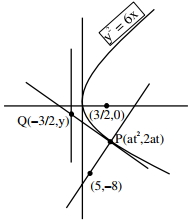
View full question & answer→MCQ 2721 Mark
If the length of the latus rectum of a parabola, whose focus is $( a , a )$ and the tangent at its vertex is $x+y=a$, is $16 $, then $|a|$ is equal to.
- A
$2 \sqrt{2}$
- B
$2 \sqrt{3}$
- ✓
$4 \sqrt{2}$
- D
$4$
AnswerCorrect option: C. $4 \sqrt{2}$
c
$| P |=\left|\frac{ a }{\sqrt{2}}\right|=\frac{16}{4}=4$
$| a |=4 \sqrt{2}$
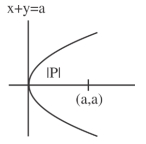
View full question & answer→MCQ 2731 Mark
Two tangent lines $l_{1}$ and $l_{2}$ are drawn from the point $(2,0)$ to the parabola $2 y^{2}=-x$. If the lines $l_{1}$ and $l_{2}$ are also tangent to the circle $(x-5)^{2}+y^{2}=r$, then $17 r$ is equal to.
Answerd
Sol. $y^{2}=-\frac{x}{2}$
$y=m x-\frac{1}{8 m}$
this tangent pass through $(2,0)$ $m =\pm \frac{1}{4}$ i.e., one tangent is $x -4 y -2=0$
$17\,r =9$
View full question & answer→MCQ 2741 Mark
Let the eccentricity of an ellipse $\frac{x^{2}}{a^{2}}+\frac{y^{2}}{b^{2}}=1, a>b$, be $\frac{1}{4}$. If this ellipse passes through the point $\left(-4 \sqrt{\frac{2}{5}}, 3\right)$, then $a^{2}+b^{2}$ is equal to
Answera
$\frac{x^{2}}{a^{2}}+\frac{y^{2}}{b^{2}}=1 a > b$
$e^{2}=1-\frac{b^{2}}{a^{2}}$
$\frac{1}{16}=1-\frac{b^{2}}{a^{2}}$
$\frac{b^{2}}{a^{2}}=1-\frac{1}{16}=\frac{15}{16} \Rightarrow b^{2}=\frac{15}{16} a^{2}$
$\frac{x^{2}}{a^{2}}+\frac{y^{2}}{b^{2}}=1$
$\frac{16 \times \frac{2}{5}}{a^{2}}+\frac{9}{b^{2}}=1$
$\frac{32}{5 a^{2}}+\frac{9}{b^{2}}=1$
$\frac{32}{5 a^{2}}+\frac{9}{\frac{15}{16} a^{2}}=1$
$\frac{80}{b^{2}}=1$
View full question & answer→MCQ 2751 Mark
If the length of the latus rectum of the ellipse $x^{2}+$ $4 y^{2}+2 x+8 y-\lambda=0$ is $4$ , and $l$ is the length of its major axis, then $\lambda+l$ is equal to$......$
Answerd
$\lambda+\ell=75$
$x^{2}+4 y^{2}+2 x+8 y-\lambda=0$
$\frac{(x+1)^{2}}{\lambda+5}+\frac{(y+1)^{2}}{\lambda+5}=1$
$\because \frac{2 b^{2}}{a}=4$
$\frac{2(\lambda+5)}{4}=4(\sqrt{\lambda+5})$
$\lambda=59$
$\lambda \neq-5$
$l=2 a=2 \sqrt{\lambda+5}=2 \sqrt{65}=16$
$\lambda+\ell=59+16=75$
View full question & answer→MCQ 2761 Mark
Let the eccentricity of the hyperbola $\frac{x^{2}}{a^{2}}-\frac{y^{2}}{b^{2}}=1$ be $\frac{5}{4}$. If the equation of the normal at the point $\left(\frac{8}{\sqrt{5}}, \frac{12}{5}\right)$ on the hyperbola is $8 \sqrt{5} x +\beta y =\lambda$, then $\lambda-\beta$ is equal to
Answerb
$e ^{2}=1+\frac{ b ^{2}}{ a ^{2}}=\frac{25}{16} \Rightarrow \frac{ b ^{2}}{ a ^{2}}=\frac{9}{16} \ldots \ldots(1)$
$A \left(\frac{8}{\sqrt{5}}, \frac{12}{5}\right)$ satisfies $\frac{ x ^{2}}{ a ^{2}}-\frac{ y ^{2}}{ b ^{2}}=1$
$\Rightarrow \frac{64}{5 a ^{2}}-\frac{144}{25 b ^{2}}=1$
Solving (1) and (2) $b =\frac{6}{5} \quad a =\frac{8}{5}$
Normal at $A$ is $\frac{\sqrt{5} a ^{2} x }{8}+\frac{5 b ^{2} y }{12}= a ^{2}+ b ^{2}$
Comparing it $8 \sqrt{5} x+\beta y=\lambda$
Gives $\lambda=100, \beta=15$
$\lambda-\beta=85$
View full question & answer→MCQ 2771 Mark
The normal to the hyperbola $\frac{x^{2}}{a^{2}}-\frac{y^{2}}{9}=1$ at the point $(8,3 \sqrt{3})$ on it passes through the point
- A
$(15,-2 \sqrt{3})$
- B
$(9,2 \sqrt{3})$
- ✓
$(-1,9 \sqrt{3})$
- D
$(-1,6 \sqrt{3})$
AnswerCorrect option: C. $(-1,9 \sqrt{3})$
c
$\frac{x^{2}}{a^{2}}-\frac{y^{2}}{9}=1:(8,3 \sqrt{3})$ lie on Hyperbola then
$\frac{64}{a^{2}}-\frac{27}{9}=1 \Rightarrow a^{2}=\frac{64}{4}=16$
equation of normal at $(8,3 \sqrt{3})$ :
$\frac{16 x}{8}+\frac{9 y}{3 \sqrt{3}}=16+9$
$2 x+\sqrt{3} y=25$
View full question & answer→MCQ 2781 Mark
Let the foci of the ellipse $\frac{x^{2}}{16}+\frac{y^{2}}{7}=1$ and the hyperbola $\frac{ x ^{2}}{144}-\frac{ y ^{2}}{\alpha}=\frac{1}{25}$ coincide. Then the length of the latus rectum of the hyperbola is:-
- A
$\frac{32}{9}$
- B
$\frac{18}{5}$
- C
$\frac{27}{4}$
- ✓
$\frac{27}{10}$
AnswerCorrect option: D. $\frac{27}{10}$
d
Ellipse : $\frac{x^{2}}{16}+\frac{y^{2}}{7}=1$
Eccentricity $=\sqrt{1-\frac{7}{16}}=\frac{3}{4}$
Foci $\equiv(\pm a \quad e, 0) \equiv(\pm 3,0)$
Hyperbola : $\frac{x^{2}}{\left(\frac{144}{25}\right)}-\frac{y^{2}}{\left(\frac{\alpha}{25}\right)}=1$
Eccentricity $=\sqrt{1+\frac{\alpha}{144}}=\frac{1}{12} \sqrt{144+\alpha}$
Foci $\equiv(\pm a e, 0) \equiv\left(\pm \frac{12}{5} \cdot \frac{1}{12} \sqrt{144+\alpha}, 0\right)$
If foci coincide then $3=\frac{1}{5} \sqrt{144+\alpha} \Rightarrow \alpha=81$
Hence, hyperbola is $\frac{x^{2}}{\left(\frac{12}{5}\right)^{2}}-\frac{y^{2}}{\left(\frac{9}{5}\right)^{2}}=1$
Length of latus rectum $=2 \cdot \frac{81 / 25}{12 / 5}=\frac{27}{10}$
View full question & answer→MCQ 2791 Mark
If the line $x-1=0$, is a directrix of the hyperbola $kx ^{2}- y ^{2}=6$, then the hyperbola passes through the point.
AnswerCorrect option: C. $(\sqrt{5},-2)$
c
$frac{x^{2}}{6 / k }-\frac{y^{2}}{6}=1$
$e ^{2}=1+\frac{6}{6 / k }$
$e =\sqrt{1+ k }$
$a =\sqrt{\frac{6}{ k }}$
Eq. of directrix $x=\frac{a}{e} \Rightarrow x=\sqrt{\frac{6}{k(k+1)}}$
$\frac{6}{k(k+1)}=1$
$k=2$
From eq.$(1)$, we get $2 x^{2}-y^{2}=6$
Check options
View full question & answer→MCQ 2801 Mark
Let the tangent drawn to the parabola $y ^{2}=24 x$ at the point $(\alpha, \beta)$ is perpendicular to the line $2 x$ $+2 y=5$. Then the normal to the hyperbola $\frac{x^{2}}{\alpha^{2}}-\frac{y^{2}}{\beta^{2}}=1$ at the point $(\alpha+4, \beta+4)$ does $NOT$ pass through the point.
- A
$(25,10)$
- B
$(20,12)$
- C
$(30,8)$
- ✓
$(15,13)$
AnswerCorrect option: D. $(15,13)$
d
Tangent at $(\alpha, \beta)$ has slope 1
$\beta^{2}=24 \alpha$
Equation of tangent $y \beta=12(x+\alpha), \frac{12}{\beta}=1$
$\Rightarrow \alpha=6, \beta=12$
$\therefore(\alpha+4, \beta+4)=(10,16)$
Normal at $(10,16)$ to $\frac{x^{2}}{36}-\frac{y^{2}}{144}=1$ is
$2 x+5 y=100$
View full question & answer→MCQ 2811 Mark
If vertex of a parabola is $(2,-1)$ and the equation of its directrix is $4 x-3 y=21$, then the length of its latus rectum is
Answerb
$a=\frac{|8+3-21|}{5}=\frac{10}{5}=2$
$\therefore$ latus rectum $=4 a=8$
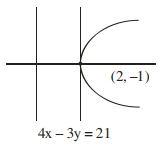
View full question & answer→MCQ 2821 Mark
Let $P : y ^{2}=4 a x , a>0$ be a parabola with focus $S$.Let the tangents to the parabola $P$ make an angle of $\frac{\pi}{4}$ with the line $y=3 x+5$ touch the parabola $P$ at $A$ and $B$. Then the value of $a$ for which $A , B$ and $S$ are collinear is
- A
$8$ only
- B
$2$ only
- C
$\frac{1}{4}$ only
- ✓
any $a > 0$
AnswerCorrect option: D. any $a > 0$
d
Lines making angle $\frac{\pi}{4}$ with $y=3 x+5$
have slope $-2$ and $1 / 2$.
Which are perpendicular to each-other so, $A, S, B$ are collinear for all $a >0$.
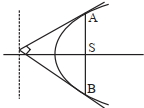
View full question & answer→MCQ 2831 Mark
Let $x^{2}+y^{2}+A x+B y+C=0$ be a circle passing through $(0,6)$ and touching the parabola $y = x ^{2}$ at $(2,4)$. Then $A + C$ is equal to
Answera
$x ^{2}+ y ^{2}+ Ax + By + C =0$ is passing through $(0,6)$ $\Rightarrow 6 B + C =-36$
The tangent of the parabola $y = x ^{2}$ at $(2,4)$ is $4 x - y -4=0 \quad-(1)$
The tangent of circle $x ^{2}+ y ^{2}+ Ax + By + C =0$ at $(2,4)$ is
$(4+ A ) x +(8+ B ) y +2 A +4 B +2 C =0 \cdots-(2)$
From Equation ($1$) and ($2$)
$\frac{4+ A }{4}=\frac{8+ B }{-1}=\frac{2 A +4 B +2 C }{-4}$
$A +4 B =-36$
$3 A +4 B +2 C =-4$
From equation ($3$) and ($4$)
$A + C =16$
View full question & answer→MCQ 2841 Mark
$A$ particle is moving in the $x y$-plane along a curve $C$ passing through the point $(3,3)$. The tangent to the curve $C$ at the point $P$ meets the $x$-axis at $Q$. If the $y$-axis bisects the segment $P Q$, then $C$ is a parabola with
- ✓
length of latus rectum $3$
- B
length of latus rectum $6$
- C
focus $\left(\frac{4}{3}, 0\right)$
- D
focus $\left(0, \frac{3}{4}\right)$
AnswerCorrect option: A. length of latus rectum $3$
a
Let Point $P ( x , y )$
$Y-y=y^{\prime}(X-x)$
$Y =0 \Rightarrow X = x -\frac{ y }{ y ^{\prime}}$
$Q \left( x -\frac{ y }{ y ^{\prime}}, 0\right)$
Mid Point of $PQ$ lies on y axis
$x-\frac{y}{y^{\prime}}+x=0$
$y^{\prime}=\frac{y}{2 \cdot x} \Rightarrow 2 \frac{d y}{y}=\frac{d x}{x}$
$2 \ell \text { ny }=\ell n nx +\ell nk$
$y ^{2}= kx$
It passes through $(3,3) \Rightarrow k =3$
curve $c \Rightarrow y^{2}=3 x$
Length of $L.R. = 3$
Focus $=\left(\frac{3}{4}, 0\right)$
View full question & answer→MCQ 2851 Mark
Let $P_{1}$ be a parabola with vertex $(3,2)$ and focus $(4,4)$ and $P _{2}$ be its mirror image with respect to the line $x +2 y =6$. Then the directrix of $P _{2}$ is $x +2 y$ =
Answera
$P _{1}$ : Directorix :
$x+2 y=k$
$x+2 y-k=0$
$\left|\frac{3+4-K}{\sqrt{5}}\right|=\sqrt{5}$
$|7-k|=5$
$7-K=5 \quad 7-K=-5$
$k=2 \quad k=12$
Accepted Rejected
Passes through
focus
$\left.\begin{array}{c} D _{1}= x +2 y =2 \\ \imath= x +2 y =6 \\ D _{2}= x +2 y = C \end{array}\right] \Rightarrow d \Rightarrow d \Rightarrow c=10$
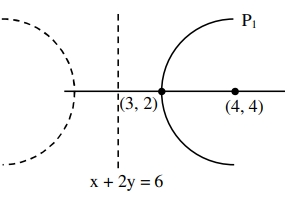
View full question & answer→MCQ 2861 Mark
If $y = m _{1} x + c _{1}$ and $y = m _{2} x + c _{2}, m _{1} \neq m _{2}$ are two common tangents of circle $x^{2}+y^{2}=2$ and parabola $y^{2}=x$, then the value of $8\left|m_{1} m_{2}\right|$ is equal to
- A
$3+4 \sqrt{2}$
- B
$-5+6 \sqrt{2}$
- ✓
$-4+3 \sqrt{2}$
- D
$7+6 \sqrt{2}$
AnswerCorrect option: C. $-4+3 \sqrt{2}$
c
$C_{1}: x^{2}+y^{2}=2$
$C_{2}: y^{2}=x$
Let tangent to parabola be $y = mx +\frac{1}{4 m }$.
It is also a tangent of circle so distance from centre of circle $(0,0)$ will be $\sqrt{2}$.
$\left|\frac{\frac{1}{4 m }}{\sqrt{1+ m ^{2}}}\right|=\sqrt{2} \Rightarrow 1=32 m ^{2}+32 m ^{4}$
by solving
$m ^{2}=\frac{3 \sqrt{2}-4}{8}, \quad m ^{2}=\frac{-3 \sqrt{2}-4}{8} \text { (rejected) }$
$m=\pm \sqrt{\frac{3 \sqrt{2}-4}{8}}$
so, $8\left| m _{1} m _{2}\right|=3 \sqrt{2}-4$
View full question & answer→MCQ 2871 Mark
Let $x=2 t, y=\frac{i}{3}$ be a conic. Let $S$ be the focus and $B$ be the point on the axis of the conic such that $SA \perp BA$, where $A$ is any point on the conic. If $k$ is the ordinate of the centroid of $\Delta SAB$, then $\lim _{ t \rightarrow 1} k$ is equal to
- A
$\frac{17}{18}$
- B
$\frac{19}{18}$
- C
$\frac{11}{18}$
- ✓
$\frac{13}{18}$
AnswerCorrect option: D. $\frac{13}{18}$
d
parabola $x ^{2}=12 y$
$SA \perp SB$
so, $m _{ AS } \cdot m _{ AB }=-1$
$\frac{\left(3-\frac{ t ^{2}}{3}\right)}{(0-2 t )} \cdot \frac{\left(\alpha-\frac{ t ^{2}}{3}\right)}{(0-2 t )}=-1$
by solving
$3 \alpha=\frac{27 t^{2}+t^{4}}{t^{2}-9}$
ordinate of centriod of $\Delta SAB = K =\frac{\alpha+\frac{ t ^{2}}{3}+3}{3}$
$k =\frac{9+3 \alpha+ t ^{2}}{9}$
$\lim \limits_{t \rightarrow 1} k=\lim _{t \rightarrow 1} \frac{1}{9}\left(9+t^{2}+\frac{27 t^{2}+t^{4}}{\left(t^{2}-9\right)}\right)=\frac{13}{18}$
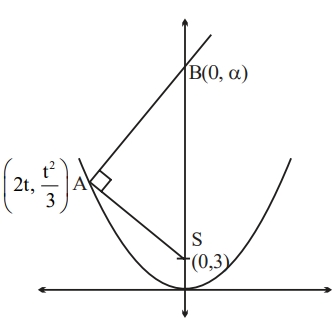
View full question & answer→MCQ 2881 Mark
If the equation of the parabola, whose vertex is at $(5,4)$ and the directrix is $3 x+y-29=0$, is $x^{2}+a y^{2}+b x y+c x+d y+k=0$ then $a + b + c + d + k$ is equal to
- A
$575$
- B
$-575$
- C
$576$
- ✓
$-576$
AnswerCorrect option: D. $-576$
d
Vertex $(5,4)$
Directrix : $3 x+y-29=0$
Co-ordinates of B (foot of directrix)
$\frac{x-5}{3}=\frac{y-4}{1}=-\left(\frac{15+4-29}{10}\right)=1$
$x=8, y=5$
$S =(2,3)$ (focus)
Equation of parabola
$PS = PM$
so equation is
$x^{2}+9 y^{2}-6 x y+134 x-2 y-711=0$
$a+b+c+d+k=9-6+134-2-711=-576$
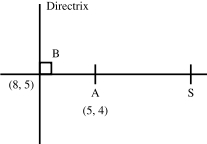
View full question & answer→MCQ 2891 Mark
A circle of radius $2$ unit passes through the vertex and the focus of the parabola $y^{2}=2 x$ and touches the parabola $y=\left(x-\frac{1}{4}\right)^{2}+\alpha$, where $\alpha>0$.
Then $(4 \alpha-8)^{2}$ is equal to
Answerd
Vertex and focus of parabola $y^{2}=2 x$ are $V (0,0)$ and $S\left(\frac{1}{2}, 0\right)$ resp.
Let equation of circle be
$(x-h)^{2}+(y-k)^{2}=4$
$\because$ Circle passes through $(0,0)$
$\Rightarrow h ^{2}+ k ^{2}=4 \ldots \ldots(1)$
$\because \text { Circle passes through }\left(\frac{1}{2}, 0\right)$
$\left(\frac{1}{2}-h\right)^{2}+k^{2}=4$
$\Rightarrow h^{2}+k^{2}-h=\frac{15}{4} \ldots \ldots(2)$
On solving $(1)$ and $(2)$
$4-h=\frac{15}{4}$
$h=4-\frac{15}{4}=\frac{1}{4}$
$k=+\frac{\sqrt{63}}{4}$
$k=-\frac{\sqrt{63}}{4}$ is rejected as circle with centre
$\left(\frac{1}{4},-\frac{\sqrt{63}}{4}\right)$ can't touch given parabola.
Equation of circle is
$\left(x-\frac{1}{4}\right)^{2}+\left(k-\frac{\sqrt{63}}{4}\right)^{2}=4$
From figure
$\alpha=2+\frac{\sqrt{63}}{4}=\frac{8+\sqrt{63}}{4}$
$4 \alpha-8=\sqrt{63}$
$(4 \alpha-8)^{2}=63$
View full question & answer→MCQ 2901 Mark
Let $\ell$ be a line which is normal to the curve $y=2 x^{2}+x+2$ at a point $P$ on the curve. If the point $Q(6,4)$ lies on the line $\ell$ and $O$ is origin, then the area of the triangle $OPQ$ is equal to.......
Answera
$\frac{d y}{d x}=4 x+1$
Let $P$ be $(h, k)$, then normal at $P$ is
$y-k=-\frac{1}{4 h+1}(x-h)$
This passes through $Q (6,4)$
$\therefore 4- k =-\frac{1}{4 h +1}(6- h )$
$\Rightarrow(4 h +1)(4- k )+6- h =0$
Also $k =2 h ^{2}+ h +2$
$\therefore(4 h+1)\left(4-2 h^{2}-h-2\right)+6+h=0$
$\Rightarrow 4 h^{3}-3 h^{2}+3 h-8=0$
$\Rightarrow h=1, k=5$
Now area of $\triangle OPQ$ will be $=\frac{1}{2}\left|\begin{array}{lll}1 \,\,\,0 \,\,\,0 \\ 1 \,\,\,1 \,\,\,5 \\ 1\,\,\, 6\,\,\, 4\end{array}\right|=13$
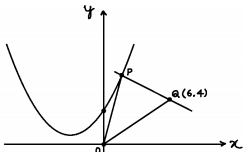
View full question & answer→MCQ 2911 Mark
The tangents at the point $A (1,3)$ and $B (1,-1)$ on the parabola $y ^{2}-2 x -2 y =1$ meet at the point $P$. Then the area (in unit ${ }^{2}$ ) of the triangle $PAB$ is :-
Answerd
Given curve : $y^{2}-2 x-2 y=1$.
Can be written as
$(y-1)^{2}=2(x+1)$
Can be plotted as shown in figure
Tangent at $A: 2 y-x-5=0$ ${using\,T=0}$
Intersection with $y=1$ is $x=-3$
Hence, point $P$ is $(-3,1)$
Taking advantage of symmetry
Area of $\triangle P A B=2 \times \frac{1}{2} \times(1-(-3)) \times(3-1)$
$=8\,sq.$ units
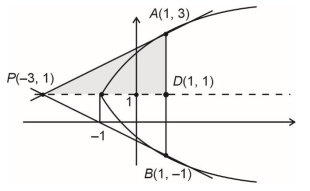
View full question & answer→MCQ 2921 Mark
The equation of a common tangent to the parabolas $y = x ^{2}$ and $y =-( x -2)^{2}$ is.
- A
$y=4(x-2)$
- ✓
$y=4(x-1)$
- C
$y=4(x+1)$
- D
$y=4(x+2)$
AnswerCorrect option: B. $y=4(x-1)$
b
Equation of tangent of $y = x ^{2}$ be
$t x=y+a t^{2}$
$y=t x-\frac{t^{2}}{4}$
Solve with $y=-(x-2)^{2}$
$tx -\frac{ t ^{2}}{4}=-( x -2)^{2}$
$x^{2}+x(t-4)-\frac{t^{2}}{4}+4=0$
$D =0$
$( t -4)^{2}-4 \cdot\left(4-\frac{ t ^{2}}{4}\right)=0$
$t ^{2}-4 t =0$
$t =0 \text { or } t =4$
From eq. (1), required common tangent is
$y =4( x -1)$
View full question & answer→MCQ 2931 Mark
If the tangents drawn at the points $P$ and $Q$ on the parabola $y^{2}=2 x-3$ intersect at the point $R(0,1)$, then the orthocentre of the triangle $PQR$ is.
- A
$(0,1)$
- ✓
$(2,-1)$
- C
$(6,3)$
- D
$(2,1)$
AnswerCorrect option: B. $(2,-1)$
b
$y^{2}=2 x-3$
Equation of chord of contact
$PQ : r =0$
$y x 1=(x+0)-3$
$y=x-3$
from $(1)$ and $(2)$
$( x \cdot 3)^{2}=2 x -3$
$x ^{2}-8 x +12=0$
$( x -2)( x -6)=0$
$x =2$ or $6$
$y =-1$ or $3$
$MPQ =\frac{1}{4}=1$
$MQR =\frac{2}{6}=\frac{1}{3}$
$MPR =\frac{2}{6}=\frac{1}{3}$
$MPR =\frac{2}{-2}=-1$
$MPQ \times MPR =-\Rightarrow PQ \perp PR$
Orthocentre $= P (2,-1)$
View full question & answer→MCQ 2941 Mark
Let the maximum area of the triangle that can be inscribed in the ellipse $\frac{x^{2}}{a^{2}}+\frac{y^{2}}{4}=1$, a $>2$, having one of its vertices at one end of the major axis of the ellipse and one of its sides parallel to the $y$-axis, be $6 \sqrt{3}$. Then the eccentricity of the ellispe is
- ✓
$\frac{\sqrt{3}}{2}$
- B
$\frac{1}{2}$
- C
$\frac{1}{\sqrt{2}}$
- D
$\frac{\sqrt{3}}{4}$
AnswerCorrect option: A. $\frac{\sqrt{3}}{2}$
a
$A=\frac{1}{2} a(1-\cos \theta)(4 \sin \theta)$
$A =2 a (1-\cos \theta) \sin \theta$
$\frac{ dA }{ d \theta}=2 a \left(\sin ^{2} \theta+\cos \theta-\cos ^{2} \theta\right)$
$\frac{ dA }{ d \theta}=0 \Rightarrow 1+\cos \theta-2 \cos ^{2} \theta=0$
$\cos \theta=1 \text { (Reject })$
OR
$\cos \theta=\frac{-1}{2} \Rightarrow \theta=\frac{2 \pi}{3}$
$\frac{ d ^{2} A }{ d \theta^{2}}=2 a \left(2 \sin ^{2} \theta-\sin \theta\right)$
$\frac{ d ^{2} A }{ d \theta^{2}}<0 \text { for } \theta=\frac{2 \pi}{3}$
Now, $A _{\max }=\frac{3 \sqrt{3}}{2} a =6 \sqrt{3}$
$a=4$
Now, $e =\sqrt{\frac{ a ^{2}- b ^{2}}{ a ^{2}}}=\frac{\sqrt{3}}{2}$
View full question & answer→MCQ 2951 Mark
If two tangents drawn from a point $(\alpha, \beta)$ lying on the ellipse $25 x^{2}+4 y^{2}=1$ to the parabola $y^{2}=4 x$ are such that the slope of one tangent is four times the other, then the value of $(10 \alpha+5)^{2}+\left(16 \beta^{2}+50\right)^{2}$ equals
- A
$7982$
- B
$2898$
- ✓
$2929$
- D
$3289$
AnswerCorrect option: C. $2929$
c
$\alpha=\frac{1}{5} \cos \theta, \beta=\frac{1}{2} \sin \theta$
Equation of tangent to $y ^{2}=4 x$
$y = mx +\frac{1}{ m }$
It passes through $(\alpha, \beta)$
$\frac{1}{2} \sin \theta=m \frac{1}{5} \cos \theta+\frac{1}{m}$
$m ^{2}\left(\frac{\cos \theta}{5}\right)- m \left(\frac{1}{2} \sin \theta\right)+1=0$
It has two roots $m_{1}$ and $m_{2}$ where $m_{1}=4 m_{2}$
$m _{1}+ m _{2}=\frac{\frac{1}{2} \sin \theta}{\frac{\cos \theta}{5}}$
$m _{1} m _{2}=\frac{5}{\cos \theta}$
After eliminating $m _{1}$ and $m _{2}$
$\cos \theta=\frac{-5 \pm \sqrt{29}}{2}$
$\alpha=\frac{-5 \pm \sqrt{29}}{10} \Rightarrow 10 \alpha+5=\pm \sqrt{29}$
$\beta^{2}=\frac{1}{4} \sin ^{2} \theta \Rightarrow 16 \beta^{2}=-50 \pm 10 \sqrt{29}$
$(10 \alpha+5)^{2}+\left(16 \beta^{2}+50\right)^{2}$ $=2929$
View full question & answer→MCQ 2961 Mark
The line $y=x+1$ meets the ellipse $\frac{x^{2}}{4}+\frac{y^{2}}{2}=1$ at two points $P$ and $Q$. If $r$ is the radius of the circle with $PQ$ as diameter then $(3 r )^{2}$ is equal to
Answera
Ellipse $x^{2}+2 y^{2}=4$
Line $y=x+1$
Point of intersection
$x^{2}+2(x+1)^{2}=4$
$3 x^{2}+4 x-2=0$
$\left|x_{1}-x_{2}\right|=\frac{\sqrt{40}}{3}$
$AB =2 r =\left| x _{1}- x _{2}\right| \sqrt{1+ m ^{2}}$
$m$ is slope of given line
$AB =\frac{\sqrt{40}}{3} \sqrt{1+1}$
$2 r =\frac{\sqrt{80}}{3} \Rightarrow r =\frac{\sqrt{80}}{6}$
$(3 r )^{2}=\left(3 \times \frac{\sqrt{80}}{6}\right)^{2}=\frac{80}{4}=20$
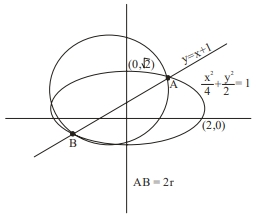
View full question & answer→MCQ 2971 Mark
If $m$ is the slope of a common tangent to the curves $\frac{x^{2}}{16}+\frac{y^{2}}{9}=1$ and $x^{2}+y^{2}=12$, then $12\; m ^{2}$ is equal to
Answerb
$\frac{x^{2}}{16}+\frac{y^{2}}{9}=1$
equation of tangent to the ellipse is
$y=m x \pm \sqrt{a^{2} m^{2}+b^{2}}$
$y=m x \pm \sqrt{16\; m^{2}+9}$
$x^{2}+y^{2}=12$
equation of tangent to the circle is
$y=m x \pm \sqrt{12} \sqrt{1+m^{2}}$
for common tangent equate eq. $(i)$ and $(ii)$
$\Rightarrow 16 \;m ^{2}+9=12\left(1+ m ^{2}\right)$
$16\; m^{2}-12\; m^{2}=3$
$4 \;m ^{2}=3$
$12 \;m ^{2}=9$
View full question & answer→MCQ 2981 Mark
The locus of the mid point of the line segment joining the point $(4,3)$ and the points on the ellipse $x^{2}+2 y^{2}=4$ is an ellipse with eccentricity
- A
$\frac{\sqrt{3}}{2}$
- B
$\frac{1}{2 \sqrt{2}}$
- ✓
$\frac{1}{\sqrt{2}}$
- D
$\frac{1}{2}$
AnswerCorrect option: C. $\frac{1}{\sqrt{2}}$
c
$\frac{ x ^{2}}{4}+\frac{ y ^{2}}{2}=1$
Coordinate of $D$ is
$\left(\frac{2 \cos \theta+4}{2}, \frac{\sqrt{2} \sin \theta+3}{2}\right) \equiv(h, k)$
$\frac{2 h -4}{2}=\cos \theta$
$\frac{2 k -3}{\sqrt{2}}=\sin \theta$
$(i)^{2}+(\text { ii })^{2}$, then we get
$\left(\frac{2 h -4}{2}\right)^{2}+\left(\frac{2 k -3}{\sqrt{2}}\right)^{2}=1 \Rightarrow \frac{( x -2)^{2}}{1}+\frac{\left( y -\frac{3}{2}\right)^{2}}{\left(\frac{1}{2}\right)}=1$
$\therefore \quad$ Required eccentricity is
$e =\sqrt{1-\frac{1}{2}}=\frac{1}{\sqrt{2}}$

View full question & answer→MCQ 2991 Mark
Let the common tangents to the curves $4\left(x^{2}+y^{2}\right)=$ $9$ and $y ^{2}=4 x$ intersect at the point $Q$. Let an ellipse, centered at the origin $O$, has lengths of semi-minor and semi-major axes equal to $OQ$ and $6$ , respectively. If $e$ and $l$ respectively denote the eccentricity and the length of the latus rectum of this ellipse, then $\frac{l}{ e ^{2}}$ is equal to
Answerb
$x^{2}+y^{2}=\frac{9}{4} \quad y=4 x$
Equation tangent in slope form
$y=m x \pm \frac{3}{2} \sqrt{\left(1+m^{2}\right)}$ .....$(1)$
$y=m x+\frac{1}{m}$ .....$(2)$
compare $(1)$ and $(2)$
$\pm \frac{3}{2} \sqrt{\left(1+m^{2}\right)}=\frac{1}{m^{2}}$
$9 m^{2}\left(1+m^{2}\right)=4$
$9 m^{4}+9 m^{2}-4=0$
$9 m^{4}+12 m^{2}-3 m^{2}-4=0$
$3 m^{2}\left(3 m^{2}+4\right)-\left(3 m^{2}+4\right)=0$
$m^{2}=-\frac{4}{3}(\text { Rejected })$
$m^{2}=\frac{1}{3} \Rightarrow m=\pm \frac{1}{\sqrt{3}}$
Equation of common tangent
$y =\frac{1}{\sqrt{3}} x +\sqrt{3}$
$\text { on } X \text { axis } y =0$
$OQ =-3$
$b =\mid OQ\mid =3$
$a =6$
$b ^{2}= a ^{2}\left(1- e ^{2}\right) \Rightarrow e ^{2}=1-\frac{9}{36}=\frac{3}{4} ~\\ e =\frac{2 b ^{2}}{ a }=\frac{2 \times 9}{6}=3 ~\\ \frac{ e }{ e ^{2}}=\frac{3}{3 / 4}=4$
$\frac{ e }{ e ^{2}}=\frac{3}{3 / 4}=4$
View full question & answer→MCQ 3001 Mark
Let $PQ$ be a focal chord of the parabola $y^{2}=4 x$ such that it subtends an angle of $\frac{\pi}{2}$ at the point $(3, 0)$. Let the line segment $PQ$ be also a focal chord of the ellipse $E: \frac{x^{2}}{a^{2}}+\frac{y^{2}}{b^{2}}=1, a^{2}>b^{2}$. If $e$ is the eccentricity of the ellipse $E$, then the value of $\frac{1}{e^{2}}$ is equal to
- A
$1+\sqrt{2}$
- ✓
$3+2 \sqrt{2}$
- C
$1+2 \sqrt{3}$
- D
$4+5 \sqrt{3}$
AnswerCorrect option: B. $3+2 \sqrt{2}$
b
$PQ$ is focal chord
$m _{P R} \cdot m_{P Q}=-1$
$\frac{2 t }{ t ^{2}-3} \times \frac{-2 / t }{\frac{1}{ t ^{2}}-3}=-1$
$\left( t ^{2}-1\right)^{2}=0$
$\Rightarrow t =1$
$\Rightarrow P$ and $Q$ must be end point of latus rectum:
$\quad P (1,2)$ and $Q (1,-2)$
$\therefore \frac{2 b ^{2}}{ a }=4$ and $ae =1$
$\because$ We know that $b ^{2}= a ^{2}\left(1- e ^{2}\right)$
$\therefore a =1+\sqrt{2}$
$\because e ^{2}=1-\frac{ b ^{2}}{ a ^{2}}$
$\therefore e ^{2}=3-2 \sqrt{2}$
$\frac{1}{ e ^{2}}=3+2 \sqrt{2}$
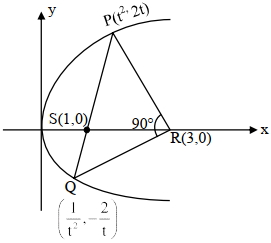
View full question & answer→MCQ 3011 Mark
If the ellipse $\frac{ x ^{2}}{ a ^{2}}+\frac{ y ^{2}}{ b ^{2}}=1$ meets the line $\frac{x}{7}+\frac{y}{2 \sqrt{6}}=1$ on the $x$-axis and the line $\frac{x}{7}-\frac{y}{2 \sqrt{6}}=1$ on the $y$-axis, then the eccentricity of the ellipse is
- ✓
$\frac{5}{7}$
- B
$\frac{2 \sqrt{6}}{7}$
- C
$\frac{3}{7}$
- D
$\frac{2 \sqrt{5}}{7}$
AnswerCorrect option: A. $\frac{5}{7}$
a
$\frac{x^{2}}{a^{2}}+\frac{y^{2}}{b^{2}}=1$ meets the line $\frac{x}{7}+\frac{y}{2 \sqrt{6}}=1$ on the $x$-axis
So, $a=7$
and $\frac{x^{2}}{a^{2}}+\frac{y^{2}}{b^{2}}=1$ meets the line $\frac{x}{7}-\frac{y}{2 \sqrt{6}}=1$ on the $y$-axis
So, $b=2 \sqrt{6}$
Therefore, $e^{2}=1-\frac{b^{2}}{a^{2}}=1-\frac{24}{49}$
$e=\frac{5}{7}$
View full question & answer→MCQ 3021 Mark
The acute angle between the pair of tangents drawn to the ellipse $2 x^{2}+3 y^{2}=5$ from the point $(1,3)$ is.
- A
$\tan ^{-1}\left(\frac{16}{7 \sqrt{5}}\right)$
- ✓
$\tan ^{-1}\left(\frac{24}{7 \sqrt{5}}\right)$
- C
$\tan ^{-1}\left(\frac{32}{7 \sqrt{5}}\right)$
- D
$\tan ^{-1}\left(\frac{3+8 \sqrt{5}}{35}\right)$
AnswerCorrect option: B. $\tan ^{-1}\left(\frac{24}{7 \sqrt{5}}\right)$
b
Equation of tangent to the ellipse $2 x ^{2}+3 y ^{2}=5$ is
$y = mx \pm \sqrt{\frac{5}{2} m ^{2}+\frac{5}{3}}$
It pass through $(1,3)$
$3=m \pm \sqrt{\frac{5}{2} m^{2}+\frac{5}{3}}$
$3\,m^{2}+12\,m-\frac{44}{3}=0$
Let $\theta$ be the angle between the tangents
$\tan \theta=\left|\frac{m_{1}-m_{2}}{1+m_{1} m_{2}}\right|$
$\tan \theta=\left|\frac{3 \sqrt{320}}{-35}\right|$
$\theta=\tan ^{-1}\left(\frac{24}{7 \sqrt{5}}\right)$
View full question & answer→MCQ 3031 Mark
Let the tangents at the points $P$ and $Q$ on the ellipse $\frac{x^{2}}{2}+\frac{y^{2}}{4}=1$ meet at the point $R(\sqrt{2}, 2 \sqrt{2}-2)$. If $S$ is the focus of the ellipse on its negative major axis, then $SP ^{2}+ SQ ^{2}$ is equal to.
Answera
Ellipse is $\frac{x^{2}}{2}+\frac{y^{2}}{4}=1 ; e=\frac{1}{\sqrt{2}} ; S \equiv(0,-\sqrt{2})$
Chord of contact is
$\frac{ x }{\sqrt{2}}+\frac{(2 \sqrt{2}-2) y }{4}=1$
$\frac{ x }{\sqrt{2}}=1-\frac{(\sqrt{2}-1) y }{2} \text { solving with ellipse }$
$y =0, \sqrt{2} \therefore x =\sqrt{2}, 1$
$P \equiv(1, \sqrt{2}) Q \equiv(\sqrt{2}, 0)$
$\therefore( SP )^{2}+( SQ )^{2}=13$
View full question & answer→MCQ 3041 Mark
Let $S=\left\{(x, y) \in N \times N : 9(x-3)^{2}+16(y-4)^{2} \leq 144\right\}$ and $ T=\left\{(x, y) \in R \times R :(x-7)^{2}+(y-4)^{2} \leq 36\right\}$ Then $n ( S \cap T )$ is equal to $......$
Answera
$S: \frac{(x-3)^{2}}{16}+\frac{(y-4)^{2}}{9} \leq 1 ; x, y \in\{1,2,3, \ldots \ldots\}$
$T:(x-7)^{2}+(y-4)^{2} \leq 36 x, y \in R$
Let $x-3=x: y-4=y$
$S: \frac{x^{2}}{16}+\frac{y^{2}}{9} \leq 1 ; x \in\{-2,-1,0,1, \ldots \ldots\}$
$T:(x-4)^{2}+y^{2} \leq 36 ; y \in\{-3,-2,-1,0, \ldots \ldots\}$
$S \cap T =(-2,0),(-1,0), \ldots .(4,0) \rightarrow(7)$
$(-1,1),(0,1), \ldots \ldots(3,1) \rightarrow(5)$
$(-1,-1),(0,-1), \ldots \ldots(3,-1) \rightarrow(5)$
$(-1,2),(0,2),(1,2),(2,2) \rightarrow(4)$
$(-1,-2),(0,-2),(1,-2),(2,-2) \rightarrow(4)$
$(0,3)(0,-3) \rightarrow(2)$
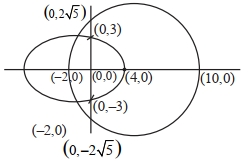
View full question & answer→MCQ 3051 Mark
Let a line $L$ pass through the point of intersection of the lines $b x+10 y-8=0$ and $2 x-3 y=0$, $b \in R -\left\{\frac{4}{3}\right\}$. If the line $L$ also passes through the point $(1,1)$ and touches the circle $17\left( x ^{2}+ y ^{2}\right)=16$, then the eccentricity of the ellipse $\frac{x^{2}}{5}+\frac{y^{2}}{b^{2}}=1$ is.
- A
$\frac{2}{\sqrt{5}}$
- ✓
$\sqrt{\frac{3}{5}}$
- C
$\frac{1}{\sqrt{5}}$
- D
$\sqrt{\frac{2}{5}}$
AnswerCorrect option: B. $\sqrt{\frac{3}{5}}$
b
Line is passing through intersection of $b x+10 y-8=0$ and $2 x-3 y=0$ is $(b x+10 y-8)+\lambda(2 x-3 y)=0$. As line is passing through $(1,1)$ so $\lambda=b+2$
Now line $(3 b+4) x-(3 b-4) y-8=0$ is tangent to circle $17\left(x^{2}+y^{2}\right)=16$
So $\frac{8}{\sqrt{(3 b+4)^{2}+(3 b-4)^{2}}}=\frac{4}{\sqrt{17}}$
$b^{2}=2 \Rightarrow e=\sqrt{\frac{3}{5}}$
View full question & answer→MCQ 3061 Mark
Let the hyperbola $H : \frac{ x ^{2}}{ a ^{2}}- y ^{2}=1$ and the ellipse $E: 3 x^{2}+4 y^{2}=12$ be such that the length of latus rectum of $H$ is equal to the length of latus rectum of $E$. If $e_{ H }$ and $e_{ E }$ are the eccentricities of $H$ and $E$ respectively, then the value of $12\left( e _{ H }^{2}+ e _{ E }^{2}\right)$ is equal to
Answera
$\frac{ x ^{2}}{ a ^{2}}-\frac{ y ^{2}}{1}=1$
$e _{ H }=\sqrt{1+\frac{1}{ a ^{2}}} \quad \frac{ x ^{2}}{4}+\frac{ y ^{2}}{3}=1$
$\ell \cdot R .=\frac{2}{ a } \quad \ell R =\frac{2 \times 3}{\frac{2}{1-\frac{3}{4}}}=\frac{1}{2}$
$\frac{2}{ a }=3$
$a =\frac{2}{3}$
$e _{ H }=\sqrt{1+\frac{9}{4}}=\frac{\sqrt{13}}{2}$
$12\left( e _{ H }^{2}+ e _{ E }^{2}\right)=12\left(\frac{13}{4}+\frac{1}{4}\right)$
$=\frac{12 \times 14}{4}=42$
View full question & answer→MCQ 3071 Mark
Let $\lambda x-2 y=\mu$ be a tangent to the hyperbola $a^{2} x^{2}-y^{2}=b^{2}$. Then $\left(\frac{\lambda}{a}\right)^{2}-\left(\frac{\mu}{b}\right)^{2}$ is equal to
Answerd
$\lambda x -2 y =\mu$ is a tangent to the curve
$a^{2} x^{2}-y^{2}=b^{2}$ then
$a ^{2} x ^{2}-\left(\frac{\lambda x -\mu}{2}\right)^{2}= b ^{2}$
$\left(4 a ^{2}-\lambda^{2}\right) x ^{2}+2 \lambda \mu x -\mu^{2}-4 b ^{2}=0$
Disc. $=0$
$4 \lambda^{2} \mu^{2}+4\left(4 a ^{2}-\lambda^{2}\right)\left(\mu^{2}+4 b ^{2}\right)=0$
$4 \lambda^{2} b^{2}-4 a^{2} \mu^{2}=16 a^{2} b^{2}$
$\frac{\lambda^{2}}{a^{2}}-\frac{\mu^{2}}{b^{2}}=4$
View full question & answer→MCQ 3081 Mark
Let a line $L_{1}$ be tangent to the hyperbola $\frac{x^{2}}{16}-\frac{y^{2}}{4}=1$ and let $L_{2}$ be the line passing through the origin and perpendicular to $L _{1}$. If the locus of the point of intersection of $L_{1}$ and $L_{2}$ is $\left(x^{2}+y^{2}\right)^{2}=$ $\alpha x^{2}+\beta y^{2}$, then $\alpha+\beta$ is equal to
Answerb
$\frac{x \sec \theta}{4}-\frac{y \tan \theta}{2}=1$
$m_{1}=\frac{\sec \theta \times 2}{4(\tan \theta)}=\frac{\sec \theta}{2 \tan \theta}$
$m_{2}=\frac{k}{h}$
$m_{1} m_{2}=-1$
$\frac{ k }{ h } \frac{\sec \theta}{2 \tan \theta}=-1$
$\frac{ k }{2 h \sin \theta}=-1$
$\sin \theta=\frac{- k }{2 h } \quad \cos \theta=\frac{\sqrt{4 h ^{2}- k ^{2}}}{2 h }$
also
$\frac{ h \sec \theta}{4}-\frac{ k \tan \theta}{2}=1$
$\frac{ h }{4} \frac{2 h }{\sqrt{4 h ^{2}- k ^{2}}}-\frac{ k }{2}\left(\frac{- k }{\sqrt{4 h ^{2}- k ^{2}}}\right)=1$
$h ^{2}+ k ^{2}=2 \sqrt{4 h ^{2}- k ^{2}}$
$\left( x ^{2}+ y ^{2}\right)^{2}=4\left(4 x ^{2}- y ^{2}\right)$
$\left( x ^{2}+ y ^{2}\right)^{2}=16 x ^{2}-4 y ^{2}$
$\alpha=16, \beta=-4$
$\alpha+\beta=16-4=12$
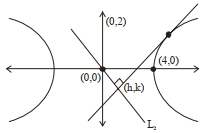
View full question & answer→MCQ 3091 Mark
Let $a>0, b>0$. Let $e$ and $\ell$ respectively be the eccentricity and length of the latus rectum of the hyperbola $\frac{ x ^{2}}{ a ^{2}}-\frac{ y ^{2}}{ b ^{2}}=1$. Let $e ^{\prime}$ and $\ell^{\prime}$ respectively the eccentricity and length of the latus rectum of its conjugate hyperbola. If $e ^{2}=\frac{11}{14} \ell$ and $\left( e ^{\prime}\right)^{2}=\frac{11}{8} \ell^{\prime}$, then the value of $77 a+44 b$ is equal to
Answerd
$e=\sqrt{1+\frac{b^{2}}{a^{2}}}, \ell=\frac{2 b^{2}}{a}$
Given $e ^{2}=\frac{11}{14} \ell$
$1+\frac{b^{2}}{a^{2}}=\frac{11}{14} \cdot \frac{2 b^{2}}{a}$
$\frac{a^{2}+b^{2}}{a^{2}}=\frac{11}{7} \cdot \frac{b^{2}}{a}$........$(1)$
Also $e ^{\prime}=\sqrt{1+\frac{ a ^{2}}{ b ^{2}}}, \ell^{\prime}=\frac{2 a ^{2}}{ b }$
Given $\left( e ^{\prime}\right)^{2}=\frac{11}{8} \ell^{\prime}$
$1+\frac{ a ^{2}}{ b ^{2}}=\frac{11}{8} \cdot \frac{2 a ^{2}}{ b }$
$\frac{ a ^{2}+ b ^{2}}{ b ^{2}}=\frac{11}{4} \cdot \frac{ a ^{2}}{ b }............(2)$
New $(1)$ $\div$ $(2)$
$\frac{ b ^{2}}{ a ^{2}}=\frac{4}{7} \cdot \frac{ b ^{3}}{ a ^{3}}$
$\therefore 7 a =4 b.......(3)$
From $(2)$
$\frac{\frac{16 b ^{2}}{49}+ b ^{2}}{ b ^{2}}=\frac{11}{4} \cdot \frac{16 b ^{2}}{49 b }$
$\frac{65}{49}=\frac{11}{4} \cdot \frac{16}{49} \cdot b$
$\therefore b =\frac{4 \times 65}{11 \times 16}..........(4)$
We have to find value of
$77 a+44 b$
$11(7 a +4 b )=11(4 b +4 b )=11 \times 8 b$
$\therefore$ Value of $11 \times 8 b =11 \times 8 \times \frac{4 \times 65}{16 \times 11}=130$
View full question & answer→MCQ 3101 Mark
Let the eccentricity of the hyperbola $H : \frac{ x ^{2}}{ a ^{2}}-\frac{ y ^{2}}{ b ^{2}}=1$ be $\sqrt{\frac{5}{2}}$ and length of its latus rectum be $6 \sqrt{2}$, If $y =2 x + c$ is a tangent to the hyperbola $H$, then the value of $c ^{2}$ is equal to
Answerb
$y = mx \pm \sqrt{ a ^{2} m ^{2}- b ^{2}}$
$m =2, c ^{2}= a ^{2} m ^{2}- b ^{2}$
$c ^{2}=4 a ^{2}- b ^{2}$
$e ^{2}=1+\frac{ b ^{2}}{ a ^{2}}$
$\frac{5}{2}=1+\frac{b^{2}}{a^{2}}$
$\frac{3}{2}=\frac{b^{2}}{a^{2}} \Rightarrow b^{2}=\frac{3 a^{2}}{2}$
$\frac{2 b^{2}}{a}=6 \sqrt{2}$
$\frac{2}{a} \times \frac{3 a^{2}}{2}=6 \sqrt{2}$
$3 a=6 \sqrt{2}$
$a=2 \sqrt{2}$
$b^{2}=\frac{3}{2} \times 8=12$
$b=2 \sqrt{3}$
$\therefore c^{2}=4 \times 8-12$
$c^{2}=20$
View full question & answer→MCQ 3111 Mark
An ellipse $E: \frac{x^{2}}{a^{2}}+\frac{y^{2}}{b^{2}}=1$ passes through the vertices of the hyperbola $H: \frac{x^{2}}{49}-\frac{y^{2}}{64}=-1$. Let the major and minor axes of the ellipse $E$ coincide with the transverse and conjugate axes of the hyperbola $H$. Let the product of the eccentricities of $E$ and $H$ be $\frac{1}{2}$. If $l$ is the length of the latus rectum of the ellipse $E$, then the value of $113\,l$ is equal to $....$
- A
$1500$
- ✓
$1552$
- C
$1000$
- D
$1553$
AnswerCorrect option: B. $1552$
b
Hyp : $\frac{y^{2}}{64}-\frac{x^{2}}{49}=1$
An ellipse $E: \frac{x^{2}}{a^{2}}+\frac{y^{2}}{b^{2}}=1$ passes through the vertices of the hyperbola $H: \frac{x^{2}}{49}-\frac{y^{2}}{64}=-1$.
$S_{0} b^{2}=64$
$e_{H}=\sqrt{1+\frac{a^{2}}{b^{2}}}=\sqrt{1+\frac{49}{64}}$
Ellipse $\frac{x^{2}}{a^{2}}+\frac{y^{2}}{b^{2}}=1$
$e_{E}=\sqrt{1-\frac{a^{2}}{b^{2}}}=\sqrt{1-\frac{a^{2}}{64}}$
$b=8, \sqrt{\frac{1-a^{2}}{64}} \times \frac{\sqrt{113}}{8}=\frac{1}{2} \Rightarrow \sqrt{64-a^{2}} \times \sqrt{113}=32$
$\left(64-a^{2}\right)=\frac{32^{2}}{113}$
$\Rightarrow a^{2}=64-\frac{32^{2}}{113}$
$l=\frac{2 a^{2}}{b}=\frac{2}{8}\left(64-\frac{32^{2}}{113}\right)=\frac{1552}{113}$
$113\,l=1552$
View full question & answer→MCQ 3121 Mark
For the hyperbola $H : x ^{2}- y ^{2}=1$ and the ellipse $E: \frac{x^{2}}{a^{2}}+\frac{y^{2}}{b^{2}}=1, a>b>0$, let the
$(1)$ eccentricity of $E$ be reciprocal of the eccentricity of $H$, and
$(2)$ the line $y=\sqrt{\frac{5}{2}} x+K$ be a common tangent of $E$ and $H$ Then $4\left(a^{2}+b^{2}\right)$ is equal to
Answerd
$e _{ E }=\sqrt{1-\frac{ b ^{2}}{ a ^{2}}}, e _{ H }=\sqrt{2}$
If $\Rightarrow e _{ E }=\frac{1}{ e _{ H }}$
$\Rightarrow \frac{ a ^{2}- b ^{2}}{ a ^{2}}=\frac{1}{2}$
$2 a ^{2-2 b } 2= a ^{2}$
$a ^{2}=2 b ^{2}$
and $y =\sqrt{\frac{5}{2}} x + k$ is tangent to ellipse then
$K ^{2}= a ^{2} \times \frac{5}{2}+ b ^{2}=\frac{3}{2}$
$\therefore b ^{2}=\frac{3}{2} \Rightarrow b ^{2}=\frac{1}{4}$ and $a ^{2}=\frac{1}{2}$
$\left.\therefore a ^{2}+ b ^{2}\right)=3$
View full question & answer→MCQ 3131 Mark
The sum of diameters of the circles that touch $(i)$ the parabola $75 x^{2}=64(5 y-3)$ at the point $\left(\frac{8}{5}, \frac{6}{5}\right)$ and $(ii)$ the $y$-axis, is equal to $......$
Answerd
$x^{2}=\frac{64.5}{75}\left(y-\frac{3}{5}\right)$
equation of tangent at $\left(\frac{8}{5}, \frac{6}{5}\right)$
$x \cdot \frac{8}{5}=\frac{64}{15}\left(\frac{y+\frac{6}{5}}{2}-\frac{3}{5}\right)$
$3 x-4 y=0$
equation of family of circle is
$\left(x-\frac{8}{5}\right)^{2}+\left(y-\frac{6}{5}\right)^{2}+\lambda(3 x-4 y)=0$
It touches $y$ axis so $f ^{2}= c$
$x^{2}+y^{2}+x\left(3 \lambda-\frac{16}{5}\right)+y\left(-4 \lambda-\frac{12}{5}\right)+4=0$
$\frac{\left(4 \lambda+\frac{12}{5}\right)^{2}}{4}=4$
$\lambda=\frac{2}{5} \text { or } \lambda=-\frac{8}{5}$
$\lambda=\frac{2}{5}, \quad r =1$
$\lambda=-\frac{8}{5}, \quad r =4$
$d _{1}+ d _{2}=10$
View full question & answer→MCQ 3141 Mark
Let $P (a, b )$ be a point on the parabola $y ^{2}=8 x$ such that the tangent at $P$ passes through the centre of the circle $x ^{2}+ y ^{2}-10 x -14 y +65=0$. Let $A$ be the product of all possible values of $a$ and $B$ be the product of all possible values of $b$. Then the value of $A + B$ is equal to.
Answerd
$P ( a , b )$ is point on $y ^{2}=8 x$, such that tangent at $P$ pass through centre of $x ^{2}+ y ^{2}-10 x -14 y +65=0$ i.e. $(5,7)$
Tangent at $P \left(a t ^{2}, 2 at \right)$ is ty $= x + at ^{2}$
$A =2$ and it pass through $(5,7)$
$7 t =5+2 t ^{2}$
$t=1, t=\frac{5}{2}$
$\therefore P\left(a t^{2}, 2 a t\right) \Rightarrow(2,4)$ when $t =1$
$\left(\frac{25}{2}, 10\right)$ when $t=\frac{5}{2}$
$\therefore A=2 \times \frac{25}{2}=25 \quad \therefore A+B=65$
View full question & answer→MCQ 3151 Mark
Let $H : \frac{ x ^{2}}{ a ^{2}}-\frac{y^{2}}{ b ^{2}}=1$, a $>0, b >0$, be a hyperbola such that the sum of lengths of the transverse and the conjugate axes is $4(2 \sqrt{2}+\sqrt{14})$. If the eccentricity $H$ is $\frac{\sqrt{11}}{2}$, then value of $a^{2}+b^{2}$ is equal to
Answerd
$\frac{x^{2}}{a^{2}}-\frac{y^{2}}{b^{2}}=1$
Given $e^{2}=1+\frac{b^{2}}{a^{2}} \Rightarrow \frac{11}{4}=1+\frac{b^{2}}{a^{2}} \Rightarrow b^{2}=\frac{7}{4} a^{2}$
$\therefore \frac{x^{2}}{(a)^{2}}-\frac{y^{2}}{\left(\frac{\sqrt{7}}{2} a\right)^{2}}=1$ Now given
$2 a+2 \cdot \frac{\sqrt{7} a}{2}=4(2 \sqrt{2}+\sqrt{14})$
$a(2+\sqrt{7})=4 \sqrt{2}(2+\sqrt{7})$
$a=4 \sqrt{2} \Rightarrow a^{2}=32$
$b^{2}=\frac{7}{4} \times 16 \times 2=56$
View full question & answer→MCQ 3161 Mark
Let the equation of two diameters of a circle $x ^{2}+ y ^{2}$ $-2 x +2 fy +1=0$ be $2 px - y =1$ and $2 x + py =4 p$. Then the slope $m \in(0, \infty)$ of the tangent to the hyperbola $3 x^{2}-y^{2}=3$ passing through the centre of the circle is equal to $......$
Answerb
$2 p+f-1=0$
$2-p f-4 p=0$
$2=p(f+4)$
$p=\frac{2}{f+4}$
$2 p=1-f$
$\frac{4}{f+4}=1-f$
$f^{2}+3 f=0$
$f=0 \text { or }-3$
Hyperbola $3 x ^{2}- y ^{2}=3, x ^{2}-\frac{ y ^{2}}{3}=1$
$y=m x \pm \sqrt{m^{2}-3}$
It passes $(1,0)$
$o=m \pm \sqrt{m^{2}-3}$
$m$ tends $\infty$
$\text { It passes }(1,3)$
$3=m \pm \sqrt{m^{2}-3}$
$(3-m)^{2}=m^{2}-3$
$m=2$
View full question & answer→MCQ 3171 Mark
A common tangent $T$ to the curves $C_{1}: \frac{x^{2}}{4}+\frac{y^{2}}{9}=1$ and $C_{2}: \frac{x^{2}}{42}-\frac{y^{2}}{143}=1$ does not pass through the fourth quadrant. If $T$ touches $C _{1}$ at ( $\left.x _{1}, y _{1}\right)$ and $C _{2}$ at $\left( x _{2}, y _{2}\right)$, then $\left|2 x _{1}+ x _{2}\right|$ is equal to $......$
Answerd
$T_{1}: y=m x \pm \sqrt{4 m^{2}+9}$
And $T_{2}: y=m x \pm \sqrt{42 m^{2}-13}$
So, $4\,m^{2}+9=42 m^{2}-143$
$38\,m ^{2}=152$
$m=\pm 2$
$c=\pm 5$
For given tangent not pass through $4^{\text {th }}$ quadrant
$T: y=2 x+5$
Now, comparing with $\frac{ xx _{1}}{4}+\frac{ yy _{1}}{9}=1$
We get, $\frac{x_{1}}{8}=-\frac{1}{5} \Rightarrow x_{1}=-\frac{8}{5}$
$\frac{ xx _{2}}{42}-\frac{ yy _{2}}{143}=1$
$2 x-y=-5$ we have
$x _{2}=-\frac{84}{5}$
So, $\left|2 x _{1}+ x _{2}\right|=\left|\frac{-100}{5}\right|=20$
View full question & answer→MCQ 3181 Mark
Let the hyperbola $H : \frac{ x ^{2}}{ a ^{2}}-\frac{ y ^{2}}{ b ^{2}}=1$ pass through the point $(2 \sqrt{2},-2 \sqrt{2})$. A parabola is drawn whose focus is same as the focus of $H$ with positive abscissa and the directrix of the parabola passes through the other focus of $H$. If the length of the latus rectum of the parabola is e times the length of the latus rectum of $H$, where $e$ is the eccentricity of $H$, then which of the following points lies on the parabola?
- A
$(2 \sqrt{3}, 3 \sqrt{2})$
- ✓
$(3 \sqrt{3},-6 \sqrt{2})$
- C
$(\sqrt{3},-\sqrt{6})$
- D
$(3 \sqrt{6}, 6 \sqrt{2})$
AnswerCorrect option: B. $(3 \sqrt{3},-6 \sqrt{2})$
b
$H: \frac{x^{2}}{a^{2}}-\frac{y^{2}}{b^{2}}=1$
Foci : S (ae, 0), S' $(- ae , 0)$
Foot of directrix of parabola is $(- ae , 0)$
Focus of parabola is (ae, 0 )
Now, semi latus rectum of parabola $=\left| SS ^{\prime}\right|=2 ae$
Given, $4 a e = e \left(\frac{2 b ^{2}}{ a }\right)$
$b ^{2}=2 a ^{2}$
Given, $(2 \sqrt{2},-2 \sqrt{2})$ lies on $H$
$\frac{1}{ a ^{2}}-\frac{1}{ b ^{2}}=\frac{1}{8}$
From $(1)$ and $(2)$
$a^{2}=4, b^{2}=8$
$\because b^{2}=a^{2}\left(e^{2}-1\right)$
$\therefore e=\sqrt{3}$
Equation of parabola is $y^{2}=8 \sqrt{3} x$
View full question & answer→MCQ 3191 Mark
Let the focal chord of the parabola $P: y^{2}=4 x$ along the line $L: y=m x+c, m>0$ meet the parabola at the points $M$ and $N$. Let the line $L$ be a tangent to the hyperbola $H : x ^{2}- y ^{2}=4$. If $O$ is the vertex of $P$ and $F$ is the focus of $H$ on the positive $x$-axis, then the area of the quadrilateral $OMFN$ is.
- A
$2 \sqrt{6}$
- ✓
$2 \sqrt{14}$
- C
$4 \sqrt{6}$
- D
$4 \sqrt{14}$
AnswerCorrect option: B. $2 \sqrt{14}$
b
$H : \frac{ x ^{2}}{4}-\frac{ y ^{2}}{4}=1$
Focus (ae, 0)
$F (2 \sqrt{2}, 0)$
Line L: $y = mx + c$ pass $(1,0)$
$o = m + C$.......(1)
Line $L$ is tangent to Hyperbola. $\frac{ x ^{2}}{4}-\frac{ y ^{2}}{4}=1$
$C=\pm \sqrt{a^{2} m^{2}-\ell^{2}}$
$C=\pm \sqrt{4 m^{2}-4}$
From $(1)$
$- m =\pm \sqrt{4 m ^{2}-4}$
Squaring
$m^{2}=4 m^{2}-4$
$4=3 m^{2}$
$\frac{2}{\sqrt{3}}= m \quad($ as $m >0)$
$C =- m$
$C =\frac{-2}{\sqrt{3}}$
$y =\frac{2 x }{\sqrt{3}}-\frac{2}{\sqrt{3}}$
$y ^{2}=4 x$
$\Rightarrow\left(\frac{2 x -2}{\sqrt{3}}\right)^{2}=4 x$
$\Rightarrow x ^{2}+1-2 x =3 x$
$\Rightarrow x ^{2}-5 x +1=0$
$y ^{2}=4\left(\frac{\sqrt{3} y +2}{2}\right)$
$y ^{2}=2 \sqrt{3} y +4$
$\Rightarrow y ^{2}-2 \sqrt{3} y -4=0$
Area,$\left|\frac{1}{2}\right| \begin{array}{lllll}0 & x _{1} & 2 \sqrt{2} & x _{2} & 0 \\ 0 & y _{1} & 0 & y _{2} & 0\end{array} \mid$
$=\left|\frac{1}{2}\left[-2 \sqrt{2} y _{1}+2 \sqrt{2} y _{2}\right]\right|$
$=\sqrt{2}\left| y _{2}- y _{1}\right|=\frac{(\sqrt{2}) \sqrt{12+16}}{111}$
$=\sqrt{56}$
$=2 \sqrt{14}$
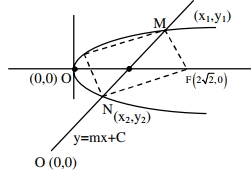
View full question & answer→MCQ 3201 Mark
For which of the following curves, the line $x+\sqrt{3} y=2 \sqrt{3}$ is the tangent at the point $\left(\frac{3 \sqrt{3}}{2}, \frac{1}{2}\right) \,?$
AnswerCorrect option: D. $x^{2}+9 y^{2}=9$
d
$m =-\frac{1}{\sqrt{3}}, c =2$
$(1)$ $c = a \sqrt{1+ m ^{2}}$
$c =\sqrt{7} \frac{2}{\sqrt{3}}$ (incorrect)
$(2)$ $c =\frac{ a }{ m }=\frac{\frac{1}{24 \sqrt{3}}}{\frac{-1}{\sqrt{3}}}=-\frac{1}{24}$ (incorrect)
$(3)$ $c =\sqrt{ a ^{2} m ^{2}- b ^{2}}$
$c =\sqrt{\frac{9}{2} \cdot \frac{1}{3}-\frac{1}{2}}=1 \quad$ (incorrect)
$(4)$ $c =\sqrt{ a ^{2} m ^{2}+ b ^{2}}$
$c =\sqrt{9 \cdot \frac{1}{3}+1}=2 \quad$ (correct)
View full question & answer→MCQ 3211 Mark
Let $C$ be the locus of the mirror image of a point on the parabola $y ^{2}=4 x$ with respect to the line $y = x$. Then the equation of tangent to $C$ at $P (2,1)$ is :
- ✓
$x-y=1$
- B
$2 x+y=5$
- C
$x+3 y=5$
- D
$x+2 y=4$
AnswerCorrect option: A. $x-y=1$
a
Given $y^{2}=4 x$
Mirror image on $y = x \Rightarrow C : x ^{2}=4 y$
$2 x =4 \cdot \frac{ dy }{ dx } \Rightarrow \frac{ dy }{ dx }=\frac{ x }{2}$
$\left.\frac{ dy }{ dx }\right|_{ P (2,1)}=\frac{2}{2}=1$
Equation of tangent at $(2,1)$
$\Rightarrow y-1=1(x-2)$
$\Rightarrow x-y=1$
View full question & answer→MCQ 3221 Mark
A tangent is drawn to the parabola $y^{2}=6 x$ which is perpendicular to the line $2 x + y =1$ Which of the following points does $NOT$ lie on it ?
- A
$(-6,0)$
- B
$(4,5)$
- ✓
$(5,4)$
- D
$(0,3)$
AnswerCorrect option: C. $(5,4)$
c
Slope of tangent $= m _{ T }= m$
So, $m(-2)=-1 \Rightarrow m=\frac{1}{2}$
Equation : $y = mx +\frac{ a }{ m }$
$\Rightarrow y=\frac{1}{2} x+\frac{3}{2 \times \frac{1}{2}}\left(a=\frac{6}{4}=\frac{3}{2}\right)$
$\Rightarrow y=\frac{x}{2}+3$
$\Rightarrow 2 y=x+6$
Point $(5,4)$ will not lie on it
View full question & answer→MCQ 3231 Mark
The length of the latus rectum of a parabola, whose vertex and focus are on the positive $x$-axis at a distance $\mathrm{R}$ and $\mathrm{S}(\,>\,\mathrm{R})$ respectively from the origin, is:
- A
$4(\mathrm{~S}+\mathrm{R})$
- B
$2(\mathrm{~S}-\mathrm{R})$
- ✓
$4(\mathrm{~S}-\mathrm{R})$
- D
$2(\mathrm{~S}+\mathrm{R})$
AnswerCorrect option: C. $4(\mathrm{~S}-\mathrm{R})$
c
$\mathrm{V} \rightarrow \text { Vertex }$
$\mathrm{F} \rightarrow \text { focus }$
$\mathrm{VF}=\mathrm{S}-\mathrm{R}$
So latus rectum $=4(\mathrm{~S}-\mathrm{R})$
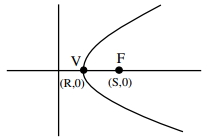
View full question & answer→MCQ 3241 Mark
Let $L$ be a tangent line to the parabola $y^{2}=4 x-20$ at $(6,2)$ . If $L$ is also a tangent to the ellipse $\frac{ x ^{2}}{2}+\frac{ y ^{2}}{ b }=1,$ then the value of $b$ is equal to ..... .
Answerb
Tangent to parabola
$2 y=2(x+6)-20$
$\Rightarrow y=x-4$
Condition of tangency for ellipse.
$16=2(1)^{2}+ b$
$\Rightarrow b =14$
View full question & answer→MCQ 3251 Mark
If the curves, $\frac{x^{2}}{a}+\frac{y^{2}}{b}=1$ and $\frac{x^{2}}{c}+\frac{y^{2}}{d}=1$ intersect each other at an angle of $90^{\circ},$ then which of the following relations is TRUE ?
- A
$a+b=c+d$
- ✓
$a-b=c-d$
- C
$a-c=b+d$
- D
$a b=\frac{c+d}{a+b}$
AnswerCorrect option: B. $a-b=c-d$
b
For orthogonal curves $a-c=b-d$ $\Rightarrow a-b=c-d$
View full question & answer→MCQ 3261 Mark
The line $12 x \,\cos \theta+5 y \,\sin \theta=60$ is tangent to which of the following curves?
AnswerCorrect option: B. $144 x^{2}+25 y^{2}=3600$
b
$12 x \cos \theta+5 y \sin \theta=60$
$\frac{x \cos \theta}{5}+\frac{y \sin \theta}{12}=1$
is tangent to $\frac{x^{2}}{25}+\frac{y^{2}}{144}=1$
$144 \mathrm{x}^{2}+25 \mathrm{y}^{2}=3600$
View full question & answer→MCQ 3271 Mark
A hyperbola passes through the foci of the ellipse $\frac{ x ^{2}}{25}+\frac{ y ^{2}}{16}=1$ and its transverse and conjugate axes coincide with major and minor axes of the ellipse, respectively. If the product of their eccentricities in one, then the equation of the hyperbola is ...... .
- A
$\frac{x^{2}}{9}-\frac{y^{2}}{25}=1$
- ✓
$\frac{x^{2}}{9}-\frac{y^{2}}{16}=1$
- C
$x^{2}-y^{2}=9$
- D
$\frac{x^{2}}{9}-\frac{y^{2}}{4}=1$
AnswerCorrect option: B. $\frac{x^{2}}{9}-\frac{y^{2}}{16}=1$
b
For ellipse $e_{1}=\sqrt{1-\frac{b^{2}}{a^{2}}}=\frac{3}{5}$
for hyperbola $e _{2}=\frac{5}{3}$
Let hyperbola be
$\frac{x^{2}}{a^{2}}-\frac{y^{2}}{b^{2}}=1$
$\because$ it passes through $(3,0) \Rightarrow \frac{9}{a_{2}}=1$
$\Rightarrow a ^{2}=9$
$\Rightarrow b ^{2}= a ^{2}\left( e ^{2}-1\right)$
$=9\left(\frac{25}{9}-1\right)=16$
$\therefore$ Hyperbola is $\frac{x^{2}}{9}-\frac{y^{2}}{16}=1$
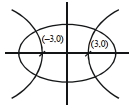
View full question & answer→MCQ 3281 Mark
If two tangents drawn from a point $\mathrm{P}$ to the parabola $\mathrm{y}^{2}=16(\mathrm{x}-3)$ are at right angles, then the locus of point $\mathrm{P}$ is :
- A
$x+3=0$
- ✓
$x+1=0$
- C
$x+2=0$
- D
$x+4=0$
AnswerCorrect option: B. $x+1=0$
b
Locus is directrix of parabola
$x-3+4=0 \Rightarrow x+1=0$
View full question & answer→MCQ 3291 Mark
Let $A (1,4)$ and $B (1,-5)$ be two points. Let $P$ be a point on the circle $(x-1)^{2}+(y-1)^{2}=1$ such that $( PA )^{2}+( PB )^{2}$ have maximum value, then the points $P , A$ and $B$ lie on ...... .
Answera
$P$ be a point on $( x -1)^{2}+( y -1)^{2}=1$
so $P (1+\cos \theta, 1+\sin \theta)$
$\begin{array}{ll} A (1,4) & B (1,-5)\end{array}$
$( PA )^{2}+( PB )^{2}$
$=(\cos \theta)^{2}+(\sin \theta-3)^{2}+(\operatorname{cso} \theta)^{2}+(\sin \theta+6)^{2}$
$=47+6 \sin \theta$
is maximum if $\sin \theta=1$
$\Rightarrow \sin \theta=1, \cos \theta=0$
$P (1,1) A (1,4) B (1,-5)$
$P , A , B$ are collinear points.
View full question & answer→MCQ 3301 Mark
If the three normals drawn to the parabola, $y ^{2}=2 x$ pass through the point $( a , 0) a \neq 0,$ then $'a'$ must be greater than
- A
$\frac{1}{2}$
- B
$-\frac{1}{2}$
- C
$-1$
- ✓
$1$
Answerd
For standard parabola For more than $3$ normals (on axis)
$x >\frac{ L }{2}$ (where $L$ is length of $L.R.$)
For $y^{2}=2 x$
$L.R.$ $=2$
for $(a, 0)$
$a>\frac{\text { L.R. }}{2} \Rightarrow a>1$
View full question & answer→MCQ 3311 Mark
The locus of the mid-point of the line segment joining the focus of the parabola $y^{2}=4 a x$ to a moving point of the parabola, is another parabola whose directrix is
- A
$x=-\frac{a}{2}$
- B
$x =\frac{ a }{2}$
- ✓
$x =0$
- D
$x = a$
AnswerCorrect option: C. $x =0$
c
$h=\frac{a t^{2}+a}{2}, k=\frac{2 a t+0}{2}$
$\Rightarrow \quad t ^{2}=\frac{2 h - a }{ a }$ and $t =\frac{ k }{ a }$
$\Rightarrow \quad \frac{ k ^{2}}{ a ^{2}}=\frac{2 h - a }{ a }$
$\Rightarrow$ Locus of $( h , k )$ is $y ^{2}= a (2 x - a )$
$\Rightarrow \quad y^{2}=2 a\left(x-\frac{a}{2}\right)$
Its directrix is $x-\frac{a}{2}=-\frac{a}{2} \Rightarrow x=0$
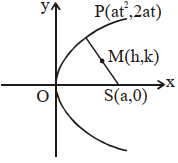
View full question & answer→MCQ 3321 Mark
A line is a common tangent to the circle $(x-3)^{2}+y^{2}=9$ and the parabola $y^{2}=4 x.$ If the two points of contact $( a , b )$ and $( c , d )$ are distinct and lie in the first quadrant, then $2(a+c)$ is equal to ........ .
Answera
Let coordinate of point $A \left( t ^{2}, 2 t \right) \quad(\because a =1)$
equation of tangent at point $A$
$y t=x+t^{2}$
centre of circle $(3,0)$
Now $PD =$ radius
$\left|\frac{3-0+t^{2}}{\sqrt{1+t^{2}}}\right|=3$
$\left(3+t^{2}\right)^{2}=9\left(1+t^{2}\right)$
$9+t^{4}+6 t^{2}=9+9 t^{2}$
$t =0,-\sqrt{3}, \sqrt{3}$
So point $A (3,2 \sqrt{3})$
$\Rightarrow a =3, b =2 \sqrt{3}$
(Since it lies in first quadrant)
For point $B$ which is foot of perpendicular from centre $(3,0)$ to the tangent $x-\sqrt{3} y+3=0$
$\frac{c-3}{1}=\frac{d-0}{-\sqrt{3}}=\frac{-(3-0+3)}{4}$
$\Rightarrow c =\frac{3}{2} \quad d =\frac{3 \sqrt{3}}{2}$
$\Rightarrow 2\left(\frac{3}{2}+3\right)=9$
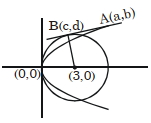
View full question & answer→MCQ 3331 Mark
If a line along a chord of the circle $4 x^{2}+4 y^{2}+120 x+675=0$, passes through the point $(-30,0)$ and is tangent to the parabola $\mathrm{y}^{2}=30 \mathrm{x}$, then the length of this chord is :
- A
$5$
- B
$7$
- C
$5 \sqrt{3}$
- ✓
$3 \sqrt{5}$
AnswerCorrect option: D. $3 \sqrt{5}$
d
Equation of tangent to $\mathrm{y}^{2}=30 \mathrm{x}$
$y=m x+\frac{30}{4 m}$
Pass thru $(-30,0): \mathrm{a}=-30 \mathrm{~m}+\frac{30}{4 \mathrm{~m}} \Rightarrow \mathrm{m}^{2}=1 / 4$
$\Rightarrow \mathrm{m}=\frac{1}{2}$ or $\mathrm{m}=-\frac{1}{2}$
At $\mathrm{m}=\frac{1}{2}: \mathrm{y}=\frac{\mathrm{x}}{2}+15 \Rightarrow \mathrm{x}-2 \mathrm{y}+30=0$
$\mathrm{P}=\frac{15}{\sqrt{5}}$
$\ell_{\mathrm{AB}}=2 \sqrt{\mathrm{R}^{2}-\mathrm{P}^{2}}=2 \sqrt{\frac{225}{4}-\frac{225}{5}}$
$\Rightarrow \ell_{\mathrm{AB}}=30 \cdot \sqrt{\frac{1}{20}}=\frac{15}{\sqrt{5}}=3 \sqrt{5}$
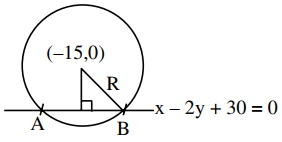
View full question & answer→MCQ 3341 Mark
A tangent and a normal are drawn at the point $\mathrm{P}(2,-4)$ on the parabola $\mathrm{y}^{2}=8 \mathrm{x}$, which meet the directrix of the parabola at the points $\mathrm{A}$ and $\mathrm{B}$ respectively. If $Q(a, b)$ is a point such that $A Q B P$ is a square, then $2 \mathrm{a}+\mathrm{b}$ is equal to :
Answera
Equation of tangent at $(2,-4)(\mathrm{T}=0)$
$-4 y=4(x+2)$
$x+y+2=0\ldots(1)$
equation of normal
$\mathrm{x}-\mathrm{y}+\lambda=0$
$\downarrow(2,-4)$
$\lambda=-6$
thus $x-y=6 \ldots(2)$ equation of normal
$P O I$ of $(1) \,\&\, x=-2$ is $A(-2,0)$
$\mathrm{POI}$ of $(2)\, \& \,\mathrm{x}=-2$ is $\mathrm{A}(-2,8)$
Given $\mathrm{AQBP}$ is a $sq.$
$\Rightarrow \mathrm{m}_{\mathrm{AQ}} \cdot \mathrm{m}_{\mathrm{AP}}=-1$
$\Rightarrow\left(\frac{\mathrm{b}}{\mathrm{a}+2}\right)\left(\frac{4}{-4}\right)=-1 \Rightarrow \mathrm{a}+2=\mathrm{b} \ldots$
Also $PQ$ must be parallel to $\mathrm{x}$-axis thus
$\Rightarrow \mathrm{b}=-4$
$\therefore \mathrm{a}=-6$
Thus $2 \mathrm{a}+\mathrm{b}=-16$
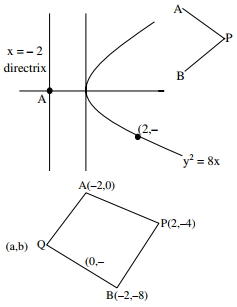
View full question & answer→MCQ 3351 Mark
A tangent line $\mathrm{L}$ is drawn at the point $(2,-4)$ on the parabola $\mathrm{y}^{2}=8 \mathrm{x}$. If the line $\mathrm{L}$ is also tangent to the circle $x^{2}+y^{2}=a$, then $'a'$ is equal to .... .
Answerd
tangent of $y^{2}=8 x$ is $y=m x+\frac{2}{m}$
$\mathrm{P}(2,-4) \Rightarrow-4=2 \mathrm{~m}+\frac{2}{\mathrm{~m}}$
$\Rightarrow \mathrm{m}+\frac{1}{\mathrm{~m}}=-2 \Rightarrow \mathrm{m}=-1$
$\therefore$ tangent is $\mathrm{y}=-\mathrm{x}-2$
$\Rightarrow x+y+2=0....(1)$
$(1)$ is also tangent to $x^{2}+y^{2}=a$
So $\frac{2}{\sqrt{2}}=\sqrt{a} \Rightarrow \sqrt{a}=\sqrt{2}$
$\Rightarrow \mathrm{a}=2$
View full question & answer→MCQ 3361 Mark
Consider the parabola with vertex $\left(\frac{1}{2}, \frac{3}{4}\right)$ and the directrix $\mathrm{y}=\frac{1}{2}$. Let $\mathrm{P}$ be the point where the parabola meets the line $\mathrm{x}=-\frac{1}{2}$. If the normal to the parabola at $\mathrm{P}$ intersects the parabola again at the point $\mathrm{Q}$, then $(\mathrm{PQ})^{2}$ is equal to :
- A
$\frac{75}{8}$
- ✓
$\frac{125}{16}$
- C
$\frac{25}{2}$
- D
$\frac{15}{2}$
AnswerCorrect option: B. $\frac{125}{16}$
b
$\left(y-\frac{3}{4}\right)=\left(x-\frac{1}{2}\right)^{2} \ldots(1)$
For $x=-\frac{1}{2}$
$y-\frac{3}{4}=1 \Rightarrow y=\frac{7}{4} \Rightarrow P\left(-\frac{1}{2}, \frac{7}{4}\right)$
Now $\mathrm{y}^{\prime}=2\left(\mathrm{x}-\frac{1}{2}\right) \quad$ At $\mathrm{x}=-\frac{1}{2}$
$\Rightarrow \mathrm{m}_{\mathrm{T}}=-2, \mathrm{~m}_{\mathrm{N}}=\frac{1}{2}$
Equation of Normal is
$y-\frac{7}{4}=\frac{1}{2}\left(x+\frac{1}{2}\right)$
$y=\frac{x}{2}+2$
Now put $y$ in equation $(1)$
$\frac{x}{2}+2-\frac{3}{4}=\left(x-\frac{1}{2}\right)^{2}$
$\Rightarrow \mathrm{x}=2\, \&\,-\frac{1}{2}$
$\Rightarrow \mathrm{Q}(2,3)$
Now $(\mathrm{PQ})^{2}=\frac{125}{16}$
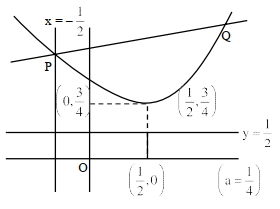
View full question & answer→MCQ 3371 Mark
Let the tangent to the parabola $S: y^{2}=2 x$ at the point $P(2,2)$ meet the $x$-axis at $Q$ and normal at it meet the parabola $S$ at the point $R$. Then the area (in $sq.\, units$) of the triangle $P Q R$ is equal to:
- A
$25$
- ✓
$\frac{25}{2}$
- C
$\frac{15}{2}$
- D
$\frac{35}{2}$
AnswerCorrect option: B. $\frac{25}{2}$
b
Tangent at $\mathrm{P}: \mathrm{y}(2)=2(1 / 2)(\mathrm{x}+2)$
$\Rightarrow 2 y=x+2$
$\therefore Q=(-2,0)$
Normal at $\mathrm{P}: \mathrm{y}-2=-\frac{(2)}{2.1 / 2}(x-2)$
$\Rightarrow y-2=-2(x-2)$
$\Rightarrow y=6-2 x$
$\therefore$ Solving with $\mathrm{y}^{2}=2 \mathrm{x} \Rightarrow \mathrm{R}\left(\frac{9}{2}-3\right)$
$\therefore \operatorname{Ar}(\Delta \mathrm{PQR})=\frac{1}{2}$ $\left|\begin{array}{ccc}2 & 2 & 1 \\ -2 & 1 & 1 \\ \frac{9}{2} & -3 & 1\end{array}\right|$
$=\frac{25}{2}$ $sq. \,units$
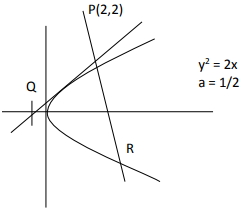
View full question & answer→MCQ 3381 Mark
Let $y=m x+c, m>0$ be the focal chord of $y^{2}=-64 x$, which is tangent to $(x+10)^{2}+y^{2}=4$ Then, the value of $4 \sqrt{2}(\mathrm{~m}+\mathrm{c})$ is equal to $.....$
Answera
$y^2=-64$
focus: $(-16,0)$
$\mathrm{y}=\mathrm{mx}+\mathrm{c}$ is focal chord
$\Rightarrow \mathrm{c}=16 \mathrm{~m} \ldots \ldots$. $(1)$
$y=m x+c$ is tangent to $(x+10)^{2}+y^{2}=4$
$\Rightarrow y-m(x+10) \pm 2 \sqrt{1+m^{2}}$
$\Rightarrow \mathrm{c}=10 \mathrm{~m} \pm 2 \sqrt{1+\mathrm{m}^{2}}$
$\Rightarrow 16 \mathrm{~m}=10 \pm 2 \sqrt{1+m^{2}}$
$\Rightarrow 6 m=2 \sqrt{1+m^{2}}(m>0)$
$\Rightarrow 9 \mathrm{~m}^{2}=1+\mathrm{m}^{2}$
$\Rightarrow m=\frac{1}{2 \sqrt{2}} \& c=\frac{8}{\sqrt{2}}$
$4 \sqrt{2}(m+c)=4 \sqrt{2}\left(\frac{17}{2 \sqrt{2}}\right)=34$
View full question & answer→MCQ 3391 Mark
Let $P$ be a variable point on the parabola $y=4 x^{2}+1$. Then the locus of the mid-point of the point $P$ and the foot of the perpendicular drawn from the point $P$ to the line $y=x$ is:
- A
$(3 x-y)^{2}+(x-3 y)+2=0$
- B
$2(x-3 y)^{2}+(3 x-y)+2=0$
- ✓
$2(3 x-y)^{2}+(x-3 y)+2=0$
- D
$(3 x-y)^{2}+2(x-3 y)+2=0$
AnswerCorrect option: C. $2(3 x-y)^{2}+(x-3 y)+2=0$
c
$\frac{K-C}{h-C}=-1$
$C=\frac{h+k}{2} \quad P(x, y)$
$R=\left(\frac{x+C}{2}, \frac{y+C}{2}\right)$
$R=\left(\frac{x}{2}+\frac{h}{4}+\frac{K}{4}, \frac{y}{2}+\frac{h}{4}+\frac{k}{4}\right)$
$\therefore x=\frac{3 h}{2}-\frac{K}{2}, y=\frac{3 K}{2}-\frac{h}{2}$, put in
$Y=4 x^{2}+1$
$\left(\frac{3 K-h}{2}\right)=4\left(\frac{3 h-k}{2}\right)^{2}+1$
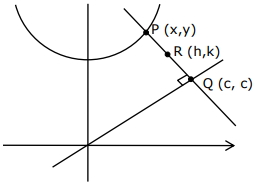
View full question & answer→MCQ 3401 Mark
If the point on the curve $y^{2}=6 x$, nearest to the point $\left(3, \frac{3}{2}\right)$ is $(\alpha, \beta)$, then $2(\alpha+\beta)$ is equal to $.....$
Answerb
Minimum distance is along the normal
$P \equiv\left(\frac{3}{2} \mathrm{t}^{2}, 3 \mathrm{t}\right)$
Normal at point $\mathrm{P}$
$t x+y=3 t+\frac{3}{2} t^{3}$
Passes through $\left(3, \frac{3}{2}\right)$
$\Rightarrow 3 t+\frac{3}{2}=3 t+\frac{3}{2} t^{3}$
$P \equiv\left(\frac{3}{2}, 3\right)=3 t+\frac{3}{2} t^{3}$
$P \equiv\left(\frac{3}{2}, 3\right)=(\alpha, \beta)$
$\Rightarrow t^{3}=1 \Rightarrow t=1$
$2(\alpha+\beta)=2\left(\frac{3}{2}+3\right)=9$
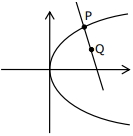
View full question & answer→MCQ 3411 Mark
Let a parabola $P$ be such that its vertex and focus lie on the positive $x$ - axis at a distance $2$ and $4$ units from the origin, respectively. If tangents are drawn from $O\,(0,0)$ to the parabola $P$ which meet $\mathrm{P}$ at $\mathrm{S}$ and $\mathrm{R}$, then the area (in $sq.\, units$) of $\triangle \mathrm{SOR}$ is equal to:
- A
$16 \sqrt{2}$
- B
$32$
- ✓
$16$
- D
$8 \sqrt{2}$
Answerc
Clearly $Rs$ is latus-rectum
$\because \mathrm{VF}=2=\mathrm{a}$
$\therefore \mathrm{RS}=4 \mathrm{a}=8$
Now OF $=2 \mathrm{a}=4$
$\Rightarrow$ Area of traingle $ORS$ $=16$
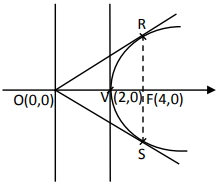
View full question & answer→MCQ 3421 Mark
The equation of a circle is $\operatorname{Re}\left(z^{2}\right)+2(\operatorname{Im}(z))^{2}+2 \operatorname{Re}(z)=0$, where $z=x+$ iy. A line which passes through the center of the given circle and the vertex of the parabola, $x^{2}-6 x-y+13=0,$ has $y$-intercept equal to $.....$
Answera
Equation of circle is $\left(x^{2}-y^{2}\right)+2 y^{2}+2 x=0$
$X^{2}+y^{2}+2 x=0$
Centre $:(-1,0)$
Parabola $: x^{2}-6 x-y+13=0$
$(x-3)^{2}=y-4$
Vertex: $(3,4)$
$\equiv \,y-0=\frac{4-0}{3+1}(x+1)$
$y=x+1$
$y$ - intercept $=1$
View full question & answer→MCQ 3431 Mark
If the point of intersections of the ellipse $\frac{ x ^{2}}{16}+\frac{ y ^{2}}{ b ^{2}}=1$ and the circle $x ^{2}+ y ^{2}=4 b , b > 4$ lie on the curve $y^{2}=3 x^{2},$ then $b$ is equal to:
Answera
$y^{2}=3 x^{2}$
And $x^{2}+y^{2}=4 b$
Solve both we get
So $x^{2}=b$
$\frac{x^{2}}{16}+\frac{3 x^{2}}{b^{2}}=1$
$\frac{b}{16}+\frac{3}{b}=1$
$b^{2}-16 b+48=0$
$(b-12)(b-4)=0$
$b=12, b > 4$
View full question & answer→MCQ 3441 Mark
Let $L$ be a common tangent line to the curves $4 x^{2}+9 y^{2}=36$ and $(2 x)^{2}+(2 y)^{2}=31$. Then the square of the slope of the line $L$ is ..... .
Answera
Given curves are $\frac{ x ^{2}}{9}+\frac{ y ^{2}}{4}=1$
$x^{2}+y^{2}=\frac{31}{4}$
let slope of common tangent be $m$
so tangents are $y=m x \pm \sqrt{9 m^{2}+4}$
$y=m x \pm \frac{\sqrt{31}}{2} \sqrt{1+m^{2}}$
hence $9 m ^{2}+4=\frac{31}{4}\left(1+ m ^{2}\right)$
$\Rightarrow 36 m ^{2}+16=31+31 m ^{2} \Rightarrow m ^{2}=3$
View full question & answer→MCQ 3451 Mark
On the ellipse $\frac{x^{2}}{8}+\frac{y^{2}}{4}=1$ let $P$ be a point in the second quadrant such that the tangent at $\mathrm{P}$ to the ellipse is perpendicular to the line $x+2 y=0$. Let $S$ and $\mathrm{S}^{\prime}$ be the foci of the ellipse and $\mathrm{e}$ be its eccentricity. If $\mathrm{A}$ is the area of the triangle $SPS'$ then, the value of $\left(5-\mathrm{e}^{2}\right) . \mathrm{A}$ is :
Answerb
Equation of tangent : $\mathrm{y}=2 \mathrm{x}+6$
at $\mathrm{P}$
$\therefore \mathrm{P}(-8 / 3,2 / 3)$
$\mathrm{e}=\frac{1}{\sqrt{2}}$
$\mathrm{~S} \& \mathrm{~S}^{\prime}=(-2,0) \&(2,0)$
Area of $\Delta$ SPS' $=\frac{1}{2} \times 4 \times \frac{2}{3}$
$A=\frac{4}{3}$
$\therefore\left(5-\mathrm{e}^{2}\right) \mathrm{A}=\left(5-\frac{1}{2}\right) \frac{4}{3}=6$
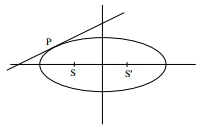
View full question & answer→MCQ 3461 Mark
If $x^{2}+9 y^{2}-4 x+3=0, x, y \in R$, then $x$ and $y$ respectively lie in the intervals:
- A
$\left[-\frac{1}{3}, \frac{1}{3}\right]$ and $\left[-\frac{1}{3}, \frac{1}{3}\right]$
- B
$\left[-\frac{1}{3}, \frac{1}{3}\right]$ and $[1,3]$
- C
$[1,3]$ and $[1,3]$
- ✓
$[1,3]$ and $\left[-\frac{1}{3}, \frac{1}{3}\right]$
AnswerCorrect option: D. $[1,3]$ and $\left[-\frac{1}{3}, \frac{1}{3}\right]$
d
$x^{2}+9 y^{2}-4 x+3=0$
$\left(x^{2}-4 x\right)+\left(9 y^{2}\right)+3=0$
$\left(x^{2}-4 x+4\right)+\left(9 y^{2}\right)+3-4=0$
$(x-2)^{2}+(3 y)^{2}=1$
$\frac{(x-2)^{2}}{(1)^{2}}+\frac{y^{2}}{\left(\frac{1}{3}\right)^{2}}=1$ (equation of an ellipse).
As it is equation of an ellipse, $x \,\&\, y$ can vary inside the ellipse.
So, $x-2 \in[-1,1]$ and $y \in\left[-\frac{1}{3}, \frac{1}{3}\right]$
$x \in[1,3] y \in\left[-\frac{1}{3}, \frac{1}{3}\right]$
View full question & answer→MCQ 3471 Mark
If the minimum area of the triangle formed by a tangent to the ellipse $\frac{x^{2}}{b^{2}}+\frac{y^{2}}{4 a^{2}}=1$ and the co-ordinate axis is $kab,$ then $\mathrm{k}$ is equal to ..... .
Answerc
Tangent
$\frac{x \cos \theta}{b}+\frac{y \sin \theta}{2 a}=1$
So, area $(\Delta \mathrm{OAB})=\frac{1}{2} \times \frac{\mathrm{b}}{\cos \theta} \times \frac{2 \mathrm{a}}{\sin \theta}$
$=\frac{2 \mathrm{ab}}{\sin 2 \theta} \geq 2 \mathrm{ab}$
$\Rightarrow \mathrm{k}=2$
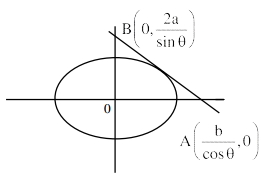
View full question & answer→MCQ 3481 Mark
The locus of mid-points of the line segments joining $(-3,-5)$ and the points on the ellipse $\frac{x^{2}}{4}+\frac{y^{2}}{9}=1$ is :
- A
$9 x^{2}+4 y^{2}+18 x+8 y+145=0$
- B
$36 x^{2}+16 y^{2}+90 x+56 y+145=0$
- ✓
$36 x^{2}+16 y^{2}+108 x+80 y+145=0$
- D
$36 x^{2}+16 y^{2}+72 x+32 y+145=0$
AnswerCorrect option: C. $36 x^{2}+16 y^{2}+108 x+80 y+145=0$
c
General point on $\frac{\mathrm{x}^{2}}{4}+\frac{\mathrm{y}^{2}}{9}=1$ is $\mathrm{A}(2 \cos \theta, 3 \sin \theta)$
given $\mathrm{B}(-3,-5)$
$\text { midpoint } C\left(\frac{2 \cos \theta-3}{2}, \frac{3 \sin \theta-5}{2}\right)$
$\mathrm{h}=\frac{2 \cos \theta-3}{2} ; \mathrm{k}=\frac{3 \sin \theta-5}{2}$
$\Rightarrow\left(\frac{2 \mathrm{~h}+3}{2}\right)^{2}+\left(\frac{2 \mathrm{k}+5}{3}\right)^{2}=1$
$\Rightarrow 36 \mathrm{x}^{2}+16 \mathrm{y}^{2}+108 \mathrm{x}+80 \mathrm{y}+145=0$
View full question & answer→MCQ 3491 Mark
Let $\theta$ be the acute angle between the tangents to the ellipse $\frac{x^{2}}{9}+\frac{y^{2}}{1}=1$ and the circle $x^{2}+y^{2}=3$ at their point of intersection in the first quadrant. Then $\tan \theta$ is equal to :
- A
$\frac{5}{2 \sqrt{3}}$
- ✓
$\frac{2}{\sqrt{3}}$
- C
$\frac{4}{\sqrt{3}}$
- D
$2$
AnswerCorrect option: B. $\frac{2}{\sqrt{3}}$
b
The point of intersection of the curves $\frac{x^{2}}{9}+\frac{y^{2}}{1}=1$ and $x^{2}+y^{2}=3$ in the first quadrant is $\left(\frac{3}{2}, \frac{\sqrt{3}}{2}\right)$
Now slope of tangent to the ellipse $\frac{x^{2}}{9}+\frac{y^{2}}{1}=1$ at $\left(\frac{3}{2}, \frac{\sqrt{3}}{2}\right)$ is
$\mathrm{m}_{1}=-\frac{1}{3 \sqrt{3}}$
And slope of tangent to the circle at $\left(\frac{3}{2}, \frac{\sqrt{3}}{2}\right)$ is $\mathrm{m}_{2}$
$=-\sqrt{3}$
So, if angle between both curves is $\theta$ then
$\tan \theta=\left|\frac{m_{1}-m_{2}}{1+m_{1} m_{2}}\right|=\left|\frac{-\frac{1}{3 \sqrt{3}}+\sqrt{3}}{1+\left(-\frac{1}{3 \sqrt{3}}(-\sqrt{3})\right)}\right|$$=\frac{2}{\sqrt{3}}$
View full question & answer→MCQ 3501 Mark
Let $E_{1}: \frac{x^{2}}{a^{2}}+\frac{y^{2}}{b^{2}}=1, \mathrm{a}\,>\,\mathrm{b} .$ Let $\mathrm{E}_{2}$ be another ellipse such that it touches the end points of major axis of $E_{1}$ and the foci $E_{2}$ are the end points of minor axis of $E_{1}$. If $E_{1}$ and $E_{2}$ have same eccentricities, then its value is :
- A
$\frac{-1+\sqrt{3}}{2}$
- B
$\frac{-1+\sqrt{6}}{2}$
- ✓
$\frac{-1+\sqrt{5}}{2}$
- D
$\frac{-1+\sqrt{8}}{2}$
AnswerCorrect option: C. $\frac{-1+\sqrt{5}}{2}$
c
$\mathrm{e}^{2}=1-\frac{\mathrm{b}^{2}}{\mathrm{a}^{2}} ....(1)$
$\mathrm{e}^{2}=1-\frac{\mathrm{a}^{2}}{\mathrm{c}^{2}} ....(2)$
$\Rightarrow \frac{\mathrm{b}^{2}}{\mathrm{a}^{2}}=\frac{\mathrm{a}^{2}}{\mathrm{c}^{2}}$
$\Rightarrow \mathrm{c}^{2}=\frac{\mathrm{a}^{4}}{\mathrm{~b}^{2}} \Rightarrow \mathrm{c}=\frac{\mathrm{a}^{2}}{\mathrm{~b}}$
Also $b=c e$
$\therefore \frac{b}{e}=\frac{a^{2}}{b} \Rightarrow \frac{b^{2}}{a^{2}}=e$
$\quad e^{2}=1-b^{2} / a^{2} \Rightarrow e^{2}+e-1=0$
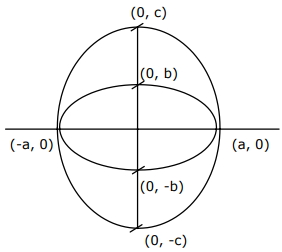
View full question & answer→MCQ 3511 Mark
Let an ellipse $E: \frac{x^{2}}{a^{2}}+\frac{y^{2}}{b^{2}}=1, a^{2}>b^{2}$, passes through $\left(\sqrt{\frac{3}{2}}, 1\right)$ and has ecentricity $\frac{1}{\sqrt{3}} .$ If a circle, centered at focus $\mathrm{F}(\alpha, 0), \alpha>0$, of $\mathrm{E}$ and radius $\frac{2}{\sqrt{3}}$, intersects $\mathrm{E}$ at two points $\mathrm{P}$ and $\mathrm{Q}$, then $\mathrm{PQ}^{2}$ is equal to:
- A
$\frac{8}{3}$
- B
$\frac{4}{3}$
- C
$3$
- ✓
$\frac{16}{3}$
AnswerCorrect option: D. $\frac{16}{3}$
d
$\frac{3}{2 a^{2}}+\frac{1}{b^{2}}=1 \text { and } 1-\frac{b^{2}}{a^{2}}=\frac{1}{3}$
$\Rightarrow a^{2}=3 b^{2}=2$
$\Rightarrow \frac{x^{2}}{3}+\frac{y^{2}}{2}=1.....(i)$
Its focus is $(1,0)$
Now, eqn of circle is
$(x-1)^{2}+y^{2}=\frac{4}{3}.....(ii)$
Solving $(i)$ and $(ii)$ we get
$y=\pm \frac{2}{\sqrt{3}}, x=1$
$\Rightarrow P Q^{2}=\left(\frac{4}{\sqrt{3}}\right)^{2}=\frac{16}{3}$
View full question & answer→MCQ 3521 Mark
If a tangent to the ellipse $x^{2}+4 y^{2}=4$ meets the tangents at the extremities of its major axis at $\mathrm{B}$ and $\mathrm{C}$, then the circle with $\mathrm{BC}$ as diameter passes through the point:
- A
$(-1,1)$
- B
$(1,1)$
- ✓
$(\sqrt{3}, 0)$
- D
$(\sqrt{2}, 0)$
AnswerCorrect option: C. $(\sqrt{3}, 0)$
c
$\frac{x^{2}}{4}+\frac{y^{2}}{1}=1 \Rightarrow a=2 \& b=1, \quad$ Let $P(2 \cos \theta, \sin \theta)$
Equation of tangent at $P$ is $(\cos \theta) x+2 \sin \theta y=2$
$\mathrm{B}\left(-2, \frac{1+\cos \theta}{\sin \theta}\right)$
$C\left(2, \frac{1-\cos \theta}{\sin \theta}\right)$
$B\left(-2, \cot \frac{\theta}{2}\right)$
$C\left(2, \tan \frac{\theta}{2}\right)$
Equation of circle is
$(x+2)(x-2)+\left(y-\cot \frac{\theta}{2}\right)\left(y-\tan \frac{\theta}{2}\right)=0$
$x^{2}-4+y^{2}-\left(\tan \frac{\theta}{2}+\cot \frac{\theta}{2}\right) y+1=0$
so, $(\sqrt{3}, 0)$ satisfying equation $(1)$
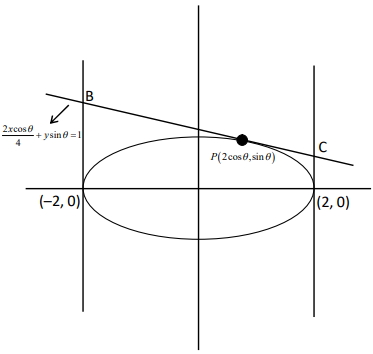
View full question & answer→MCQ 3531 Mark
A ray of light through $(2,1)$ is reflected at a point $P$ on the $y$ - axis and then passes through the point $(5,3)$. If this reflected ray is the directrix of an ellipse with eccentrieity $\frac{1}{3}$ and the distance of the nearer focus from this directrix is $\frac{8}{\sqrt{53}}$, then the equation of the other directrix can be :
- A
$2 x-7 y-39=0$ or $2 x-7 y-7=0$
- B
$11 x+7 y+8=0$ or $11 x+7 y-15=0$
- ✓
$2 x-7 y+29=0$ or $2 x-7 y-7=0$
- D
$11 x-7 y-8=0$ or $11 x+7 y+15=0$
AnswerCorrect option: C. $2 x-7 y+29=0$ or $2 x-7 y-7=0$
c
Equation of reflected Ray
$y-1=\frac{2}{7}(x+2)$
$7 y-7=2 x+4$
$2 x-7 y+11=0$
Let the equation of other directrix is
$2 x-7 y+\lambda$
Distance of directrix from Focub
$\frac{a}{e}-a e=\frac{8}{\sqrt{53}}$
$3 a-\frac{a}{3}=\frac{8}{\sqrt{53}} \text { or } a=\frac{3}{\sqrt{53}}$
Distance between two directric $=\frac{2 \mathrm{a}}{\mathrm{e}}$
$=2 \times 3 \times \frac{3}{\sqrt{53}}=\frac{18}{\sqrt{53}}$
$\left|\frac{\lambda-11}{\sqrt{53}}\right|=\frac{18}{\sqrt{53}}$
$\lambda-11=18 \text { or }-18$
$\lambda=29 \text { or }-7$
$2 x-7 y-7=0 \text { or } 2 x-7 y+29=0$
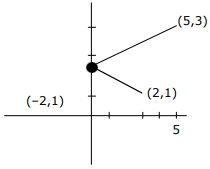
View full question & answer→MCQ 3541 Mark
Let $\mathrm{E}$ be an ellipse whose axes are parallel to the co-ordinates axes, having its center at $(3,-4)$, one focus at $(4,-4)$ and one vertex at $(5,-4) .$ If $m x-y=4, m\,>\,0$ is a tangent to the ellipse $\mathrm{E}$, then the value of $5 \mathrm{~m}^{2}$ is equal to $.....$
Answerc
and $\mathrm{A}(5,-4)$
Hence, $\mathrm{a}=2\, \,\mathrm{ae}=1$
$\Rightarrow \mathrm{e}=\frac{1}{2}$
$\Rightarrow \mathrm{b}^{2}=3$
So, $E: \frac{(x-3)^{2}}{4}+\frac{(y+4)^{2}}{3}=1$
Intersecting with given tangent.
$\frac{x^{2}-6 x+9}{4}+\frac{m^{2} x^{2}}{3}=1$
Now, $D=0$ (as it is tangent)
So, $5 \mathrm{~m}^{2}=3$.
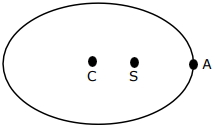
View full question & answer→MCQ 3551 Mark
The locus of the midpoints of the chord of the circle, $x^{2}+y^{2}=25$ which is tangent to the hyperbola $, \frac{ x ^{2}}{9}-\frac{ y ^{2}}{16}=1$ is
- A
$\left(x^{2}+y^{2}\right)^{2}-16 x^{2}+9 y^{2}=0$
- B
$\left(x^{2}+y^{2}\right)^{2}-9 x^{2}+144 y^{2}=0$
- C
$\left(x^{2}+y^{2}\right)^{2}-9 x^{2}-16 y^{2}=0$
- ✓
$\left(x^{2}+y^{2}\right)^{2}-9 x^{2}+16 y^{2}=0$
AnswerCorrect option: D. $\left(x^{2}+y^{2}\right)^{2}-9 x^{2}+16 y^{2}=0$
d
$y-k=-\frac{h}{k}(x-h)$
$ky - k ^{2}=- hx + h ^{2}$
$hx + ky = h ^{2}+ k ^{2}$
$y =-\frac{ hx }{ k }+\frac{ h ^{2}+ k ^{2}}{ k }$
tangent to $\frac{ x ^{2}}{9}-\frac{ y ^{2}}{16}=1$
$c ^{2}= a ^{2} m ^{2}- b ^{2}$
$\left(\frac{ h ^{2}+ k ^{2}}{ k }\right)^{2}=9\left(-\frac{ h }{ k }\right)^{2}-16$
$\left( x ^{2}+ y ^{2}\right)^{2}=9 x ^{2}-16 y ^{2}$
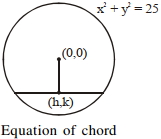
View full question & answer→MCQ 3561 Mark
A square $ABCD$ has all its vertices on the curve $x ^{2} y ^{2}=1$. The midpoints of its sides also lie on the same curve. Then, the square of area of $ABCD$ is
Answerd
$xy =1,-1$
$\frac{t_{1}+t_{2}}{2} \cdot \frac{\frac{1}{t_{1}}-\frac{1}{t_{2}}}{2}=1$
$\Rightarrow t_{1}^{2}-t_{2}^{2}=4 t_{1} t_{2}$
$\frac{1}{t_{1}^{2}} \times\left(-\frac{1}{t_{2}^{2}}\right)=-1 \Rightarrow t_{1} t_{2}=1$
$\Rightarrow\left(t_{1} t_{2}\right)^{2}=1 \Rightarrow t_{1} t_{2}=1$
$t_{1}^{2}-t_{2}^{2}=4$
$\Rightarrow t_{1}^{2}+t_{2}^{2}=\sqrt{4^{2}+4}=2 \sqrt{5}$
$A B^{2}=\left(t_{1}-t_{2}\right)^{2}+\left(\frac{1}{t_{1}}+\frac{1}{t_{2}}\right)^{2}$
$\Rightarrow t_{1}^{2}=2+\sqrt{5} \Rightarrow \frac{1}{t_{1}^{2}}=\sqrt{5}-2$
$=2\left(t_{1}^{2}+\frac{1}{t_{1}^{2}}\right)=4 \sqrt{5} \Rightarrow$ Area $^{2}=80$
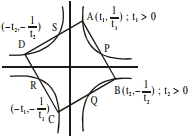
View full question & answer→MCQ 3571 Mark
Consider a hyperbola $H : x ^{2}-2 y ^{2}=4$. Let the tangent at a point $P (4, \sqrt{6})$ meet the $x$ -axis at $Q$ and latus rectum at $R \left( x _{1}, y _{1}\right), x _{1}>0 .$ If $F$ is a focus of $H$ which is nearer to the point $P$, then the area of $\Delta QFR$ is equal to ....... .
- A
$4 \sqrt{6}$
- B
$\sqrt{6}-1$
- ✓
$\frac{7}{\sqrt{6}}-2$
- D
$4 \sqrt{6}-1$
AnswerCorrect option: C. $\frac{7}{\sqrt{6}}-2$
c
$\frac{x^{2}}{4}-\frac{y^{2}}{2}=1$
$e=\sqrt{1+\frac{b^{2}}{a^{2}}}=\sqrt{\frac{3}{2}}$
$\therefore$ Focus $F ( ae , 0) \Rightarrow F (\sqrt{6}, 0)$
equation of tangent at $P$ to the hyperbola is
$2 x-y \sqrt{6}=2$
tangent meet $x$ -axis at $Q(1,0)$
And latus rectum $x=\sqrt{6}$ at $R\left(\sqrt{6}, \frac{2}{\sqrt{6}}(\sqrt{6}-1)\right)$
$\therefore$ Area of $\Delta_{ QFR }=\frac{1}{2}(\sqrt{6}-1) \cdot \frac{2}{\sqrt{6}}(\sqrt{6}-1)$
$=\frac{7}{\sqrt{6}}-2$
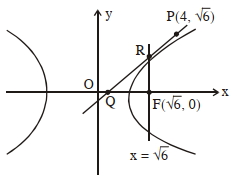
View full question & answer→MCQ 3581 Mark
The locus of the point of intersection of the lines $(\sqrt{3}) kx + ky -4 \sqrt{3}=0$ and $\sqrt{3} x-y-4(\sqrt{3}) k=0$ is a conic, whose eccentricity is .............
Answerb
$K =\frac{4 \sqrt{3}}{\sqrt{3} x + y }=\frac{\sqrt{3} x - y }{4 \sqrt{3}}$
$\Rightarrow 3 x ^{2}- y ^{2}=48$
$\Rightarrow \frac{ x ^{2}}{16}-\frac{ y ^{2}}{48}=1$
Now, $48=16\left( e ^{2}-1\right)$
$\Rightarrow e =\sqrt{4}=2$
View full question & answer→MCQ 3591 Mark
The point $\mathrm{P}(-2 \sqrt{6}, \sqrt{3})$ lies on the hyperbola $\frac{x^{2}}{a^{2}}-\frac{y^{2}}{b^{2}}=1$ having eccentricity $\frac{\sqrt{5}}{2} .$ If the tangent and normal at $\mathrm{P}$ to the hyperbola intersect its conjugate axis at the point $\mathrm{Q}$ and $\mathrm{R}$ respectively, then $QR$ is equal to :
- A
$4 \sqrt{3}$
- B
$6$
- C
$6 \sqrt{3}$
- ✓
$3 \sqrt{6}$
AnswerCorrect option: D. $3 \sqrt{6}$
d
$\mathrm{P}(-2 \sqrt{6}, \sqrt{3})$ lies on hyperbola
$\mathrm{e}=\frac{\sqrt{5}}{2} \Rightarrow \mathrm{b}^{2}=\mathrm{a}^{2}\left(\frac{5}{4}-1\right) \Rightarrow 4 \mathrm{~b}^{2}=\mathrm{a}^{2}$
$\text { Put in (i) } \Rightarrow \frac{6}{\mathrm{~b}^{2}}-\frac{3}{\mathrm{~b}^{2}}=1 \Rightarrow \mathrm{b}=\sqrt{3}$
$\Rightarrow \mathrm{a}=\sqrt{12}$
$\frac{x^{2}}{12}-\frac{y^{2}}{3}=1$ $[Image]$
Tangent at $\mathrm{P}$ :
$\frac{-x}{\sqrt{6}}-\frac{y}{\sqrt{3}}=1 \Rightarrow Q(0, \sqrt{3})$
Slope of $\mathrm{T}=-\frac{1}{\sqrt{2}}$
Normal at $P :$
$y-\sqrt{3}=\sqrt{2}(x+2 \sqrt{6})$
$\Rightarrow \quad R=(0,5 \sqrt{3})$
$Q R=6 \sqrt{3}$
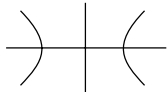
View full question & answer→MCQ 3601 Mark
The locus of the mid points of the chords of the hyperbola $\mathrm{x}^{2}-\mathrm{y}^{2}=4$, which touch the parabola $\mathrm{y}^{2}=8 \mathrm{x}$, is :
AnswerCorrect option: C. $\mathrm{y}^{2}(\mathrm{x}-2)=\mathrm{x}^{3}$
c
$\mathrm{T}=\mathrm{S}_{1}$
$\mathrm{xh}-\mathrm{yk}=\mathrm{h}^{2}-\mathrm{k}^{2}$
$\mathrm{y}=\frac{\mathrm{xh}}{\mathrm{k}}-\frac{\left(\mathrm{h}^{2}-\mathrm{k}^{2}\right)}{\mathrm{k}}$
this touches $y^{2}=8 x$ then $c=\frac{a}{m}$
$\left(\frac{\mathrm{k}^{2}-\mathrm{h}^{2}}{\mathrm{k}}\right)=\frac{2 \mathrm{k}}{\mathrm{h}}$
$2 \mathrm{y}^{2}=\mathrm{x}\left(\mathrm{y}^{2}-\mathrm{x}^{2}\right)$
$\mathrm{y}^{2}(\mathrm{x}-2)=\mathrm{x}^{3}$
View full question & answer→MCQ 3611 Mark
Let $\mathrm{A}\,(\sec \theta, 2 \tan \theta)$ and $\mathrm{B}\,(\sec \phi, 2 \tan \phi)$, where $\theta+\phi=\pi / 2$, be two points on the hyperbola $2 \mathrm{x}^{2}-\mathrm{y}^{2}=2$. If $(\alpha, \beta)$ is the point of the intersection of the normals to the hyperbola at $\mathrm{A}$ and $\mathrm{B}$, then $(2 \beta)^{2}$ is equal to ..... .
Answerd
Since, point $A(\sec \theta, 2 \tan \theta)$
lies on the hyperbola
$2 x^{2}-y^{2}=2$
Therefore, $2 \sec ^{2} \theta-4 \tan ^{2} \theta=2$
$\Rightarrow 2+2 \tan ^{2} \theta-4 \tan ^{2} \theta=2$
$\Rightarrow \tan \theta=0 \Rightarrow \theta=0$
Similarly, for point $\mathrm{B}$, we will get $\phi=0$.
but according to question $\theta+\phi=\frac{\pi}{2}$
which is not possible.
View full question & answer→MCQ 3621 Mark
Let a line $L: 2 x+y=k, k\,>\,0$ be a tangent to the hyperbola $x^{2}-y^{2}=3 .$ If $L$ is also a tangent to the parabola $y^{2}=\alpha x$, then $\alpha$ is equal to :
Answerc
Tangent to hyperbola of
Slope $\mathrm{m}=-2$ (given)
$y=-2 x \pm \sqrt{3(3)}$
$\left(y=m x \pm \sqrt{a^{2} m^{2}-b^{2}}\right)$
$\Rightarrow y+2 x=\pm 3 \Rightarrow 2 x+y=3(k\,>\,0)$
For parabola $y^{2}=a x$
$y=m x+\frac{\alpha}{4 m}$
$\Rightarrow y=-2 x+\frac{\alpha}{-8}$
$\Rightarrow \frac{\alpha}{-8}=3$
$\Rightarrow=-24$
View full question & answer→MCQ 3631 Mark
The locus of the centroid of the triangle formed by any point $\mathrm{P}$ on the hyperbola $16 \mathrm{x}^{2}-9 \mathrm{y}^{2}+$ $32 x+36 y-164=0$, and its foci is:
- A
$9 x^{2}-16 y^{2}+36 x+32 y-36=0$
- ✓
$16 x^{2}-9 y^{2}+32 x+36 y-36=0$
- C
$16 x^{2}-9 y^{2}+32 x+36 y-144=0$
- D
$9 x^{2}-16 y^{2}+36 x+32 y-144=0$
AnswerCorrect option: B. $16 x^{2}-9 y^{2}+32 x+36 y-36=0$
b
Given hyperbola is
$16(x+1)^{2}-9(y-2)^{2}=164+16-36=144$
$\Rightarrow \frac{(x+1)^{2}}{9}-\frac{(y-2)^{2}}{16}=1$
$\text { Eccentricity, } e=\sqrt{1+\frac{16}{9}}=\frac{5}{3}$
$\Rightarrow \text { foci are }(4,2) \text { and }(-6,2)$
Let the centroic be $(\mathrm{h}, \mathrm{k})$
$\, A(\alpha, \beta)$ be point on hyperbola
So $h=\frac{\alpha-6+4}{3}, k=\frac{\beta+2+2}{3}$
$\Rightarrow \alpha=3 h+2, \beta=3 k-4$
$(\alpha, \beta)$ lies on hyperbola so
$16(3 h+2+1)^{2}-9(3 k-4-2)^{2}=144$
$\Rightarrow 144(h+1)^{2}-81(k-2)^{2}=144$
$\Rightarrow 16\left(h^{2}+2 h+1\right)-9\left(k^{2}-4 k+4\right)=16$
$\Rightarrow 16 x^{2}-9 y^{2}+32 x+36 y-36=0$
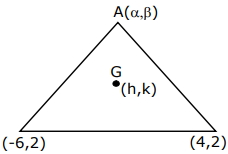
View full question & answer→MCQ 3641 Mark
Area (in sq. units) of the region outside $\frac{|\mathrm{x}|}{2}+\frac{|\mathrm{y}|}{3}=1$ and inside the ellipse $\frac{\mathrm{x}^{2}}{4}+\frac{\mathrm{y}^{2}}{9}=1$ is
- A
$3(4-\pi)$
- ✓
$6(\pi-2)$
- C
$3(\pi-2)$
- D
$6(4-\pi)$
AnswerCorrect option: B. $6(\pi-2)$
b
$\frac{|x|}{2}+\frac{|y|}{3}=1$
$\frac{x^{2}}{4}+\frac{y^{2}}{9}=1$
Area of Ellipse $=\pi a b=6 \pi$
Required area,
$=\pi \times 2 \times 3-($ Area of quadrilateral $)$
$=6 \pi-\frac{1}{2} 6 \times 4$
$=6 \pi-12$
$=6(\pi-2)$
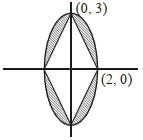
View full question & answer→MCQ 3651 Mark
If the co-ordinates of two points $A$ and $B$ are $(\sqrt{7}, 0)$ and $(-\sqrt{7}, 0)$ respectively and $P$ is any point on the conic, $9 x^{2}+16 y^{2}=144,$ then $PA + PB$ is equal to
Answera
$\frac{x^{2}}{16}+\frac{y^{2}}{9}=1$
$a =4 ; b =3 ; e =\sqrt{\frac{16-9}{16}}=\frac{\sqrt{7}}{4}$
A and $B$ are foci
$\Rightarrow PA + PB =2 a =2 \times 4=8$
View full question & answer→MCQ 3661 Mark
If $y=m x+4$ is a tangent to both the parabolas, $\mathrm{y}^{2}=4 \mathrm{x}$ and $\mathrm{x}^{2}=2 \mathrm{by},$ then $\mathrm{b}$ is equal to
- A
$128$
- B
$-64$
- ✓
$-128$
- D
$-32$
AnswerCorrect option: C. $-128$
c
$y=m x+4$ is tangent to $y^{2}=4 x$
$\Rightarrow \mathrm{m}=\frac{1}{4}$
$y=\frac{1}{4} x+4$ is tangent to $x^{2}=2 b y$
$\Rightarrow x^{2}-\frac{b}{2} x-8 b=0$
$\Rightarrow \mathrm{D}=0$
$b^{2}+128 b=0$
$\Rightarrow \mathrm{b}=-128,0$
$\mathrm{b} \neq 0 \Rightarrow \mathrm{b}=-128$
View full question & answer→MCQ 3671 Mark
Let a line $\mathrm{y}=\mathrm{mx}(\mathrm{m}>0)$ intersect the parabola, $\mathrm{y}^{2}=\mathrm{x}$ at a point $\mathrm{P},$ other than the origin. Let the tangent to it at $P$ meet the $x$ -axis at the point $Q$. If area $(\Delta \mathrm{OPQ})=4$ sq. units, then $\mathrm{m}$ is equal to
- A
$1.5$
- ✓
$0.5$
- C
$1.33$
- D
$1.67$
Answerb
$\Delta \mathrm{OPQ}=4$
$\frac{1}{2}\left|\begin{array}{ccc}{0} & {0} & {1} \\ {t^{2}} & {t} & {1} \\ {-t^{2}} & {0} & {1}\end{array}\right|=4$
$\mathrm{t}=2(\because \mathrm{t}>0)$
$\therefore m=\frac{1}{2}$
Ans. $0.50$
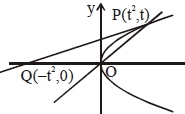
View full question & answer→MCQ 3681 Mark
The locus of a point which divides the line segment joining the point $(0,-1)$ and a point on the parabola, $\mathrm{x}^{2}=4 \mathrm{y},$ internally in the ratio $1: 2,$ is
- A
$9 x^{2}-3 y=2$
- ✓
$9 x^{2}-12 y=8$
- C
$x^{2}-3 y=2$
- D
$4 x^{2}-3 y=2$
AnswerCorrect option: B. $9 x^{2}-12 y=8$
b
$\Rightarrow 3 \mathrm{h}=2 \mathrm{t}$ and $3 \mathrm{k}=\mathrm{t}^{2}-2$
$\Rightarrow 3 \mathrm{y}=\left(\frac{3 \mathrm{x}}{2}\right)^{2}-2 $$\Rightarrow 12 \mathrm{y}=9 \mathrm{x}^{2}-8$
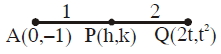
View full question & answer→MCQ 3691 Mark
If one end of a focal chord $\mathrm{AB}$ of the parabola $\mathrm{y}^{2}=8 \mathrm{x}$ is at $\mathrm{A}\left(\frac{1}{2},-2\right),$ then the equation of the tangent to it at $\mathrm{B}$ is
- A
$2 x+y-24=0$
- ✓
$x-2 y+8=0$
- C
$2 x-y-24=0$
- D
$x+2 y+8=0$
AnswerCorrect option: B. $x-2 y+8=0$
b
$\mathrm{y}^{2}=8 \mathrm{x}$
$4 \mathrm{t}_{1}=-2 \Rightarrow \mathrm{t}_{1}=-\frac{1}{2}$
$\mathrm{t}_{1}, \mathrm{t}_{2}=-1$
$\mathrm{t}_{2}=-\frac{1}{\mathrm{t}_{1}}$
$\Rightarrow \mathrm{t}_{2}=2$
So coordinate of $\mathrm{B}$ is $(8,8)$
$\therefore$ Equation of tangent at $\mathrm{B}$ is $8 y=4(x+8) \Rightarrow 2 y=x+8$
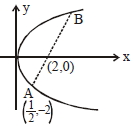
View full question & answer→MCQ 3701 Mark
Let $P$ be a point on the parabola, $y^{2}=12 x$ and $N$ be the foot of the perpendicular drawn from $P$ on the axis of the parabola. A line is now drawn through the mid-point $M$ of $PN$, parallel to its axis which meets the parabola at $Q$. If the $y$-intercept of the line $NQ$ is $\frac{4}{3},$ then
- A
$MQ =\frac{1}{3}$
- B
$PN =3$
- ✓
$MQ =\frac{1}{4}$
- D
$PN =4$
AnswerCorrect option: C. $MQ =\frac{1}{4}$
c
Let $P =\left(3 t ^{2}, 6 t \right) ; N =\left(3 t ^{2}, 0\right)$
$M =\left(3 t ^{2}, 3 t \right)$
Equation of $MQ : y =3 t$
$\therefore \quad Q=\left(\frac{3}{4} t^{2}, 3 t\right)$
Equation of NQ
$y=\frac{3 t}{\left(\frac{3}{4} t^{2}-3 t^{2}\right)}\left(x-3 t^{2}\right)$
y-intercept of $NQ =4 t =\frac{4}{3} \Rightarrow t =\frac{1}{3}$
$\therefore \quad MQ =\frac{9}{4} t ^{2}=\frac{1}{4}$
$PN =6 t =2$
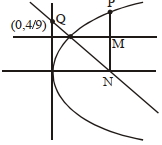
View full question & answer→MCQ 3711 Mark
Let $P (3,3)$ be a point on the hyperbola, $\frac{x^{2}}{a^{2}}-\frac{y^{2}}{b^{2}}=1 .$ If the normal to it at $P$ intersects the $x$-axis at $(9,0)$ and $e$ is its eccentricity, then the ordered pair $\left( a ^{2}, e ^{2}\right)$ is equal to
- ✓
$\left(\frac{9}{2}, 3\right)$
- B
$\left(\frac{9}{2}, 2\right)$
- C
$\left(\frac{3}{2}, 2\right)$
- D
$(9,3)$
AnswerCorrect option: A. $\left(\frac{9}{2}, 3\right)$
a
since, (3,3) lies on $\frac{x^{2}}{a^{2}}-\frac{y^{2}}{b^{2}}=1$
$\frac{9}{a^{2}}-\frac{9}{b^{2}}=1$
Now, normal at (3,3) is $y-3=-\frac{a^{2}}{b^{2}}(x-3)$
which passes through $(9,0) \Rightarrow b ^{2}=2 a ^{2} \quad \ldots .(2)$
So, $e ^{2}=1+\frac{ b ^{2}}{ a ^{2}}=3$
Also, $a^{2}=\frac{9}{2} \quad($ from $(i) \&($ ii $))$
Thus, $\left(a^{2}, e^{2}\right)=\left(\frac{9}{2}, 3\right)$
View full question & answer→MCQ 3721 Mark
If the common tangent to the parabolas, $y ^{2}=4 x$ and $x ^{2}=4 y$ also touches the circle, $x^{2}+y^{2}=c^{2},$ then $c$ is equal to
- A
$\frac{1}{2}$
- B
$\frac{1}{2 \sqrt{2}}$
- ✓
$\frac{1}{\sqrt{2}}$
- D
$\frac{1}{4}$
AnswerCorrect option: C. $\frac{1}{\sqrt{2}}$
c
$y=m x+\frac{1}{m}\left(\operatorname{tangent} a t y^{2}=4 x\right)$
$y=m x-m^{2}\left(\operatorname{tangent} a t x^{2}=4 y\right)$
$\frac{1}{ m }=- m ^{2}$ (for common tangent)
$m ^{3}=-1$
$m=-1$
$y=-x-1$
$x+y+1=0$
This line touches circle
$\therefore$ apply $p = r$
$c=\left|\frac{0+0+1}{\sqrt{2}}\right|=\frac{1}{\sqrt{2}}$
View full question & answer→MCQ 3731 Mark
Let $L_{1}$ be a tangent to the parabola $y ^{2}=4( x +1)$ and $L _{2}$ be a tangent to the parabola $y ^{2}=8( x +2)$ such that $L _{1}$ and $L _{2}$ intersect at right angles. Then $L_{1}$ and $L_{2}$ meet on the straight line
- ✓
$x+3=0$
- B
$x+2 y=0$
- C
$2 x+1=0$
- D
$x+2=0$
AnswerCorrect option: A. $x+3=0$
a
$y^{2}=4(x+1)$
equation of tangent $y=m(x+1)+\frac{1}{m}$
$y=m x+m+\frac{1}{m}$
$y^{2}=8(x+2)$
equation of tangent $y = m ^{\prime}( x +2)+\frac{2}{ m ^{\prime}}$
$y = m ^{\prime} x +2\left( m ^{\prime}+\frac{1}{ m ^{\prime}}\right)$
since lines intersect at right angles $\therefore mm ^{\prime}=-1$
Now $y=m x+m+\frac{1}{m}$
$y=m^{\prime} x+2\left(m^{\prime}+\frac{1}{m^{\prime}}\right)$
$y =-\frac{1}{ m } x +2\left(-\frac{1}{ m }- m \right)$
$y=-\frac{1}{m} x-2\left(m+\frac{1}{m}\right)$
From equation (1) and (2)
$mx + m +\frac{1}{ m }=-\frac{1}{ m } x -2\left( m +\frac{1}{ m }\right)$
$\left( m +\frac{1}{ m }\right) x +3\left( m +\frac{1}{ m }\right)=0$
$\therefore x+3=0$
View full question & answer→MCQ 3741 Mark
If $3 x+4 y=12 \sqrt{2}$ is a tangent to the ellipse $\frac{\mathrm{x}^{2}}{\mathrm{a}^{2}}+\frac{\mathrm{y}^{2}}{9}=1$ for some a $\in \mathrm{R},$ then the distance between the foci of the ellipse is
- A
$4$
- ✓
$2\sqrt 7$
- C
$2\sqrt 5$
- D
$2\sqrt 2$
AnswerCorrect option: B. $2\sqrt 7$
b
$3 \mathrm{x}+4 \mathrm{y}=12 \sqrt{12}$ is tangent to $\frac{\mathrm{x}^{2}}{\mathrm{a}^{2}}+\frac{\mathrm{y}^{2}}{9}=1$
$c^{2}=m^{2} a^{2}+b^{2}$
$\Rightarrow a^{2}=16$
$\mathrm{e}=\sqrt{1-\frac{9}{16}}=\frac{\sqrt{7}}{4}$
Distance between focii $=2 \mathrm{ae}=2 \sqrt{7}$
View full question & answer→MCQ 3751 Mark
If the distance between the foci of an ellipse is $6$ and the distance between its directrices is $12$, then the length of its latus rectum is
- A
$\sqrt 3$
- B
$2\sqrt 3$
- ✓
$3\sqrt 2$
- D
$\frac{3}{\sqrt 2}$
AnswerCorrect option: C. $3\sqrt 2$
c
Given $2 \mathrm{ae}=6 \Rightarrow \quad \mathrm{ae}=3\dots(1)$
and $\frac{2 a}{e}=12 \Rightarrow \mathbb{a}=6 e\dots(2)$
from $( 1)$ and $( 2)$
$6 e^{2}=3 \Rightarrow \quad e=\frac{1}{\sqrt{2}}$
$\Rightarrow \quad a=3 \sqrt{2}$
Now, $b^{2}=a^{2}\left(1-e^{2}\right)$
$\Rightarrow \mathrm{b}^{2}=18\left(1-\frac{1}{2}\right)=9$
Length of L.R $=\frac{2(9)}{3 \sqrt{2}}=3 \sqrt{2}$
View full question & answer→MCQ 3761 Mark
Let the line $y=m x$ and the ellipse $2 x^{2}+y^{2}=1$ intersect at a ponit $\mathrm{P}$ in the first quadrant. If the normal to this ellipse at $P$ meets the co-ordinate axes at $\left(-\frac{1}{3 \sqrt{2}}, 0\right)$ and $(0, \beta),$ then $\beta$ is equal to
- A
$\frac{2}{\sqrt{3}}$
- B
$\frac{2 \sqrt{2}}{3}$
- C
$\frac{2 }{3}$
- ✓
$\frac{\sqrt{2}}{3}$
AnswerCorrect option: D. $\frac{\sqrt{2}}{3}$
d
Any normal to the ellipse is
$\frac{\mathrm{x} \sec \theta}{\sqrt{2}}-\mathrm{y} \cos \mathrm{ec} \theta=-\frac{1}{2}$
$\Rightarrow \frac{\mathrm{x}}{\left(\frac{-\cos \theta}{\sqrt{2}}\right)}+\frac{\mathrm{y}}{\left(\frac{\sin \theta}{2}\right)}=1$
$\Rightarrow \frac{\cos \theta}{\sqrt{2}}=\frac{1}{3 \sqrt{2}}$ and $\frac{\sin \theta}{2}=\beta$
$\Rightarrow \beta=\frac{\sqrt{2}}{3}$
View full question & answer→MCQ 3771 Mark
The length of the minor axis (along $y-$axis) of an ellipse in the standard form is $\frac{4}{\sqrt{3}} .$ If this ellipse touches the line, $x+6 y=8 ;$ then its eccentricity is
- A
$\sqrt{\frac{5}{6}}$
- ✓
$\frac{1}{2} \sqrt{\frac{11}{3}}$
- C
$\frac{1}{3} \sqrt{\frac{11}{3}}$
- D
$\frac{1}{2} \sqrt{\frac{5}{3}}$
AnswerCorrect option: B. $\frac{1}{2} \sqrt{\frac{11}{3}}$
b
Let $\frac{\mathrm{x}^{2}}{\mathrm{a}^{2}}+\frac{\mathrm{y}^{2}}{\mathrm{b}^{2}}=1 ; \mathrm{a}>\mathrm{b}$
$2 b=\frac{4}{\sqrt{3}} \Rightarrow b=\frac{2}{\sqrt{3}} \Rightarrow b^{2}=\frac{4}{3}$
tangent $\mathrm{y}=\frac{-\mathrm{x}}{6}+\frac{4}{3}$ compare with
$\mathrm{y}=\mathrm{mx} \pm \sqrt{\mathrm{a}^{2} \mathrm{m}^{2}+\mathrm{b}^{2}}$
$\Rightarrow \mathrm{m}=\frac{-1}{6} \Rightarrow \sqrt{\frac{\mathrm{a}^{2}}{36}+\frac{4}{3}}=\frac{4}{3} \Rightarrow \mathrm{a}=4$
$e=\sqrt{1-\frac{b^{2}}{a^{2}}}=\frac{1}{2} \sqrt{\frac{11}{3}}$
View full question & answer→MCQ 3781 Mark
For some $\theta \in\left(0, \frac{\pi}{2}\right),$ if the eccentricity of the hyperbola, $x^{2}-y^{2} \sec ^{2} \theta=10$ is $\sqrt{5}$ times the eccentricity of the ellipse, $x^{2} \sec ^{2} \theta+y^{2}=5,$ then the length of the latus rectum of the ellipse is
- A
$\sqrt{30}$
- ✓
$\frac{4 \sqrt{5}}{3}$
- C
$2 \sqrt{6}$
- D
$\frac{2 \sqrt{5}}{3}$
AnswerCorrect option: B. $\frac{4 \sqrt{5}}{3}$
b
Given $\theta \in\left(0, \frac{\pi}{2}\right)$
equation of hyperbola $\Rightarrow x^{2}-y^{2} \sec ^{2} \theta=10$
$\Rightarrow \frac{x^{2}}{10}-\frac{y^{2}}{10 \cos ^{2} \theta}=1$
Hence eccentricity of hyperbola
$\left(\mathrm{e}_{\mathrm{H}}\right)=\sqrt{1+\frac{10 \cos ^{2} \theta}{10}} \ldots$.
$\left\{e=\sqrt{1+\frac{b^{2}}{a^{2}}}\right\}$
Now equation of ellipse $\Rightarrow x^{2} \sec ^{2} \theta+y^{2}=5$
$\Rightarrow \frac{\mathrm{x}^{2}}{5 \cos ^{2} \theta}+\frac{\mathrm{y}^{2}}{5}=1 \quad\left\{\mathrm{e}=\sqrt{1-\frac{\mathrm{a}^{2}}{\mathrm{b}^{2}}}\right\}$
Hence eccenticity of ellipse
$\left(e_{E}\right)=\sqrt{1-\frac{5 \cos ^{2} \theta}{5}}$
$\left(e_{E}\right)=\sqrt{1-\cos ^{2} \theta}=\sin \theta=\sin \theta \quad \cdots(2)$
$\left\{\because \theta \in\left(0, \frac{\pi}{2}\right)\right\}$
given $\Rightarrow \mathrm{e}_{\mathrm{H}}=\sqrt{5} \mathrm{e}_{\mathrm{e}}$
Hence $1+\cos ^{2} \theta=5 \sin ^{2} \theta$
$1+\cos ^{2} \theta=5\left(1-\cos ^{2} \theta\right)$
$1+\cos ^{2} \theta=5-5 \cos ^{2} \theta$
$6 \cos ^{2} \theta=4$
$\cos ^{2} \theta=\frac{2}{3}$
Now length of latus rectum of ellipse
$=\frac{2 \mathrm{a}^{2}}{\mathrm{b}}=\frac{10 \cos ^{2} \theta}{\sqrt{5}}=\frac{20}{3 \sqrt{5}}=\frac{4 \sqrt{5}}{3}$
View full question & answer→MCQ 3791 Mark
If the normal at an end of a latus rectum of an ellipse passes through an extremity of the minor axis, then the eccentricity $e$ of the ellipse satisfies
- A
$e ^{2}+2 e -1=0$
- B
$e ^{2}+ e -1=0$
- C
$e ^{4}+2 e ^{2}-1=0$
- ✓
$e ^{4}+ e ^{2}-1=0$
AnswerCorrect option: D. $e ^{4}+ e ^{2}-1=0$
d
$\frac{ a ^{2} x }{ x _{1}}-\frac{ b ^{2} y }{ y _{1}}= a ^{2} e ^{2}$
$\frac{a^{2} x}{a e}-\frac{b^{2} y}{b^{2}} \cdot a=a^{2} e^{2}$
$\frac{ ax }{ e }- ay = a ^{2} e ^{2} \Rightarrow \frac{ x }{ e }- y = ae ^{2}$
passes through $(0,$ b) $-b=a e^{2} \Rightarrow b^{2}=a^{2} e^{4}$
$a^{2}\left(1-e^{2}\right)=a^{2} e^{4} \Rightarrow e^{4}+e^{2}=1$
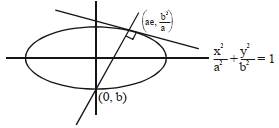
View full question & answer→MCQ 3801 Mark
Which of the following points lies on the locus of the foot of perpendicular drawn upon any tangent to the ellipse, $\frac{x^{2}}{4}+\frac{y^{2}}{2}=1$ from any of its foci?
- ✓
$(-1, \sqrt{3})$
- B
$(-1, \sqrt{2})$
- C
$(-2, \sqrt{3})$
- D
$(1,2)$
AnswerCorrect option: A. $(-1, \sqrt{3})$
a
Let foot of perpendicular is $( h , k )$
$\frac{x^{2}}{4}+\frac{y^{2}}{2}=1 \quad($ Given $)$
$a=2, b=\sqrt{2}, e=\sqrt{1-\frac{2}{4}}=\frac{1}{\sqrt{2}}$
$\therefore$ Focus $( ae , 0)=(\sqrt{2}, 0)$
Equation of tangent
$y=m x+\sqrt{a^{2} m^{2}+b^{2}}$
$y \equiv m x+\sqrt{4 m^{2}+2}$
Passes throguh (h,k) $( k - mh )^{2}=4 m ^{2}+2$
line perpendicular to tangent will have slope
$-\frac{1}{m}$
$y-0=-\frac{1}{m}(x-\sqrt{2})$
$my =- x +\sqrt{2}$
$( h + mk )^{2}=2$
Add equaiton (1) and (2) $k ^{2}\left(1+ m ^{2}\right)+ h ^{2}\left(1+ m ^{2}\right)=4\left(1+ m ^{2}\right)$
$h^{2}+k^{2}=4$
$x^{2}+y^{2}=4$ (Auxilary circle)
$\therefore(-1, \sqrt{3})$ lies on the locus.
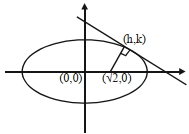
View full question & answer→MCQ 3811 Mark
If a hyperbola passes through the point $\mathrm{P}(10,16)$ and it has vertices at $(\pm 6,0),$ then the equation of the normal to it at $P$ is
- A
$x+2 y=42$
- B
$3 x+4 y=94$
- ✓
$2 x+5 y=100$
- D
$x+3 y=58$
AnswerCorrect option: C. $2 x+5 y=100$
c
$\frac{x^{2}}{36}-\frac{y^{2}}{b^{2}}=1$
$\mathrm{P}(10,16)$ lies on ( i ) get $\mathrm{b}^{2}=144$
$\frac{x^{2}}{36}-\frac{y^{2}}{144}=1$
Equation of normal is
$\frac{\mathrm{a}^{2} \mathrm{x}}{\mathrm{x}_{1}}+\frac{\mathrm{b}^{2} \mathrm{y}}{\mathrm{y}_{1}}=\mathrm{a}^{2} \mathrm{e}^{2}$
$2 x+5 y=100$
View full question & answer→MCQ 3821 Mark
If $\mathrm{e}_{1}$ and $\mathrm{e}_{2}$ are the eccentricities of the ellipse, $\frac{\mathrm{x}^{2}}{18}+\frac{\mathrm{y}^{2}}{4}=1$ and the hyperbola, $\frac{\mathrm{x}^{2}}{9}-\frac{\mathrm{y}^{2}}{4}=1$ respectively and $\left(\mathrm{e}_{1}, \mathrm{e}_{2}\right)$ is a point on the ellipse, $15 \mathrm{x}^{2}+3 \mathrm{y}^{2}=\mathrm{k},$ then $\mathrm{k}$ is equal to
Answerd
$e_{1}=\sqrt{1-\frac{4}{18}}=\frac{\sqrt{7}}{3}$
$\mathrm{e}_{2}=\sqrt{1+\frac{4}{9}}=\frac{\sqrt{13}}{3}$
$\because \quad\left(\mathrm{e}_{1}, \mathrm{e}_{2}\right)$ lies on $15 \mathrm{x}^{2}+3 \mathrm{y}^{2}=\mathrm{k}$
$\Rightarrow \quad 15 \mathrm{e}_{1}^{2}+3 \mathrm{e}_{2}^{2}=\mathrm{k}$
$\Rightarrow \quad k=16$
View full question & answer→MCQ 3831 Mark
A line parallel to the straight line $2 x-y=0$ is tangent to the hyperbola $\frac{x^{2}}{4}-\frac{y^{2}}{2}=1$ at the point $\left(x_{1}, y_{1}\right) .$ Then $x_{1}^{2}+5 y_{1}^{2}$ is equal to
Answerb
Slope of tangent is $2,$ Tangent of hyperbola
$\frac{x^{2}}{4}-\frac{y^{2}}{2}=1$ at the point $\left(x_{1}, y_{1}\right)$ is
$\frac{\mathrm{xx}_{1}}{4}-\frac{\mathrm{yy}_{1}}{2}=1 \quad(\mathrm{T}=0)$
Slope $: \frac{1}{2} \frac{x_{1}}{y_{1}}=2 \Rightarrow\left[x_{1}=4 y_{1}\right.$
$\left(\mathrm{x}_{1}, \mathrm{y}_{1}\right)$ lies on hyperbola
$\Rightarrow\left[\frac{x_{1}^{2}}{4}-\frac{y_{1}^{2}}{2}=1\right.$
From (1)$\&(2)$
$\frac{\left(4 y_{1}\right)^{2}}{4}-\frac{y_{1}^{2}}{2}=1 \Rightarrow 4 y_{1}^{2}-\frac{y_{1}^{2}}{2}=1$
$\Rightarrow 7 y_{1}^{2}=2 \Rightarrow y_{1}^{2}=2 / 7$
Now $x_{1}^{2}+5 y_{1}^{2}=\left(4 y_{1}\right)^{2}+5 y_{1}^{2}$
$=(21) \mathrm{y}_{1}^{2}=21 \times \frac{2}{7}=6$
View full question & answer→MCQ 3841 Mark
Let $e_{1}$ and $e_{2}$ be the eccentricities of the ellipse, $\frac{x^{2}}{25}+\frac{y^{2}}{b^{2}}=1(b<5)$ and the hyperbola $\frac{ x ^{2}}{16}-\frac{ y ^{2}}{ b ^{2}}=1$ respectively satisfying $e _{1} e _{2}=1 .$ If $\alpha$ and $\beta$ are the distances between the foci of the ellipse and the foci of the hyperbola respectively, then the ordered pair $(\alpha, \beta)$ is equal to
- ✓
$(8,10)$
- B
$(8,12)$
- C
$\left(\frac{20}{3}, 12\right)$
- D
$\left(\frac{24}{5}, 10\right)$
AnswerCorrect option: A. $(8,10)$
a
For ellipse $\frac{x^{2}}{25}+\frac{y^{2}}{b^{2}}=1 \quad(b<5)$
Let e $_{1}$ is eccentricity of ellipse
$\therefore \quad b^{2}=25\left(1-e_{1}^{2}\right) \ldots \ldots .(1)$
Again for hyperbola
$\frac{x^{2}}{16}-\frac{y^{2}}{b^{2}}=1$
Let $e _{2}$ is eccentricity of hyperbola.
$\therefore \quad b^{2}=16\left(e_{2}^{2}-1\right) \quad \ldots \ldots$
by (1)$\&(2)$
$25\left(1- e _{1}^{2}\right)=16\left( e _{2}^{2}-1\right)$
Now $e _{1} e _{2}=1 \quad$ (given)
$\therefore \quad 25\left(1- e _{1}^{2}\right)=16\left(\frac{1- e _{1}^{2}}{ e _{1}^{2}}\right)$
or $\quad e _{1}=\frac{4}{5} \quad \therefore e _{2}=\frac{5}{4}$
Now distance between foci is $2 ae$
$\therefore$ distance for ellipse $=2 \times 5 \times \frac{4}{5}=8=\alpha$
distance for hyperbola $=2 \times 4 \times \frac{5}{4}=10=\beta$
$\therefore(\alpha, \beta) \equiv(8,10)$
View full question & answer→MCQ 3851 Mark
A hyperbola having the transverse axis of length $\sqrt{2}$ has the same foci as that of the ellipse $3 x^{2}+4 y^{2}=12,$ then this hyperbola does not pass through which of the following points?
- A
$\left(1,-\frac{1}{\sqrt{2}}\right)$
- ✓
$\left(\sqrt{\frac{3}{2}}, \frac{1}{\sqrt{2}}\right)$
- C
$\left(\frac{1}{\sqrt{2}}, 0\right)$
- D
$\left(-\sqrt{\frac{3}{2}}, 1\right)$
AnswerCorrect option: B. $\left(\sqrt{\frac{3}{2}}, \frac{1}{\sqrt{2}}\right)$
b
Ellipse $: \frac{x^{2}}{4}+\frac{y^{2}}{3}=1$
eccentricity $=\sqrt{1-\frac{3}{4}}=\frac{1}{2}$
$\therefore$ foci $=(\pm 1,0)$
for hyperbola, given $2 a =\sqrt{2} \Rightarrow a =\frac{1}{\sqrt{2}}$
$\therefore \quad$ hyperbola will be
$\frac{x^{2}}{1 / 2}-\frac{y^{2}}{b^{2}}=1$
eccentricity $=\sqrt{1+2 b^{2}}$
$\therefore$ foci $=\left(\pm \sqrt{\frac{1+2 b^{2}}{2}}, 0\right)$
Ellipse and hyperbola have same foci
$\Rightarrow \sqrt{\frac{1+2 b^{2}}{2}}=1$
$\Rightarrow \quad b^{2}=\frac{1}{2}$
$\therefore$ Equation of hyperbola $: \frac{x^{2}}{1 / 2}-\frac{y^{2}}{1 / 2}=1$
$\Rightarrow x^{2}-y^{2}=\frac{1}{2}$
Clearly $\left(\sqrt{\frac{3}{2}}, \frac{1}{\sqrt{2}}\right)$ does not lie on it.
View full question & answer→MCQ 3861 Mark
If the line $y=m x+c$ is a common tangent to the hyperbola $\frac{x^{2}}{100}-\frac{y^{2}}{64}=1$ and the circle $x^{2}+y^{2}=36,$ then which one of the following is true?
- A
$5 m =4$
- ✓
$4 c^{2}=369$
- C
$c^{2}=369$
- D
$8 m+5=0$
AnswerCorrect option: B. $4 c^{2}=369$
b
$y=m x+c$ is tangent to
$\frac{x^{2}}{100}-\frac{y^{2}}{64}=1$ and $x^{2}+y^{2}=36$
$c^{2}=100 m^{2}-64 l c^{2}=36\left(1+m^{2}\right)$
$\Rightarrow 100 m ^{2}-64=36+36 m ^{2}$
$m ^{2}=\frac{100}{64} \Rightarrow m =\pm \frac{10}{8}$
$c^{2}=36\left(1+\frac{100}{64}\right)=\frac{36 \times 164}{64}$
$4 c^{2}=369$
View full question & answer→MCQ 3871 Mark
Let $S = \left\{ {\left( {x,y} \right) \in {R^2}:\frac{{{y^2}}}{{1 + r}} - \frac{{{x^2}}}{{1 - r}} = 1} \right\}$, where $r \ne \pm 1$. Then $S$ represents
- A
a hyperbola whose eccentricity is $\frac{2}{{\sqrt {1 - r} }}$ , when $0 < r < 1$.
- ✓
an ellipse whose eccentricity is $\sqrt {\frac{2}{{r + 1}}} $ , when $r > 1$
- C
a hyperbola whose eccentricity is $\frac{2}{{\sqrt {1 + r} }}$ , when $0 < r < 1$.
- D
an ellipse whose eccentricity is $\frac{1}{{\sqrt {1 + r} }}$ , when $r > 1$.
AnswerCorrect option: B. an ellipse whose eccentricity is $\sqrt {\frac{2}{{r + 1}}} $ , when $r > 1$
b
$\frac{{{y^2}}}{{1 + r}} - \frac{{{x^2}}}{{1 - r}} = 1$
$r > 1\,\,\,\, \Rightarrow $ ellipse
$e = \sqrt {1 - \left( {\frac{{r - 1}}{{r + 1}}} \right)} = \sqrt {\frac{2}{{r + 1}}} $
View full question & answer→MCQ 3881 Mark
Axis of a parabola lies along $x -$ axis. If its vertex and focus are at distance $2$ and $4$ respectively from the origin, on the positive $x -$ axis then which of the following points does not lie on it?
- A
$\left( {5,2\sqrt 6 } \right)$
- ✓
$(8, 6)$
- C
$\left( {6,4\sqrt 2 } \right)$
- D
$(4, -4)$
AnswerCorrect option: B. $(8, 6)$
b
Vertex is $(2, 0)$
$a = 2$
Any general point on given parabola can be taken as $\left( {2 + 2{t^2},4t} \right)\,\forall t \in R$ $(8, 6)$ does not lie on this
View full question & answer→MCQ 3891 Mark
Equation of a common tangent to the circle, $x^2 + y^2 - 6x = 0$ and the parabola, $y^2 = 4x$ , is
- A
$2\sqrt 3 y = 12x + 1$
- ✓
$\sqrt 3 y = x + 3$
- C
$2\sqrt 3 y = - x - 12$
- D
$\sqrt 3 y = 3x + 1$
AnswerCorrect option: B. $\sqrt 3 y = x + 3$
b
$ty = x + {t^2}$
$\left| {\frac{{3 + {t^2}}}{{\sqrt {1 + {t^2}} }}} \right| = 3$
$ \Rightarrow t = \sqrt 3 $
$ \Rightarrow \sqrt {3y} = x + 3$
View full question & answer→MCQ 3901 Mark
If $\theta$ denotes the acute angle between the curves, $y = 10 - x^2$ and $y = 2 + x^2$ at a point of their intersection, then $|\tan \,\theta |$ is equal to
- A
$\frac{4}{9}$
- ✓
$\frac{8}{15}$
- C
$\frac{7}{17}$
- D
$\frac{8}{17}$
AnswerCorrect option: B. $\frac{8}{15}$
b
$y = {x^2} + 2$ and $y = 10 - {x^2}$
Meet at $\left( { \pm 2,6} \right)$
$ \Rightarrow {m_1} = 4$ and ${m_2} = - 4$
$\left| {\tan \theta } \right| = \frac{8}{{15}}$
View full question & answer→MCQ 3911 Mark
Let $A\,(4, -4)$ and $B\,(9,6)$ be points on the parabola $y^2 = 4x$ . Let $C$ be chosen on the arc $AOB$ of the parabola, where $O$ is the origin, such that the area of $\Delta ACB$ is maximum. Then, the area (in sq. units) of $\Delta ACB,$ is
- A
$31\frac{3}{4}$
- B
$32$
- C
$30\frac{1}{2}$
- ✓
$31\frac{1}{4}$
AnswerCorrect option: D. $31\frac{1}{4}$
d
For maximum area, tangent at the point $c$ must be parallet to chord $BC$.
$\therefore t = \frac{1}{2}$
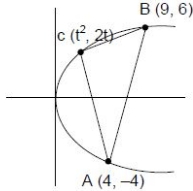
View full question & answer→MCQ 3921 Mark
If the parabolas $y^2 = 4b\,(x -c)$ and $y^2 = 8ax$ have a common normal, then which one of the following is a valid choice for the ordered triad $(a, b, c)$ ?
- A
$\left( {\frac{1}{2},2,3} \right)$
- ✓
$(1, 1, 3)$
- C
$\left( {\frac{1}{2},2,0} \right)$
- D
$(1, 1, 0)$
AnswerCorrect option: B. $(1, 1, 3)$
b
Normal to there $2$ curves are
$y = m\left( {x - c} \right) - 2bm - b{m^3}$
$y = mx - 4am - 2a{m^3}$
If they how a common normal
$\left( {c + 2b} \right) - 4a = \left( {2a - b} \right){m^2}$ ($m=0$ corresponds axis )
$ \Rightarrow {m^2} = \frac{c}{{2a - b}} - 2 < 0$
$\frac{c}{{2a - b}} < 2$
According to the quation answer is $(1,2,3,4)$ but my be in quation they want common noraml other than $x$ -axis hence answer is $(B)$
View full question & answer→MCQ 3931 Mark
The length of the chord of the parabola $x^2 = 4y$ having equation $x - \sqrt 2y + 4\sqrt 2 = 0$ is
- A
$3\sqrt 2$
- B
$2\sqrt {11}$
- C
$8\sqrt 2$
- ✓
$6\sqrt 3$
AnswerCorrect option: D. $6\sqrt 3$
d
$x = \sqrt 2 y - 4\sqrt 2 $
${x^2} = 4y$
Solving we get point of intersection
$A\left( { - 2\sqrt 2 ,2} \right),B\left( {4\sqrt 2 ,8} \right)$
$\therefore AB = \sqrt {{{\left( {6\sqrt 2 } \right)}^2} + {6^2}} = 6\sqrt 3 $
View full question & answer→MCQ 3941 Mark
If the area of the triangle whose one vertex is at the vertex of the parabola, ${y^2} + 4\,\left( {x - {a^2}} \right) = 0$ and the other two vertices are the points of intersection of the parabola and $y -$ axis, is $250\, sq$. units, then a value of $‘a’$ is
Answerd
${y^2} = - 4\left( {x - {a^2}} \right)$
Vertices of triangle are $\left( {{a^2},0} \right)$ and $\left( {0,2a} \right)$ and $\left( {0, - 2a} \right)$
Area $ = \frac{1}{2}\left( {{a^2}} \right)\left( {4a} \right) = 250$
$ \Rightarrow {a^3} = 125$
View full question & answer→MCQ 3951 Mark
Let $P(4, -4)$ and $Q(9, 6)$ be two points on the parabola, $y^2 = 4x$ and let $X$ be any point on the arc $POQ$ of this parabola, where $O$ is the vertex of this parabola, such that the area of $\Delta PXQ$ is maximum. Then this maximum Area (in sq. units) is
- A
$\frac{75}{2}$
- ✓
$\frac{125}{4}$
- C
$\frac{625}{4}$
- D
$\frac{125}{2}$
AnswerCorrect option: B. $\frac{125}{4}$
b
$^mPQ = \frac{{6 + 4}}{{9 - 4}} = 2$
$2yy' = 4 \Rightarrow 2y \times 2 = 4 \Rightarrow y = 1,x = \frac{1}{4},X = \left( {\frac{1}{4},1} \right)$
(coordinates of points $X$ for maximum area)
$\therefore $ area $ = \frac{{125}}{4}$ sq. units.
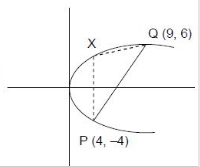
View full question & answer→MCQ 3961 Mark
The tangent to the parabola $y^2 = 4x$ at the point where it intersects the circle $x^2 + y^2 = 5$ in the first quadrant, passes through the point
- A
$\left( { - \frac{1}{3},\frac{4}{3}} \right)$
- ✓
$\left( {\frac{3}{4},\frac{7}{4}} \right)$
- C
$\left( { - \frac{1}{4},\frac{1}{2}} \right)$
- D
$\left( {\frac{1}{4},\frac{3}{4}} \right)$
AnswerCorrect option: B. $\left( {\frac{3}{4},\frac{7}{4}} \right)$
b
${x^2} + 4x = 5$
$ \Rightarrow x = - 5,x = 1$
$ \Rightarrow P\left( {1,2} \right)$
Tangent at $P$ is $y = x + 1$
$\left( {\frac{3}{4},\frac{7}{4}} \right)$ lies on this.
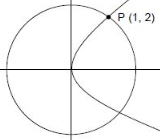
View full question & answer→MCQ 3971 Mark
If one end of a focal chord of the parabola, $y^2 = 16x$ is at $(1, 4),$ then the length of this focal chord is
Answera
${y^2} = 4ax = 16x \Rightarrow a = 4$
$A\left( {1,4} \right) \Rightarrow 2.4{t_1} = 4 \Rightarrow {t_1} = \frac{1}{2}$
$\therefore $ length of focal chord $ = a{\left( {t + \frac{1}{t}} \right)^2}$
$ = 4{\left( {\frac{1}{2} + 2} \right)^2} = 4.\frac{{25}}{4} = 25$
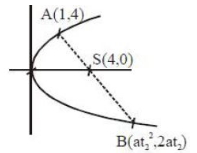
View full question & answer→MCQ 3981 Mark
The area (in $sq. units$) of the smaller of the two circles that touch the parabola, $y^2 = 4x$ at the points $(1, 2)$ and the axis is
- A
$4\pi \left( {2 - \sqrt 2 } \right)$
- ✓
$8\pi \left( {3 - 2\sqrt 2 } \right)$
- C
$4\pi \left( {3 + \sqrt 2 } \right)$
- D
$8\pi \left( {2 - \sqrt 2 } \right)$
AnswerCorrect option: B. $8\pi \left( {3 - 2\sqrt 2 } \right)$
b
Equation of tangent to the parabola ${y^2} = 4x\,\,at$
$\left( {1,2} \right)\,\,$ is $2y = 4\left( {\frac{{x + 1}}{2}} \right)$
$ \Rightarrow y = x + 1$
Equation of normal $y = - x + 3$
Let center be $C\left( {3 - r,r} \right)$
Now $P{C^2} = {r^2}$
$ \Rightarrow {\left( {3 - r - 1} \right)^2} + {\left( {r - 2} \right)^2} = {r^2}$
$ \Rightarrow 2{\left( {2 - r} \right)^2} = {r^2}$
$ \Rightarrow {r^2} - 8r + 8 = 0$
$ \Rightarrow r = 4 \pm 2\sqrt 2 $
For $r = 4 + 2\sqrt 2 \,\,\,\,\,\,\left( {3 - r < 0} \right)$ Not
possible
So $r = 4 - 2\sqrt 2 \,\,\,$
Area $ = \pi {r^2} = \pi \left( {16 + 8 - 16\sqrt 2 } \right)$
$ = 8\pi \left( {3 - 2\sqrt 2 } \right)$
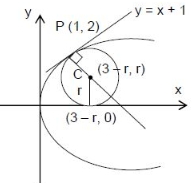
View full question & answer→MCQ 3991 Mark
If the line $ax + y = c,$ touches both the curves $x^2 + y^2 = 1$ and $y^2 - 4\sqrt 2 x ,$ then $|c|$ is equal to
- A
$\frac {1}{\sqrt 2}$
- ✓
$\sqrt 2$
- C
$\frac {1}{2}$
- D
$2$
AnswerCorrect option: B. $\sqrt 2$
b
Tangent to ${y^2} = 4\sqrt 2 x$ is $y = mx + \frac{{\sqrt 2 }}{m}$ it is also tangent to ${x^2} + {y^2} = 1$
$ \Rightarrow \left| {\frac{{\sqrt 2 /m}}{{\sqrt {1 + {m^2}} }}} \right| = 1 \Rightarrow m = \pm 1$
$ \Rightarrow $ Tnagent will be $y = x + \sqrt 2 $ or $y = - x - \sqrt 2 $ compara with $y = - ax + C$
$ \Rightarrow a = \pm 1$ and $C = \pm \sqrt 2 $
View full question & answer→MCQ 4001 Mark
The tangents to the curve $y = (x -2)^2 -1$ at its points of intersection with the line $x -y = 3$, intersect at the point
- A
$\left( {\frac{5}{3},1} \right)$
- B
$\left( {-\frac{5}{2},-1} \right)$
- C
$\left( {-\frac{5}{2},1} \right)$
- ✓
$\left( {\frac{5}{2},-1} \right)$
AnswerCorrect option: D. $\left( {\frac{5}{2},-1} \right)$
d
$x - y - 3 = 0\,\,\,\,\,\,\,\,\,\,......\left( i \right)$
will be chord of contact of parabola
Let the required point is $P\left( {{x_1},{y_1}} \right)$ chord of contact for point $P$ is
$\frac{{y + {y_1}}}{2} = x{x_1} - 4\frac{{\left( {x + {x_1}} \right)}}{2} + 3$
$y + {y_1} = 2{x_1}x - 4x - 4{x_1} + 6$
As equation $(i)$ and $(ii)$ are same line
$\frac{{2{x_1} - 4}}{1} = \frac{{ - 1}}{{ - 1}} = \frac{{ - 4{x_1} - {y_1} + 6}}{{ - 3}}$
$ \Rightarrow 2{x_1} - 4 = 1\,\,\,\,\,\,\,\,\,\,\,\,\,\,\,\,\,\,\,\,\,\,\,\,\, - 4{x_1} - {y_{ 1}} + 6 = - 3$
${x_1} = \frac{5}{2}\,\,\,\,\,\,\,\,\,\,\,\,\,\,\,\,\,\,\,\,\,\,\,\,\,\,\,\,\,\,\,\,\,\,\,\,\,\,\,\,\,\,\,\,\,\,\,\,\,\,\,\,\,\, - 10 - {y_{\kern 1pt} } + 9 = 0$
$\,\,\,\,\,\,\,\,\,\,\,\,\,\,\,\,\,\,\,\,\,\,\,\,\,\,\,\,\,\,\,\,\,\,\,\,\,\,\,\,\,\,\,\,\,\,\,\,\,\,\,\,\,\,\,\,\,\,\,\,\,\,\,\,\,\,\,\,\,\,\,{y_1} = - 1$
Hence correct answer is $\left( {\frac{5}{2}\,, - 1} \right)$ which is option $(D)$.
View full question & answer→MCQ 4011 Mark
If tangents are drawn to the ellipse $x^2 + 2y^2 = 2$ at all points on the ellipse other than its four vertices than the mid points of the tangents intercepted between the coordinate axes lie on the curve
- A
$\frac{1}{{4{x^2}}} + \frac{1}{{2{y^2}}} = 1$
- B
$\frac{{{x^2}}}{4} + \frac{{{y^2}}}{2} = 1$
- ✓
$\frac{1}{{2{x^2}}} + \frac{1}{{4{y^2}}} = 1$
- D
$\frac{{{x^2}}}{2} + \frac{{{y^2}}}{4} = 1$
AnswerCorrect option: C. $\frac{1}{{2{x^2}}} + \frac{1}{{4{y^2}}} = 1$
c
equation of tangent is
$\frac{x}{a}\cos \theta + \frac{y}{b}\sin \theta = 1$
$A$ is $\left( {\frac{a}{{\cos \theta }},0} \right)$
$B$ is $\left( {0,\frac{b}{{\sin \theta }}} \right)$
Let $P\left( {h,k} \right)$ is mid point
$2h = \frac{a}{{\cos \theta }}$
$2k = \frac{b}{{\sin \theta }}$
${\cos ^2}\theta + {\sin ^2}\theta = 1$
$ \Rightarrow \frac{{{a^2}}}{{4{h^2}}} + \frac{{{b^2}}}{{4{k^2}}} = 1$
$ \Rightarrow \frac{2}{{4{x^2}}} + \frac{1}{{4{y^2}}} = 1$
$ \Rightarrow \frac{1}{{2{x^2}}} + \frac{1}{{4{y^2}}} = 1$
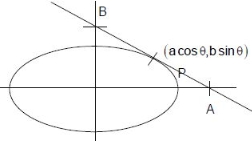
View full question & answer→MCQ 4021 Mark
Let the length of the latus rectum of an ellipse with its major axis long $x -$ axis and center at the origin, be $8$. If the distance between the foci of this ellipse is equal to the length of the length of its minor axis, then which one of the following points lies on it?
- A
$\left( {4,\sqrt 2 ,2\sqrt 2 } \right)$
- ✓
$\left( {4,\sqrt 3 ,2\sqrt 2 } \right)$
- C
$\left( {4,\sqrt 3 ,2\sqrt 3 } \right)$
- D
$\left( {4,\sqrt 2 ,2\sqrt 3 } \right)$
AnswerCorrect option: B. $\left( {4,\sqrt 3 ,2\sqrt 2 } \right)$
b
Consider $\frac{{{x^2}}}{{{a^2}}} + \frac{{{y^2}}}{{{b^2}}} = 1$
Given that $2b = 2ae$
$ \Rightarrow b = ae$ and $\frac{{2{b^2}}}{a} = 8$
$a\left( {1 - {e^2}} \right) = 4,{a^2}{e^2} = {a^2}\left( {1 - {e^2}} \right)$
$ \Rightarrow {e^2} = \frac{1}{2}$
$ \Rightarrow a = 8,b = 4\sqrt 2 $
Hence equation oh ellipse is $\frac{{{x^2}}}{{64}} + \frac{{{y^2}}}{{32}} = 1$
$\left( {4\sqrt 3 ,2\sqrt 2 } \right)$ lies on this
View full question & answer→MCQ 4031 Mark
Let $S$ and $S\,'$ be the foci of an ellipse and $B$ be any one of the extremities of its minor axis. If $\Delta S\,'BS$ is a right angled triangle with right angle at $B$ and area $(\Delta S\,'BS) = 8\,sq.$ units, then the length of a latus rectum of the ellipse is
- ✓
$4$
- B
$2\sqrt 2$
- C
$4\sqrt 2$
- D
$2$
Answera
${m_{SB}}.{m_{S'B}} = 1$
${b^2} = {a^2}{e^2}\,\,\,\,\,\,\,\,.......\left( i \right)$
$\frac{1}{2}S'B.SB = 8$
${a^2}{e^2} + {b^2} = 16\,\,\,\,\,\,\,\,.......\left( {ii} \right)$
${b^2} = {a^2}\left( {1 - {e^2}\,} \right)\,\,\,\,\,\,\,\,.......\left( {iii} \right)$
using $(i),(ii),(ii)$ $a = 4$
$b = 2\sqrt 2 $
$e = \frac{1}{{\sqrt 2 }}$
$\therefore \ell \left( {L.R} \right) = \frac{{2{b^2}}}{a} = 4$
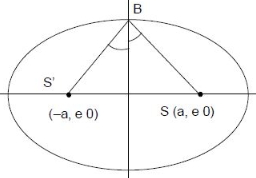
View full question & answer→MCQ 4041 Mark
If the tangents on the ellipse $4x^2 + y^2 = 8$ at the points $(1, 2)$ and $(a, b)$ are perpendicular to each other, then $a^2$ is equal to
- ✓
$\frac{2}{{17}}$
- B
$\frac{4}{{17}}$
- C
$\frac{64}{{17}}$
- D
$\frac{128}{{17}}$
AnswerCorrect option: A. $\frac{2}{{17}}$
a
$4{a^2} + {b^2} = 8\,\,\,\,\,\,.......\left( 1 \right)$
${\left( {\frac{{dy}}{{dx}}} \right)_{\left( {1,2} \right)}} = - \frac{{4x}}{y} = - 2$
$ \Rightarrow - \frac{{4a}}{b} = \frac{1}{2}$
$b = - 8a$
$ \Rightarrow {b^2} = 64{a^2}$
$68{a^2} = 8,{a^2} = \frac{2}{{17}}$
View full question & answer→MCQ 4051 Mark
In an ellipse, with centre at the origin, if the difference of the lengths of major axis and minor axis is $10$ and one of the foci is at $(0, 5\sqrt 3 )$, then the length of its latus rectum is
Answerb
$be = 5\sqrt 3 $
${b^2}{e^2} = 75$
$\left( {b - a} \right)\left( {b + a} \right) = 75 \Rightarrow b + a = 15$
$ \Rightarrow b = 10,a = 5$
$LR = \frac{{2{a^2}}}{b}5$
View full question & answer→MCQ 4061 Mark
If the tangent to the parabola $y^2 = x$ at a point $\left( {\alpha ,\beta } \right)\,,\,\left( {\beta > 0} \right)$ is also a tangent to the ellipse, $x^2 + 2y^2 = 1$, then $a$ is equal to
- A
$2\sqrt 2 + 1$
- B
$\sqrt 2 - 1$
- ✓
$\sqrt 2 + 1$
- D
$2\sqrt 2 - 1$
AnswerCorrect option: C. $\sqrt 2 + 1$
c
Equation of tangent to the parabola ${y^2} = x$
$At\left( {\alpha ,\beta } \right)$ is $T=0$
$y\beta = \frac{{x + \alpha }}{2}$
$ \Rightarrow y\beta = \frac{{x + {\beta ^2}}}{2}\,$ ($\because$ ${\beta ^2} = \alpha $)
$ \Rightarrow y = \frac{1}{{2\beta }}x + \frac{\beta }{2}$
$\left( {m = \frac{1}{{2\beta }},c = \frac{\beta }{2}} \right)$
This is also a tangent to ellipse ${x^2} + 2{y^2} = 1$
$\therefore C = \pm \sqrt {{a^2}{m^2} + {b^2}} $
$ \Rightarrow \frac{\beta }{2} = \pm \sqrt {\frac{1}{{4\beta }} + \frac{1}{2}} $
$ \Rightarrow \frac{{{\beta ^2}}}{4} = \frac{1}{{4\beta }} + \frac{1}{2}$
$ \Rightarrow {\beta ^4} - 2{\beta ^2} - 1 = 0$
$ \Rightarrow {\left( {{\beta ^2} - 1} \right)^2} = 2$
$ \Rightarrow {\beta ^2} - 1 = \sqrt 2 $
$ \Rightarrow {\beta ^2} = \sqrt 2 + 1$
$\alpha = {\beta ^2} = \sqrt 2 + 1$
View full question & answer→MCQ 4071 Mark
If the lines $x -2y = 12$ is tangent to the ellipse $\frac{{{x^2}}}{{{a^2}}} + \frac{{{y^2}}}{{{b^2}}} = 1$ at the point $\left( {3,\frac{-9}{2}} \right)$, then the length of the latus rectum of the ellipse is
- A
$12\sqrt 2$
- ✓
$9$
- C
$8\sqrt 3$
- D
$5$
Answerb
Tangent at $\left( {3,\frac{{ - 9}}{2}} \right)$
$\frac{{3x}}{{{a^2}}} - \frac{{9y}}{{2{b^2}}} = 1$
Comparing with $x - 2y = 12$
$\frac{3}{{{a^2}}} - \frac{9}{{4{b^2}}} = \frac{1}{{12}}$
$ \Rightarrow a = 6$ and $b = 3\sqrt 3 $
Length of latus rectum $ = \frac{{2{b^2}}}{a} = 9$
View full question & answer→MCQ 4081 Mark
The tangent and normal to the ellipse $3x^2 + 5y^2 = 32$ at the point $P(2, 2)$ meet the $x-$ axis at $Q$ and $R,$ respectively. Then the area(in sq. units) of the triangle $PQR$ is
- A
$\frac {34}{15}$
- ✓
$\frac {68}{15}$
- C
$\frac {14}{3}$
- D
$\frac {16}{3}$
AnswerCorrect option: B. $\frac {68}{15}$
b
$3{x^2} + 5{y^2} = 32$
${\left. {\frac{{dy}}{{dx}}} \right|_{\left( {2,2} \right)}} = - \frac{3}{5}$
tengent $:y - 2 = - \frac{3}{5}\left( {x - 2} \right) \Rightarrow Q\left( {\frac{{16}}{3},0} \right)$
Normal $:y - 2 = - \frac{5}{3}\left( {x - 2} \right) \Rightarrow R\left( {\frac{4}{5},0} \right)$
Area is $ = \frac{1}{2}\left( {QR} \right) \times 2 = \frac{{68}}{{15}}$
View full question & answer→MCQ 4091 Mark
If the normal to the ellipse $3x^2 + 4y^2 = 12$ at a point $P$ on it is parallel to the line, $2x + y = 4$ and the tangent to the ellipse at $P$ passes through $Q(4, 4)$ then $PQ$ is equal to
- A
$\frac{{\sqrt {157} }}{2}$
- ✓
$\frac{{5\sqrt 5 }}{2}$
- C
$\frac{{\sqrt {221} }}{2}$
- D
$\frac{{\sqrt {61} }}{2}$
AnswerCorrect option: B. $\frac{{5\sqrt 5 }}{2}$
b
$3{x^2} + 4{y^2} = 12$
$\frac{{{x^2}}}{4} + \frac{{{y^2}}}{3} = 1$
$x = 2\,\cos \theta ,y = \sqrt 3 \sin \theta $ Equation of noraml is $\frac{{{a^2}x}}{{{x_1}}} + \frac{{{b^2}y}}{{{y_1}}} = {a^2} - {b^2}$
$2\,x\,\sin \theta - \sqrt 3 \cos \theta y = \sin \theta \cos \theta $
Slope $\frac{2}{{\sqrt 3 }}\tan \theta = - 2\,\,\,\,\,$ $\therefore \tan \theta = - \sqrt 3 $
equation of tangent is it passes through $(4,4)$
$3\,x\cos \theta + 2\sqrt 3 \sin \theta y = 6$
$12\cos \theta + 8\sqrt 3 \sin \theta y = 6$
$\cos \theta = - \frac{1}{2},\sin \theta = \frac{{\sqrt 3 }}{2}\therefore {120^o}$
Hence point $P$ is $\left( {2\cos \theta {{120}^o},\sqrt 3 \sin {{120}^o}} \right)$
$P\left( { - 1,\frac{2}{2}} \right),Q\left( {4,4} \right)$
$PQ = \frac{{5\sqrt 5 }}{2}$
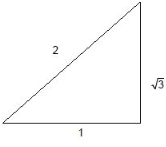
View full question & answer→MCQ 4101 Mark
An ellipse, with foci at $(0, 2)$ and $(0, -2)$ and minor axis of length $4$, passes through which of the following points?
- A
$(2, \sqrt 2 )$
- B
$(2, 2\sqrt 2 )$
- C
$(1, 2\sqrt 2 )$
- ✓
$( \sqrt 2, 2 )$
AnswerCorrect option: D. $( \sqrt 2, 2 )$
d
Given $2a = 4$ and $2be = 4$
$ \Rightarrow a = 2,be = 2$
$ \Rightarrow {b^2}{e^2} = 4$
$ \Rightarrow {b^2} - {a^2} = 4$
$ \Rightarrow {b^2} = 8$
$ \Rightarrow $ equation of ellipse
$\frac{{{x^2}}}{4} + \frac{{{y^2}}}{8} = 1$
Clearly option $(D)$ satisfy the given curve.
View full question & answer→MCQ 4111 Mark
Let $0 < \theta < \frac{\pi }{2}$. If the eccentricity of the hyperbola $\frac{{{x^2}}}{{{{\cos }^2}\,\theta }} - \frac{{{y^2}}}{{{{\sin }^2}\,\theta }} = 1$ is greater than $2$, then the length of its latus rectum lies in the interval
- ✓
$\left( {3,\infty } \right)$
- B
$\left( {\frac{3}{2},2} \right]$
- C
$\left( {2,3} \right]$
- D
$\left( {1,\frac{3}{2}} \right]$
AnswerCorrect option: A. $\left( {3,\infty } \right)$
a
$\frac{{{x^2}}}{{{{\cos }^2}\theta }} - \frac{{{y^2}}}{{{{\sin }^2}\theta }} = 1$
$\because $ $e > 2$ (given)
${e^2} > 4 \Rightarrow 1 + \frac{{{{\sin }^2}\theta }}{{{{\cos }^2}\theta }} > 4$
$ \Rightarrow 1 + {\tan ^2}\theta > 4$
$ \Rightarrow {\tan ^2}\theta > 3$
$\because $ $\theta \in \left( {\frac{\pi }{3},\frac{\pi }{2}} \right)$
Latus ractum $ = 2\frac{{{{\sin }^2}\theta }}{{\cos \theta }} = 2\tan \theta \sin \theta $
$\because $ for $\theta \in \left( {\frac{\pi }{3},\frac{\pi }{2}} \right),2\tan \theta \sin \theta $ is increasing
Hence latus rectum $ \in \left( {3,\infty } \right)$
View full question & answer→MCQ 4121 Mark
A hyperbola has its centre at the origin, passes through the point $(4, 2)$ and has transverse axis of length $4$ along the $x -$ axis. Then the eccentricity of the hyperbola is
- ✓
$\frac {2}{\sqrt 3}$
- B
$\frac {3}{2}$
- C
$\sqrt 3$
- D
$2$
AnswerCorrect option: A. $\frac {2}{\sqrt 3}$
a
Given hyperbolo is
$\frac{{{x^2}}}{4} - \frac{{{y^2}}}{{{b^2}}} = 1$
Satisfying the point $\left( {4,2} \right)$
$ \Rightarrow {b^2} = \frac{4}{3}$
$ \Rightarrow e = \frac{2}{{\sqrt 3 }}$
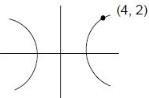
View full question & answer→MCQ 4131 Mark
The equation of a tangent to the hyperbola $4x^2 -5y^2 = 20$ parallel to the line $x -y = 2$ is
- ✓
$x -y + 1 = 0$
- B
$x -y + 7 = 0$
- C
$x -y + 9 = 0$
- D
$x -y -3 = 0$
AnswerCorrect option: A. $x -y + 1 = 0$
a
Hyperbola is $\frac{{{x^2}}}{5} - \frac{{{y^2}}}{4} = 1$
Equation of its tangent in slop from is $y = mx \pm \sqrt {5{m^2} - 4} $
Hence tangent with slope $1$ is $y = x \pm 1$
View full question & answer→MCQ 4141 Mark
If a hyperbola has length of its conjugate axis equal to $5$ and the distance between its foci is $13$, then the eccentricity of the hyperbola is
- ✓
$\frac{{13}}{{12}}$
- B
$2$
- C
$\frac{{13}}{{6}}$
- D
$\frac{{13}}{{8}}$
AnswerCorrect option: A. $\frac{{13}}{{12}}$
a
$2b = 5$ and $2ae = 13$
${\left( {ae} \right)^2} = {a^2} + {b^2}$
$ \Rightarrow {a^2} = {\left( {ae} \right)^2} - {b^2} = \frac{{169}}{4} - \frac{{25}}{4}$
$ \Rightarrow a = 6$
$e = \frac{{ae}}{a} = \frac{{13}}{{12}}$
View full question & answer→MCQ 4151 Mark
If the vertices of a hyperbola be at $(-2, 0)$ and $(2, 0)$ and one of its foci be at $(-3, 0)$, then which one of the following points does not lie on this hyperbola?
- A
$\left( { - 6 , 2\sqrt {10} } \right)$
- B
$\left( {2\sqrt 6 , 5} \right)$
- C
$\left( { 4 , \sqrt {15} } \right)$
- ✓
$\left( { 6 , 5\sqrt {2} } \right)$
AnswerCorrect option: D. $\left( { 6 , 5\sqrt {2} } \right)$
d
equation of hyperbola is $\frac{{{x^2}}}{4} - \frac{{{y^2}}}{{{b^2}}} = 1$ and $ae = 3$
We know that ${a^2}{e^2} = {a^2} + {b^2}$
$9 = 4 + {b^2} \Rightarrow {b^2} = 5$ Hence equation of hyperbola is $\frac{{{x^2}}}{4} - \frac{{{y^2}}}{5} = 1\,$
Hence $\left( {6,5\sqrt 2 } \right)$ does not lie on $\frac{{{x^2}}}{4} - \frac{{{y^2}}}{5} = 1\,$
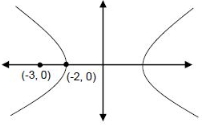
View full question & answer→MCQ 4161 Mark
If the eccentricity of the standard hyperbola passing, through the point $(4, 6)$ is $2$, then the equation of the tangent to the hyperbola at $(4, 6)$ is
- A
$2x -3y + 10 = 0$
- B
$x -2y + 8 = 0$
- ✓
$2x -y -2 = 0$
- D
$3x -2y = 0$
AnswerCorrect option: C. $2x -y -2 = 0$
c
Let equation of hyperbola be $\frac{{{x^2}}}{{{a^2}}} - \frac{{{y^2}}}{{{b^2}}} = 1\,\,$
passes through $\left( {4,6} \right)$
$ \Rightarrow \frac{{16}}{{{a^2}}} - \frac{{36}}{{{b^2}}} = 1\,\,\,\,\,\,\,.....\left( i \right)$
Also ${e^2} = 1 + \frac{{{b^2}}}{{{a^2}}} \Rightarrow {b^2} = 3{a^2}\,\,\,\,\,\,\,\,\,......\left( {ii} \right)$
from $(i)$ and $(ii)$
${a^2} = 4,{b^2} = 12$
equation $\frac{{{x^2}}}{4} - \frac{{{y^2}}}{{12}} = 1\,$
Tangent at $\left( {4,6} \right)$ is $x - \frac{y}{2} = 1\,\,\,$
Or
$2x - y = 2$
View full question & answer→MCQ 4171 Mark
If the line $y\, = \,mx\, + \,7\sqrt 3 $ is normal to the hyperbola $\frac{{{x^2}}}{{24}} - \frac{{{y^2}}}{{18}} = 1,$ then a value of $m$ is
AnswerCorrect option: A. $\frac{2}{{\sqrt 5 }}$
a
$\frac{{{x^2}}}{{24}} - \frac{{{y^2}}}{{18}} = 1\,\,\,\,\, \Rightarrow a\, = \sqrt {24} :b\, = \sqrt {18} $
Paramentric normal:
$\sqrt {24} \cos \theta .x + \sqrt {18} .y\cot \theta = 42$
At $x = 0;y = \frac{{42}}{{\sqrt {18} }}\tan \theta = 7\sqrt 3 $ (from given equation)
$ \Rightarrow \tan \theta = \sqrt {\frac{3}{2}} \Rightarrow \sin \theta = \pm \sqrt {\frac{3}{5}} $
slope of parametric normal $ = \frac{{ - \sqrt {24} \cos \theta }}{{\sqrt {18} \cot \theta }} = m$
$ \Rightarrow m = - \sqrt {\frac{4}{3}} \sin \theta = - \frac{2}{{\sqrt 5 }}$
View full question & answer→MCQ 4181 Mark
If a directrix of a hyperbola centered at the origin and passing through the point $(4, -2\sqrt 3)$ is $5x = 4\sqrt 5$ and its eccentricity is $e$, then
- A
$4e^4 + 8e^2 -35 = 0$
- ✓
$4e^4 -24e^2 + 35 = 0$
- C
$4e^4 -12e^2 -27 = 0$
- D
$4e^4 -24e^2 + 27 = 0$
AnswerCorrect option: B. $4e^4 -24e^2 + 35 = 0$
b
Let hyperbola be $\frac{{{x^2}}}{{{a^2}}} - \frac{{{y^2}}}{{{b^2}}} = 1$ and passes through $\left( {4, - 2\sqrt 3 } \right)$ therefore
$\frac{{16}}{{{a^2}}} - \frac{{12}}{{{b^2}}} = 1\,\,\,\,\,\,\,\,\,\,\,......\left( i \right)$
$\because$ ${b^2} = {a^2}\left( {{e^2} - 1} \right)$
$x = \frac{{4\sqrt 5 }}{5} = \frac{e}{a} \Rightarrow {a^2} = \frac{{16}}{5}{e^2}\,\,\,\,\,\,\,\,\,\,.........\left( {ii} \right)$
On solving $(i)$ and $(ii)$
$ \Rightarrow 4{e^2}\, - 24{e^2}\, + 35 = 0$
View full question & answer→MCQ 4191 Mark
If $5x + 9 = 0$ is the directrix of the hyperbola $16x^2 -9y^2 = 144,$ then its corresponding focus is
- A
$(5, 0)$
- B
$\left( {\frac{5}{3},0} \right)$
- ✓
$(-5, 0)$
- D
$\left( { - \frac{5}{3},0} \right)$
AnswerCorrect option: C. $(-5, 0)$
c
$\frac{{{x^2}}}{9} - \frac{{{y^2}}}{{16}} = 1$
$a = 3,b = 4$ and $e = \sqrt {1 + \frac{{16}}{9}} = \frac{5}{3}$
corresponding focus will be $\left( { - ae,0} \right)$ i.e. $\left( { - 5,0} \right)$.
View full question & answer→MCQ 4201 Mark
Let $P$ be the point of intersection of the common tangents to the parabola $y^2 = 12x$ and the hyperbola $8x^2 -y^2 = 8$. If $S$ and $S'$ denote the foci of the hyperbola where $S$ lies on the positive $x-$ axis then $P$ divides $SS'$ in a ratio
- A
$2 : 1$
- B
$13 : 11$
- ✓
$5 : 4$
- D
$14 : 13$
AnswerCorrect option: C. $5 : 4$
c
Tangents ${y^2} = 12x \Rightarrow y = 2x + \frac{3}{m}$
$\frac{{{x^2}}}{1} - \frac{{{y^2}}}{8} = 1 \Rightarrow y = mx \pm \sqrt {{m^2} - 8} $
Common tangent given
$\therefore \frac{3}{{m = \pm \sqrt {{m^2} - 8} }}\,\,\,\,\,\,\,\,\,\,\,\,\,\,\,\,\,\,\,\,\frac{{{x^2}}}{1} - \frac{{{y^2}}}{8} = 1$
${m^4} - 8{m^2} - 9 = 0\,\,\,\,\,\,\,\,\,\,\,\,\,\,\,\,\,\,\,\,e = 3$
$m = \pm 3\,\,\,\,\,\,\,\,\,\,\,\,\,\,\,\,\,\,\,\,\,\,\,\,\,\,\,\,\,\,\,\,\,\,\,\,\,\,\,\,ae = 3$
$\therefore y = 3x + 1\,\,\,\,\,P\left( { - \frac{1}{3},0} \right)\,\,\,\,\,S = \left( {3,0} \right)$
$y = - 3x - 1$ $P$ divies $SS'$ in $5:4$.
View full question & answer→MCQ 4211 Mark
A helicopter is flying along the curve given by $y - x^{3/2} = 7, (x \geq 0)$. A solider positioned at the point $\left( {\frac{1}{2},7} \right)$ wants to shoot down the helicopter when it is nearest to him. Then this nearest distance is
AnswerCorrect option: C. $\frac{1}{6}\sqrt {\frac{7}{3}} $
c
$y = {x^{3/2}} - 2$ $\frac{{dy}}{{dx}} = \frac{3}{2}\sqrt x $
Slope of normal $ = - \frac{2}{{3\sqrt x }}$
Let point is $\left( {{x_1},x_1^{3/2} - 2} \right)$
$\therefore $ Normal $y - \left( {x_1^{3/2} - 2} \right) = \frac{{ - 2}}{{3\sqrt {{x_1}} }}\left( {x - {x_1}} \right)$
Now put $\left( {1,7} \right)$ and slove it.
$ \Rightarrow {x_1} = \frac{1}{3}$
$\therefore P \Rightarrow \left( {\frac{1}{3},7 + \frac{1}{{3\sqrt 3 }}} \right),A \Rightarrow \left( {1,7} \right)$
$\therefore AD = \frac{1}{6}\sqrt {\frac{7}{3}} $
View full question & answer→MCQ 4221 Mark
The locus of the point of intersection of the lines, $\sqrt 2 x - y + 4\sqrt 2 k = 0$ and $\sqrt 2 kx + ky - 4\sqrt 2 = 0$ ( $k$ is any non-zero real parameter) is
- ✓
A hyperbola with length of its transverse axis $8\sqrt 2 $
- B
An ellipse with length ofits major axis $8\sqrt 2 $
- C
An ellipse whose eccentricity is $\frac{1}{{\sqrt 3 }}$
- D
A hyperbola whose eccentricity is $\sqrt 3$
AnswerCorrect option: A. A hyperbola with length of its transverse axis $8\sqrt 2 $
a
Here, lines are:
$\sqrt 2 x - y + 4\sqrt 2 k = 0$
$ \Rightarrow \sqrt 2 x + 4\sqrt 2 k = y\,\,\,.....\left( i \right)$ and
$\sqrt 2 kx + ky - 4\sqrt 2 = 0\,\,\,.....\left( {ii} \right)$
Put the value of $y$ from $(i)$ in$(ii)$ we get :
$ \Rightarrow 2\sqrt 2 kx + 4\sqrt 2 \left( {{k^2} - 1} \right) = 0$
$ \Rightarrow x = \frac{{2\left( {1 - {k^2}} \right)}}{k},y = \frac{{2\sqrt 2 \left( {1 - {k^2}} \right)}}{k}$
$\therefore {\left( {\frac{y}{{4\sqrt 2 }}} \right)^2} - {\left( {\frac{x}{4}} \right)^2} = 1$
$\therefore $ length of tran sverse axis
$2a = 2 \times 4\sqrt 2 = 8\sqrt 2 $
Hence, the locus is a hyperbola with length
of its tranverse axis to $8\sqrt 2 $
View full question & answer→MCQ 4231 Mark
Tangent and normal are drawn at $P(16, 16)$ on the parabola ${y^2} = 16x$, which intersect the axis of the parabola at $A$ and $B$, respectively. If $C$ is the centre of the circle through the points $P, A$ and $B$ and $\angle CPB = \theta $ , then a value of $\tan \theta \;$is :
- ✓
$2$
- B
$3$
- C
$\frac{4}{3}$
- D
$\frac{1}{2}$
Answera
Slope of $PC\left( {{m_1}} \right) = \frac{4}{3}$
Slope of $PB\left( {{m_2}} \right) = - 2$
Hence, $\tan \theta = \left| {\frac{{{m_1} - {m_2}}}{{1 + {m_1}.{m_2}}}} \right| = \left| {\frac{{\frac{4}{3} + 2}}{{1 - \frac{4}{3}.2}}} \right|$
$\tan \theta = 2$
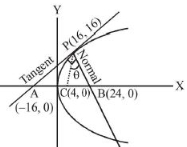
View full question & answer→MCQ 4241 Mark
Two parabolas with a common vertex and with axes along $x-$ axis and $y-$ axis, respectively, intersect each other in the first quadrant. if the length of the latus rectum of each parabola is $3$ , then the equation of the common tangent to the two parabolas is?
- A
$3\, (x +y)+4 = 0$
- B
$8\, (2x+y)+3 = 0$
- ✓
$4\, (x+y)+3 = 0$
- D
$x+ 2y+3 = 0$
AnswerCorrect option: C. $4\, (x+y)+3 = 0$
c
As origin is the only common point to $x$ - axis and $y$ - axis, so, origin is the common vertex
Let the equation of two of parabolas be $y^{2}=4 a x$ and $x^{2}=4 b y$
Now latus rectum of both parabolas $=3$
$\therefore 4 a=4 b=3$
$\Rightarrow a=b=\frac{3}{4}$
$\therefore$ Two parabolas are $y^{2}=3 x$ and $x^{2}=3 y$
Suppose $y=m x+c$ is the common tangent.
$\therefore$ $y^{2}=3 x \Rightarrow(m x+c)^{2}=3 x$
$\Rightarrow m^{2} x^{2}+(2 m c-3) x+c^{2}=0$
As, the tangent touches at one point only $\mathrm{So}, b^{2}-4 a c=0$
$\Rightarrow(2 m c-3)^{2}-4 m^{2} c^{2}=0$
$\Rightarrow 4 m^{2} c^{2}+9-12 m c-4 m^{2} c^{2}=0$
$\Rightarrow c=\frac{9}{12 m}=\frac{3}{4 m}$ ......$(i)$
$\therefore x^{2}=3 y \Rightarrow x^{2}=3(m x+c)$
$\Rightarrow x^{2}-3 m x-3 c=0$
Again, $b^{2}-4 a c=0$
$\Rightarrow 9 m^{2}-4(1)(-3 c)=0$
$\Rightarrow 9 m^{2}=-12 c$ .......$(ii)$
Form $(i)$ and $(ii)$
$m^{2}=\frac{-4 c}{3}=\frac{-4}{3}\left(\frac{-3}{4 m}\right)$
$\Rightarrow m^{3}=-1 \Rightarrow m=-1 \Rightarrow c=\frac{-3}{4}$
Hence, $y=m x+c=-x-\frac{3}{4}$
$\Rightarrow 4(x+y)+3=0$
View full question & answer→MCQ 4251 Mark
Tangents drawn from the point $(- 8, 0)$ to the parabola $y^2\, = 8x$ touch the parabola at $P$ and $Q$. If $F$ is the focus of the parabola, then the area of the triangle $PFQ$ (in sq. units) is equal to
Answera
Equation of the chord of contact $PQ$ is given by:
$T=0$
or $T = y{y_1} - 4\left( {x + {x_1}} \right)$
where $\left( {{x_1},{y_1}} \right) \equiv \left( { - 8,0} \right)$
$\therefore $ Equation becomes: $x=8$
Chord of contact is $x=8$
$\therefore $ Coordinates of point $P$ and $Q$ are $(8,8)$
and $(8,-8)$
and focus of the parabola is $F(2,0)$
$\therefore $ Area of triangle $PQF = \frac{1}{2} \times \left( {8 - 2} \right) \times \left( {8 + 8} \right)$
$ = 48$ sq. units
View full question & answer→MCQ 4261 Mark
Let $P$ be a point on the parabola, $x^2 = 4y.$ If the distance of $P$ from the centre of the circle, $x^2 + y^2 + 6x + 8 = 0$ is minimum, then the equation of the tangent to the parabola at $P,$ is
- A
$x+4y - 2 = 0$
- B
$x+ 2y = 0$
- ✓
$x+y+ 1 = 0$
- D
$x -y+3=0$
AnswerCorrect option: C. $x+y+ 1 = 0$
c
Let $\frac{{{t^2} - 0}}{{2t + 3}}$ be any point on the parabola.
Centre of the given circle
$C = \left( { - g, - f} \right) = \left( { - 3,0} \right)$
For $PC$ to be minimum, it must be the normal to the parabola at $P$.
Slop of line $PC = \frac{{{y_2} - {y_1}}}{{{x_2} - {x_1}}} = \frac{{{t^2} - 0}}{{2t + 3}}$
Also,slope of tangent to parabola at
$P = \frac{{dy}}{{dx}} = \frac{x}{2} = t$
$\therefore $ Slope of normal $ = \frac{{ - 1}}{t}$
$\therefore \frac{{{t^2} - 0}}{{2t + 3}} = \frac{{ - 1}}{t}$
$ \Rightarrow {t^3} + 2t + 3 = 0$
$ \Rightarrow \left( {t + 1} \right)\left( {{t^2} - t + 3} \right) = 0$
$\therefore $ Real roots of above equation is
$t=-1$
Coordinate of $P = \left( {2t,{t^2}} \right) = \left( { - 2,1} \right)$
Slope of tangent to parabola at $P = t = - 1$
Therefore,equation of tangent is :
$\left( {y - 1} \right) = \left( { - 1} \right)\left( {x + 2} \right)$
$ \Rightarrow x + y + 1 = 0$
View full question & answer→MCQ 4271 Mark
Two sets $A$ and $B$ are as under:
$A = \{ \left( {a,b} \right) \in R \times R:\left| {a - 5} \right| < 1 \,\,and\,\,\left| {b - 5} \right| < 1\} $; $B = \left\{ {\left( {a,b} \right) \in R \times R:4{{\left( {a - 6} \right)}^2} + 9{{\left( {b - 5} \right)}^2} \le 36} \right\}$ then : . . . . .
AnswerCorrect option: A. $A \subset B$
a
$A = \left\{ {\left( {a,b} \right) \in R \times R:\left| {a - 5} \right| < 1,\left| {b - 5} \right| < 1} \right\}$
Let $a - 5 = x,b - 5 = y$
set $A$ contains all points inside $\left| x \right| < 1,\left| y \right| < 1$
$B = \left\{ {\left( {a,b} \right) \in R \times R:4{{\left( {a - 6} \right)}^2} + 9{{\left( {B - 5} \right)}^2} \le 36} \right\}$
St $B$ contains all points inside or on
$\frac{{{{\left( {x - 1} \right)}^2}}}{9} + \frac{{{y^2}}}{4} = 1$
$\left( { \pm 1, \pm 1} \right)$ lies inside the ellipse.
Hence, $A \subset B$.
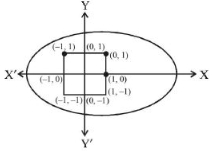
View full question & answer→MCQ 4281 Mark
If the length of the latus rectum of an ellipse is $4\,units$ and the distance between a focus and its nearest vertex on the major axis is $\frac {3}{2}\,units$ , then its eccentricity is?
- A
$\frac {1}{2}$
- B
$\frac {2}{3}$
- C
$\frac {1}{9}$
- ✓
$\frac {1}{3}$
AnswerCorrect option: D. $\frac {1}{3}$
d
Let for ellipse coordinates of focus and vertex are $(ae,0)$ and $(a,0)$ respectively.
$\therefore $ Distance between focus and vertex
$ = a\left( {1 - e} \right) = \frac{3}{2}$ (given)
$ \Rightarrow a - \frac{3}{2} = ae$
$ \Rightarrow {a^2} + \frac{9}{4} - 3a = {a^2}{e^2}\,\,\,\,\,\,\,......\left( i \right)$
Length of latus rectum $ = \frac{{2{b^2}}}{a} = 4$
$ \Rightarrow {b^2} = 2a\,\,\,\,\,\,\,\,\,\,......\left( {ii} \right)$
${e^2} = 1 - \frac{{{b^2}}}{{{a^2}}}$
$ \Rightarrow {e^2} = 1 - \frac{{2a}}{{{a^2}}}$ (from$(ii)$)
$ \Rightarrow {e^2} = 1 - \frac{2}{a}\,\,\,\,\,\,\,\,\,.......\left( 3 \right)$
Substituting the value of ${e^2}$ in eq. $(i)$ we get;
$ \Rightarrow {a_2} + \frac{9}{4} - 3a = {a^2}\left( {1 - \frac{2}{a}} \right)$
$ \Rightarrow a = \frac{9}{4}$
$\therefore $ from eq. $(iii)$ we get;
${e^2} = 1 - \frac{2}{a} = 1 - \frac{8}{9} = \frac{1}{9}$
$ \Rightarrow e = \frac{1}{3}$
View full question & answer→MCQ 4291 Mark
Tangents are drawn to the hyperbola $4{x^2} - {y^2} = 36$ at the points $P$ and $Q.$ If these tangents intersect at the point $T(0,3)$ then the area (in sq. units) of $\Delta PTQ$ is :
- A
$54\sqrt 3 $
- B
$60\sqrt 3 $
- C
$36\sqrt 5 $
- ✓
$45$$\sqrt 5 $
AnswerCorrect option: D. $45$$\sqrt 5 $
d
(4) Here equation of hyperbola is $\frac{{{x^2}}}{9} - \frac{{{y^2}}}{{36}} = 1$
Now, $PQ$ is the chord of contant
$\therefore $ Equation of $PQ$ is $\,:\frac{{x\left( 0 \right)}}{9} - \frac{{y\left( 3 \right)}}{{36}} = 1$
$ \Rightarrow y = - 12$
$\therefore $ Area of $\Delta PQT = \frac{1}{2} \times TR \times PQ$
$\because $ $P \equiv \left( {3\sqrt 5 , - 12} \right)\,\,\,\,\,\,\therefore TR = 3 + 12 = 15$
$\therefore $ Area of $\Delta PQT = \frac{1}{2} \times 15 \times 6\sqrt 5 = 45\sqrt 5 $ sq.units
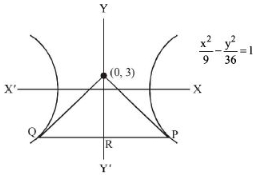
View full question & answer→MCQ 4301 Mark
If the tangents drawn to the hyperbola $4y^2 = x^2 + 1$ intersect the co-ordinate axes at the distinct points $A$ and $B$, then the locus of the mid point of $AB$ is
- A
$x^2 - 4y^2 + 16 x^2y^2 = 0$
- B
$4x^2 -y^2 + 16 x^2 y^2 = 0$
- C
$4x^2 -y^2 - 16 x^2 y^2 = 0$
- ✓
$x^2 - 4y^2 - 16 x^2 y^2 = 0$
AnswerCorrect option: D. $x^2 - 4y^2 - 16 x^2 y^2 = 0$
d
equation of hyperbola is :
$4{y^2} = {x^2} + 1 \Rightarrow - {x^2} + 4{y^2} = 1$
$ \Rightarrow - \frac{{{x^2}}}{{{1^2}}} + \frac{{{y^2}}}{{{{\left( {\frac{1}{2}} \right)}^2}}} = 1$
$\therefore a = 1,b = \frac{1}{2}$
Now, tangent to the curve at point $\left( {{x_1},{y_1}} \right)$ is given by.
$4 \times 2{y_1}\frac{{dy}}{{dx}} = 2{x_1}$
$ \Rightarrow \frac{{dy}}{{dx}} = \frac{{2{x_1}}}{{8{y_1}}} = \frac{{{x_1}}}{{4{y_1}}}$
equation of tangent at $\left( {{x_1},{y_1}} \right)$ is
$y = mx + c$
$ \Rightarrow y = \frac{{{x_1}{x_1}}}{{4{y_1}}}.x + c$
As tangent passes through ${{x_1},{y_1}}$
$\therefore {y_1} = \frac{{{x_1}{x_1}}}{{4{y_1}}} + c$
$ \Rightarrow C = \frac{{4y_1^2 - x_1^2}}{{4{y_1}}} = \frac{1}{{4{y_1}}}$
Therefore $y = \frac{{{x_1}}}{{4{y_1}}}x + \frac{1}{{4{y_1}}}$
$ \Rightarrow 4{y_1}y = {x_1}x + 1$
which intersects at $A\left( {\frac{{ - 1}}{{{x_1}}},0} \right)$ and $y$ -axis at $B\left( {0,\frac{1}{{4{y_1}}}} \right)$
Let midpoint of $AB$ is $(h,k)$
$\therefore h = \frac{{ - 1}}{{2{x_1}}}$
$ \Rightarrow {x_1} = \frac{{ - 1}}{{2h}}\,\,\,\,\,\,{y_1} = \frac{1}{{8k}}$
Thus, $4{\left( {\frac{1}{{8k}}} \right)^2} = {\left( {\frac{{ - 1}}{{2h}}} \right)^2} + 1$
$ \Rightarrow \frac{1}{{16{k^2}}} = \frac{1}{{4{h^2}}} + 1$
$ \Rightarrow 1 = \frac{{16{k^2}}}{{4{h^2}}} + 16{k^2}\,\,\,\, \Rightarrow {h^2} = 4{k^2} + 16{h^2}k$
So, requatired equation is
${x^2} - 4{y^2}16{x^2}{y^2} = 0$
View full question & answer→MCQ 4311 Mark
A normal to the hyperbola, $4x^2 - 9y^2\, = 36$ meets the co-ordinate axes $x$ and $y$ at $A$ and $B$, respectively. If the parallelogram $OABP$ ( $O$ being the origin) is formed, then the locus of $P$ is
- A
$4x^2 -9y^2\, = 121$
- B
$4x^2 +9y^2\,= 121$
- ✓
$9x^2 -4y^2\, = 169$
- D
$9x^2 +4y^2\, = 169$
AnswerCorrect option: C. $9x^2 -4y^2\, = 169$
c
Given, $4{x^2} - 9{y^2} = 36$
ater differentiating w.r.t.$x$, we get
$4.2x - 9.2y.\frac{{dy}}{{dx}} = 0$
$ \Rightarrow $ slope of tangent $ = \frac{{dy}}{{dx}} = \frac{{4x}}{{9y}}$
so, slope of normal $ = \frac{{ - 9y}}{{4x}}$
Now, equation of normal at point $({x_0},{y_0})$ is given by
${y_0} - {y_0} = \frac{{ - 9y}}{{4x}}\left( {{x_0} - {x_0}} \right)$
As normal intersects $X$ axis at $A$, Then
$A \equiv \left( {\frac{{13{x_0}}}{9},0} \right)$
and $B \equiv \left( {0,\frac{{13{y_0}}}{4}} \right)$
As $OABP$ is a parallelogram
$\therefore $ midpoint of $OB \equiv \left( {0,\frac{{13{y_0}}}{8}} \right) \equiv $ Midpoint of $AP$
So,$P\left( {x,y} \right) \equiv \left( {\frac{{ - 13{x_0}}}{9},\frac{{13{y_0}}}{4}} \right)\,\,\,\,\,\,......\left( i \right)$
$\therefore \,({x_0},{y_0})$ lies on hyperbola, therfore
$4{\left( {{x_0}} \right)^2} - 9{\left( {{y_0}} \right)^2} = 36\,\,\,\,\,\,\,\,.......\left( {ii} \right)$
Feom equation $(i):$ ${x_0} = \frac{{ - 9x}}{{13}}\,$ and ${y_0} = \frac{{4y}}{{13}}$
From equation $(ii)$, we get
$9{x^2} - 4{y^2} = 169$
Hence, locus point $P$ is :$9{x^2} - 4{y^2} = 169$
View full question & answer→MCQ 4321 Mark
The locus of the point of intersection of the straight lines,
$tx -2y-3t=0$
$x - 2ty+ 3 = 0$ $\left( {t \in R} \right)$, is
- A
an ellipse with eccentricity $\frac{2}{{\sqrt 5 }}$
- B
an ellipse with the length of major axis $6$
- C
a hyperbola with eccentricity $\sqrt 5 $
- ✓
a hyperbola with the length of conjugate axis $3$
AnswerCorrect option: D. a hyperbola with the length of conjugate axis $3$
d
Here, $tx - 2y - 3t = 0\,\ and \,x - 2ty + 3 = 0$
On solving we get;
$y = \frac{{3t}}{{{t^2} - 1}}\,\,\ and \,\,x = \frac{{3{t^2} + 3}}{{{t^2} - 1}}$
Put $t = \tan \,\theta $
$\therefore x = - 3\,\sec 2\theta \,\ and \,\,2y = 3\left( { - tan2\theta } \right)$
$\because $ ${\sec ^2}2\theta - ta{n^2}2\theta = 1$
$ \Rightarrow \frac{{{x^2}}}{9} - \frac{{{y^2}}}{{9/4}} = 1$
which represents ahyperbola
$\therefore {a^2} = 9\,\ and \,{b^2} = 9/4$
$\lambda \left( {T.A.} \right) = 6\,\,\ and \,\,{e^2} = 1 + \frac{{9/4}}{9} = 1 + \frac{1}{4}$
$ \Rightarrow e = \frac{{\sqrt 5 }}{2}$
View full question & answer→MCQ 4331 Mark
The radius of circle, having minimum area, which touches the cruve $y = 4 - {x^2}$ and the lines $y = \left| x \right|$ is :
- A
$4\left( {\sqrt 2 + 1} \right)$
- B
$2\left( {\sqrt 2 + 1} \right)$
- C
$2\left( {\sqrt 2 - 1} \right)$
- ✓
$ \frac{{ - 2 + \sqrt {34} }}{{2\sqrt 2 }}$
AnswerCorrect option: D. $ \frac{{ - 2 + \sqrt {34} }}{{2\sqrt 2 }}$
d
The equation has error
(Let the equation of circle be
${x^2} + {\left( {y - k} \right)^2} = {r^2}$)
It touches $x - y = 0$
$ \Rightarrow \left| {\frac{{0 - k}}{{\sqrt 2 }}} \right| = r$
$ \Rightarrow k = r\sqrt 2 $
$\therefore $ Equation of circle bacomes
${x^2} + {\left( {y - k} \right)^2} = \frac{{{k^2}}}{2}\,\,\,\,\,\,\,.......\left( i \right)\,$
It touches $y = 4 - {x^2}$ well
$\therefore $ Solving the two equations
$ \Rightarrow 4 - y + \left( {y - {k^2}} \right) = \frac{{{k^2}}}{2}$
$ \Rightarrow y - {y^2}\left( {2k + 1} \right) + \frac{{{k^2}}}{2} + 4 = 0$
It will give equal roots $\therefore $ $D=0$
$ \Rightarrow {\left( {2k + 1} \right)^2} = 4\left( {\frac{{{k^2}}}{2} + 4} \right)$
$ \Rightarrow 2{k^2} + 4k - 15 = 0$
$ \Rightarrow k = \frac{{ - 2 + \sqrt {34} }}{2}$
$\therefore r = \frac{k}{{\sqrt 2 }} = \frac{{ - 2 + \sqrt {34} }}{{2\sqrt 2 }}$
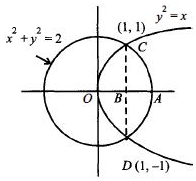
View full question & answer→MCQ 4341 Mark
If the common tangents to the parabola, $x^2 = 4y$ and the circle, $x^2 + y^2 = 4$ intersect at the point $P$, then find the square of the slope of the line:
AnswerCorrect option: C. $2\left( {\sqrt 2 + 1} \right)$
c
Tangent to ${x^2} + {y^2} = 4$
$y = mx \pm 2\sqrt {1 + {m^2}} $
Also, ${x^2} = 4y$
$ \Rightarrow {x^2} = 4mx + 8\sqrt {1 + {m^2}} $
or ${x^2} = 4mx - 8\sqrt {1 + {m^2}} $
For $D=0$ we have;
$16{m^2} + 4.8\sqrt {1 + {m^2}} = 0$
$ \Rightarrow {m^2} + 2\sqrt {1 + {m^2}} = 0$
$ \Rightarrow {m^2} = - 2\sqrt {1 + {m^2}} $
$ \Rightarrow {m^4} = 4 + 4{m^2}$
$ \Rightarrow {m^4} - 4{m^2} - 4 = 0$
$ \Rightarrow {m^2} = \frac{{4 \pm \sqrt {16 + 16} }}{2}$
$ \Rightarrow {m^2} = \frac{{4 \pm 4\sqrt 2 }}{2}$
$ \Rightarrow {m^2} = 2 + 2\sqrt 2 $
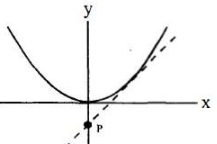
View full question & answer→MCQ 4351 Mark
If $y\, = mx + c$ is the normal at a point on the parabola $y^2\, = 8x$ whose focal distance is $8\, units$, then $\left| c \right|$ is equal to
- A
$2\sqrt 3 $
- B
$8\sqrt 3 $
- ✓
$10\sqrt 3 $
- D
$16\sqrt 3 $
AnswerCorrect option: C. $10\sqrt 3 $
c
$c = - 29m - 9{m^3}$
$a = 2$
Given ${\left( {a{t^2} + a} \right)^2} + 4{a^2}{t^2} = 64$
$ \Rightarrow \left( {a\left( {{t^2} + 1} \right)} \right) = 8$
$ \Rightarrow {t^2} + 1 = 4\,\, \Rightarrow {t^2} = 3$
$ \Rightarrow t = \sqrt 3 $
$\therefore c = 2at\left( {2 + {t^2}} \right)$
$\,\,\,\,\,\,\, = 2\sqrt 3 \left( 5 \right)$
$\left| c \right| = 10\sqrt 3 $
View full question & answer→MCQ 4361 Mark
The eccentricity of an ellipse whose centre is at the origin is $\frac{1}{2}$ . If one of its directices is $x = - 4$ then the equation of the normal to it at $\left( {1,\frac{3}{2}} \right)$ is
- A
$x + 2y = 4$
- B
$2y - x = 2$
- ✓
$4x - 2y = 1$
- D
$4x + 2y = 7$
AnswerCorrect option: C. $4x - 2y = 1$
c
Eccentricity of ellipse $ = \frac{1}{2}$
Now, $ - \frac{a}{e} = - 4 \Rightarrow a = 4 \times \frac{1}{2} = 2 \Rightarrow a = 2$
we have ${b^2} = {a^2}\left( {1 - {e^2}} \right) = {a^2}\left( {1 - \frac{1}{4}} \right) = 4 \times \frac{3}{4} = 3$
$\therefore $ Equation of ellipse
$\frac{{{x^2}}}{4} + \frac{{{y^2}}}{3} = 1$
Now differentiating, we get
$ \Rightarrow \frac{x}{2} + \frac{{2y}}{3} \times y' = 0 \Rightarrow y' = - \frac{{3x}}{{4y}}$
$y'\left| {_{\left( {1,3/2} \right)}} \right| = - \frac{3}{4} \times \frac{2}{3} = - \frac{1}{2}$
Slope of normal $=2$
$\therefore $ Equation of normal at $\left( {1,\frac{3}{2}} \right)$ is
$y - \frac{3}{2} = 2\left( {x - 1} \right) \Rightarrow 2y - 4x - 4$
$\therefore 4x - 2y = 1$
View full question & answer→MCQ 4371 Mark
Consider an elIipse, whose centre is at the origin and its major axis is along the $x-$ axis. If its eccentricity is $\frac{3}{5}$ and the distance between its foci is $6$, then the area (in sq. units) of the quadrilateral inscribed in the ellipse, with the vertices as the vertices of the ellipse, is
Answerd
$e = 3/5\,\, \&\,\, 2ae = 6 \Rightarrow a = 5$
$\because $ ${b^2} = {a^2}\left( {1 - {e^2}} \right)$
$ \Rightarrow {b^2} = 25\left( {1 - 9/25} \right)$
$ \Rightarrow b = 4$
$\therefore $ area of required quadrilateral $ = 4\left( {1/2ab} \right)$
$ = 2ab = 40$
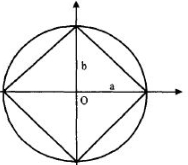
View full question & answer→MCQ 4381 Mark
The eccentricity of an ellipse having centre at the origin, axes along the co-ordinate axes and passing through the points $(4,-1)$ and $(-2, 2)$ is
- A
$\frac{1}{2}$
- B
$\frac{2}{{\sqrt 5 }}$
- ✓
$\frac{{\sqrt 3 }}{2}$
- D
$\frac{{\sqrt 3 }}{4}$
AnswerCorrect option: C. $\frac{{\sqrt 3 }}{2}$
c
Centre at $(0,0)$
$\frac{{{x^2}}}{{{a^2}}} + \frac{{{y^2}}}{{{b^2}}} = 1$
at point $(4,-1)$
$\frac{{16}}{{{a^2}}} + \frac{1}{{{b^2}}} = 1$
$16{b^2} + {a^2} = {a^2}{b^2}\,\,\,\,\,\,\,\,.......\left( i \right)$ at point $(-2,2)$
$\frac{4}{{{a^2}}} + \frac{4}{{{b^2}}} = 1$
$4{b^2} + {a^2} = {a^2}{b^2}\,\,\,\,\,\,\,\,.......\left( {ii} \right)$
$ \Rightarrow 16{b^2} + {a^2} = 4{b^2} + {a^2}$
From equation $(i)$ and $(ii)$
$ \Rightarrow 3{a^2} = 12{b^2}$
$ \Rightarrow \boxed{{a^2} = 4{b^2}}$
${b^2} = {a^2}\left( {1 - {e^2}} \right)$
${e^2} = \frac{3}{4}$
$e = \frac{{\sqrt 3 }}{2}$
View full question & answer→MCQ 4391 Mark
A hyperbola passes through the point $P\left( {\sqrt 2 ,\sqrt 3 } \right)$ has foci at $\left( { \pm 2,0} \right)$. Then the tangent to this hyperbola at $P$ also passes through the point
- A
$\left( { - \sqrt 2 , - \sqrt 3 } \right)$
- B
$\left( {3\sqrt 2 ,2\sqrt 3 } \right)$
- ✓
$\left( {2\sqrt 2 ,3\sqrt 3 } \right)$
- D
$\left( {3,\sqrt 2 } \right)$
AnswerCorrect option: C. $\left( {2\sqrt 2 ,3\sqrt 3 } \right)$
c
Equation of hyperbola is $\frac{x^{2}}{a^{2}}-\frac{y^{2}}{b^{2}}=1$
foci is $(\pm 2,0) \Rightarrow a c=2 \Rightarrow a^{2} c^{2}=4$
Since $b^{2}=a^{2}\left(e^{2}-1\right)$
$b^{2}=a^{2} e^{2}-a^{2}$
$\therefore \quad a^{2}+b^{2}=4$ .......$(1)$
Hyperbola passes through $(\sqrt{2}, \sqrt{3})$
$\therefore \frac{2}{a^{2}}-\frac{3}{b^{2}}=1$ ........$(2)$
$\frac{2}{4-b^{2}} \frac{-3}{b^{2}}=1$
$\Rightarrow b^{4}+b^{2}-12=0$
$\Rightarrow\left(b^{2}-3\right)\left(b^{2}+4\right)=0$
$\Rightarrow b^{2}=3$
$b^{2}=-4 \quad$ (Not possible)
For $b^{2}=3$
$\Rightarrow a^{2}=1$
$\therefore \frac{x^{2}}{1}-\frac{y^{2}}{3}=1$
Equation of tangent is $\frac{\sqrt{2} x}{1}-\frac{\sqrt{3} y}{3}=1$
Clearly $(2 \sqrt{2}, 3 \sqrt{3})$ satisfies it.
View full question & answer→MCQ 4401 Mark
The eccentricity of the hyperbola whose length of the latus rectum is equal to $8$ and the length of its conjugate axis is equal to half of the distance between its foci is :
- ✓
$\frac{2}{{\sqrt 3 }}\;$
- B
$\sqrt 3 $
- C
$\frac{4}{3}$
- D
$\frac{4}{{\sqrt 3 }}$
AnswerCorrect option: A. $\frac{2}{{\sqrt 3 }}\;$
a
We have $\frac{2 b^{2}}{a}=8$
and $2 b=\frac{1}{2}(2 a e)$
$\therefore \frac{2}{a}\left(\frac{a e}{2}\right)^{2}=8$
$a e^{2}=16--(1)$
Now $\frac{2 b^{2}}{a}=8$
$b^{2}=4 a$
$a^{2}\left(e^{2}-1\right)=4 a$
$a e^{2}-a=4$
Substitute the value of $a e^{2}=16$ in eq $(1)$
$16-a=4$
$-a=4-16$
$-a=-12$
$a=12$
$a e^{2}=16$
$e^{2}=\frac{16}{12}$
$e^{2}=\frac{4}{3}$
$e=\frac{2}{\sqrt{3}}$
View full question & answer→MCQ 4411 Mark
Let $P$ be the point on the parabola ${y^2} = 8x$ which is at a minimun distance from the centre $C$ of the circle ${x^2} + {\left( {y + 6} \right)^2} = 1$ . Then the equation of the circle , passing through $C$ and having its centre at $P $ is :
- A
${x^2} + {y^2} - \frac{x}{4} + 2y - 24 = 0$
- B
$\;{x^2} + {y^2} - 4x + 9y + 18 = 0$
- ✓
$\;{x^2} + {y^2} - 4x + 8y + 12 = 0$
- D
$\;{x^2} + {y^2} - x + 4y - 12 = 0$
AnswerCorrect option: C. $\;{x^2} + {y^2} - 4x + 8y + 12 = 0$
c
Minimum distance occurs along common normal
Let normal to parabola be
$y+t x=2.2 . t+2 t^{3}$
pass through $(0,-6):$
$-6=4 t+2 t^{3} \Rightarrow t^{3}+2 t+3=0$
$\Rightarrow \mathrm{t}=-1$ (only real value)
$\therefore P(2,-4)$
$\therefore \mathrm{CP}=\sqrt{4+4}=2 \sqrt{2}$
$\therefore $ equation of circle
$(x-2)^{2}+(y+4)^{2}=(2 \sqrt{2})^{2}$
$\Rightarrow x^{2}+y^{2}-4 x+8 y+12=0$
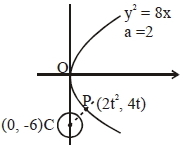
View full question & answer→MCQ 4421 Mark
$P$ and $Q$ are two distinct points on the parabola, $y^2 = 4x$, with parameters $t$ and $t_1$ respectively. If the normal at $P$ passes through $Q$, then the minimum value of $t_1^2$ is
Answera
${t_1} = -t - \frac{2}{t}$
$t_1^2 = {t^2} + \frac{4}{{{t^2}}} + 4$
${t^2} + \frac{4}{{{t^2}}} \ge 2\sqrt {{t^2}.\frac{4}{{{t^2}}}} = 4$
Minimum value of $t_1^2 = 8$
View full question & answer→MCQ 4431 Mark
If the tangent at a point on the ellipse $\frac{{{x^2}}}{{27}} + \frac{{{y^2}}}{3} = 1$ meets the coordinate axes at $A$ and $B,$ and $O$ is the origin, then the minimum area (in sq. units) of the triangle $OAB$ is
- A
$3\sqrt 3$
- B
$\frac {9}{2}$
- ✓
$9$
- D
$\frac {9}{\sqrt 3}$
Answerc
Equation of tangent to ellipse
$\frac{x}{{\sqrt {27} }}\cos \theta + \frac{y}{{\sqrt 3 }}\sin \theta = 1$
Area bounded by line and co-ordinate axis
$\Delta = \frac{1}{2}.\frac{{\sqrt {27} }}{{\cos \,\theta }}.\frac{{\sqrt 3 }}{{\sin \theta }} = \frac{9}{{\sin 2\theta }}$
$\Delta = $ will be minimum when $\sin 2\theta = 1$
${\Delta _{\min }} = 9$
View full question & answer→MCQ 4441 Mark
Let $a$ and $b$ respectively be the semitransverse and semi-conjugate axes of a hyperbola whose eccentricity satisfies the equation $9e^2 - 18e + 5 = 0.$ If $S(5, 0)$ is a focus and $5x = 9$ is the corresponding directrix of this hyperbola, then $a^2 - b^2$ is equal to
Answera
$S\left( {5,0} \right)\,$ is focus $ \Rightarrow ae = 5$ (focus) ......$(1)$
$x = \frac{a}{5} \Rightarrow \frac{a}{e} = \frac{9}{5}$ (directrix) .....$(2)$
$\left( 1 \right) \left( 2 \right) \Rightarrow {a^2} = 9$
$\left( 1 \right) \Rightarrow \left( e \right) = \frac{5}{3}$
${b^2} = {a^2}\left( {{e^2} - 1} \right) \Rightarrow {b^2} = 16$
${a^2} + {b^2} = 9 - 16 = - 7$
View full question & answer→MCQ 4451 Mark
A hyperbola whose transverse axis is along the major axis of then conic, $\frac{{{x^2}}}{3} + \frac{{{y^2}}}{4} = 4$ and has vertices at the foci of this conic . If the eccentricity of the hyperbola is $\frac{3}{2}$ , then which of the following points does $NOT$ lie on it ?
- A
$\left( {\sqrt 5 ,2\sqrt 2 } \right)$
- B
$(0, 2)$
- ✓
$\left( {5,2\sqrt 3 } \right)$
- D
$\left( {\sqrt 10 ,2\sqrt 3 } \right)$
AnswerCorrect option: C. $\left( {5,2\sqrt 3 } \right)$
c
$\left( c \right)\,\,\,\,\frac{{{x^2}}}{{12}} + \frac{{{y^2}}}{{16}} = 1$
$e = \sqrt {1 - \frac{{12}}{{16}}} = \frac{1}{2}$
Foci $(0,2)$ &$(0,-2)$
So, transverse axis of hyperbola $a = 2b = 4 \Rightarrow b = 2$
${a^2} = {1^2}\left( {{e^2} - 1} \right)$
$ \Rightarrow {a^2} = 4\left( {\frac{9}{4} - 1} \right)$
$ \Rightarrow {a^2} = 5$
$\therefore $ It's equation is $\frac{{{x^2}}}{5} + \frac{{{y^2}}}{4} = 1$
The point $\left( {5,2\sqrt 3 } \right)$does not satisfy the above equation.
View full question & answer→MCQ 4461 Mark
Let $O $ be the vertex and $Q$ be any point on the parabola ${x^2} = 8y$ .If the point $P$ divides the line segment $OQ$ internally in the ratio $ 1:3$ , then locus of $P$ is :
- ✓
$\;{x^2} = 2y$
- B
$\;{x^2} = y$
- C
$\;{y^2} = x$
- D
$\;{y^2} = 2x$
AnswerCorrect option: A. $\;{x^2} = 2y$
a
$P = (\frac{4t}{4}, \frac{2t^2}{4})$
$h=\frac{4t}{4}=t$
$k=\frac{2t^2}{4}=\frac{t^2}{2}$
$x^2=2y$
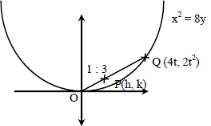
View full question & answer→MCQ 4471 Mark
Let $PQ$ be a double ordinate of the parabola, $y^2\, = - 4x$, where $P$ lies in the second quadrant. If $R$ divides $PQ$ in the ratio $2 : 1$ then the locus of $R$ is
- A
$3y^2\, = - 2x$
- B
$3y^2\, = 2x$
- C
$9y^2\, = 4x$
- ✓
$9y^2\, = - 4x$
AnswerCorrect option: D. $9y^2\, = - 4x$
d
Let $P\left( { - at_1^2,2a{t_1}} \right),Q\left( { - at_1^2, - 2a{t_1}} \right)$ and $R(h,k)$
By using section formula, we have
$h = - at_1^2,k = \frac{{ - 2a{t_1}}}{3}$
$k = - \frac{{2a{t_1}}}{3}$
$ \Rightarrow 3k = - 2a{t_1}$
$ \Rightarrow 9{k^2} = 4{a^2}t_1^2 = 4a\left( { - h} \right)$
$ \Rightarrow 9{k^2} = - 4ah$
$ \Rightarrow 9{k^2} = - 4h \Rightarrow 9{y^2} = - 4x$
View full question & answer→MCQ 4481 Mark
The area (in sq, units) of the quadrilateral formed by the tangents at the end points of the latera recta to the ellipse $\frac{{{x^2}}}{9} + \frac{{{y^2}}}{5} = 1$ is :
- ✓
$27$
- B
$\frac{{27}}{4}$
- C
$18$
- D
$\frac{{27}}{2}$
Answera
$a=3, b=\sqrt{5}$
$e=\sqrt{1-\frac{5}{9}}=\frac{2}{3}$
foci $=(\pm 2,0)$
tangent at $P \Rightarrow \frac{2 x}{9}+\frac{5 y}{3.5}=1$
$\frac{2 x}{9}+\frac{y}{3}=1$
$2 x+3 y=9$
Area of quadrilateral
$=4 \times \text { (area of triangle } \mathrm{QCR})$
$=\left(\frac{1}{2} \times \frac{9}{2} \times 3\right) \times 4=27$
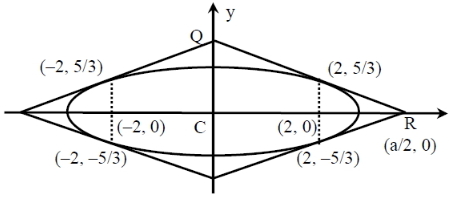
View full question & answer→MCQ 4491 Mark
If the distance between the foci of an ellipse is half the length of its latus rectum, then the eccentricity of the ellipse is
AnswerCorrect option: B. $\sqrt 2 - 1$
b
Focus of an ellipse is given as $\left( { \pm ae,0} \right)$
distance between then $=2ae$
According to the quation, $2ae = \frac{{{b^2}}}{a}$
$ \Rightarrow 2{a^2}e = {b^2} = {a^2}\left( {1 - {e^2}} \right)$
$ \Rightarrow 2e = 1 - {e^2} \Rightarrow {\left( {e - 1} \right)^2} = 2 \Rightarrow e = \sqrt 2 - 1$
View full question & answer→MCQ 4501 Mark
An ellipse passes through the foci of the hyperbola, $9x^2 - 4y^2 = 36$ and its major and minor axes lie along the transverse and conjugate axes of the hyperbola respectively. If the product of eccentricities of the two conics is $\frac {1}{2}$, then which of the following points does not lie on the ellipse?
- A
$\left( {\sqrt {\frac{{13}}{2}} ,\sqrt 6 } \right)$
- B
$\left( {\frac{{\sqrt {39} }}{2},\sqrt 3 } \right)$
- ✓
$\left( {\frac{1}{2}\sqrt {13} ,\frac{{\sqrt 3 }}{2}} \right)$
- D
$(\sqrt {13} ,0)$
AnswerCorrect option: C. $\left( {\frac{1}{2}\sqrt {13} ,\frac{{\sqrt 3 }}{2}} \right)$
c
Equation of hyperbola is
$\frac{{{x^2}}}{4} - \frac{{{y^2}}}{9} = 1$
Its foci $ = \left( { \pm \sqrt {13} ,0} \right)$
$e = \frac{{\sqrt {13} }}{2}$
If $e$, $2$ the eccentricity of the ellipse, then
${e_1} \times \frac{{\sqrt {13} }}{2} = \frac{1}{2}\,\,\,\,\,\,\, \Rightarrow {e_1} = \frac{1}{{\sqrt {13} }}$
Equation of ellipse is
$\frac{{{x^2}}}{{{a^2}}} - \frac{{{y^2}}}{{{b^2}}} = 1$
since ellise passes through the foci $\left( { \pm \sqrt {13} ,0} \right)$ of the hyperbola, therfoer
${a^2} = 13$
Now $\sqrt {{a^2} - {b^2}} = a{e_1}$
$\therefore 13 - {b^2} = 1$
$ \Rightarrow {b^2} = 12$
Hence, equation of ellipse is
$\frac{{{x^2}}}{{13}} - \frac{{{y^2}}}{{12}} = 1$
Now putting the coordinate of the point $\left( {\frac{{\sqrt {13} }}{2},\frac{{\sqrt 3 }}{2}} \right)$ in the equation of the ellipse,
we get
$\frac{{13}}{{14 \times 13}} + \frac{3}{{4 \times 12}} = 1$
$ \Rightarrow \frac{1}{4} + \frac{1}{{16}} = 1$ , which is not true,
Hence the point $\left( {\frac{{\sqrt {13} }}{2},\frac{{\sqrt 3 }}{2}} \right)$ does not lie on the ellipse.
View full question & answer→MCQ 4511 Mark
The slope of the line touching both the parabolas ${y^2} = 4x$ and ${x^2} = - 32y$, is
- A
$\frac{1}{8}$
- B
$\frac{2}{3}$
- ✓
$\frac{1}{2}$
- D
$\frac{3}{2}$
AnswerCorrect option: C. $\frac{1}{2}$
c
$y^{2}=4 x$
$\Longrightarrow a=1$
$x^{2}=-32 y$
$\Longrightarrow a=-8$
tangent to the parabola $y^{2}=4 x$ is $y=m x+\frac{a}{m}$
$\Longrightarrow y=m x+\frac{1}{m}---(1)$
tangent to the parabola $x^{2}=-32 y$ is
$y=m x+a m^{2}$
$\Longrightarrow y=m x+8 m^{2}---(2)$
Equating $( 1)$ and $( 2)$
$m x+\frac{1}{m}=m x+8 m^{2}$
$\Longrightarrow 8 m^{3}=1$
$\therefore m=\frac{1}{2}$
View full question & answer→MCQ 4521 Mark
Let $a$ and $b$ be any two numbers satisfying $\frac{1}{{{a^2}}} + \frac{1}{{{b^2}}} = \frac{1}{4}$. Then, the foot of perpendicular from the origin on the variable line, $\frac{x}{a} + \frac{y}{b} = 1$ , lies on
- A
a hyperbola with each semi-axis $ = \sqrt 2 $
- B
a hyperbola with each semi-axis $= 2$
- ✓
a circle of radius $= 2$
- D
a circle of radius $ = \sqrt 2 $
AnswerCorrect option: C. a circle of radius $= 2$
c
Let the foot of the perpendicular from $(0,0)$ on the variable line
$\frac{x}{a} + \frac{y}{b} = 1\,$ is $\left( {{x_1} > {y_1}} \right)$
Hence, perpendicular distance of the variable line $\frac{x}{a} + \frac{y}{b} = 1\,\,$ from the point $O$
$\left( {0,0} \right) = OA$
$ \Rightarrow \frac{{ - 1}}{{\sqrt {\frac{1}{{{a^2}}} + \frac{1}{{{b^2}}}} }} = \sqrt {x_1^2 + y_1^2} $
$ \Rightarrow \frac{1}{{\frac{1}{{{a^2}}} + \frac{1}{{{b^2}}}}} = x_1^2 + y_1^2$
$ \Rightarrow 4 = x_1^2 + y_1^2$ [$\because $ $\frac{1}{{{a^2}}} + \frac{1}{{{b^2}}} = \frac{1}{4}$]
which is equation of aciecle with radius $2$.
Hence $\left( {{x_1},{y_1}} \right)\,\,\,$ i.e., the foot of the perpendicular from the point $\left( {0,0} \right)$ to the variable line $\frac{x}{a} + \frac{x}{b} = 1$ is line on a circle with radius $=2$
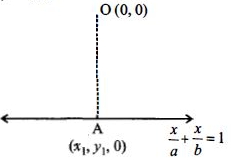
View full question & answer→MCQ 4531 Mark
A stair-case of length $l$ rests against a vertical wall and a floor of a room. Let $P$ be a point on the stair-case, nearer to its end on the wall, that divides its length in the ratio $1 : 2$. If the staircase begins to slide on the floor, then the locus of $P$ is
- A
an ellipse of eccentricity $\frac{1}{2}$
- ✓
an ellipse of eccentncity $\frac{{\sqrt 3 }}{2}$
- C
a circle of radius $\frac{1}{2}$
- D
a circle of radius $\frac{{\sqrt 3 }}{2}l$
AnswerCorrect option: B. an ellipse of eccentncity $\frac{{\sqrt 3 }}{2}$
b
Let point $A\left( {a,0} \right)$is on $x$-axis and $B\left( {0,b} \right)$is on $y$-axis.
Let $P(h,k)$ divides $AB$ in the ration $1:2$
So, by section formula
$h = \frac{{2\left( 0 \right) + 1\left( a \right)}}{{1 + 2}} = \frac{a}{3}$
$k = \frac{{2\left( b \right) + 1\left( 0 \right)}}{3} = \frac{{2b}}{3}$
$ \Rightarrow a = 3h$ and $b = \frac{{3k}}{2}$
Now, ${a^2} + {b^2} = {l^2}$
$ \Rightarrow 9{h^2} + \frac{{9{k^2}}}{4} = {l^2}$
$ \Rightarrow \frac{{{h^2}}}{{{{\left( {\frac{l}{3}} \right)}^2}}} + \frac{{{k^2}}}{{{{\left( {\frac{{2l}}{3}} \right)}^2}}} = 1$
Now $e = \sqrt {1 - \left( {\frac{{{l^2}}}{9} \times \frac{9}{{4{l^2}}}} \right)} = \sqrt {1 - \frac{1}{4}} = \frac{{\sqrt 3 }}{2}$
Thus, required locus of $P$ is an ellipse
with eccentricity $\frac{{\sqrt 3 }}{2}$.
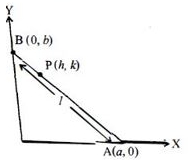
View full question & answer→MCQ 4541 Mark
Let $L_1$ be the length of the common chord of the curves $x^2 + y^2\, = 9$ and $y^2\, = 8x$, and $L_2$ be the length of the latus rectum of $y^2\, = 8x$, then
AnswerCorrect option: C. $L_1 < L_2$
c
We have
${x^2} + \left( {8x} \right) = 9$
${x^2} + 9x + x + 9 = 0$
$x\left( {x + 9} \right) - 1\left( {x + 9} \right) = 0$
$\left( {x + 9} \right)\left( {x - 1} \right) = 0$
$x = - 9,1$
for $x = 1,y = \pm 2\sqrt {2x} = \pm 2\sqrt 2 $
${L_1} = $ Length of $AB$
$ = \sqrt {{{\left( {2\sqrt 2 + 2\sqrt 2 } \right)}^2} + {{\left( {1 - 1} \right)}^2}} = 4\sqrt 2 $
${L_2} = $ Length of latus rectum
$ = 4a = 4 \times 2 = 8$
${L_1} < {L_2}$
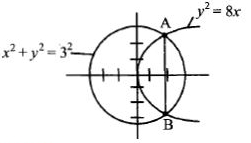
View full question & answer→MCQ 4551 Mark
Two tangents are drawn from a point $(- 2, - 1)$ to the curve, $y^2 = 4x.$ If $\alpha $ is the angle between them, then $\left| {\tan \,\alpha } \right|$ is equal to
- A
$\frac {1}{3}$
- B
$\frac {1}{\sqrt 3}$
- C
$\sqrt 3$
- ✓
$3$
Answerd
The locus of the point of intersection of tangents to the parabola ${y^2} = 4ax$ inclined at an angle $\alpha $ to each other is
${\tan ^2}\alpha {\left( {x + a} \right)^2} = {y^2} - 4ax$
Given equation of Parabola
${y^2} - 4a\left\{ {a = 1} \right\}$
Point of intersection $\left( { - 2, - 1} \right)$
${\tan ^2}\alpha {\left( { - 2 + 1} \right)^2} = {\left( { - 1} \right)^2} - 4 \times 1 \times \left( { - 2} \right)$
$ \Rightarrow {\tan ^2}\alpha = 9$
$ \Rightarrow \tan \alpha = \pm 3$
$ \Rightarrow \left| {\tan \alpha } \right| = 3$
View full question & answer→MCQ 4561 Mark
A chord is drawn through the focus of the parabola $y^2\, = 6x$ such that its distance from the vertex of this parabola is $\frac{{\sqrt 5 }}{2}$ , then its slope can be:
- ✓
$\frac{{\sqrt 5 }}{2}$
- B
$\frac{{\sqrt 3 }}{2}$
- C
$\frac{2}{{\sqrt 5 }}$
- D
$\frac{2}{{\sqrt 3 }}$
AnswerCorrect option: A. $\frac{{\sqrt 5 }}{2}$
a
Equation of parabola, ${y^2} = 6x$
$ \Rightarrow {y^2} = 4 \times \frac{3}{2}x$
$\therefore $ Focus $ = \left( {\frac{3}{2},0} \right)$
Let equation of chord passing throught focus be
$ax + by + c = 0\,\,\,\,\,\,\,.......\left( 1 \right)$
Since chord is passinh throught $\left( {\frac{3}{2},0} \right)$
$\therefore $ Put $x = \frac{3}{2},y = 0$ in eqn $(1)$, we get
$\frac{3}{2} + a + c = 0$
$ \Rightarrow c = - \frac{3}{2}a\,\,\,\,\,\,\,\,......\left( 2 \right)$
distance of chord from origin is $\frac{{\sqrt 5 }}{2}$
$\frac{{\sqrt 5 }}{2} = \frac{{a\left( 0 \right) + b\left( 0 \right) + c}}{{\sqrt {{a^2} + {b^2}} }} = \frac{c}{{\sqrt {{a^2} + {b^2}} }}$
distance of chord from origin is $\frac{{\sqrt 5 }}{2}$
$\frac{{\sqrt 5 }}{2} = \frac{{a\left( 0 \right) + b\left( 0 \right) + c}}{{\sqrt {{a^2} + {b^2}} }} = \frac{c}{{\sqrt {{a^2} + {b^2}} }}$
Squaring both sides
$\frac{5}{4} = \frac{{{c^2}}}{{{a^2} + {b^2}}}$
$ \Rightarrow {a^2} + {b^2} = \frac{4}{5}{c^2}$
Putting value of $c$ from $(2)$, we get
${a^2} + {b^2} = \frac{4}{5} \times \frac{9}{4}{a^2}$
${b^2} = \frac{9}{4}{a^2} - {a^2} = \frac{4}{5}{a^2}$
$\frac{{{a^2}}}{{{b^2}}} = \frac{5}{4},\frac{a}{b} = \pm \frac{{\sqrt 5 }}{2}$
Slope of chord, $\frac{{dy}}{{dx}}$
$ = - \frac{a}{b} = - \left( {\frac{{ \pm \sqrt 5 }}{2}} \right) = \pm \frac{{\sqrt 5 }}{2}$
View full question & answer→MCQ 4571 Mark
The locus of the foot of perpendicular drawn from the centre of the ellipse ${x^2} + 3{y^2} = 6$ on any tangent to it is
- ✓
${\left( {{x^2} + {y^2}} \right)^2} = 6{x^2} + 2{y^2}$
- B
$\;{\left( {{x^2} + {y^2}} \right)^2} = 6{x^2} - 2{y^2}$
- C
$\;{\left( {{x^2} - {y^2}} \right)^2} = 6{x^2} + 2{y^2}$
- D
$\;{\left( {{x^2} - {y^2}} \right)^2} = 6{x^2} - 2{y^2}$
AnswerCorrect option: A. ${\left( {{x^2} + {y^2}} \right)^2} = 6{x^2} + 2{y^2}$
a
$x^{2}+3 y^{2}=6$
$\Rightarrow \frac{x^{2}}{6}+\frac{y^{2}}{2}=1$
Now, we know that any tangent to the ellipse $\frac{x^{2}}{a^{2}}+\frac{y^{2}}{b^{2}}=1$ is given by:
$y=m x+\sqrt{a^{2} m^{2}+b^{2}}$
So, the equation of the tangent to the given ellipse is:-
$y=m x+\sqrt{6 m^{2}+2}$ ...........$(1)$
Now, equation of the line through $(0,0)$ and perpendicular to $(1)$ is:-
$y-0=\left(-\frac{1}{m}\right) x-0$
$\Rightarrow m=-\frac{x}{y}$ .....$(2)$
Using $( 2)$ in $(1),$ we have:
$y=\left(-\frac{x}{y}\right) x+\sqrt{6\left(\frac{x^{2}}{y^{2}}\right)+2}$
$\Rightarrow y^{2}=-x^{2}+\sqrt{6 x^{2}+2 y^{2}}$
$\Rightarrow\left(x^{2}+y^{2}\right)^{2}=6 x^{2}+2 y^{2}$
View full question & answer→MCQ 4581 Mark
If $OB$ is the semi-minor axis of an ellipse, $F_1$ and $F_2$ are its foci and the angle between $F_1B$ and $F_2B$ is a right angle, then the square of the eccentricity of the ellipse is
- ✓
$\frac{1}{2}$
- B
$\frac{1}{{\sqrt 2 }}$
- C
$\frac{1}{{2\sqrt 2 }}$
- D
$\frac{1}{4}$
AnswerCorrect option: A. $\frac{1}{2}$
a
Let $\frac{{{x^2}}}{{{a^2}}} + \frac{{{y^2}}}{{{b^2}}} = 1$ be he equation of ellipse.
Given that ${F_1}B$ and ${F_2}B$ are perpandicluar to each other.
Slope of ${F_1}B \times $ alop of ${F_2}B = - 1$
$\left( {\frac{{0 - b}}{{ - ae - 0}}} \right) \times \left( {\frac{{0 - b}}{{ae - 0}}} \right) = - 1$
$\left( {\frac{b}{{ae}}} \right) \times \left( {\frac{{ - b}}{{ae}}} \right) = - 1$
${b^2} = {a^2}{e^2}$
${e^2} = \frac{{{b^2}}}{{{a^2}}}\,\,\,$ {$\because $ $\,\,{e^2} = 1 - \frac{{{b^2}}}{{{a^2}}}\,\,$}
$1 - \frac{{{b^2}}}{{{a^2}}}\,\,\, = \frac{{{b^2}}}{{{a^2}}}\,$
$1 = 2\frac{{{b^2}}}{{{a^2}}}\,\,\, \Rightarrow \frac{{{b^2}}}{{{a^2}}}\,\,\, = \frac{1}{2}$
${e^2} = 1 - \frac{{{b^2}}}{{{a^2}}}\,\,\, = 1 - \frac{1}{2} = \frac{1}{2}$
${e^2} = \frac{1}{2}$
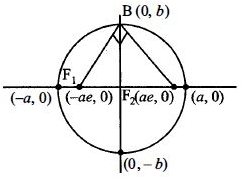
View full question & answer→MCQ 4591 Mark
Let $P (3\, sec\,\theta , 2\, tan\,\theta )$ and $Q\, (3\, sec\,\phi , 2\, tan\,\phi )$ where $\theta + \phi \, = \frac{\pi}{2}$ , be two distinct points on the hyperbola $\frac{{{x^2}}}{9} - \frac{{{y^2}}}{4} = 1$ . Then the ordinate of the point of intersection of the normals at $P$ and $Q$ is
- A
$\frac{11}{3}$
- B
$-\frac{11}{3}$
- C
$\frac{13}{2}$
- ✓
$-\frac{13}{2}$
AnswerCorrect option: D. $-\frac{13}{2}$
d
Let the coordinate at point of intersection of normal at $P$ and $Q$ be $(h,k)$
Since, equation of normal to the hyperbola $\,\frac{{{x^2}}}{{{a^2}}} - \frac{{{y^2}}}{{{b^2}}} = 1$ At point $\left( {{x_1},{y_1}} \right)$ is
$\frac{{{a^2}x}}{{{x_1}}} + \frac{{{b^2}y}}{{{y_1}}} = {a^2} + {b^2}$ therefore equation of normal to the hyperbola $\frac{{{x^2}}}{{{3^2}}} - \frac{{{y^2}}}{{{2^2}}} = 1$
at point $P\left( {3\,\sec \theta ,2\,\tan \theta } \right)$ is
$\frac{{{3^2}x}}{{3\,\sec \theta }} + \frac{{{2^2}y}}{{2\tan \theta }} = {3^2} + {2^2}$
$ \Rightarrow \boxed{3x\,\cos \theta + 2y\cot \theta = {3^2} + {2^2}} ......\left( 1 \right)$
Similarly , equation of normal to the hyperbola $\frac{{{x^2}}}{{{3^2}}} - \frac{{{y^2}}}{{{2^2}}}$ at point
$Q\left( {3\,\sec \phi ,2\,\tan \phi } \right)$ is
$\frac{{{3^2}x}}{{3\,\sec \phi }} + \frac{{{2^2}y}}{{2\tan \phi }} = {3^2} + {2^2}$
$ \Rightarrow \boxed{3x\,\cos \phi + 2y\cot \phi = {3^2} + {2^2}} ......\left( 2 \right)$
Given $\theta + \phi = \frac{\pi }{2} \Rightarrow \phi = \frac{\pi }{2} - \theta $ and these passes through $(h,k)$
$\therefore $ Frem eq. $(2)$
$ \Rightarrow \boxed{3h\,\sin \theta + 2k\tan \theta = {3^2} + {2^2}} ......\left( 3 \right)$
and $\boxed{3h\,\cos \theta + 2k\cot \theta = {3^2} + {2^2}} ......\left( 4 \right)$
Commparing equation $(3) \;and \;(4)$, we get
$3h\,\cos \theta + 2k\cot \theta = 3h\,\sin \theta + 2k\tan \theta $
$3h\,\cos \theta - 3h\sin \theta = 2k\tan \theta - 2k\cot \theta $
$3h\left( {\cos \theta - \sin \theta } \right) = 2k\left( {\tan \theta - \cot \theta } \right)$
$3h\left( {\cos \theta - \sin \theta } \right)$
$ = 2k\frac{{\left( {\sin \theta - \cos \theta } \right)\left( {\sin \theta + \cos \theta } \right)}}{{\sin \theta \cos \theta }}$
or $3h = \frac{{ - 2k\left( {\sin \theta \cos \theta } \right)}}{{\sin \theta \cos \theta }} ......\left( 5 \right)$
Now, putting the value of equation $(5)$ in eq.$(3)$
$\frac{{ - 2k\left( {\sin \theta \cos \theta } \right)\sin \theta }}{{\sin \theta \cos \theta }} + \,2k\tan \theta = {3^2} + {2^2}$
$ \Rightarrow \,2k\tan \theta - 2k + 2k\tan \theta = 13$
$ - 2k = 13 \Rightarrow k = \frac{{ - 13}}{2}$
Hence, ordinate of point of intersection of the at $P$ and $Q$ is $\frac{{ - 13}}{2}$
View full question & answer→MCQ 4601 Mark
The tangent at an extremity (in the first quadrant) of latus rectum of the hyperbola $\frac{{{x^2}}}{4} - \frac{{{y^2}}}{5} = 1$ , meet $x-$ axis and $y-$ axis at $A$ and $B$ respectively. Then $(OA)^2 - (OB)^2$ , where $O$ is the origin, equals
- ✓
$ - \frac{{20}}{9}$
- B
$ \frac{{16}}{9}$
- C
$4$
- D
$ - \frac{{4}}{3}$
AnswerCorrect option: A. $ - \frac{{20}}{9}$
a
Given $\frac{{{x^2}}}{4} - \frac{{{y^2}}}{5} = 1$
$ \Rightarrow {a^2} = 4,{b^2} = 5$
$e = \sqrt {\frac{{{a^2} + {b^2}}}{{{a^2}}}} = \sqrt {\frac{{4 + 5}}{4}} = \frac{3}{2}$
$L = \left( {2 \times \frac{3}{2},\frac{5}{2}} \right) = \left( {3,\frac{5}{2}} \right)$
equation of tangent at $\left( {{x_1},{y_1}} \right)$ is
$\frac{{x{x_1}}}{{{a^2}}} - \frac{{y{y_1}}}{{{b^2}}} = 1$
Here ${x_1} = 3,\,\,\,{y_1} = \frac{5}{2}$
$ \Rightarrow \frac{{3x}}{4} - \frac{y}{2} = 1 \Rightarrow \frac{x}{{\frac{4}{3}}} + \frac{y}{{ - 2}} = 1$
$x$ -intercept pf the tangent, $OA = \frac{4}{3}\,\,$
$y$ -intercept pf the tangent, $\,OB = - 2$
$O{A^2} - O{B^2} = \frac{{16}}{9} - 4 = - \frac{{20}}{9}$
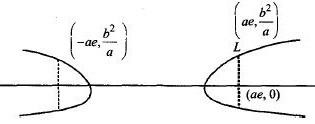
View full question & answer→MCQ 4611 Mark
The the circle passing through the foci of the $\frac{{{x^2}}}{{16}} + \frac{{{y^2}}}{9} = 1$ and having centre at $(0,3) $ is
- ✓
${x^2} + {y^2} - 6y - 7 = 0$
- B
$\;{x^2} + {y^2} - 6y + 7 = 0$
- C
$\;{x^2} + {y^2} - 6y - 5 = 0$
- D
$\;{x^2} + {y^2} - 6y + 5 = 0$
AnswerCorrect option: A. ${x^2} + {y^2} - 6y - 7 = 0$
a
$a=4, b=3, e=\sqrt{1-\frac{9}{16}} \quad \Rightarrow \quad \frac{\sqrt{7}}{4}$
Foci is $(\pm \text { ae }, 0)$ $\Rightarrow \quad(\pm \sqrt{7}, 0)$
$r=\sqrt{(a e)^{2}+b^{2}}$
$\sqrt{7+9}$
$=4$
Now equation of circle is $(x-0)^{2}+(y-3)^{2}=16$
$x^{2}+y^{2}-6 y-7=0$
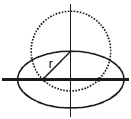
View full question & answer→MCQ 4621 Mark
Given; A circle $2{x^2} + 2{y^2} = 5$ and parabola ${y^2} = 4\sqrt 5 x$
Statement $-1$:An equation of a common tangent to these curve is $y = x + \sqrt 5 $
Statement $-2$: If the line, $y = mx + \frac{{\sqrt 5 }}{m}\left( {m \ne 0} \right)$ is their common tangent , then $m$ satisfies ${m^4} - 3{m^2} + 2 = 0$.
- A
Statement $-1$ is false, Statement $-2$ is true
- B
Statement $-1$ is true, Statement $-2$ is false
- C
Statement $-1$ is true, Statement $-2$ is true; Statement $-2$ is acorrect explanation for Statement $-1$
- ✓
Statement $-1$ is true, Statement $-2$ is true; Statement $-2$ is not acorrect explanation for Statement $-1$
AnswerCorrect option: D. Statement $-1$ is true, Statement $-2$ is true; Statement $-2$ is not acorrect explanation for Statement $-1$
d
Let common tangent
$ y=m x +\frac{\sqrt{5}}{m} $
$\frac{{\frac{{\sqrt 5 }}{m}}}{{\sqrt {1 + {m^2}} }} = \sqrt {\frac{5}{2}} $
$ m \sqrt{1+m^{2}}=\sqrt{2} $
$ m^{2}\left(1+m^{2}\right) =2 $
$ m^{4}+m^{2}-2 =2 $
$\left(m^{2}+2\right)\left(m^{2}-1\right) =0 $
$m =\pm 1 $
$ y=\pm(x+\sqrt{5}) \text { both statements are correct as }$
$ m=\pm 1 \text { satisfies the given equation of statement-2. } $
View full question & answer→MCQ 4631 Mark
Statement $-1$ : The slope of the tangent at any point $P$ on a parabola, whose axis is the axis of $x$ and vertex is at the origin, is inversely proportional to the ordinate of the point $P$.
Statement $-2$ : The system of parabolas $y^2 = 4ax$ satisfies a differential equation of degree $1$ and order $1$
- A
Statement $- 1$ is true; Statement $-2$ is true;
Statement $-2$ is a correct explanation for statement $- 1$
- ✓
Statement $- 1$ is true; Statement $-2$ is true;
Statement $-2$ is not a correct explanation for statement $- 1$
- C
Statement $- 1$ is true; Statement $-2$ is false
- D
Statement $- 1$ is false; Statement $-2$ is true
AnswerCorrect option: B. Statement $- 1$ is true; Statement $-2$ is true;
Statement $-2$ is not a correct explanation for statement $- 1$
b
statement- $1$ : ${y^2} = \pm 4ax$
$ \Rightarrow \frac{{dy}}{{dx}} = \pm 2a.\frac{1}{y} \Rightarrow \frac{{dy}}{{dx}} \propto \frac{1}{y}$
Statememt-$2$ : ${y^2} = 4ax \Rightarrow 2y\frac{{dy}}{{dx}} = 4a$
Thus both statements are true but statement- $2$ is not a correct explanation for statement- $1$.
View full question & answer→MCQ 4641 Mark
Statement $-1:$ The line $x - 2y = 2$ meets the parabola, $y^2 + 2x = 0$ only at the point $(-2, - 2).$
Statement $-2:$ The line $y = mx - \frac{1}{{2m}}(m \ne 0)$ is tangent to the parabola, $y^2 = - 2x$ at the point $\left( { - \frac{1}{{2{m^2}}}, - \frac{1}{m}} \right).$
AnswerCorrect option: B. Statement $-1$ is true; Statement $-2$ is true;
Statement $-2$ is a correct explanation for statement $-1.$
b
Both satements are true and satement-$2$ is the correct expalnation of satement-$1$
$\therefore $ The straight line $y = mx + \frac{a}{m}$ is always a tangent to the parabola ${y^2} = 4ax$ for any value of $m$.
The co-ordinates of point of contact
$\left( {\frac{a}{{{m^2}}}.\frac{{2a}}{m}} \right)$
View full question & answer→MCQ 4651 Mark
The point of intersection of the normals to the parabola $y^ 2\, = 4x$ at the ends of its latus rectum is
- A
$(0, 2)$
- ✓
$(3, 0)$
- C
$(0, 3)$
- D
$(2, 0)$
AnswerCorrect option: B. $(3, 0)$
b
We know that point of intersection of the normal to the parabola $y^ 2\, = 4ax$ at the ends of its latus rectum is $(3a, 0)$ Hence required point of intersection $= (3, 0)$
View full question & answer→MCQ 4661 Mark
If $a$ and $c$ are positive real numbers and the ellipse $\frac{{{x^2}}}{{4{c^2}}} + \frac{{{y^2}}}{{{c^2}}} = 1$ has four distinct points in common with the circle $x^2 + y^2 = 9a^2$ , then
- A
$9ac -9a^2 - 2c^2 <0$
- B
$6ac + 9a^2 - 2c^2 < 0$
- ✓
$9ac -9a^2 -2c^2 > 0$
- D
$6ac +9a^2 - 2c^2 >0$
AnswerCorrect option: C. $9ac -9a^2 -2c^2 > 0$
c
Radius $=3a$
Length of major axis $=4c$
Now, (radius)<(Half of the length of major axis)
$3a < 2c$
$9{a^2} < 4{c^2}$
$9ac - 9{a^2} > 9ac - 4{c^2}$
$9ac - 9{a^2} - 2{c^2} > 9ac - 6{c^2}\,\,\,\,\,\,\,\,......\left( i \right)$
Again $3a < 2c$
$ \Rightarrow 9ac < 6{c^2}$
$ \Rightarrow 9ac - 6{c^2} < 0\,\,\,\,\,\,\,\,\,\,.....\left( {ii} \right)$
From $(i)$ and $(ii)$,
$9ac - 9{a^2} - 2{c^2} > 0$
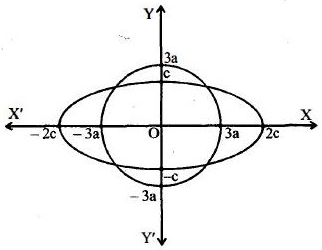
View full question & answer→MCQ 4671 Mark
Let the equations of two ellipses be ${E_1}:\,\frac{{{x^2}}}{3} + \frac{{{y^2}}}{2} = 1$ and ${E_2}:\,\frac{{{x^2}}}{16} + \frac{{{y^2}}}{b^2} = 1,$ If the product of their eccentricities is $\frac {1}{2},$ then the length of the minor axis of ellipse $E_2$ is
Answerc
Given equationd of ellipses
${E_1}:\frac{{{x^2}}}{3} + \frac{{{y^2}}}{2} = 1$
$ \Rightarrow {e_1} = \sqrt {1 - \frac{2}{3}} = \frac{1}{{\sqrt 3 }}$
and ${E_2}:\frac{{{x^2}}}{{16}} + \frac{{{y^2}}}{{{b^2}}} = 1$
$ \Rightarrow {e_1} = \sqrt {\frac{{1 - {b^2}}}{{16}}} = \sqrt {\frac{{16 - {b^2}}}{4}} $
Also, given ${e_1} \times {e_2} = \frac{1}{2}$
$ \Rightarrow \frac{1}{{\sqrt 3 }} \times \sqrt {\frac{{16 - {b^2}}}{4}} = \frac{1}{2} \Rightarrow 16 - {b^2} = 12$
$ \Rightarrow {b^2} = 4$
$\therefore $ Length of minor axis of
${E_2} = 2b = 2 \times 2 = 4$
View full question & answer→MCQ 4681 Mark
A point on the ellipse, $4x^2 + 9y^2 = 36$, where the normal is parallel to the line, $4x -2y-5 = 0$ , is
- A
$\left( {\frac{9}{5},\frac{8}{5}} \right)$
- B
$\left( {\frac{8}{5},-\frac{9}{5}} \right)$
- ✓
$\left( {-\frac{9}{5},\frac{8}{5}} \right)$
- D
$\left( {\frac{8}{5},\frac{9}{5}} \right)$
AnswerCorrect option: C. $\left( {-\frac{9}{5},\frac{8}{5}} \right)$
c
Given ellipse is $4{x^2} + 9{y^2} = 36$
$ \Rightarrow \frac{{{x^2}}}{9} + \frac{{{y^2}}}{4} = 1$
Normal at the point is parallel to the line
$4x + 2y - 5 = 0$
Slope of normal $=2$
slope of tangent $ = \frac{{ - 1}}{2}$
Point of contact to ellipse $\frac{{{x^2}}}{{{a^2}}} + \frac{{{y^2}}}{{{b^2}}} = 1$
and line is $\left( {\frac{{{a^2}m}}{{\sqrt {{a^2}{m^2} + {b^2}} }},\frac{b}{{\sqrt {{a^2}{m^2} + {b^2}} }}} \right)$
Now, ${a^2} = 9,{b^2} = 4$
$\therefore $ point $ = \left( {\frac{{ - 9}}{5},\frac{8}{5}} \right)$
View full question & answer→MCQ 4691 Mark
A tangent to the hyperbola $\frac{{{x^2}}}{4} - \frac{{{y^2}}}{2} = 1$ meets $x-$ axis at $P$ and $y-$ axis at $Q$. Lines $PR$ and $QR$ are drawn such that $OPRQ$ is a rectangle (where $O$ is the origin). Then $R$ lies on
- A
$\frac{4}{{{x^2}}} + \frac{2}{{{y^2}}} = 1$
- B
$\frac{2}{{{x^2}}} - \frac{4}{{{y^2}}} = 1$
- C
$\frac{2}{{{x^2}}} + \frac{4}{{{y^2}}} = 1$
- ✓
$\frac{4}{{{x^2}}} - \frac{2}{{{y^2}}} = 1$
AnswerCorrect option: D. $\frac{4}{{{x^2}}} - \frac{2}{{{y^2}}} = 1$
d
equation of the tangent at the point $'\theta '$ is
$\frac{{x\sec \theta }}{a} - \frac{{y\tan \theta }}{b} = 1$
$ \Rightarrow P = \left( {a\cos \theta ,0} \right)\,\,\,\,Q = \left( {0, - b\cot \theta } \right)$
Let $R$ be $\left( {h,k} \right) \Rightarrow h = a\cos \theta ,k = - b\cot \theta $
$ \Rightarrow \frac{k}{h} = \frac{{ - b}}{{a\sin \theta }} \Rightarrow \sin \theta = \frac{{ - bh}}{{ak}}$
$\cos \theta = \frac{h}{a}$
By squaring and adding,
$\frac{{{b^2}{h^2}}}{{{a^2}{k^2}}} + \frac{{{h^2}}}{{{a^2}}} = 1$
$ \Rightarrow \frac{{{b^2}}}{{{k^2}}} + 1 = \frac{{{a^2}}}{{{h^2}}}$
$ \Rightarrow \frac{{{a^2}}}{{{h^2}}} - \frac{{{b^2}}}{{{k^2}}} = 1$
Now, given $e{q^n}$ of hyperbola is $\frac{{{x^2}}}{4} - \frac{{{y^2}}}{2} = 1$
$ \Rightarrow {a^2} = 4,{b^2} = 2$
$\therefore $ $R$ lies on $\frac{{{a^2}}}{{{x^2}}} - \frac{{{b^2}}}{{{y^2}}} = 1$ i.e., $\frac{4}{{{x^2}}} - \frac{2}{{{y^2}}} = 1$
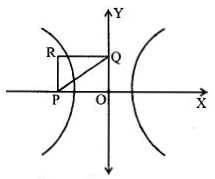
View full question & answer→MCQ 4701 Mark
Equation of the line passing through the points of intersection of the parabola $x^2 = 8y$ and the ellipse $\frac{{{x^2}}}{3} + {y^2} = 1$ is
- A
$y- 3=0$
- B
$y+ 3=0$
- C
$3y + 1 =0$
- ✓
$3y -1 =0$
AnswerCorrect option: D. $3y -1 =0$
d
${x^2} = 8y\,\,\,\,\,\,\,\,\,......\left( i \right)$
$\frac{{{x^2}}}{3} + {y^2} = 1\,\,\,\,\,\,\,\,.....\left( {ii} \right)$
From $(i)$ and $(ii)$,
$\frac{{8y}}{3} + {y^2} = 1\,\,\,\,\, \Rightarrow y = - 3,\frac{1}{3}$
When $y = - 3$, then ${x^2} = - 24$, which is not possible.
when $y = \frac{1}{3}$ , then ${x^2} = \pm \frac{{2\sqrt 6 }}{3}$
Point of intersection are
$\left( {\frac{{2\sqrt 6 }}{3},\frac{1}{3}\,} \right)\,\,$ and $\left( { - \frac{{2\sqrt 6 }}{3},\frac{1}{3}\,} \right)$
Reeuired equation of the line,
$y - \frac{1}{3}\, = 0\,\,\,\,\, \Rightarrow 3y - 1 = 0$
View full question & answer→MCQ 4711 Mark
Let $A_1, B_1, C_1$ be three points in the $x y$-plane. Suppose that the lines $A_1 C_1$ and $B_1 C_1$ are tangents to the curve $y^2=8 x$ at $A_1$ and $B_1$, respectively. If $O=(0,0)$ and $C_1=(-4,0)$, then which of the following statement is (are) $TRUE$?
$(A)$ The length of the line segment $O A_1$ is $4 \sqrt{3}$
$(B)$ The length of the line segment $A_1 B_1$ is 16
$(C)$ The orthocenter of the triangle $A_1 B_1 C_1$ is $(0,0)$
$(D)$ The orthocenter of the triangle $A_1 B_1 C_1$ is $(1,0)$
- ✓
$A,C$
- B
$A.B$
- C
$A,D$
- D
$A,B,C$
Answera
Equation of tangent at $\left(2 t^2, 4 t \right)$ is
$\text { ty }= x +2 t ^2$
$\because \text { It is passing through }(-4,0)$
$\therefore 0=-4+2 t ^2 \Rightarrow t = \pm \sqrt{2}$
$\therefore A _1=(4,4 \sqrt{2})$
$\left. B _1=(4,-4 \sqrt{2})\right\} OA _1=\sqrt{48}=4 \sqrt{3}$
$A _1 B _1=8 \sqrt{2}$
Equation of altitude of $\triangle A_1 B_1 C_1$ drawn from $A_1$ is
$y-4 \sqrt{2}=\sqrt{2}(x-4)$
$\Rightarrow \sqrt{2} x - y =0$
Equation of altitude of $\triangle A_1 B_1 C_1$ drawn from $C_1$ is
$x =0$
Solving $(1)$ and $(2)$ $\Rightarrow$ orthocentre is $(0,0)$
$\therefore$ correct options are $(A), (C)$
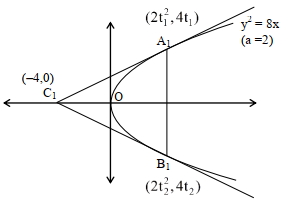
View full question & answer→MCQ 4721 Mark
A normal with slope $\frac{1}{\sqrt{6}}$ is drawn from the point $(0,-a)$ to the parabola $x^2=-4 a y$, where $a>0$. Let $L$ be the line passing through $(0,-a)$ and parallel to the directrix of the parabola. Suppose that $L$ intersects the parabola at two points $A$ and $B$. Let $r$ denote the length of the latus rectum and $s$ denote the square of the length of the line segment $A B$. If $r: s=1: 16$, then the value of $24 a$ is. . . .
Answerb
$\frac{d y}{d x}=\left.\frac{x}{-2 a} \Rightarrow \frac{d y}{d x}\right|_N=-t$
Slope of normal $=\frac{1}{t}=\frac{1}{\sqrt{6}} \Rightarrow t=\sqrt{6}$
Now, $\frac{- at ^2+\alpha}{2 at }=\frac{1}{ t }$
$\Rightarrow- at ^2+\alpha=2 a$
$\Rightarrow-6 a+\alpha=2 a \Rightarrow \alpha=8 a$
$\text { For } A \text { and } B$
$x^2=-4 a(-8 a)$
$\Rightarrow x^2=32 a^2 \Rightarrow x= \pm 4 \sqrt{2} a$
$\therefore A(-4 \sqrt{2} a,-8 a), B(4 \sqrt{2} a,-8 a)$
$\therefore A B^2=(8 \sqrt{2} a)^2=128 a^2=s$
$\therefore \text { Length of } L R=r=4 a$
$\Rightarrow \frac{r}{s}=\frac{4 a}{128 a^2}=\frac{1}{16}$
$\therefore 32 a=16 \Rightarrow a=\frac{1}{2}$
$\therefore 24 a=12 \text { Ans. }$
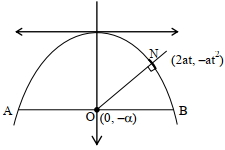
View full question & answer→MCQ 4731 Mark
Consider the ellipse $\frac{x^2}{9}+\frac{y^2}{4}=1$. Let $S(p, q)$ be a point in the tirst quadrant such that $\frac{p^2}{9}+\frac{q^2}{4}>1$. I wo tangents are drawn from $S$ to the ellipse, of which one meets the ellipse at one end point of the minor axis and the other meets the ellipse at a point $T$ in the fourth quadrant. Let $R$ be the vertex of the ellipse with positive $x$-coordinate and $O$ be the center of the ellipse. If the area of the triangle $\triangle O R T$ is $\frac{3}{2}$, then which of the following options is correct?
- ✓
$q=2, p=3 \sqrt{3}$
- B
$q=2, p=4 \sqrt{3}$
- C
$q=1, p=5 \sqrt{3}$
- D
$q=1, p=6 \sqrt{3}$
AnswerCorrect option: A. $q=2, p=3 \sqrt{3}$
a
$\operatorname{Ar}(\triangle ORT )=\frac{3}{2}$
$\left|\frac{1}{2} \times 3 \times 2 \sin \theta\right|=\frac{3}{2}$
$\sin \theta=\frac{1}{2} \Rightarrow \theta=\frac{11 \pi}{6}$
$T \left(\frac{3 \sqrt{3}}{2},-1\right)$
Tanget at $(0,2) \frac{x(0)}{9}+\frac{y(2)}{4}=1 \Rightarrow y=2$ $. . . . .(1)$
Tangent at $\left(\frac{3 \sqrt{3}}{2},-1\right) \frac{x\left(\frac{3 \sqrt{3}}{2}\right)}{9}+\frac{y(-1)}{4}=1$ $. . . . .(2)$
$\therefore$ By solving $(1)$ & $(2)$ $\Rightarrow p=3 \sqrt{3}, q=2$
$\Rightarrow$ Option $(A)$ is Correct.
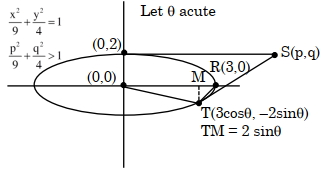
View full question & answer→MCQ 4741 Mark
Let $\mathrm{P}$ be a point on the parabola $\mathrm{y}^2=4 \mathrm{ax}$, where $\mathrm{a}>0$. The normal to the parabola at $\mathrm{P}$ meets the $\mathrm{x}$-axis at a point $\mathrm{Q}$. The area of the triangle $\mathrm{PFQ}$, where $\mathrm{F}$ is the focus of the parabola, is $120$ . If the slope $\mathrm{m}$ of the normal and a are both positive integers, then the pair $(\mathrm{a}, \mathrm{m})$ is
- ✓
$(2,3)$
- B
$(1,3)$
- C
$(2,4)$
- D
$(3,4)$
AnswerCorrect option: A. $(2,3)$
a
Let point $P\left(a t^2, 2 a t\right)$ normal at $P$ is $y=-t x+2 a t+a t^3$ $y=0, x=2 a+a t^2$ $Q\left(2 a+a t^2, 0\right)$
(Image)
$\text { Area of } \triangle \mathrm{PFQ}=\left|\frac{1}{2}\left(a+a t^2\right)(2 a t)\right|=120$
$\because \mathrm{m}=-t$
$\because \mathrm{a}^2\left[1+\mathrm{m}^2\right] \mathrm{m}=120$
$(a, \mathrm{~m})=(2,3) \text { will satisfy }$
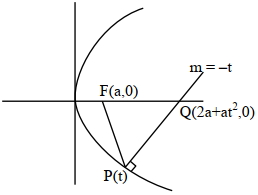
View full question & answer→MCQ 4751 Mark
Let $T_1$ and $T_2$ be two distinct common tangents to the ellipse $E: \frac{x^2}{6}+\frac{y^2}{3}=1$ and the parabola $P: y^2=12 x$. Suppose that the tangent $T_1$ touches $P$ and $E$ at the point $A_1$ and $A_2$, respectively and the tangent $T_2$ touches $P$ and $E$ at the points $A_4$ and $A_3$, respectively. Then which of the following statements is(are) true?
($A$) The area of the quadrilateral $A_1 A _2 A _3 A _4$ is $35$ square units
($B$) The area of the quadrilateral $A_1 A_2 A_3 A_4$ is $36$ square units
($C$) The tangents $T_1$ and $T_2$ meet the $x$-axis at the point $(-3,0)$
($D$) The tangents $T_1$ and $T_2$ meet the $x$-axis at the point $(-6,0)$
Answera
$y=m x+\frac{3}{m}$
$C^2=a^2 m^2+b^2$
$\frac{9}{m^2}=6 m^2+3 \quad \Rightarrow m^2=1$
$\mathrm{T}_1 \& \mathrm{~T}_2$
$y=x+3, y=-x-3$
Cuts $\mathrm{x}$-axis at $(-3,0)$
$\mathrm{A}_1(3,6) \mathrm{A}_4(3,-6)$
$\mathrm{A}_2(-2,1) \mathrm{A}_3(-2,-1)$
$\mathrm{A}_1 \mathrm{~A}_4=12, \quad \mathrm{~A}_2 \mathrm{~A}_3=2, \quad \mathrm{MN}=5$
$\text { Area }=\frac{1}{2}(12+2) \times 5=35 \text { sq.unit }$
Ans. $(A, C)$
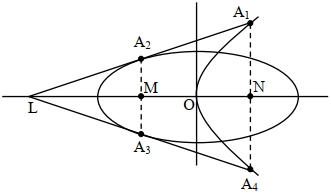
View full question & answer→MCQ 4761 Mark
Consider the parabola $y^2=4 x$. Let $S$ be the focus of the parabola. A pair of tangents drawn to the parabola from the point $P=(-2,1)$ meet the parabola at $P_1$ and $P_2$. Let $Q_1$ and $Q_2$ be points on the lines $S P_1$ and $S P_2$ respectively such that $P Q_1$ is perpendicular to $S P_1$ and $P Q_2$ is perpendicular to $S P_2$. Then, which of the following is/are $TRUE$ ?
$(A)$ $S Q_1=2$
$(B)$ $Q _1 Q _2=\frac{3 \sqrt{10}}{5}$
$(C)$ $PQ _1=3$
$(D)$ $SQ _2=1$
- ✓
$B,C,D$
- B
$B,C$
- C
$B,D$
- D
$C,D$
AnswerCorrect option: A. $B,C,D$
a
$T : y = mx +\frac{1}{ m }$
T : passes through $(-2,1)$ so
$1=-2 m+\frac{1}{m}$
$\Rightarrow m =-1 \text { or } m =\frac{1}{2}$
Points are given by $\left(\frac{ a }{ m ^2}, \frac{2 a }{ m }\right)$
So, one point will be $(1,-2) \&(4,4)$
Let $P _1(4,4) \& P _2(1,-2)$
$P_1 S: 4 x-3 y-4=0$
$P_2 S: x-1=0$
$PQ _1=\left|\frac{4(-2)-3(1)-4}{5}\right|=3$
$SP =\sqrt{10} ; PQ _2=3 ; SQ _1=1= SQ _2$
$\frac{1}{2}\left(\frac{ Q _1 Q _2}{2}\right) \times \sqrt{10}=\frac{1}{2} \times 3 \times 1 \quad$ (comparing Areas)
$\Rightarrow Q_1 Q_2=\frac{2 \times 3}{\sqrt{10}}=\frac{3 \sqrt{10}}{5}$
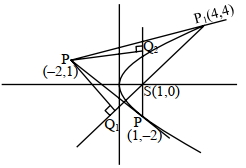
View full question & answer→MCQ 4771 Mark
Consider the ellipse
$\frac{x^2}{4}+\frac{y^2}{3}=1$
Let $H (\alpha, 0), 0<\alpha<2$, be a point. A straight line drawn through $H$ parallel to the $y$-axis crosses the ellipse and its auxiliary circle at points $E$ and $F$ respectively, in the first quadrant. The tangent to the ellipse at the point $E$ intersects the positive $x$-axis at a point $G$. Suppose the straight line joining $F$ and the origin makes an angle $\phi$ with the positive $x$-axis.
| $List-I$ |
$List-II$ |
| If $\phi=\frac{\pi}{4}$, then the area of the triangle $F G H$ is |
($P$) $\frac{(\sqrt{3}-1)^4}{8}$ |
| If $\phi=\frac{\pi}{3}$, then the area of the triangle $F G H$ is |
($Q$) $1$ |
| If $\phi=\frac{\pi}{6}$, then the area of the triangle $F G H$ is |
($R$) $\frac{3}{4}$ |
| If $\phi=\frac{\pi}{12}$, then the area of the triangle $F G H$ is |
($S$) $\frac{1}{2 \sqrt{3}}$ |
| |
($T$) $\frac{3 \sqrt{3}}{2}$ |
The correct option is:
- A
$(I) \rightarrow (R); (II) \rightarrow (S); (III) \rightarrow (Q); (IV) \rightarrow (P)$
- B
$(I) \rightarrow (R); (II) \rightarrow (T); (III) \rightarrow (S); (IV) \rightarrow (P)$
- ✓
$(I) \rightarrow (Q); (II) \rightarrow (T); (III) \rightarrow (S); (IV) \rightarrow (P)$
- D
$(I) \rightarrow (Q); (II) \rightarrow (S); (III) \rightarrow (Q); (IV) \rightarrow (P)$
AnswerCorrect option: C. $(I) \rightarrow (Q); (II) \rightarrow (T); (III) \rightarrow (S); (IV) \rightarrow (P)$
c
Let $F (2 \cos \phi, 2 \sin \phi)$ $\& E (2 \cos \phi, \sqrt{3} \sin \phi)$
$\text { EG }: \frac{x}{2} \cos \phi+\frac{ y }{\sqrt{3}} \sin \phi=1$
$\therefore G \left(\frac{2}{\cos \phi}, 0\right) \text { and } \alpha=2 \cos \phi$
$\operatorname{ar}(\Delta FGH )=\frac{1}{2} HG \times FH$
$=\frac{1}{2}\left(\frac{2}{\cos \phi}-2 \cos \phi\right) \times 2 \sin \phi$
$f (\phi)=2 \tan \phi \sin ^2 \phi$
$\therefore$ (I) $f\left(\frac{\pi}{4}\right)=1$
$(II)$ $f\left(\frac{\pi}{3}\right)=\frac{3 \sqrt{3}}{2}$
$(III)$ $f\left(\frac{\pi}{6}\right)=\frac{1}{2 \sqrt{3}}$
$(IV)$ $f\left(\frac{\pi}{12}\right)=2(2-\sqrt{3})\left(\frac{\sqrt{3}-1}{2 \sqrt{2}}\right)^2=(4-2 \sqrt{3}) \frac{(\sqrt{3}-1)^2}{8}=\frac{(\sqrt{3}-1)^4}{8}$
$\therefore( I ) \rightarrow( Q ) ; \text { (II) } \rightarrow \text { (T) ; (III) } \rightarrow \text { (S) ; IV) } \rightarrow( P )$
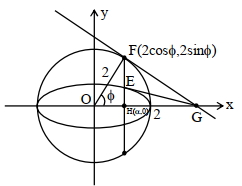
View full question & answer→MCQ 4781 Mark
Consider the hyperbola
$\frac{x^2}{100}-\frac{y^2}{64}=1$
with foci at $S$ and $S_1$, where $S$ lies on the positive $x$-axis. Let $P$ be a point on the hyperbola, in the first quadrant. Let $\angle SPS _1=\alpha$, with $\alpha<\frac{\pi}{2}$. The straight line passing through the point $S$ and having the same slope as that of the tangent at $P$ to the hyperbola, intersects the straight line $S_1 P$ at $P_1$. Let $\delta$ be the distance of $P$ from the straight line $SP _1$, and $\beta= S _1 P$. Then the greatest integer less than or equal to $\frac{\beta \delta}{9} \sin \frac{\alpha}{2}$ is. . . . . . .
Answerc
$S_1 P-S P=20$
$\beta-\frac{\delta}{\sin \frac{\alpha}{2}}=20$
$\beta^2+\frac{\delta^2}{\sin ^2 \frac{\alpha}{2}}-400=\frac{2 \beta \delta}{\sin \frac{\alpha}{2}}$
$\frac{1}{ SP }=\frac{\sin \frac{\alpha}{2}}{\delta}$
$\cos \alpha=\frac{ SP ^2+\beta^2-656}{2 \beta \frac{\delta}{\sin \frac{\alpha}{2}}}$
$=\frac{\frac{2 \beta \delta}{\sin \frac{\alpha}{2}}-256}{\frac{2 \beta S}{\sin \frac{\alpha}{2}}}=\cos \alpha$
$\frac{\lambda-128}{\lambda}=\cos \alpha$
$\lambda(1-\cos \alpha)=128$
$\frac{\beta \delta}{\sin \frac{\alpha}{2}} \cdot 2 \sin ^2 \frac{\alpha}{2}=128$
$\frac{\beta \delta}{9} \sin \frac{\alpha}{2}=\frac{64}{9} \Rightarrow\left[\frac{\beta \delta}{9} \sin \frac{\alpha}{2}\right]=7 \text { where [.] denotes greatest integer function }$
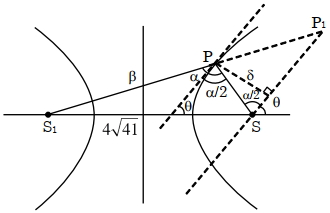
View full question & answer→MCQ 4791 Mark
Let $E$ denote the parabola $y^2=8 x$. Let $P=(-2,4)$, and let $Q$ and $Q^{\prime}$ be two distinct points on $E$ such that the lines $PQ$ and $PQ$ ' are tangents to $E$. Let $F$ be the focus of $E$. Then which of the following statements is (are) $TRUE$?
$(A)$ The triangle $PFQ$ is a right-angled triangle
$(B)$ The triangle $QPQ ^{\prime}$ is a right-angled triangle
$(C)$ The distance between $P$ and $F$ is $5 \sqrt{2}$
$(D)$ $F$ lies on the line joining $Q$ and $Q ^{\prime}$
- A
$A,B,C$
- B
$A,B$
- C
$A,C$
- ✓
$A,B,D$
AnswerCorrect option: D. $A,B,D$
d
Note that $P$ lies on directrix so triangle $PQQ ^{\prime}$ is right angled, hence $QQ ^{\prime}$ passes through focus $F$. $PF =4 \sqrt{2}$
Equation of $QF$ is $y = x -2 \& PF$ is $x + y =2$
Hence $A, B, D$.
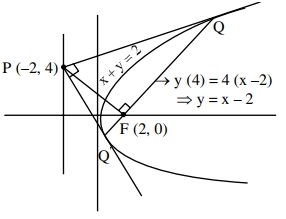
View full question & answer→MCQ 4801 Mark
Let $E$ be the ellipse $\frac{x^2}{16}+\frac{y^2}{9}=1$. For any three distinct points $P, Q$ and $Q^{\prime}$ on $E$, let $M(P, Q)$ be the mid-point of the line segment joining $P$ and $Q$, and $M \left( P , Q ^{\prime}\right)$ be the mid-point of the line segment joining $P$ and $Q ^{\prime}$. Then the maximum possible value of the distance between $M ( P , Q )$ and $M \left( P , Q ^{\prime}\right)$, as $P, Q$ and $Q^{\prime}$ vary on $E$, is. . . . .
Answerc
$A$ and $B$ be midpoints of segment $PQ$ and $PQ ^{\prime}$ respectively $AB =$ distance between $M ( P , Q )$ and $M \left( P , Q ^{\prime}\right)=\frac{1}{2} \cdot QQ ^{\prime}$
Since, $Q , Q$ ' must be on $E$, so, maximum of $QQ ^{\prime}=8$
$\therefore$ Maximum of $AB =\frac{8}{2}=4$
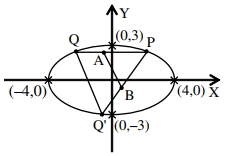
View full question & answer→MCQ 4811 Mark
Let $a , b$ and $\lambda$ be positive real numbers. Suppose $P$ is an end point of the latus rectum of the parabola $y^2=4 \lambda x$, and suppose the ellipse $\frac{x^2}{a^2}+\frac{y^2}{b^2}=1$ passes through the point $P$. If the tangents to the parabola and the ellipse at the point $P$ are perpendicular to each other, then the eccentricity of the ellipse is
- ✓
$\frac{1}{\sqrt{2}}$
- B
$\frac{1}{2}$
- C
$\frac{1}{3}$
- D
$\frac{2}{5}$
AnswerCorrect option: A. $\frac{1}{\sqrt{2}}$
a
$y ^2=4 \lambda x , P (\lambda, 2 \lambda)$
Slope of the tangent to the parabola at point $P$
$\frac{ dy }{ dx }=\frac{4 \lambda}{2 y }=\frac{4 \lambda}{2 x 2 \lambda}=1$
Slope of the tangent to the ellipse at $P$
$\frac{2 x }{ a ^2}+\frac{2 yy ^{\prime}}{ b ^2}=0$
As tangents are perpendicular $y^{\prime}=-1$
$\Rightarrow \frac{2 \lambda}{a^2}-\frac{4 \lambda}{b^2}=0 \Rightarrow \frac{a^2}{b^2}=\frac{1}{2}$
$\Rightarrow e=\sqrt{1-\frac{1}{2}}=\frac{1}{\sqrt{2}}$
View full question & answer→MCQ 4821 Mark
Starting at time $t=0$ from the origin with speed $1 ms ^{-1}$, a particle follows a two-dimensional trajectory in the $x$-y plane so that its coordinates are related by the equation $y=\frac{x^2}{2}$. The $x$ and $y$ components of its acceleration are denoted by $a_x$ and $a_y$, respectively. Then
$(A)$ $a_x=1 ms ^{-2}$ implies that when the particle is at the origin, $a_y=1 ms ^{-2}$
$(B)$ $a_x=0$ implies $a_y=1 ms ^{-2}$ at all times
$(C)$ at $t=0$, the particle's velocity points in the $x$-direction
$(D)$ $a_x=0$ implies that at $t=1 s$, the angle between the particle's velocity and the $x$ axis is $45^{\circ}$
- A
$A,B,C$
- ✓
$A,B,C,D$
- C
$A,B,D$
- D
$A,B$
AnswerCorrect option: B. $A,B,C,D$
b
$y =\frac{ x ^2}{2}$
at $\left.t=0, \begin{array}{l}x=0, y=0 \\ u=1\end{array}\right\}$ given
$y=\frac{x^2}{2}$
$\frac{d y}{d t}=\frac{1}{2} \cdot 2 x \frac{ dx }{ dt }$
$\Rightarrow v _{ Y }= xv _{ x }$
difference wit time
$a_y=\frac{d x}{d t} \cdot V_x+x a_x$
$a_y=v_x^2+x a_x$
Option
$(A)$ If $a _{ x }=1$ and particle is at origin
$(x=0, y=0)$
$a_y=v_x^2$
$z_y=1^2=1$
At origin, at $t=0 sec$
speed $=1$ given
$(B)$ Option
$a_y=v_s^2+\pi a_s$
given in option $B, a _{ x }=0$
$\Rightarrow a _{ s }= v _{ s }^2$
If $a _{ x }=0, v_{ s }=$ constant $=1$. (all the time)
$\Rightarrow a_{ y }=1^2=1 \text { (all the tume) }$
$(C)$
$at t =0, x =0 \quad v_{ y }=\pi v_{ s }$
$\text { speed }=1$
$v_{ y }=0$
$v_{ s }=1$
$(D)$
$a _{ y }=v_{ x }^2+ xa _{ x }$
$v_y=\pi v_x$
$a _2=0 \text { (given m D option) }$
$\Rightarrow a _{ y }= v _{ x }^2$
$\text { If } a _{ a }=0 \Rightarrow V _{ x }=\text { comstant initially }\left( v _{ x }=1\right)$
$\Rightarrow a _{ y }=1^2=1$
$a t t=1 sec$
$v_y=0+3, \times t=1 \times 1=1$
$\tan \theta=\frac{v_y}{v_s}= x$
$(\theta \rightarrow \text { angle with } x \text { axis) }$
$\tan \theta=\frac{v_s}{v_s}=\frac{1}{1}=1$
$\theta=45^{\circ}$
View full question & answer→MCQ 4831 Mark
Let $a$ and $b$ be positive real numbers such that $a > 1$ and $b < a$. Let $P$ be a point in the first quadrant that lies on the hyperbola $\frac{ x ^2}{ a ^2}-\frac{ y ^2}{ b ^2}=1$. Suppose the tangent to the hyperbola at $P$ passes through the point $(1,0)$, and suppose the normal to the hyperbola at $P$ cuts off equal intercepts on the coordinate axes. Let $\Delta$ denote the area of the triangle formed by the tangent at $P$, the normal at $P$ and the $x$-axis. If $e$ denotes the eccentricity of the hyperbola, then which of the following statements is/are $TRUE$?
$(A)$ $1 < e < \sqrt{2}$
$(B)$ $\sqrt{2} < e < 2$
$(C)$ $\Delta=a^4$
$(D)$ $\Delta=b^4$
Answera
Since Normal at point $P$ makes equal intercept on co-ordinate axes, therefore slope of Normal $=-1$
Hence slope of tangent $=1$
Equation of tangent
$y-0=1(x-1)$
$y=x-1$
Equation of tangent at $\left( x _1 y _1\right)$
$\frac{ xx _1}{ a ^2}-\frac{ yy _1}{ b ^2}=1$
$x-y=1$ (equation of Tangent)
on comparing $x _1= a ^2, y _1- b ^2$
Also $a^2-b^2=1$
Now equation of normal at $\left( x _1 y _1\right)=\left( a _1 b ^2\right)$
$y-b^2=-1\left(x-a^2\right)$
$x+y=a^2+b^2 \ldots \text { (Normal) }$
point of intersection with $x$-axis is $\left( a ^2+ b ^2\right)$
Now $e=\sqrt{1+\frac{b^2}{a^2}}$
$e=\sqrt{1+\frac{b^2}{b^2+1}} \quad\left[\text { from (1) } \frac{b^2}{b^2+1}<1\right] 1$
$\Delta=\frac{1}{2} \text {.AB.PQ }$
$\text { and } \Delta=\frac{1}{2}\left(a^2+b^2-1\right) \cdot b^2$
$\left.\Delta=\frac{1}{2}\left(2 b^2\right) b^2 \text { (from (1) } a^2-1=b^2\right)$
$\Delta=b^4 \text { so option (D) }$
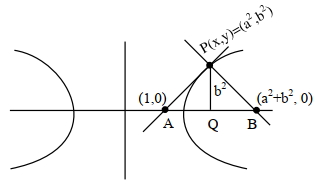
View full question & answer→MCQ 4841 Mark
Define the collections $\left\{ E _1, E _2, E _3, \ldots ..\right\}$ of ellipses and $\left\{ R _1, K _2, K _3, \ldots ..\right\}$ of rectangles as follows : $E_1: \frac{x^2}{9}+\frac{y^2}{4}=1$
$K _1$ : rectangle of largest area, with sides parallel to the axes, inscribed in $E _1$;
$E_n$ : ellipse $\frac{x^2}{a_n^2}+\frac{y^2}{b_{n}^2}=1$ of largest area inscribed in $R_{n-1}, n>1$;
$R _{ n }$ : rectangle of largest area, with sides parallel to the axes, inscribed in $E _{ n }, n >1$.
Then which of the following options is/are correct?
$(1)$ The eccentricities of $E _{18}$ and $E _{19}$ are NOT equal
$(2)$ The distance of a focus from the centre in $E_9$ is $\frac{\sqrt{5}}{32}$
$(3)$ The length of latus rectum of $E_Q$ is $\frac{1}{6}$
$(4)$ $\sum_{n=1}^N\left(\right.$ area of $\left.R_2\right)<24$, for each positive integer $N$
Answerd
Area of $R_1=3 \sin 2 \theta$; for this to be maximum
$\Rightarrow \theta=\frac{\pi}{4}$ $\Rightarrow $$(\frac{3}{\sqrt{2}}, \frac{2}{\sqrt{2}})$
Hence for subsequent areas of rectangles $R _{ n }$ to be maximum the coordinates will be in GP with common ratio $r =\frac{1}{\sqrt{2}} \Rightarrow a _{ n }=\frac{3}{(\sqrt{2})^{ n -1}} ; b _{ n }=\frac{3}{(\sqrt{2})^{ n -1}}$
Eccentricity of all the ellipses will be same
Distance of a focus from the centre in $E_9=a_9 e_9=\sqrt{a_g^2-b_9^2}=\frac{\sqrt{3}}{16}$
Length of latus rectum of $E_9=\frac{2 b_9^2}{a_9}=\frac{1}{6}$
$\because \sum_{n=1}^{\infty} \text { Area of } R_n=12+\frac{12}{2}+\frac{12}{4}+\ldots . \infty=24$
$\Rightarrow \sum_{ n =1}^{ N }\left(\text { area of } R _{ n }\right)<24, $for each positive integer $N$
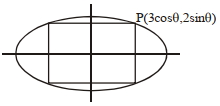
View full question & answer→MCQ 4851 Mark
Consider two straight lines, each of which is tangent to both the circle $x ^2+ y ^2=\frac{1}{2}$ and the parabola $y^2=4 x$. Let these lines intersect at the point $Q$. Consider the ellipse whose center is at the origin $O (0,0)$ and whose semi-major axis is $OQ$. If the length of the minor axis of this ellipse is $\sqrt{2}$, then which of the following statement($s$) is (are) $TRUE$?
$(A)$ For the ellipse, the eccentricity is $\frac{1}{\sqrt{2}}$ and the length of the latus rectum is $1$
$(B)$ For the ellipse, the eccentricity is $\frac{1}{2}$ and the length of the latus rectum is $\frac{1}{2}$
$(C)$ The area of the region bounded by the ellipse between the lines $x=\frac{1}{\sqrt{2}}$ and $x=1$ is $\frac{1}{4 \sqrt{2}}(\pi-2)$
$(D)$ The area of the region bounded by the ellipse between the lines $x=\frac{1}{\sqrt{2}}$ and $x=1$ is $\frac{1}{16}(\pi-2)$
- A
$A,B$
- B
$A,D$
- ✓
$A,C$
- D
$A,B,C$
Answerc
Eq. of tangent to $y^2=4 x$ is
$y = mx +\frac{1}{ m }$
Eq. of tangent to $x^2+y^2=\left(\frac{1}{\sqrt{2}}\right)^2$ is
$y=m x \pm \frac{\sqrt{1+m^2}}{\sqrt{2}}$
Comparing (1) and (2), we get $m ^2=1 \Rightarrow m = \pm 1$
$\therefore Q \equiv(-1,0)$
$\therefore$ Eq. of ellipse is $\frac{x^2}{1^2}+\frac{y^2}{\left(\frac{1}{2}\right)}=1$
Eccentricity $=\sqrt{1-\frac{1}{2}}=\frac{1}{\sqrt{2}}$
Length of latus rectum $=2 \cdot \frac{1}{2}=1$
$\text { Area } =2 \int_{\frac{1}{\sqrt{2}}}^1 \sqrt{\frac{1-x^2}{2}} d x$
$=\sqrt{2}\left[\frac{x}{2} \sqrt{1-x^2}+\frac{1}{2} \sin ^{-1}(x)\right]_{\frac{1}{\sqrt{2}}}^1=\frac{(\pi-2)}{4 \sqrt{2}}$
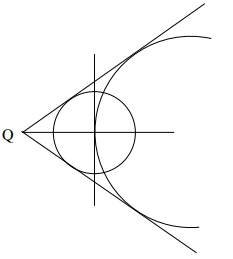
View full question & answer→MCQ 4861 Mark
Let $H : \frac{ x ^2}{ a ^2}-\frac{ y ^2}{ b ^2}=1$, where $a > b >0$, be $a$ hyperbola in the $xy$-plane whose conjugate axis $LM$ subtends an angle of $60^{\circ}$ at one of its vertices $N$. Let the area of the triangle $LMN$ be $4 \sqrt{3}$..
| List $I$ |
List $II$ |
| $P$ The length of the conjugate axis of $H$ is |
$1$ $8$ |
| $Q$ The eccentricity of $H$ is |
$2$ ${\frac{4}{\sqrt{3}}}$ |
| $R$ The distance between the foci of $H$ is |
$3$ ${\frac{2}{\sqrt{3}}}$ |
| $S$ The length of the latus rectum of $H$ is |
$4$ $4$ |
The correct option is:
- A
$P \rightarrow 4 ; Q \rightarrow 2 ; R \rightarrow 1 ; S \rightarrow 3$
- ✓
$P \rightarrow 4 ; Q \rightarrow 3 ; R \rightarrow 1 ; S \rightarrow 2$
- C
$P \rightarrow 4 ; Q \rightarrow 1 ; R \rightarrow 3 ; S \rightarrow 2$
- D
$P \rightarrow 3 ; Q \rightarrow 4 ; R \rightarrow 2 ; S \rightarrow 1$
AnswerCorrect option: B. $P \rightarrow 4 ; Q \rightarrow 3 ; R \rightarrow 1 ; S \rightarrow 2$
b
$\triangle LMN =4 \sqrt{3}$
$\frac{1}{2} 2 ab =4 \sqrt{3}$
$ab =4 \sqrt{3}$
$\text { a. }\left(\frac{ a }{\sqrt{3}}\right)=4 \sqrt{3}$
$a ^2=12 \Rightarrow a =2 \sqrt{3}$
$\frac{ b }{ a }=\tan 30^{\circ}$
$b =\frac{2 \sqrt{3}}{\sqrt{3}}=20$
Length of conjugate axis $2 b =4$.
$e =\sqrt{1+\frac{4}{12}}=\sqrt{1+\frac{1}{3}}=\frac{2}{\sqrt{3}}$
$SS ^{\prime}=2 ae =2 \times 2 \sqrt{3} \times \frac{2}{\sqrt{3}}=8$
$\text { L.R. }=\frac{2 b ^2}{ a }=\frac{2 \times 4}{2 \sqrt{3}}=\frac{4}{\sqrt{3}}$
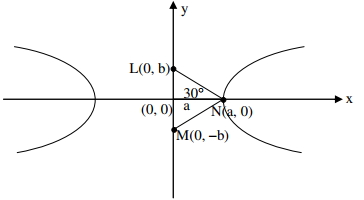
View full question & answer→MCQ 4871 Mark
If a chord, which is not a tangent, of the parabola $y^2=16 x$ has the equation $2 x+y=p$, and midpoint $(h, k)$, then which of the following is(are) possible value(s) of $p, h$ and $k$ ?
- A
$p=5, h=4, k=-3$
- B
$p=-1, h=1, k=-3$
- C
$p=-2, h=2, k=-4$
- ✓
$p=2, h=3, k=-4$
AnswerCorrect option: D. $p=2, h=3, k=-4$
d
$y^2=16 x$
$2 x+y=p$
Equation of chord having mid point $(h, k)$ is $T=S_1$ $. . . . . .(1)$
$\mathrm{yk}-8(\mathrm{x}+\mathrm{h})=\mathrm{k}^2-16 \mathrm{~h}$
$\Rightarrow \mathrm{yk}-8 \mathrm{x}=\mathrm{k}^2-8 \mathrm{~h}$ $. . . . . .(2)$
Comparing $(i)$ and $(ii)$
$\frac{\mathrm{k}}{1}=-\frac{8}{2}=\frac{\mathrm{k}^2-8 \mathrm{~h}}{\mathrm{p}}$
$\Rightarrow \quad \mathrm{k}=-4 \text { and } \mathrm{k}^2-8 \mathrm{~h}=-4 \mathrm{p}$
$\Rightarrow \quad 16-8 \mathrm{~h}=-4 \mathrm{p}$
$\Rightarrow \quad 2 \mathrm{~h}-\mathrm{p}=4$
$\text { Clearly } \mathrm{h}=3, \mathrm{p}=2$
View full question & answer→MCQ 4881 Mark
Columns $1,2$ and $3$ contain conics, equations of tangents to the conics and points of contact, respectively.
| $column 1$ |
$column 2$ |
$column 3$ |
| $(I)$ $x^2+y^2=a^2$ |
$(i)$ $m y=m^2 x+a$ |
$(P)$ $\left(\frac{a}{m^2}, \frac{2 a}{m}\right)$ |
| $(II)$ $x^2+a^2 y^2=a^2$ |
$(ii)$ $y=m x+a \sqrt{m^2+1}$ |
$(Q)$ $\quad\left(\frac{-m a}{\sqrt{m^2+1}}, \frac{a}{\sqrt{m^2+1}}\right)$ |
| $(III)$ $y^2=4 a x$ |
$(iii)$ $y=m x+\sqrt{a^2 m^2-1}$ |
$(R)$ $\quad\left(\frac{-a^2 m}{\sqrt{a^2 m^2+1}}, \frac{1}{\sqrt{a^2 m^2+1}}\right)$ |
| $(IV)$ $x^2-a^2 y^2=a^2$ |
$(iv)$ $y=m x+\sqrt{a^2 m^2+1}$ |
$(S)$ $\quad\left(\frac{-a^2 m}{\sqrt{a^2 m^2-1}}, \frac{-1}{\sqrt{a^2 m^2-1}}\right)$ |
($1$) The tangent to a suitable conic (Column $1$) at $\left(\sqrt{3}, \frac{1}{2}\right)$ is found to be $\sqrt{3} x+2 y=4$, then which of the following options is the only CORRECT combination?
$[A] (II) (iii) (R)$ $[B] (IV) (iv) (S)$ $[C] (IV) (iii) (S)$ $[D] (II) (iv) (R)$
($2$) If a tangent to a suitable conic (Column $1$) is found to be $y=x+8$ and its point of contact is $(8,16$ ), then which of the following options is the only CORRECT combination?
$[A] (III) (i) (P)$ $[B] (III) (ii) (Q)$ $[C] (II) (iv) (R)$ $[D] (I) (ii) (Q)$
($3$) For $a=\sqrt{2}$, if a tangent is drawn to a suitable conic (Column $1$ ) at the point of contact $(-1,1)$, then which of the following options is the only CORRECT combination for obtaining its equation?
$[A] (II) (ii) (Q)$ $[B] (III) (i) (P)$ $[\mathrm{C}]$ $(I) (1) (P)$ $[D] (I) (ii) (Q)$
- A
$A,D,C$
- ✓
$D,A,D$
- C
$B,A,C$
- D
$D,C,B$
AnswerCorrect option: B. $D,A,D$
b
($1$) Tangent at $\left(\sqrt{3}, \frac{1}{2}\right)$ is $\sqrt{3} \mathrm{x}+2 \mathrm{y}=4$
Since slope of tangent at $\left(\sqrt{3}, \frac{1}{2}\right)$ is -ve hence possible curve are $(I), (II)$ only
$\Rightarrow$ equation of curve is $\frac{x^2}{4}+y^2=1$, i.e., $x^2+a^2 y^2=a^2$
Hence equation of tangent is $\mathrm{y}=\mathrm{mx}+\sqrt{\mathrm{a}^2 \mathrm{~m}^2+1}$
($2$) Tangent at $(8,16)$ is $y=x+8$
Slope of tangent is +ve hence possible curve will be $y^2=4 a x$ $\Rightarrow$ equation of tangent is $m y=m^2 x+a$ and point of contact is
$\left(\frac{\mathrm{a}}{\mathrm{m}^2}, \frac{2 \mathrm{a}}{\mathrm{m}}\right)$
And point of contact is $\left(\frac{-\mathrm{a}^2 \mathrm{~m}}{\sqrt{\mathrm{a}^2 \mathrm{~m}^2+1}}, \frac{1}{\sqrt{\mathrm{a}^2 \mathrm{~m}^2+1}}\right)$
($3$) For $a=\sqrt{2}$ and point $(-1,1)$ on the curve is $x^2+y^2=a^2$ equation of tangent is $y=m x+a \sqrt{m^2+1}$ and point of contact is $\left(\frac{-\mathrm{ma}}{\sqrt{\mathrm{m}^2+1}}, \frac{\mathrm{a}}{\sqrt{\mathrm{m}^2+1}}\right)$
View full question & answer→MCQ 4891 Mark
If $2 x-y+1=0$ is a tangent to the hyperbola $\frac{x^2}{a^2}-\frac{y^2}{16}=1$, then which of the following $CANNOT$ be sides of a right angled triangle?
$[A]$ $2 a, 4,1$ $[B]$ $2 a, 8,1$ $[C]$ $a, 4,1$ $[D]$ $a, 4,2$
- A
$A,D$
- B
$B,D$
- C
$B,C$
- ✓
$B,C,D$
AnswerCorrect option: D. $B,C,D$
d
Tangent to $\frac{x^2}{a^2}-\frac{y^2}{4^2}=1$ is
$\mathrm{y}=\mathrm{mx} \pm \sqrt{\mathrm{a}^2 \mathrm{~m}^2-16}$
Comparing with $\mathrm{y}=2 \mathrm{x}+1$
$\mathrm{m}=2$
$\Rightarrow 4 \mathrm{a}^2-16=1$
$\mathrm{a}^2=\frac{17}{4}$
$\mathrm{a}=\frac{\sqrt{17}}{2}$
Only $2 \mathrm{a}, 4,1$ are sides of a right-angled triangle
View full question & answer→MCQ 4901 Mark
The circle $C_1: x^2+y^2=3$, with centre at $O$, intersects the parabola $x^2=2 y$ at the point $P$ in the first quadrant. Let the tangent to the circle $C_1$ at $P$ touches other two circles $C_2$ and $C_3$ at $R_2$ and $R_3$, respectively. Suppose $C_2$ and $C_3$ have equal radii $2 \sqrt{3}$ and centres $Q_2$ and $Q_3$, respectively. If $Q_2$ and $Q_3$ lie on the $y$-axis, then
($A$) $Q_2 Q_3=12$
($B$) $ R_2 R_3=4 \sqrt{6}$
($C$) area of the triangle $O R_2 R_3$ is $6 \sqrt{2}$
($D$) area of the triangle $P Q_2 Q_3$ is $4 \sqrt{2}$
- A
$A,B,D$
- ✓
$A,B,C$
- C
$A,B$
- D
$B,C$
AnswerCorrect option: B. $A,B,C$
b
$x^2+y^2=3$
$x^2=2 y$
Intersection point is $P \equiv(\sqrt{ } 2,1)$
Equation of tangent is $\sqrt{ } 2 x+y=3$
$\tan (\theta)=-\sqrt{ } 2$
$\tan (\alpha)=\tan (\theta-90)=-\cot \theta=\frac{1}{\sqrt{2}}$
$\sin (\alpha)=\frac{1}{\sqrt{3}}=\frac{2 \sqrt{3}}{Q_3 T}$
$\Rightarrow \quad Q_3 T=6$
$\therefore \quad Q_2 Q_3=2 Q_3 T=12$
$\tan (\alpha)=\frac{1}{\sqrt{2}}=\frac{2 \sqrt{3}}{R_3 T} \Rightarrow R_3 T=2 \sqrt{6}$
$\therefore \quad R_2 R_3=2 R_3 T=4 \sqrt{6}$
$\perp$ distance of o from $R_2 R_1$ is
$\left|\frac{3}{\sqrt{(\sqrt{2})^2+1^2}}=\sqrt{3}\right|$
$\therefore$ Area $\left( OR _2 R _3\right)=\frac{1}{2} \times \sqrt{3} \times 4 \sqrt{6}$
$=6 \sqrt{2}$ square units
Similarly, Area $\left( PQ _2 Q _3\right)$ $=\frac{1}{2} \times \sqrt{2} \times 12=6 \sqrt{2} \quad$ square units
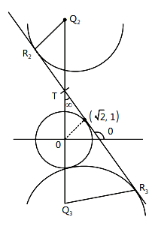
View full question & answer→MCQ 4911 Mark
Let $P$ be the point on the parabola $y^2=4 x$ which is at the shortest distance from the center $S$ of the circle $x^2+y^2-4 x-16 y+64=0$. Let $Q$ be the point on the circle dividing the line segment $S P$ internally. Then
($A$) $S P=2 \sqrt{5}$
($B$) $S Q: Q P=(\sqrt{5}+1): 2$
($C$) the $x$-intercept of the normal to the parabola at $P$ is $6$
($D$) the slope of the tangent to the circle at $Q$ is $\frac{1}{2}$
- A
$A,C,B$
- ✓
$A,C,D$
- C
$A,C$
- D
$C,D$
AnswerCorrect option: B. $A,C,D$
b
The centre of circle is $S(2,8)$
Let $P =\left( t ^2, 2 t \right)$
For point $P$ to be closest to $S, S P$ must normal to parabola at $P$
Slope of normal to parabola at $P$ is $-t$
Therefore, slope of $SP =-t$
$\therefore \frac{8-2 t }{2-2 t ^2}=- t$
$\therefore t =2$
So, $P=(4,4)$
$(a)$ $S =(2,8), P =(4,4)$
$\therefore SP =\sqrt{(4-2)^2+(4-8)^2}=2 \sqrt{5}$
$(c)$ Slope of normal to parabola at $P=-t=-2$
So, the equation of normal is $(y-4)=-2(x-4)$
$\therefore y =12-2 x$
$\Rightarrow x -\text { intercept }=6$
$(b)$ $Q$ is the point of intersection of circle and the line $y=12-2 x$
Solving the two equations, we get
$Q=\left(2+\frac{2}{\sqrt{5}}, 2+\frac{2}{\sqrt{5}}\right)$
$S Q=\sqrt{\left(2-\left(2+\frac{2}{\sqrt{5}}\right)\right)^2+\left(8-\left(2+\frac{2}{\sqrt{5}}\right)\right)^2}$
$\therefore S Q=\sqrt{24\left(1+\frac{1}{\sqrt{5}}\right)}$
$\therefore \frac{S Q}{P Q}=\frac{2}{\sqrt{24\left(1+\frac{1}{\sqrt{5}}\right)}}$
$(d)$ Slope of $S Q=$ slope of $S P=-2$
$SQ$ is normal to the circle at $Q$
So, slope of tangent at $Q=\frac{-1}{-2}=\frac{1}{2}$
So, $A, C,D$ are the right answers
View full question & answer→MCQ 4921 Mark
Let $F_1\left(x_1, 0\right)$ and $F_2\left(x_2, 0\right)$, for $x_1<0$ and $x_2>0$, be the foci of the ellipse $\frac{x^2}{9}+\frac{y^2}{8}=1$. Suppose a parabola having vertex at the origin and focus at $F_2$ intersects the ellipse at point $M$ in the first quadrant and at point $N$ in the fourth quadrant.
($1$)The orthocentre of the triangle $F_1 M N$ is
($A$) $\left(-\frac{9}{10}, 0\right)$ ($B$) $\left(\frac{2}{3}, 0\right)$ ($C$) $\left(\frac{9}{10}, 0\right)$ ($D$) $\left(\frac{2}{3}, \sqrt{6}\right)$
($2$) If the tangents to the ellipse at $M$ and $N$ meet at $R$ and the normal to the parabola at $M$ meets the $x$-axis at $Q$, then the ratio of area of the triangle $M Q R$ to area of the quadrilateral $M F_{\mathrm{I}} N F_2$ is
($A$) $3: 4$ ($B$) $4: 5$ ($C$) $5: 8$ ($D$) $2: 3$
Givan the answer qestion ($1$) and ($2$)
- A
$A,B$
- B
$A,D$
- ✓
$A,C$
- D
$A,B,D$
Answerc
$1.$ The correct option is $A \left(-\frac{9}{10}, 0\right)$
$Image$
Equation of the ellipse:
$\frac{x^2}{9}+\frac{y^2}{8}=1$
$a=3, b=2 \sqrt{2}$
Hence, eccentricity is
$e^2=1-\frac{b^2}{a^2}=\frac{1}{9}$
$\Rightarrow e=\frac{1}{3}$
So, foci of ellipse are ( $\pm 1,0$ )
Equation of the parabola having vertex $(0,0)$ and focus $(1,0)$ is
$y^2=4 x$
From equations $(1)$ and $(2)$, we get
$\frac{x^2}{9}+\frac{4 x}{8}=1$
$\Rightarrow 2 x^2+9 x-18=0$
$\Rightarrow(2 x-3)(x+6)=0$
$\Rightarrow x=\frac{3}{2} \quad[\because x=-6 \rightarrow \text { not possible }]$
$\therefore M \equiv\left(\frac{3}{2} \cdot \sqrt{6}\right), \quad N \equiv\left(\frac{3}{2}-\sqrt{6}\right)$
Equation of altitude from vertex $M\left(\frac{3}{2}, \sqrt{6}\right)$ is
$(y-\sqrt{6})=\frac{5}{2 \sqrt{6}}\left(x-\frac{3}{2}\right)$
$\because x$-axis is altitude drawn through vertex $F_1$
$\therefore$ orthocentre lies on the $x$-axis,
$\therefore 0-\sqrt{6}=\frac{5}{2 \sqrt{6}}\left(x-\frac{3}{2}\right)$
$\Rightarrow x =-\frac{9}{10}$
Hence, the orthocentre of $\triangle F_1 M N$ is
$\left(-\frac{9}{10} 0\right)$
$2.$ $Image$ Equation of tangent at point $M\left(\frac{3}{2}, \sqrt{6}\right)$ to the ellipse is $\frac{x\left(\frac{3}{2}\right)}{9}+\frac{y \sqrt{6}}{8}=1$ Put $y=0 \Rightarrow R$ is $(6,0) \quad[\because R$ lies on $x$-axis $)$
Equation of the normal to the parabola at point $M\left(\frac{3}{2} \sqrt{6}\right)$ is
$y-\sqrt{6}=\frac{-\sqrt{6}}{2}\left(x-\frac{3}{2}\right)$
Put $y=0 \Rightarrow Q$ is $\left(\frac{7}{2}, 0\right) \quad[\because Q$ lies on $x$-axis $)$
Area of $\triangle M Q R=\frac{1}{2} \times \sqrt{6} \times \frac{5}{2}=\frac{5 \sqrt{6}}{4}$
Area of quadrilateral $MF _1 NF _2$
$=$ Area of $\triangle M F_1 F_2+$ Area of $\triangle N F_1 F_2$
$=\sqrt{6}+\sqrt{6}=2 \sqrt{6}$
$\therefore$ Area of $\triangle M Q R$ : Area of quadrilateral $M F_1 N F_2=5: 8$
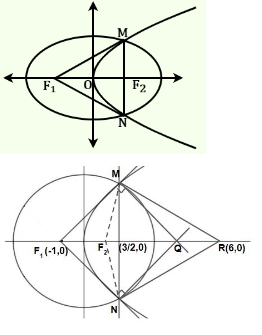
View full question & answer→MCQ 4931 Mark
Let the curve $C$ be the mirror image of the parabola $y^2=4 x$ with respect to the line $x+y+4=0$. If $A$ and $B$ are the points of intersection of $C$ with the line $y=-5$, then the distance between $A$ and $B$ is
Answera
Image of $y=-5$ about the line $x+y+4=0$ is $x=1$
$\Rightarrow$ Distance $AB =4$
View full question & answer→MCQ 4941 Mark
If the normals of the parabola $y^2=4 x$ drawn at the end points of its latus rectum are tangents to the circle $(x-3)^2+(y+2)^2=r^2$, then the value of $r^2$ is
Answerb
Equation of normals are $x + y =3$ and $x - y =3$. $\Rightarrow$ Distance from $(3,-2)$ on both normals is ' $r$ '
$\Rightarrow \frac{|3-2-3|}{\sqrt{2}}= r$
$\Rightarrow r ^2=2 .$
View full question & answer→MCQ 4951 Mark
Let $P$ and $Q$ be distinct points on the parabola $y^2=2 x$ such that a circle with $P Q$ as diameter passes through the vertex $O$ of the parabola. If $P$ lies in the first quadrant and the area of the triangle $\Delta O P Q$ is $3 \sqrt{2}$, then which of the following is (are) the coordinates of $P$ ?
$(A)$ $(4,2 \sqrt{2})$ $(B)$ $(9,3 \sqrt{2})$ $(C)$ $\left(\frac{1}{4}, \frac{1}{\sqrt{2}}\right)$ $(D)$ $(1, \sqrt{2})$
- A
$(B,C)$
- B
$(B,D)$
- C
$(A,C)$
- ✓
$(A,D)$
AnswerCorrect option: D. $(A,D)$
d
$P\left( at ^2, 2 at \right)$
$Q \left(\frac{16 a }{ t ^2},-\frac{8 a }{ t }\right)$
$\triangle OPQ =\frac{1}{2} OP \cdot OQ$
$\Rightarrow \frac{1}{2}\left| at \sqrt{ t ^2+4} \cdot \frac{ a (-4)}{ t } \sqrt{\frac{16}{ t ^2}+4}\right|=3 \sqrt{2}$
$t ^2-3 \sqrt{2} t +4=0 $
$t =\sqrt{2}, 2 \sqrt{2}$
$\text { Hence, } P ( at , 2 at )= P \left(\frac{ t ^2}{2}, t \right)$
$t =\sqrt{2} \Rightarrow P (1, \sqrt{2}) $
$t =2 \sqrt{2} \Rightarrow P (4,2 \sqrt{2})$
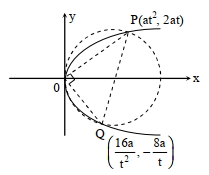
View full question & answer→MCQ 4961 Mark
Let $E_1$ and $E_2$ be two ellipses whose centers are at the origin. The major axes of $E_1$ and $E_2$ lie along the $x$-axis and the $y$-axis, respectively. Let $S$ be the circle $x^2+(y-1)^2=2$. The straight line $x+y=3$ touches the curves $S, E_1$ ad $E_2$ at $P, Q$ and $R$, respectively. Suppose that $P Q=P R=\frac{2 \sqrt{2}}{3}$. If $e_1$ and $e_2$ are the eccentricities of $E_1$ and $E_2$, respectively, then the correct expression$(s)$ is(are)
$(A)$ $e_1^2+e_2^2=\frac{43}{40}$
$(B)$ $e_1 e_2=\frac{\sqrt{7}}{2 \sqrt{10}}$
$(C)$ $\left|e_1^2-e_2^2\right|=\frac{5}{8}$
$(D)$ $e_1 e_2=\frac{\sqrt{3}}{4}$
- ✓
$(A,B)$
- B
$(B,D)$
- C
$(B,C)$
- D
$(A,C)$
AnswerCorrect option: A. $(A,B)$
a
For the given line, point of contact for $E_1: \frac{x^2}{a^2}+\frac{y^2}{b^2}=1$ is $\left(\frac{a^2}{3}, \frac{b^2}{3}\right)$ and for $E_2: \frac{x^2}{B^2}+\frac{y^2}{A^2}=1$ is $\left(\frac{B^2}{3}, \frac{A^2}{3}\right)$
Point of contact of $x+y=3$ and circle is (1,2)
Also, general point on $x+y=3$ can be taken as $\left(1 \mp \frac{r}{\sqrt{2}}, 2 \pm \frac{r}{\sqrt{2}}\right)$ where, $r=\frac{2 \sqrt{2}}{3}$
So, required points are $\left(\frac{1}{3}, \frac{8}{3}\right)$ and $\left(\frac{5}{3}, \frac{4}{3}\right)$
Comparing with points of contact of ellipse, $a^2=5, B^2=8$
$b^2=4, A^2=1$
$\therefore e_1 e_2=\frac{\sqrt{7}}{2 \sqrt{10}}$ and $e_1^2+e_2^2=\frac{43}{40}$
View full question & answer→MCQ 4971 Mark
Suppose that the foci of the ellipse $\frac{x^2}{9}+\frac{y^2}{5}=1$ are $\left(f_1, 0\right)$ and $\left(f_2, 0\right)$ where $f_1>0$ and $f_2<0$. Let $P _1$ and $P _2$ be two parabolas with a common vertex at $(0,0)$ and with foci at $\left(f_1, 0\right)$ and $\left(2 f_2, 0\right)$, respectively. Let $T_1$ be a tangent to $P_1$ which passes through $\left(2 f_2, 0\right)$ and $T_2$ be a tangent to $P_2$ which passes through $\left(f_1, 0\right)$. The $m_1$ is the slope of $T_1$ and $m_2$ is the slope of $T_2$, then the value of $\left(\frac{1}{m^2}+m_2^2\right)$ is
Answerd
The equation of $P_1$ is $y^2-8 x=0$ and $P_2$ is $y^2+16 x=0$
Tangent to $y ^2-8 x =0$ passes through $(-4,0)$
$\Rightarrow 0= m _1(-4)+\frac{2}{ m _1} \Rightarrow \frac{1}{ m _1^2}=2$
Also tangent to $y^2+16 x=0$ passes through $(2,0)$
$\Rightarrow 0= m _2 \times 2-\frac{4}{ m _2} \Rightarrow m _2^2=2$
$\Rightarrow \frac{1}{ m _1^2}+ m _2^2=4$
View full question & answer→MCQ 4981 Mark
The common tangents to the circle $x^2+y^2=2$ and the parabola $y^2=8 x$ touch the circle at the points $P$, $Q$ and the parabola at the points $R , S$. Then the area of the quadrilateral $PQRS$ is
Answerd
$y=m x+\frac{2}{m}$
If it is tangent to $x^2+y^2=2$
Then,
$\left|\frac{\frac{2}{m}}{\sqrt{1+m^2}}\right|=\sqrt{2} \Rightarrow \frac{4}{m^2\left(1+m^2\right)}=2 \Rightarrow m= \pm 1 .$
Hence equation of tangent is $y=x+2 y=-x-2$.
Chord of contact $P Q$ is $-2 x=2 \Rightarrow x=-1$
Chord of contanct $RS$ is $y .0=4(x-2) \Rightarrow x=2$
Hence co-ordinates of $P, Q, R, S$ are $(-1,1) ;(-1,-1) ;(2,-4) \&(2,4)$
Area of trapezium is $=\frac{1}{2}( PQ + RS ) \times$ Height $=\frac{1}{2}(10) \times 3=15$
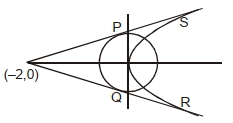
View full question & answer→MCQ 4991 Mark
Let $a , r , s , t$ be nonzero real numbers. Let $P \left( at ^2\right.$, $2$at), $Q , R \left( ar ^2\right.$, 2ar) and $\left( as ^2\right.$, 2as) be distinct points on the parabola $y^2=4 a x$. Suppose that $P Q$ is the focal chord and lines $Q R$ and $P K$ are parallel, where $K$ is the point $(2 a , 0)$
$1.$ The value of $r$ is
$(A)$ $-\frac{1}{t}$ $(B)$ $\frac{t^2+1}{t}$ $(C)$ $\frac{1}{ t }$ $(D)$ $\frac{t^2-1}{t}$
$2.$ If st $=1$, then the tangent at $P$ and the normal at $S$ to the parabola meet at a point whose ordinate is
$(A)$ $\frac{\left(t^2+1\right)^2}{2 t^3}$ $(B)$ $\frac{a\left(t^2+1\right)^2}{2 t^3}$ $(C)$ $\frac{a\left(t^2+1\right)^2}{t^3}$ $(D)$ $\frac{a\left(t^2+2\right)^2}{t^3}$
Give the answer question $1$ and $2.$
- ✓
$(D,B)$
- B
$(A,D)$
- C
$(B,D)$
- D
$(B,C)$
AnswerCorrect option: A. $(D,B)$
a
$1.$ $m_{P K}=m_{Q R} $
$\frac{2 a t-0}{a t^2-2 a}=\frac{2 a t^{\prime}-2 a r}{a\left(t^{\prime}\right)^2-a r^2} $
$\frac{t}{t^2-2}=\frac{t^{\prime}-r}{\left(t^{\prime}\right)^2-r^2} $
$-t^{\prime}-t^2=-t-t^2-2 t^{\prime}+2 r, t^{\prime}=-1 $
$t^{\prime}-t^2=-t+2 r-t^2 $
$-t r^2+r\left(t^2-2\right)+t^{\prime}+t=0 $
$\lambda=\frac{\left(2-t^2\right) \pm \sqrt{\left(t^2-2\right)^2+4\left(-1+t^2\right)}}{-2 t} $
$=\frac{\left(2-t^2\right) \pm \sqrt{t^4}}{-2 t}=\frac{2-t^2 \pm t^2}{-2 t}$
$r=-\frac{1}{t}$ It is not possible as the $R \& Q$ will be one same.
or $r =\frac{ t ^2-1}{ t }$
$2.$ $\text { Tangent at } P \text { is ty }=x+a t^2 $
$\text { Normal at } S \text { is } y+s x=2 a s+a s^2 $
$P \text {ty }=x+a t^2 $
$S \text y+s x=2 a s+a s^2 $
$\text { ty }+x=2 a+\frac{a}{t^2} $
$\text { ty }=2 a+\frac{a}{t^2}-t y+a t^2 $
$2 t^3 y=a t^4+2 a t^2+a $
$y=\frac{a\left(t^2+1\right)^2}{2 t^3}$
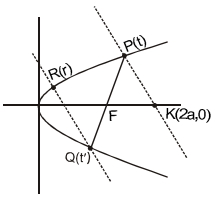
View full question & answer→MCQ 5001 Mark
Let $P Q$ be a focal chord of the parabola $y^2=4 a x$. The tangents to the parabola at $P$ and $Q$ meet at a point lying on the line $y=2 x+a, a > 0$.
$1.$ Length of chord $P Q$ is
$(A)$ $7 a$ $(B)$ $5 a$ $(C)$ $2 a$ $(D)$ $3 a$
$2.$ If chord $PQ$ subtends an angle $\theta$ at the vertex of $y^2=4 a x$, then $\tan \theta=$
$(A)$ $\frac{2}{3} \sqrt{7}$ $(B)$ $\frac{-2}{3} \sqrt{7}$ $(C)$ $\frac{2}{3} \sqrt{5}$ $(D)$ $\frac{-2}{3} \sqrt{5}$
Give the answer question $1$ and $2.$
- A
$(B,C)$
- ✓
$(B,D)$
- C
$(A,C)$
- D
$(A,D)$
AnswerCorrect option: B. $(B,D)$
b
$1.$ $R$ lies on $y=2 x+a$
$R, y=2 x+a$
$\Rightarrow \quad a \left( t -\frac{1}{ t }\right)=- a$
$t-\frac{1}{t}=-1 $
$\Rightarrow \quad\left(t+\frac{1}{t}\right)^2=1+4=5 $
$P Q=a\left(t+\frac{1}{t}\right)^2=5 a$ $Image$
$2.$ $t-\frac{1}{t}=-1 $
$\Rightarrow \quad t+\frac{1}{t}=\sqrt{5} $
$\tan \theta=\frac{\frac{2}{t}+2 t}{1-4}=\frac{2\left(\frac{1}{t}+t\right)}{-3}=\frac{2 \sqrt{5}}{-3}$ $Image$
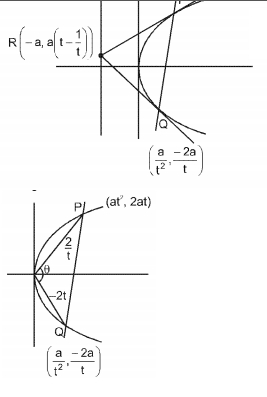
View full question & answer→