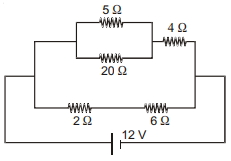
A circuit containing five resistors is connected to a battery with a $12 \,V$ emf as shown in figure. The potential difference across $4 \,\Omega$ resistor is ........... $V$
Medium
Download our app for free and get started
(b)
$i=\frac{12}{4}=3 \,A$
$\Delta V_4=6 \,V$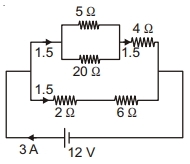

Download our appand get started for free
Experience the future of education. Simply download our apps or reach out to us for more information. Let's shape the future of learning together!No signup needed.*
Similar Questions
- 1The $n$ rows each containing $m$ cells in series are joined in parallel. Maximum current is taken from this combination across an external resistance of $3 \,\Omega$ resistance. If the total number of cells used are $24$ and internal resistance of each cell is $0.5 \,\Omega$ thenView Solution
- 2In a potentiometer circuit a cell of $EMF$ $1.5\, {V}$ gives balance point at $36\, {cm}$ length of wire. If another cell of $EMF$ $2.5\, {V}$ replaces the first cell, then at what length of the wire, the balance point occurs ? (in $cm$)View Solution
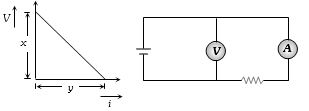
- 3In an experiment, a graph was plotted of the potential difference $V$ between the terminals of a cell against the circuit current $i$ by varying load rheostat. Internal conductance of the cell is given byView Solution
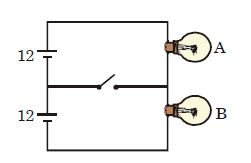
- 4Two light bulbs in the circuit have rating $A\,[24\ V, 48\,W]$ and $B\,[24\ V, 36\,W]$ as shown.View Solution
- 5A cell can be balanced against $110\,\, cm$ and $100\,\, cm$ of potentiometer wire, respectively with and without being short circuited through a resistance of $10 \,\,\Omega$. Its internal resistance is ............... $\Omega$View Solution
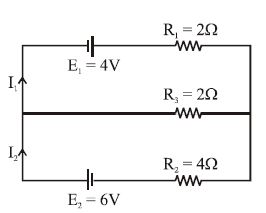
- 6In the circuit shown below $E_1\, =4.0\, V$, $R_1\, = 2\,\Omega$, $E_2\, = 6.0\, V$, $R_2\, = 4\,\Omega$ and $R_3\, = 2\,\Omega$. The current $I_1$ is ............... $\mathrm{A}$View Solution
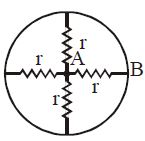
- 7The equivalent resistance betweent point $A$ and $B$View Solution
- 8If $n, e, \tau$ and $m$ are representing electron density, charge, relaxation time and mass of an electron respectively, then the resistance of a wire of length / and cross-sectional area $A$ is given byView Solution
- 9A wire of resistance $4 \,\Omega$ is stretched to twice its original length. The resistance of stretched wire would be ........... $\Omega$View Solution
- 10In the circuit shown, the resistances are given in ohms and the battery is assumed ideal with $\mathrm{emf}$ equal to $3.0$ $\mathrm{volts}.$ The resistor that dissipates the most power isView Solution