A cell can be balanced against $110\,\, cm$ and $100\,\, cm$ of potentiometer wire, respectively with and without being short circuited through a resistance of $10 \,\,\Omega$. Its internal resistance is ............... $\Omega$
AIPMT 2008, Medium
Download our app for free and get started
In the question, the length $110\, \mathrm{cm}$ and
${100\,\,{\mkern 1mu} {\text{cm}}}$ are interchanged as ${\varepsilon > \frac{{\varepsilon R}}{{R + r}}}$
Without being short circuited through $R,$ only the battery $\varepsilon$ is balanced.
$\varepsilon=\frac{V}{L} \times l_{1}=\frac{V}{L} \times 110 \,\mathrm{cm}$ ....$(i)$
When $R$ is connected across $\varepsilon$,
$R i=R \cdot\left(\frac{\varepsilon}{R+r}\right)=\frac{V}{L} \times l_{2} \Rightarrow \frac{R \varepsilon}{R+r}=\frac{V}{L} \times 100$ ......$(ii)$
Dividing eqn. $(i)$ and $(ii)$, $\frac{(R+r)}{R}=\frac{110}{100}$
$\Rightarrow 1+\frac{r}{R}=\frac{110}{100} \Rightarrow \frac{r}{R}=\frac{110}{100}-\frac{100}{100}$
$\Rightarrow r=R \cdot \frac{10}{100}=\frac{R}{10} \cdot$ As $R=10\, \Omega ; r=1\, \Omega$

Download our appand get started for free
Experience the future of education. Simply download our apps or reach out to us for more information. Let's shape the future of learning together!No signup needed.*
Similar Questions
- 1The number of electrons flowing per second in the filament of a $110 \mathrm{~W}$ bulb operating at $220 \mathrm{~V}$ is : (Given $\mathrm{e}=1.6 \times 10^{-19} \mathrm{C}$ )View Solution
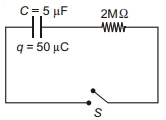
- 2The following circuit consist of a $5 \,\mu F$ capacitor, having charge $50 \,\mu C$ as shown. The switch is closed at $t=0$. The value of current in $2 \,M \Omega$ resistor at $t=0$ is ........... $\mu A$View Solution
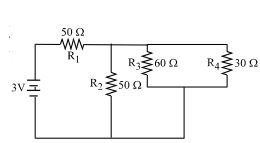
- 3In the circuit shown, the resistances are given in ohms and the battery is assumed ideal with $\mathrm{emf}$ equal to $3.0$ $\mathrm{volts}.$ The resistor that dissipates the most power isView Solution
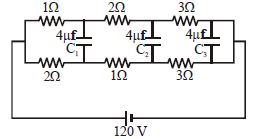
- 4View SolutionIn given circuit
- 5Column $- I$ gives certain physical terms associated with flow of current through a metallic conductor. Column $- II$ gives some mathematical relations involving electrical quantities. Match Column $- I$ and Column $- II$ with appropriate relations.View Solution
Column $- I$ Column $- II$ $(A)$ Drift Velocity $(P)$ $\frac{m}{n e^{2} \rho}$ $(B)$ Electrical Resistivity $(Q)$ $\mathrm{ne} v_{\mathrm{d}}$ $(C)$ Relaxation Period $(R)$ $\frac{\mathrm{eE}}{\mathrm{m}} \tau$ $(D)$ Current Density $(S)$ $\frac{E}{J}$ - 6Four resistances of $100$ $\Omega$ each are connected in the form of square. Then, the effective resistance along the diagonal points is .............. $\Omega$View Solution
- 7By using only two resistance coils-singly, in series, or in parallel one should be able to obtain resistances of $3$, $4$, $12$ and $16\, ohms$. The separate resistances of the coil areView Solution
- 8At room temperature, copper has free electron density of $8.4 \times {10^{28}}$ per ${m^3}$. The copper conductor has a cross-section of $10^{-6} \,m^2$ and carries a current of $5.4\, A$. The electron drift velocity in copper isView Solution
- 9Ten $60 \,W , 220 \,V$ bulbs are connected in series to $220 \,V$ supply. Power consumed in the circuit is ......... $W$View Solution
- 10In a conductor $4$ coulombs of charge flows for $2$ seconds. The value of electric current will beView Solution