MCQ
A circular coil ‘$A$’ has a radius $R$ and the current flowing through it is $I$. Another circular coil ‘$B$’ has a radius $2R$ and if $2I$ is the current flowing through it, then the magnetic fields at the centre of the circular coil are in the ratio of (i.e.${B_A}$ to ${B_B}$)
  • A
    $4:1$
  • B
    $2:1$
  • C
    $3:1$
  • $1:1$

Answer

Correct option: D.
$1:1$
d
(d) $B \propto \frac{i}{r}$

Need a full question paper?

Generate a complete, print-ready paper with questions like this in minutes — across 16+ boards, with answer keys.

Start Generating Free

Similar questions

A horizontal overhead power line is at a height of $4\,m$ from the ground and carries a current of $100\,A$ from east to west. The magnetic field directly below it on the ground is $(\mu _0 = 4\pi \times 10^{-7}\,TmA^{-1})$
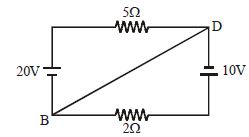
Calculate the current in wire $BD$ ................ $A$
If $R_1$ and $R_2$ are respectively the filament resistances of a 200 watt bulb and 100 watt bulb designed to operate on the same voltage, then
In a step-up transformer the voltage in the primary is $220\,V$ and the current is $5\,A$. The secondary voltage is found to be $22000\,V$. The current in the secondary (neglect losses) is......$A$
The depletion layer in silicon diode is $1 \ mm$ wide and the knee potential is $0.6 V,$ then the electric field in the depletion layer will be
If $g_E$ and $g_M$ are the accelerations due to gravity on the surfaces of the earth and the moon respectively and if Millikan's oil drop experiment could be performed on the two surfaces, one will find the ratio (electronic charge on the moon/electronic charge on the earth) to be
If the energy of a photon corresponding to a wavelength of 6000 Å is $3.32 \times 10^{-19} \mathrm{J}$, the photon energy for a wavelength of 4000 Å will be
An electric dipole in a uniform electric field experiences (When it is placed at an angle θ with the field)
If a hole is made at the centre of a bar magnet, then its magnetic moment will
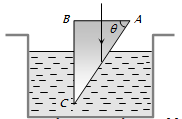
A glass prism (μ = 1.5) is dipped in water (μ = 4/3) as shown in figure. A light ray is incident normally on the surface AB. It reaches the surface BC after totally reflected, if