A circular coil is in $y-z$ plane with centre at the origin. The coil is carrying a constant current. Assuming direction of magnetic field at $x = -25\, cm$ to be positive direction of magnetic field, which of the following graphs shows variation of magnetic field along $x-$ axis
Medium
Download our app for free and get started
Direction of magnetic field at every point on the axis of a current carrying circular coil remains same. Though its magnitude varies. Hence $\mathrm{B}$ always remains positive.
Therefore, $( 3)$ and $( 4)$ are wrong. Further,
$\mathrm{B}=\frac{\mu_{0} \mathrm{Nia}^{2}}{2\left(\mathrm{a}^{2}+\mathrm{x}^{2}\right)^{3 / 2}}$
where a is the radius of the coil
At $\mathrm{x}=0, \quad \mathrm{B}=\frac{\mu_{0} \mathrm{Ni}}{2 \mathrm{a}}$
when $\mathrm{x} \rightarrow \infty, \mathrm{B} \rightarrow 0$
Slope of the graph will be $\frac{\mathrm{dB}}{\mathrm{dx}}=\frac{3 \mu_{0} \mathrm{Nia}^{2} \mathrm{x}}{2\left(\mathrm{a}^{2}+\mathrm{x}^{2}\right)^{5 / 2}}$
which means at $\mathrm{x}=0,$ slope is equal to zero or tangent to the graph at $\mathrm{x}=0$ must be parallel to $x$ - axis. Hence $(2)$ is correct and $(1)$ is wrong.

Download our appand get started for free
Experience the future of education. Simply download our apps or reach out to us for more information. Let's shape the future of learning together!No signup needed.*
Similar Questions
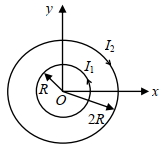
- 1Two concentric circular loops, one of radius $R$ and the other of radius $2 R$, lie in the $x y$-plane with the origin as their common center, as shown in the figure. The smaller loop carries current $I_1$ in the anti-clockwise direction and the larger loop carries current $I_2$ in the clockwise direction, with $I_2>2 I_1 . \vec{B}(x, y)$ denotes the magnetic field at a point $(x, y)$ in the $x y$-plane. Which of the following statement($s$) is(are) current?View Solution
$(A)$ $\vec{B}(x, y)$ is perpendicular to the $x y$-plane at any point in the plane
$(B)$ $|\vec{B}(x, y)|$ depends on $x$ and $y$ only through the radial distance $r=\sqrt{x^2+y^2}$
$(C)$ $|\vec{B}(x, y)|$ is non-zero at all points for $r$
$(D)$ $\vec{B}(x, y)$ points normally outward from the $x y$-plane for all the points between the two loops
- 2Two long current carrying thin wires, both with current $I$, are held by insulating threads oflength $L$ and are in equilibrium as shown in the figure, with threads making an angle '$\theta$' with the vertical. If wires have mass $\lambda$ per unit length then the value of $l$ isView Solution
($g =$ gravitational acceleration)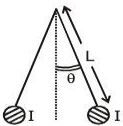
- 3A rectangular loop of wire shown below is coplanar with a long wire carrying current $I$. The loop is pulled to the right a s indicated. What are the directions of the induced current in the loop and the magnetic forces on the left and the right sides of the loop?View Solution
Induced current Force on left side Force on right side $a.$ Counter clockwise To the left To the right $b.$ clockwise To the left To the right $c.$ Counter clockwise To the right To the left $d.$ clockwise To the right To the left 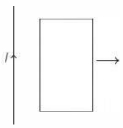
- 4A moving coil galvanometer has resistance $50\,\Omega $ and it indicates full deflection at $4\,mA$ current. A voltmeter is made using this galvanometer and a $5\,k\Omega $ resistance. The maximum voltage, that can be measured using this voltamenter, will be close to ......$V$View Solution
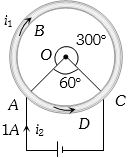
- 5A cell is connected between the points $A$ and $C$ of a circular conductor $ABCD$ of centre $O$ with angle $AOC = {60^o}$. If ${B_1}$ and ${B_2}$ are the magnitudes of the magnetic fields at $O$ due to the currents in $ABC$ and $ADC$ respectively, the ratio $\frac{{{B_1}}}{{{B_2}}}$ isView Solution
- 6The coil of a galvanometer consists of $100$ $turns$ and effective area of $1\, square-cm$. The restoring couple is ${10^{ - 8}}\,N - m/radian$. The magnetic field between the pole pieces is $5\, T$. The current sensitivity of this galvanometer will beView Solution
- 7View SolutionA beam of electrons passes undeflected through mutually perpendicular electric and magnetic fields. It the electric field is switched off, and the same magnetic field is maintained, the electrons move
- 8View SolutionAn electron is travelling in east direction and a magnetic field is applied in upward direction then electron will deflect in
- 9The earth's magnetic induction at a certain point is $7 \times {10^{ - 5}}\,Wb/{m^2}.$ This is to be annulled by the magnetic induction at the centre of a circular conducting loop of radius $5 \,cm$. The required current in the loop is......$A$View Solution
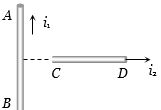
- 10An infinitely long, straight conductor $AB$ is fixed and a current is passed through it. Another movable straight wire $CD$ of finite length and carrying current is held perpendicular to it and released. Neglect weight of the wireView Solution