An electron is travelling in east direction and a magnetic field is applied in upward direction then electron will deflect in
Easy
Download our app for free and get started
(b) By Fleming left hand rule.

Download our appand get started for free
Experience the future of education. Simply download our apps or reach out to us for more information. Let's shape the future of learning together!No signup needed.*
Similar Questions
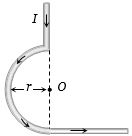
- 1In the figure, what is the magnetic field at the point $O$View Solution
- 2View SolutionA current carrying circular loop is freely suspended by a long thread. The plane of the loop will point in the direction
- 3View SolutionAssertion : If the current in a solenoid is reversed in direction while keeping the same magnitude, the magnetic field energy stored in the solenoid decreases.
Reason : Magnetic field energy density is proportional to square of current.
- 4View SolutionA charged particle enters a uniform magnetic field perpendicular to it. The magnetic field
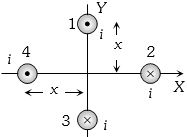
- 5What will be the resultant magnetic field at origin due to four infinite length wires. If each wire produces magnetic field '$B$' at originView Solution
- 6A charged particle carrying charge $1\,\mu C$ is moving with velocity $(2 \hat{ i }+3 \hat{ j }+4 \hat{ k })\, ms ^{-1} .$ If an external magnetic field of $(5 \hat{ i }+3 \hat{ j }-6 \hat{ k }) \times 10^{-3}\, T$ exists in the region where the particle is moving then the force on the particle is $\overline{ F } \times 10^{-9} N$. The vector $\overrightarrow{ F }$ is :View Solution
- 7A galvanometer has a resistance of $50\ \Omega$ and it allows maximum current of $5 \mathrm{~mA}$. It can be converted into voltmeter to measure upto $100 \mathrm{~V}$ by connecting in series a resistor of resistanceView Solution
- 8The magnetic field at the center of current carrying circular loop is $B _{1}$. The magnetic field at a distance of $\sqrt{3}$ times radius of the given circular loop from the center on its axis is $B_{2}$. The value of $B_{1} / B_{2}$ will be.View Solution
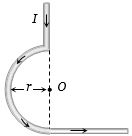
- 9In the figure, what is the magnetic field at the point $O$View Solution
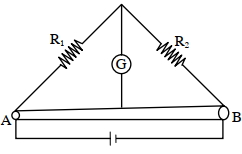
- 10Two resistances $R_1=X \Omega$ and $R_2=1 \Omega$ are connected to a wire $A B$ of uniform resistivity, as shown in the figure. The radius of the wire varies linearly along its axis from $0.2 mm$ at $A$ to $1 mm$ at $B$. A galvanometer ($G$) connected to the center of the wire, $50 cm$ from each end along its axis, shows zero deflection when $A$ and $B$ are connected to a battery. The value of $X$ is. . . . .View Solution