The increase in length is $l$ of a wire of length $L$ by the longitudinal stress. Then the stress is proportional to
Easy


Download our appand get started for free
Experience the future of education. Simply download our apps or reach out to us for more information. Let's shape the future of learning together!No signup needed.*
Similar Questions
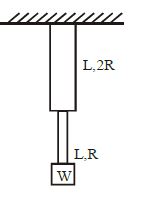
- 1Two wires of the same material (Young's modulus $Y$ ) and same length $L$ but radii $R$ and $2R$ respectively are joined end to end and a weight $W$ is suspended from the combination as shown in the figure. The elastic potential energy in the system isView Solution
- 2View SolutionThe following four wires are made of the same material. Which of these will have the largest extension when the same tension is applied ?
- 3Two wires $A$ and $B$ are of same materials. Their lengths are in the ratio $1 : 2$ and diameters are in the ratio $2 : 1$ when stretched by force ${F_A}$ and ${F_B}$ respectively they get equal increase in their lengths. Then the ratio ${F_A}/{F_B}$ should beView Solution
- 4View SolutionUnder elastic limit the stress is
- 5The ratio of lengths of two rods $A$ and $B$ of same material is $1 : 2$ and the ratio of their radii is $2 : 1$, then the ratio of modulus of rigidity of $A$ and $B$ will beView Solution
- 6A $5$ metre long wire is fixed to the ceiling. A weight of $10\, kg$ is hung at the lower end and is $1$ metre above the floor. The wire was elongated by $1\, mm$. The energy stored in the wire due to stretching is ......... $ joule$View Solution
- 7If the volume of the given mass of a gas is increased four times, the temperature is raised from $27°C$ to $127°C.$ The elasticity will becomeView Solution
- 8A material has Poisson's ratio $0.50.$ If a uniform rod of it suffers a longitudinal strain of $2 \times {10^{ - 3}}$, then the percentage change in volume isView Solution
- 9A solid sphere of radius $r$ made of a soft material of bulk modulus $K$ is surrounded by a liquid in a cylindrical container. A massless piston of area $a$ floats on the surface of the liquid, covering entire crosssection of cylindrical container. When a mass $m$ is placed on the surface of the piston to compress the liquid, the fractional decrement in the radius of the sphere, $\left( {\frac{{dr}}{r}} \right)$ isView Solution
- 10A steel wire of diameter $0.5 mm$ and Young's modulus $2 \times 10^{11} N m ^{-2}$ carries a load of mass $M$. The length of the wire with the load is $1.0 m$. A vernier scale with $10$ divisions is attached to the end of this wire. Next to the steel wire is a reference wire to which a main scale, of least count $1.0 mm$, is attached. The $10$ divisions of the vernier scale correspond to $9$ divisions of the main scale. Initially, the zero of vernier scale coincides with the zero of main scale. If the load on the steel wire is increased by $1.2 kg$, the vernier scale division which coincides with a main scale division is. . . . Take $g =10 m s ^{-2}$ and $\pi=3.2$.View Solution