Question
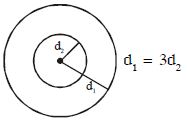
A circular disc is shown. On heating, $d_1$ increases by $0.3\%$ , then $d_2$ will
Answer

Expansion of a metal is same as photographic enlargement $\Rightarrow d_{1}$ will increase by $0.3 \%$

$\Rightarrow d_{1}, 0.3 \%$

Need a full question paper?

Generate a complete, print-ready paper with questions like this in minutes — across 16+ boards, with answer keys.
Start Generating Free

Similar questions

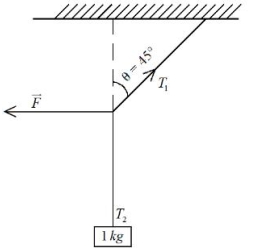
A $1 \mathrm{~kg}$ mass is suspended from the ceiling by a rope of length $4 \mathrm{~m}$. A horizontal force ' $F$ ' is applied at the mid point of the rope so that the rope makes an angle of $45^{\circ}$ with respect to the vertical axis as shown in figure. The magnitude of $F$ is:
Two particles of masses $m_1$ and $m_2$ in projectile motion have velocities ${\vec v_1}$ and ${\vec v_2}$ respectively at time $t$ = $0$ . they collide at time $t_0$ . Their velocities become ${\vec v_1'}$ and ${\vec v_2'}$ at time $2t_0$ while still moving in air. The value of $\left| {\left( {{m_1}{{\vec v}_1}' + {m_2}{{\vec v}_2}'} \right) - \left( {{m_1}{{\vec v}_1} + {m_2}{{\vec v}_2}} \right)} \right|$ is
The angle of incidence for a ray of light at a refracting surface of a prism is $45^o  $. The angle of prism is $60^o $ . If the ray suffers minimum deviation through the prism, the angle of minimum deviation and refractive index of the material of the prism respectively, are 
A body $A$ moves with a uniform acceleration $a$ and zero initial velocity. Another body $B$, starts from the same point moves in the same direction with a constant velocity $v$. The two bodies meet after a time $t$. The value of $t$ is
In normal adjustment, for a refracting telescope, the distance between objective and eye piece is $30\,cm$. The focal length of the objective, when the angular magnification of the telescope is $2$ , will be $.....cm$ 
A particle is moving with constant speed $\sqrt 2\,m/s$ on a circular path of radius $10\,cm$. Find the magnitude of average velocity when it has covered ${\left( {\frac{3}{4}} \right)^{th}}$ circular path
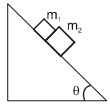
A block of mass $m_1=1 \ kg$ another mass $m_2=2 \ kg$, are placed together (see figure) on an inclined plane with angle of inclination $\theta$. Various values of $\theta$ are given in List $I$. The coefficient of friction between the block $m _1$ and the plane is always zero. The coefficient of static and dynamic friction between the block $m _2$ and the plane are equal to $\mu=0.3$. In List $II$ expression for the friction on block $m _2$ given. Match the correct expression of the friction in List $II$ with the angles given in List $I$, and choose the correct option. The acceleration due to gravity is denoted by $g$.

[Useful information : $\tan \left(5.5^{\circ}\right) \approx 0.1 ; \tan \left(11.5^{\circ}\right) \approx 0.2 ; \tan \left(16.5^{\circ} \approx 0.3\right)$ ]

List $I$ List $II$
$P.\quad$ $\theta=5^{\circ}$ $1.\quad$ $m _2 g \sin \theta$
$Q.\quad$ $\theta=10^{\circ}$ $2.\quad$ $\left(m_1+m_2\right) g \sin \theta$
$R.\quad$ $\theta=15^{\circ}$ $3.\quad$ $\mu m _2 g \cos \theta$
$S.\quad$ $\theta=20^{\circ}$ $4.\quad$ $\mu\left(m_1+m_2\right) g \cos \theta$

Symbol  represents
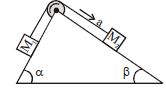
Two masses $M_1$ and $M_2$ are attached to the ends of a string which passes over a pulley attached to the top of a double inclined plane of angles of inclination $\alpha $ and $\beta $. If $M_2 > M_1$, the acceleration $a$ of the system is given by
A cylindrical tank has a hole of $1 cm^2$ in its bottom. If the water is allowed to flow into the tank from a tube above it at the rate of $70 cm^3/sec$. then the maximum height up to which water can rise in the tank is  .......... $cm$