A cylindrical tank has a hole of $1 cm^2$ in its bottom. If the water is allowed to flow into the tank from a tube above it at the rate of $70 cm^3/sec$. then the maximum height up to which water can rise in the tank is .......... $cm$
Diffcult


Download our appand get started for free
Experience the future of education. Simply download our apps or reach out to us for more information. Let's shape the future of learning together!No signup needed.*
Similar Questions
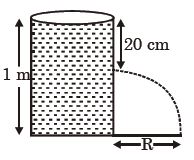
- 1A tank is filled with water upto a height $1\,m$. A hole is made at a distance $20\, cm$ from top. Find, the horizontal distance from the base of the tank, where the water strikes the ground. ......... $cm$View Solution
- 2In a test experiment on a model aeroplane in wind tunnel, the flow speeds on the upper and lower surfaces of the wings are $70 \mathrm{~ms}^{-1}$ and $65 \mathrm{~ms}^{-1}$ respectively. If the wing area is $2 \mathrm{~m}^2$ the lift of the wing is__________ $\mathrm{N}$.View Solution
(Given density of air $=1.2 \mathrm{~kg} \mathrm{~m}^{-3}$ )
- 3A sudden drop in the mercury level by $10 \,mm$ or more is a sign of ..........View Solution
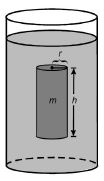
- 4A right circular cylinder has a mass $m$, radius $r$, and a height $h$. The cylinder is completely submerged in a fluid of density $\rho$, as shown in the diagram. What is the magnitude of the net force on the cylinder?View Solution
- 5If $W$ be the weight of a body of density $\rho $ in vacuum then its apparent weight in air of density $\sigma $ isView Solution
- 6View SolutionWater falls from a tap, down the streamline
- 7Two water pipes $P$ and $Q$ having diameters $2$$ \times 10^{-2} $ $m$ and $4$ $\times 10^{-2}$ $m$, respectively, are joined in series with the main supply line of water. The velocity of water flowing in pipe $P$ isView Solution
- 8A large open tank has two holes in the wall. One is a square hole of side $L$ at a depth $y $ from the top and the other is a circular hole of radius $ R$ at a depth $ 4y $ from the top. When the tank is completely filled with water the quantities of water flowing out per second from both the holes are the same. Then $ R$ is equal toView Solution
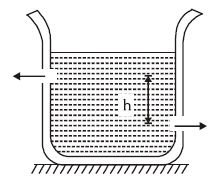
- 9There are two identical small holes of area of cross-section a on the opposite sides of a tank containing a liquid of density $\rho$. The difference in height between the holes is $h$. Tank is resting on a smooth horizontal surface. Horizontal force which will have to be applied on the tank to keep it in equilibrium isView Solution
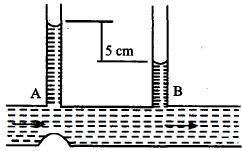
- 10In the diagram shown, the difference in the two tubes of the manometer is $5\, cm$, the cross section of the tube at $A$ and $B$ is $6\, mm^2$ and $10\, mm^2$ respectively. The rate at which water flows through the tube is ........ $ cc/s$ $(g\, = 10\, ms^{-2})$View Solution