MCQ
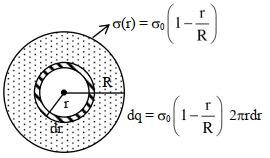
A circular disc of radius $R$ carries surface charge density $\sigma(r)=\sigma_0\left(1-\frac{r}{R}\right)$, where $\sigma_0$ is a constant and $r$ is the distance from the center of the disc. Electric flux through a large spherical surface that encloses the charged disc completely is $\phi_0$. Electric flux through another spherical surface of radius $\frac{R}{4}$ and concentric with the disc is $\phi$. Then the ratio $\frac{\phi_0}{\phi}$ is. . . . . .
  • A
    $6.30$
  • B
    $6.35$
  • $6.40$
  • D
    $6.45$

Answer

Correct option: C.
$6.40$
c
$\phi_0=\frac{\int dq }{\varepsilon_0}=\frac{\int_0^{ R } \sigma_0\left(1-\frac{ r }{ R }\right) 2 \pi rdr }{\varepsilon_0}$

$\phi=\frac{\int dq }{\varepsilon_0}=\frac{\int_0^{ R / 4} \sigma_0\left(1-\frac{ r }{ R }\right) 2 \pi rdr }{\varepsilon_0}$

$\therefore \quad \frac{\phi_0}{\phi}=\frac{\sigma_0 2 \pi \int_0^{ R }\left( r -\frac{ r ^2}{ R }\right) dr }{\sigma_0 2 \pi \int_0^{ R / 4}\left( r -\frac{ r ^2}{ R }\right) dr }$

$=\frac{\frac{ R ^2}{ R ^2}-\frac{ R ^2}{3}}{32}-\frac{ R ^2}{3 \times 64}=\frac{32}{5}$

$=6.40$

Need a full question paper?

Generate a complete, print-ready paper with questions like this in minutes — across 16+ boards, with answer keys.

Start Generating Free