MCQ 11 Mark
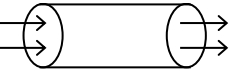
If $\oint_s \vec{E} \cdot \overrightarrow{d S}=0$ over a surface, then:
- A
the electric field inside the surface is necessarily uniform.
- ✓
the number of flux lines entering the surface must be equal to the number of flux lines leaving it.
- C
the magnitude of electric field on the surface is constant.
- D
all the charges must necessarily be inside the surface.
AnswerCorrect option: B. the number of flux lines entering the surface must be equal to the number of flux lines leaving it.
b
$\phi_{\text {closed }}=0$
$\text { So } \phi_{\text {in }}=\phi_{\text {out }}$
Number of field lines entering is equal number of field lines leaving.
View full question & answer→MCQ 21 Mark
An electric dipole is placed at an angle of $30^{\circ}$ with an electric field of intensity $2 \times 10^5\,NC ^{-1}$. It experiences a torque equal to $4\,Nm$. Calculate the magnitude of charge on the dipole, if the dipole length is $2\,cm$.
- ✓
$2\,mC$
- B
$8\,mC$
- C
$6\,mC$
- D
$4\,mC$
AnswerCorrect option: A. $2\,mC$
a
$\tau \text { on a dipole }=\overrightarrow{ p } \times \overrightarrow{ E }$
$\tau= pEsin \theta$
$4= q \times \ell \times E \times \sin 30^{\circ}$
$4= q \times 2 \times 10^{-2} \times 2 \times 10^5 \times \frac{1}{2}$
$q =2 \times 10^{-3}$
$q =2\,mC$
View full question & answer→MCQ 31 Mark
The ratio of coulomb's electrostatic force to the gravitational force between an electron and a proton separated by some distance is $2.4 \times 10^{39}$. The ratio of the proportionality constant, $K=\frac{1}{4 \pi \varepsilon_0}$ to the Gravitational constant $G$ is nearly (Given that the charge of the proton and electron each $=1.6 \times 10^{-19}\; C$, the mass of the electron $=9.11 \times 10^{-31}\; kg$, the mass of the proton $=1.67 \times 10^{-27}\,kg$ ):
- ✓
$10^{20}$
- B
$10^{30}$
- C
$10^{40}$
- D
$10$
AnswerCorrect option: A. $10^{20}$
a
$\frac{ F _e}{ F _{ G }}=\frac{\frac{ Kq _1 q _2}{ r ^2}}{\frac{ Gm _1 m _2}{ r ^2}}$
$2.4 \times 10^{39}=\frac{ K }{ G } \times \frac{\left(1.6 \times 10^{-19}\right)^2}{\left(9.11 \times 10^{-31} \times 1.67 \times 10^{-27}\right)}$
$\frac{ K }{ G }=\frac{2.4 \times 10^{39} \times 15.2137 \times 10^{-58}}{2.56 \times 10^{-38}}$
$=14.26 \times 10^{19}$
$=1.426 \times 10^{20}$
$\approx 10^{20}$
View full question & answer→MCQ 41 Mark
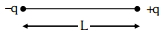
Two point charges $-q$ and $+q$ are placed at a distance of $L$, as shown in the figure.
The magnitude of electric field intensity at a distance $R ( R \gg L )$ varies as :
- ✓
$\frac{1}{ R ^{3}}$
- B
$\frac{1}{ R ^{4}}$
- C
$\frac{1}{ R ^{6}}$
- D
$\frac{1}{ R ^{2}}$
AnswerCorrect option: A. $\frac{1}{ R ^{3}}$
a
It is electric dipole at large distance electric field intensity
$E=\frac{K P}{R^{3}} \sqrt{1+3 \cos ^{2} \theta}$
$\therefore E \propto \frac{1}{R^{3}}$
View full question & answer→MCQ 51 Mark
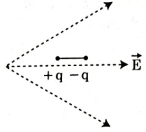
A dipole is placed in an electric field as shown. In which direction will it move ?
- A
towards the left as its potential energy will increase.
- ✓
towards the right as its potential energy will decrease.
- C
towards the left as its potential energy will decrease.
- D
towards the right as its potential energy will increase.
AnswerCorrect option: B. towards the right as its potential energy will decrease.
b
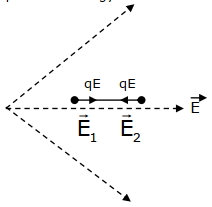
$\left|\vec{E}_{1}\right|>\left|\vec{E}_{2}\right|$
As field lines are closer at charge $+q$.
So, net force on the dipole acts towards right side. A system always moves to decrease it's potential energy.
View full question & answer→MCQ 61 Mark
The acceleration of an electron due to the mutual attraction between the electron and a proton when they are $1.6 \;\mathring A$ apart is,$\left(m_{e} \simeq 9 \times 10^{-31} kg , e=1.6 \times 10^{-19} C \right)$
(Take $\frac{1}{4 \pi \varepsilon_{0}}=9 \times 10^{9} Nm ^{2} C ^{-2}$ )
- A
$10^{25} \;m / s ^{2}$
- B
$10^{24} \;m / s ^{2}$
- C
$10^{23} \;m / s ^{2}$
- ✓
$10^{22} \;m / s ^{2}$
AnswerCorrect option: D. $10^{22} \;m / s ^{2}$
d
$F=\frac{e^{2}}{4 \pi \varepsilon_{0} r^{2}}$
$a_{e}=\frac{F}{m_{e}}$
$a_{e}=\frac{e^{2}}{4 \pi \varepsilon_{0} m_{e} r^{2}}$
$a_{e}=\frac{9 \times 10^{9} \times(1.6)^{2} \times 10^{-38}}{9 \times 10^{-31} \times(1.6)^{2} \times 10^{-20}}$
$a_{n}=10^{22} m / s ^{2}$
View full question & answer→MCQ 71 Mark
A spherical conductor of radius $10\, cm$ has a charge of $3.2 \times 10^{-7} \,C$ distributed uniformly. What is the magnitude of electric field at a point $15 \,cm$ from the centre of the sphere?
$\left(\frac{1}{4 \pi \in_{0}}=9 \times 10^{9} Nm ^{2} / C ^{2}\right)$
- A
$1.28 \times 10^{7} N / C$
- B
$1.28 \times 10^{4} N / C$
- ✓
$1.28 \times 10^{5} N / C$
- D
$1.28 \times 10^{6} N / C$
AnswerCorrect option: C. $1.28 \times 10^{5} N / C$
c
$E =\frac{ kQ }{ r ^{2}}=\frac{9 \times 10^{9} \times 3.2 \times 10^{-7}}{\left(15 \times 10^{-2}\right)^{2}}$
$E =1.28 \times 10^{5} N / C$
View full question & answer→MCQ 81 Mark
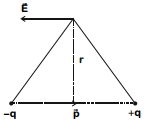
The electric field at a point on the equatorial plane at a distance $r$ from the centre of a dipole having dipole moment $\overrightarrow{ p }$ is given by, ($r >>$ separation of two charges forming the dipole, $\varepsilon_{0}$ - permittivity of free space)
- ✓
$\overrightarrow{E}=-\frac{\overrightarrow{p}}{4 \pi \in_{0} r^{3}}$
- B
$\overrightarrow{E}=\frac{\overrightarrow{ p }}{4 \pi \in_{0} r ^{3}}$
- C
$\overrightarrow{ E }=\frac{2 \overrightarrow { p }}{4 \pi \in_{0} r ^{3}}$
- D
$\overrightarrow{ E }=-\frac{\overrightarrow{ p }}{4 \pi \in_{0} r ^{2}}$
AnswerCorrect option: A. $\overrightarrow{E}=-\frac{\overrightarrow{p}}{4 \pi \in_{0} r^{3}}$
a
Electric field in equitorial plane
$E=-\frac{1}{4 \pi \in_{0}} \frac{\bar{P}}{r^{3}}$
View full question & answer→MCQ 91 Mark
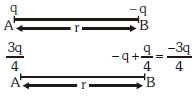
Two point charges $A$ and $B$, having charges $+Q$ and $- Q$ respectively, are placed at certain distance apart and force acting between them is $\mathrm{F}$. If $25 \%$ charge of $A$ is transferred to $B$, then force between the charges becomes
AnswerCorrect option: B. $\frac{9 \mathrm{F}}{16}$
b
$F=\frac{-kq^2}{r^2}$
$25 \%$ charge from $A$ is transferred to $B$
New force $(\mathrm{F})=\frac{\mathrm{K}\left(\frac{3 \mathrm{q}}{4}\right)\left(\frac{-3 \mathrm{q}}{4}\right)}{\mathrm{r}^{2}}=\frac{-9 \mathrm{kq}^{2}}{16 \mathrm{r}^{2}}=\frac{9 \mathrm{F}}{16}$
View full question & answer→MCQ 101 Mark
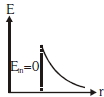
A hollow metal sphere of radius $R$ is uniformly charged. The electric field due to the sphere at a distance r from the centre
- A
increases as $\mathrm{r}$ increases for $\mathrm{r}<\mathrm{R}$ and for $\mathrm{r}>\mathrm{R}$
- ✓
zero as $\mathrm{r}$ increases for $\mathrm{r}<\mathrm{R}$, decreases as $\mathrm{r}$ increases for $\mathrm{r}>\mathrm{R}$
- C
zero as $\mathrm{r}$ increases for $\mathrm{r}<\mathrm{R},$ increases as $\mathrm{r}$ increases for $\mathrm{r}>\mathrm{R}$
- D
decreases as $\mathrm{r}$ increases for $\mathrm{r}<\mathrm{R}$ and for $\mathrm{r}>\mathrm{R}$
AnswerCorrect option: B. zero as $\mathrm{r}$ increases for $\mathrm{r}<\mathrm{R}$, decreases as $\mathrm{r}$ increases for $\mathrm{r}>\mathrm{R}$
b
For a metal sphere $\mathrm{E}_{\mathrm{m}}=0$ and $\overline{\mathrm{E}}_{\infty}=\frac{\mathrm{Kq}}{\mathrm{r}^{2} \mathrm{f}}$
View full question & answer→MCQ 111 Mark
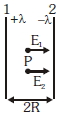
Two parallel infinite line charges with linear charge densities $+\lambda\; \mathrm{C} / \mathrm{m}$ and $-\lambda\; \mathrm{C} / \mathrm{m}$ are placed at a distance of $2 \mathrm{R}$ in free space. What is the electric field mid-way between the two line charges?
- A
$0\;N/C$
- B
$\frac{2 \lambda}{\pi \in_{0} \mathrm{R}} \mathrm{N} / \mathrm{C}$
- ✓
$\frac{\lambda}{\pi \mathrm{e}_{0} \mathrm{R}} \mathrm{N} / \mathrm{C}$
- D
$\frac{\lambda}{2 \pi \in_{0} R} \mathrm{N} / \mathrm{C}$
AnswerCorrect option: C. $\frac{\lambda}{\pi \mathrm{e}_{0} \mathrm{R}} \mathrm{N} / \mathrm{C}$
c
$\overrightarrow{\mathrm{E}}=\overrightarrow{\mathrm{E}}_{1}+\overrightarrow{\mathrm{E}}_{2}$
$\mathrm{E}=\mathrm{E}_{1}+\mathrm{E}_{2}$
$E=\frac{\lambda}{2 \pi \in_{0} R}+\frac{\lambda}{2 \pi \in_{0} R}$
$\mathrm{E}=\frac{\lambda}{\pi \in_{0} \mathrm{R}} \mathrm{N} / \mathrm{C}$
View full question & answer→MCQ 121 Mark
A sphere encloses an electric dipole with charge $\pm 3 \times 10^{-6} \;\mathrm{C} .$ What is the total electric flux across the sphere?......${Nm}^{2} / {C}$
- A
$-3 \times 10^{-6}$
- ✓
$0$
- C
$3 \times 10^{-6}$
- D
$6 \times 10^{-6}$
Answerb
$\phi=\frac{q_{\text {in }}}{\in_{0}}=0$
View full question & answer→MCQ 131 Mark
An electron falls from rest through a vertical distance $h$ in a uniform and vertically upward directed electric field $E.$ The direction of electric field is now reversed, keeping its magnitude the same. A proton is allowed to fall from rest in it through the same vertical distance $h.$ The time of fall of the electron, in comparison to the time of fall of the proton is
- ✓
- B
$5$ times greater
- C
- D
$10$ times greater
Answera
$h = \frac{1}{2}\frac{{eE}}{m}{t^2}$
$\therefore \,\,t = \sqrt {\frac{{2hm}}{{eE}}} $
$\therefore \,\,t \propto \sqrt m $ as $'e'$ is same for electron and proton.
$\because $ Electron has smaller mass so it will take smaller time.
View full question & answer→MCQ 141 Mark
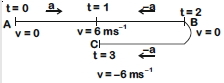
A toy car with charge $q$ moves on a frictionless horizontal plane surface under the influence of a uniform electric field $\vec E .$ Due to the force $q\vec E$ , its velocity increases from $0$ to $6\,\, m s^{-1}$ in one second duration. At that instant the direction of the field is reversed. The car continues to move for two more seconds under the influence of this field. The average velocity and tlie average speed of the toy car between $0$ to $3$ seconds are respectively
- A
$2 \,\,m/s, 4 \,\,m/s$
- ✓
$1\,\, m/s, 3 \,\,m/s$
- C
$1.5 \,\,m/s, 3 \,\,m/s$
- D
$1 \,\,m/s, 3.5 \,\,m/s$
AnswerCorrect option: B. $1\,\, m/s, 3 \,\,m/s$
b
Acceleration $a=\frac{6-0}{1}=6 \,{ms}^{-2}$
For $t=0$ to $t=1 \,\mathrm{s}$
$S_{1}=\frac{1}{2} \times 6(1)^{2}=3 \,{m}.........(i)$
For $t=1$ $s$ to $t=2 \,s$
$S_{2}=6.1-\frac{1}{2} \times 6(1)^{2}=3\,{m}.........(ii)$
For $t=2$ $s$ to $t=3\, s$
$S_{3}=0-\frac{1}{2} \times 6(1)^{2}=-3 \,{m}$
Total displacement $\mathrm{S}=\mathrm{S}_{1}+\mathrm{S}_{2}+\mathrm{S}_{3}=3\, \mathrm{m}$
Average velocity $=\frac{3}{3}=1\,{ms}^{-1}$
Total distance travelled $=9 \,{m}$
Average speed $=\frac{9}{3}=3 \,{ms}^{-1}$
View full question & answer→MCQ 151 Mark
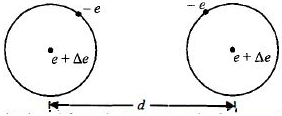
Suppose the charge of a proton and an electron differ slightly. One of them is $-e,$ the other is $(e + \Delta e).$ If the net of electrostatic force and gravitational force between two hydrogen atoms placed at a distanced (much greater than atomic size) apart is zero, then $\Delta e$ is of the order of $[$ Given: mass of hydrogen $m_h = 1.67 \times 10^{- 27}\,\, kg]$
- A
$10^{-23}\,\, C$
- ✓
$10^{-37 }\,\,C$
- C
$10^{-47} \,\,C$
- D
$10^{-20}\,\, C$
AnswerCorrect option: B. $10^{-37 }\,\,C$
b
A hydrogen atom consists of an electron and a proton.
$\therefore$ Charge on one hydrogen atom
$=q_{e}+q_{p}=-e+(e+\Delta e)=\Delta e$
Since a hydrogen atom carry a net charge $\Delta e$
$\therefore \quad$ Electrostatic force,
$F_{e} \frac{1}{4 \pi \varepsilon_{o}} \frac{(\Delta e)^{2}}{d^{2}}.........(i)$
will act between two hydrogen atoms.
The gravitational force between two hydrogen atoms is given as
$F_{g}=\frac{G m_{h} m_{h}}{d^{2}}.........(ii)$
since, the net force on the system is zero, $F_{e}=F_{g}$ Using eqns. $(i)$ and $(ii)$, we get
${\frac{(\Delta e)^{2}}{4 \pi \varepsilon_{o} d^{2}}=\frac{G m_{h}^{2}}{d^{2}}}$
${(\Delta e)^{2}=4 \pi \varepsilon_{o} G m_{h}^{2}}$
${=6.67 \times 10^{-11} \times\left(1.67 \times 10^{-27}\right)^{2} /\left(9 \times 10^{9}\right)}$
${\Delta e=10^{-37} \,\mathrm{C}}$
View full question & answer→MCQ 161 Mark
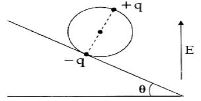
A wheel having mass $m$ has charges $+q$ and $-q$ on diametrically opposite points. It remains in equilibrium on a rough inclined plane in the presence of a vertical electric field $E$. Then value of $E$ is
AnswerCorrect option: B. $\;\frac{{mg}}{{2q}}$
b
The torque of electric force about centre is balanced by torque due to friction about the centre
$r f ={ PE } \sin \theta$
$\tau= PE \sin \theta$
$\text { But } f = mg \sin \theta$
$mgr \sin \theta= PE \sin \theta$
$E =\frac{ mgr }{ P }=\frac{ mgr }{ q \times 2 r }$
$P = q \times 2 r (\text { dipole moment })$
$E =\frac{ mg }{2 q }$
View full question & answer→MCQ 171 Mark
An electric dipole is placed at an angle of $30^o $ with an electric field intensity $2 \times \,\,10^5 \,\,NC^{-1}$ It experiences a torque equal to $4\,\, N m.$ The charge on the dipole, if the dipole length is $2\,\, cm,$ is
- A
$5 \,\,mC$
- B
$7$ $\mu \;C$
- C
$8\,\, mC$
- ✓
$2\,\, mC$
AnswerCorrect option: D. $2\,\, mC$
d
Here, $\theta = {30^\circ },E = 2 \times {10^5}\,{\text{N}}{{\text{C}}^{ - 1}}$
$\tau = 4\,{\text{Nm}},l = 2\,{\text{cm}} = 0.02\,{\text{m}},q = ?$
$\tau = pE\sin \theta = (ql)E\sin \theta $
$\therefore q =\frac{\tau}{E l \sin \theta}=\frac{4}{2 \times 10^{5} \times 0.02 \times \frac{1}{2}}$
$ = \frac{4}{{2 \times {{10}^3}}} = 2 \times {10^{ - 3}}{\text{C}} = 2\,{\text{mC}}$
View full question & answer→MCQ 181 Mark
Two identical charged spheres suspended from a common point by two massless strings of lengths $l,$ are initially at a distance $d\;(d < < l)$ apart because of their mutual repulsion. The charges begin to leak from both the spheres at a constant rate. As a result, the spheres approach each other with a velocity $v.$ Then $v$ varies as a function of the distance $x$ between the spheres, as
AnswerCorrect option: B. $v \propto {x^{ - \frac{1}{2}}}$
b
$\text { From figure, } T \cos \theta=m g.........(i)$
$T \sin \theta=\frac{k q^{2}}{x^{2}}.........(ii)$
From eqns. $(i)$ and $(ii)$, $tan \theta=\frac{k q^{2}}{x^{2} m g}$
since $\theta$ is small, $\therefore \tan \theta \approx \sin \theta = \frac{x}{{2l}}$
$\therefore \quad \frac{x}{2 l}=\frac{k q^{2}}{x^{2} m g} \Rightarrow q^{2}=x^{3} \frac{m g}{2 l k}$ or $q \propto x^{3 / 2}$
$\Rightarrow \frac{d q}{d t} \propto \frac{3}{2} \sqrt{x} \frac{d x}{d t}=\frac{3}{2} \sqrt{x} v$
since, $\frac{d q}{d t}=$ constant
$\therefore v \propto \frac{1}{\sqrt{x}}$
View full question & answer→MCQ 191 Mark
Five balls numbered $1$ to $5$ are suspended using separate threads. Pairs $(1, 2)$, $(2, 4)$ and $(4, 1)$ show electrostatic attraction, while pair $(2, 3)$ and $(4, 5)$ show repulsion. Therefore ball $1$ must be
Answerc
(c) Let us consider $1$ ball has any type of charge. $1$ and $2$ must have different charges, $2$ and $4$ must have different charges i.e. $1$ and $4$ must have same charges but electrostatics attraction is also present in $(1, 4)$ which is impossible.
View full question & answer→MCQ 201 Mark
Find change in mass of a body if it is given $+2C$ charge.
- A
$30.33\times10^{-12}\, kg$
- B
$11.37\times10^{-30}\, kg$
- ✓
$11.37\times10^{-12}\, kg$
- D
$30.33\times10^{-30}\, kg$
AnswerCorrect option: C. $11.37\times10^{-12}\, kg$
c
$q=n e$
$2=n \times 1.6 \times 10^{-19}$
Removed ${e^ - }s.$ $\mathrm{n}=\frac{2}{1.6 \times 10^{-19}}$
So mass transfer $=\mathrm{n} \times \mathrm{Me}$
$=\frac{2}{1.6 \times 10^{-19}} \times 9.1 \times 10^{-31} \mathrm{\,kg}$
so $11.37 \times 10^{-12} \mathrm{\,kg}$ will be the answer.
View full question & answer→MCQ 211 Mark
How much positive and negative charge is there in a cup of water $(250\;gm)$?
- A
$7.58 \times 10^{9} \;C$
- B
$3.65 \times 10^{6} \;C$
- ✓
$1.34 \times 10^{7} \;C$
- D
$2.68 \times 10^{8} \;C$
AnswerCorrect option: C. $1.34 \times 10^{7} \;C$
c
Let us assume that the mass of one cup of water is $250 \,g .$ The molecular mass of water is $18\, g$.
Thus, one mole $\left( =6.02 \times 10^{23} \text { molecules }\right)$ Therefore the number of molecules in one cup of water is $(250 / 18) \times 6.02 \times 10^{23}$
Each molecule of water contains two hydrogen atoms and one oxygen atom. i.e... $10$ electrons and $10$ protons. Hence the total positive and total negative charge has the same magnitude. It is equal to $(250 / 18) \times 6.02 \times 10^{23} \times 10 \times 1.6 \times 10^{-19}\, C$$ =1.34 \times 10^{7} \;C$
View full question & answer→MCQ 221 Mark
A charged gold leaf electroscope has its leaves apart by certain amount having enclosed air. When the electroscope is subjected to $X$-rays, then the leaves
Answerc
(c)
A charged gold leaf electroscope has its leaves apart by certain amount having enclosed air. When an electroscope is subjected to $x$-rays, then the $x$-ray will ionize the air around the leaves into positive and negative charges. Hence, the charge created in the air and opposite to the gold leaf will move towards it. Thus, the opposite charges neutralize the charge on the leaf, causing the leaf to collapse.
View full question & answer→MCQ 231 Mark
${F_g}$ and ${F_e}$ represents gravitational and electrostatic force respectively between electrons situated at a distance $10\, cm$. The ratio of ${F_g}/{F_e}$ is of the order of
- A
${10^{42}}$
- B
$10$
- C
$1$
- ✓
${10^{ - 43}}$
AnswerCorrect option: D. ${10^{ - 43}}$
d
(d) Gravitational force between electrons ${F_G} = \frac{{G{{({m_e})}^2}}}{{{r^2}}}$
Electrostatics force between electrons ${F_e} = k.\frac{{{e^2}}}{{{r^2}}}$
$\frac{{{F_G}}}{{{F_e}}} = \frac{{G{{({m_e})}^2}}}{{k.{e^2}}} = \frac{{6.67 \times {{10}^{ - 11}} \times {{(9.1 \times {{10}^{ - 31}})}^2}}}{{9 \times {{10}^9} \times {{(1.6 \times {{10}^{ - 19}})}^2}}}$$ = 2.39 \times {10^{ - 43}}$
View full question & answer→MCQ 241 Mark
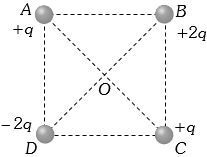
Four charges are arranged at the corners of a square $ABCD$, as shown in the adjoining figure. The force on the charge kept at the centre $O$ is
AnswerCorrect option: C. Along the diagonal $BD$
c
(c) We put a unit positive charge at $O$. Resultant force due to the charge placed at $A$ and $C$ is zero and resultant charge due to $B$ and $D$ is towards $D$ along the diagonal $BD$.
View full question & answer→MCQ 251 Mark
A total charge $Q$ is broken in two parts ${Q_1}$ and ${Q_2}$ and they are placed at a distance $R$ from each other. The maximum force of repulsion between them will occur, when
- A
${Q_2} = \frac{Q}{R},\;{Q_1} = Q - \frac{Q}{R}$
- B
${Q_2} = \frac{Q}{4},\;{Q_1} = Q - \frac{{2Q}}{3}$
- C
${Q_2} = \frac{Q}{4},\;{Q_1} = \frac{{3Q}}{4}$
- ✓
${Q_1} = \frac{Q}{2},\;{Q_2} = \frac{Q}{2}$
AnswerCorrect option: D. ${Q_1} = \frac{Q}{2},\;{Q_2} = \frac{Q}{2}$
d
(d) ${Q_1} + {Q_2} = Q$ ..... $(i)$ and $F = k\frac{{{Q_1}{Q_2}}}{{{r^2}}}$ .....$(ii)$
From $(i)$ and $(ii)$ $F = \frac{{k{Q_1}(Q - {Q_1})}}{{{r^2}}}$
For $F$ to be maximum $\frac{{dF}}{{d{Q_1}}} = 0$ $==>$ ${Q_1} = {Q_2} = \frac{Q}{2}$
View full question & answer→MCQ 261 Mark
Two similar spheres having $ + \,q$ and $ - \,q$ charge are kept at a certain distance. $F$ force acts between the two. If in the middle of two spheres, another similar sphere having $ + \,q$ charge is kept, then it experience a force in magnitude and direction as
- A
- B
$8F$ towards $ + \,q$ charge
- ✓
$8F$ towards $ - \,q$ charge
- D
$4F$ towards $ + \,q$ charge
AnswerCorrect option: C. $8F$ towards $ - \,q$ charge
c
(c) Initially, force between $A$ and $C$ $F = k\frac{{{Q^2}}}{{{r^2}}}$
When a similar sphere $B$ having charge $+Q$ is kept at the mid point of line joining $A$ and $C$, then Net force on $B$ is ${F_{net}} = {F_A} + {F_C}$ $ = k\frac{{{Q^2}}}{{{{(r/2)}^2}}} + \frac{{k{Q^2}}}{{{{(r/2)}^2}}} = 8\frac{{k{Q^2}}}{{{r^2}}} = 8F$
(Direction is shown in figure)
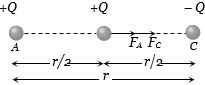
View full question & answer→MCQ 271 Mark
Two point charges $ + 3\,\mu C$ and $ + 8\,\mu C$ repel each other with a force of $40\,N$. If a charge of $ - 5\,\mu C$ is added to each of them, then the force between them will become....$N$
- ✓
$ - 10$
- B
$ + 10$
- C
$ + 20$
- D
$ - 20$
AnswerCorrect option: A. $ - 10$
a
(a) In second case, charges will be $ - \,2\,\mu C$ and $ + 3\,\mu C$
Since $F \propto {Q_1}{Q_2}$ i.e. $\frac{F}{{F'}} = \frac{{{Q_1}{Q_2}}}{{Q{'_1}Q{'_2}}}$
$\frac{{40}}{{F'}} = \frac{{3 \times 8}}{{ - 2 \times 3}} = - 4$ $==>$ $F' = 10\,N$(Attractive)
View full question & answer→MCQ 281 Mark
Two electrons are separated by a distance of $1\,\mathop A\limits^o $. What is the coulomb force between them
- ✓
$2.3 \times {10^{ - 8}}$ $N$
- B
$4.6 \times {10^{ - 8}}$ $N$
- C
$1.5 \times {10^{ - 8}}$ $N$
- D
AnswerCorrect option: A. $2.3 \times {10^{ - 8}}$ $N$
a
(a) $F = 9 \times {10^9} \times \frac{{{Q^2}}}{{{r^2}}}$$ = 9 \times {19^9} \times \frac{{{{(1.6 \times {{10}^{ - 19}})}^2}}}{{{{({{10}^{ - 10}})}^2}}} = 2.3 \times {10^{ - 8}}\,N$
View full question & answer→MCQ 291 Mark
Two copper balls, each weighing $10\,g$ are kept in air $10\, cm$ apart. If one electron from every ${10^6}$ atoms is transferred from one ball to the other, the coulomb force between them is (atomic weight of copper is $63.5$)
AnswerCorrect option: C. $2.0 \times {10^8}\,N$
c
(c) Number of atoms in given mass $ = \frac{{10}}{{63.5}} \times 6.02 \times {10^{23}}= 9.48 \times 10^{22}$
Transfer of electron between balls $ = \frac{{9.48 \times {{10}^{22}}}}{{{{10}^6}}} = 9.48 \times 10^{16}$
Hence magnitude of charge gained by each ball.
$Q = 9.48 \times 10^{16} \times 1.6 \times 10^{-19} = 0.015\, C$
Force of attraction between the balls $F = 9 \times {10^9} \times \frac{{{{(0.015)}^2}}}{{{{(0.1)}^2}}} = 2 \times {10^8}\,N.$
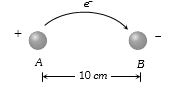
View full question & answer→MCQ 301 Mark
Two particle of equal mass $m$ and charge $q$ are placed at a distance of $16\, cm$. They do not experience any force. The value of $\frac{q}{m}$ is
- A
- B
$\sqrt {\frac{{\pi {\varepsilon _0}}}{G}} $
- C
$\sqrt {\frac{G}{{4\pi {\varepsilon _0}}}} $
- ✓
$\sqrt {4\pi {\varepsilon _0}G} $
AnswerCorrect option: D. $\sqrt {4\pi {\varepsilon _0}G} $
d
(d) They will not experience any force if $|\overrightarrow {{F_G}} |\, = \,|\overrightarrow {{F_e}} |$
$==>$ $G\frac{{{m^2}}}{{{{(16 \times {{10}^{ - 2}})}^2}}} = \frac{1}{{4\pi {\varepsilon _0}}}.\frac{{{q^2}}}{{{{(16 \times {{10}^{ - 2}})}^2}}}$ $==>$ $\frac{q}{m} = \sqrt {4\pi {\varepsilon _0}G} $
View full question & answer→MCQ 311 Mark
Two point charges placed at a certain distance $r$ in air exert a force $F$ on each other. Then the distance $r'$ at which these charges will exert the same force in a medium of dielectric constant $k$ is given by
- A
$r$
- B
$r/k$
- ✓
$r/\sqrt k $
- D
$r\sqrt k $
AnswerCorrect option: C. $r/\sqrt k $
c
(c) $F = F'$ or $\frac{{{Q_1}{Q_2}}}{{4\pi {\varepsilon _0}{r^2}}} = \frac{{{Q_1}{Q_2}}}{{4\pi {\varepsilon _0}r{'^2}K}} \Rightarrow r' = \frac{r}{{\sqrt K }}$
View full question & answer→MCQ 321 Mark
The charges on two sphere are $+7\,\mu C$ and $-5\,\mu C$ respectively. They experience a force $F$. If each of them is given and additional charge of $-2\,\mu C$, the new force of attraction will be
- ✓
$F$
- B
$F / 2$
- C
$F/\sqrt 3 $
- D
$2F$
Answera
(a) $F = \frac{1}{{4\pi {\varepsilon _0}}}\frac{{( + 7 \times {{10}^{ - 6}})\,( - 5\, \times {{10}^{ - 6}})}}{{{r^2}}} = - \frac{1}{{4\pi {\varepsilon _0}}}\frac{{35 \times {{10}^{12}}}}{{{r^2}}}\,N$
$F' = \frac{1}{{4\pi {\varepsilon _0}}}\frac{{( + 5 \times {{10}^{ - 6}})( - 7 \times {{10}^{ - 6}})}}{{{r^2}}} = - \frac{1}{{4\pi {\varepsilon _0}}}\frac{{35 \times {{10}^{12}}}}{{{r^2}}}\,N$
View full question & answer→MCQ 331 Mark
Two spheres $A$ and $B$ of radius $4\,cm$ and $6\,cm$ are given charges of $80\,\mu c$ and $40\,\mu c$ respectively. If they are connected by a fine wire, the amount of charge flowing from one to the other is
- A
$20\,\mu C$ from $A$ to $B$
- B
$16\,\mu C$ from $A$ to $B$
- C
$32\,\mu C$ from $B$ to $A$
- ✓
$32\,\mu C$ from $A$ to $B$
AnswerCorrect option: D. $32\,\mu C$ from $A$ to $B$
d
(d) Total charge $Q = 80 + 40 = 120\,\mu \,C$. By using the formula ${Q_1}' = Q\,\left[ {\frac{{{r_1}}}{{{r_1} + {r_2}}}} \right]$.
New charge on sphere A is $Q'_A $$= Q\,[ \frac {r_A}{r_A + r_B} ]$ $ = 120\,\left[ {\frac{4}{{4 + 6}}} \right]\, = 48\,\mu \,C$.
Initially it was $80\,\mu C$ i.e., $32\,\mu \,C$ charge flows from $A$ to $B$.
View full question & answer→MCQ 341 Mark
Two charges $ + 4e$ and $ + e$ are at a distance $x$ apart. At what distance, a charge $q$ must be placed from charge $ + e$ so that it is in equilibrium
- A
$x/2$
- B
$2x/3$
- ✓
$x/3$
- D
$x/6$
Answerc
(c) For equilibrium of $q$
|$F_1$| = |$F_2$|
Which gives ${x_2} = \frac{x}{{\sqrt {\frac{{{Q_1}}}{{{Q_2}}}} + 1}} = \frac{x}{{\sqrt {\frac{{4e}}{e}} + 1}} = \frac{x}{3}$
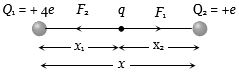
View full question & answer→MCQ 351 Mark
Two point charges $ + 9e$ and $ + e$ are at $16\, cm$ away from each other. Where should another charge $q$ be placed between them so that the system remains in equilibrium
- A
$24\, cm$ from $ + 9e$
- ✓
$12\, cm$ from $ + 9e$
- C
$24\, cm$ from $ + e$
- D
$12\, cm$ from $ + e$
AnswerCorrect option: B. $12\, cm$ from $ + 9e$
b
(b) Suppose $q$ is placed at a distance $x$ from $+9e$, then for equilibrium net force on it must be zero i.e. $|F_1| = |F_2|$
Which gives ${x_1} = \frac{x}{{\sqrt {\frac{{{Q_2}}}{{{Q_1}}}} + 1}} = \frac{{16}}{{\sqrt {\frac{e}{{9e}}} + 1}} = 12\,cm$
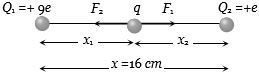
View full question & answer→MCQ 361 Mark
The distance between charges $5 \times {10^{ - 11}}\,C$ and $ - 2.7 \times {10^{ - 11}}\,C$ is $0.2\, m$. The distance at which a third charge should be placed in order that it will not experience any force along the line joining the two charges is......$m$
- A
$0.44$
- B
$0.65$
- ✓
$0.556$
- D
$0.350$
AnswerCorrect option: C. $0.556$
c
(c) If two opposite charges are separated by a certain distance, then for it’s equilibrium a third charge should be kept outside and near the charge which is smaller in magnitude.
Here, suppose third charge $q$ is placed at a distance $x$ from -$2.7 \times 10^{-11}C$ then for it’s equilibrium $|F_1| = |F_2|$
$==>$ $\frac{{k{Q_1}q}}{{{{(x + 0.2)}^2}}} = \frac{{k{Q_2}q}}{{{x^2}}}$ $==>$ $x = 0.556\, m$
$\left( {{\rm{Here }}\,k = \frac{1}{{4\pi {\varepsilon _0}}}\,{\rm{and}}\,{Q_1} = 5 \times {{10}^{ - 11}}\,C,\,{Q_2} = - \,2.7 \times {{10}^{ - 11}}\,C} \right)\,$
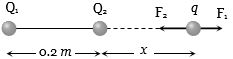
View full question & answer→MCQ 371 Mark
Charges $4Q$, $q$ and $Q$ and placed along $x$-axis at positions $x = 0,x = l/2$ and $x = l$, respectively. Find the value of $q$ so that force on charge $Q$ is zero
- A
$Q$
- B
$Q / 2$
- C
$-Q / 2$
- ✓
$-Q$
Answerd
(d) The total force on $Q$
$\frac{{Qq}}{{4\pi {\varepsilon _0}{{\left( {\frac{l}{2}} \right)}^2}}} + \frac{{4{Q^2}}}{{4\pi {\varepsilon _0}{l^2}}}\,\, = 0$
$\frac{{Qq}}{{4\pi {\varepsilon _0}{{\left( {\frac{l}{4}} \right)}^2}}} = - \frac{{4{Q^2}}}{{4\pi {\varepsilon _0}{l^2}}}\,\, \Rightarrow \,\,q = - Q.$
View full question & answer→MCQ 381 Mark
A point charge of $40$ stat coulomb is placed $2$ $cm$ in front of an earthed metallic plane plate of large size. Then the force of attraction on the point charge is.....$dynes$
- ✓
$100$
- B
$160$
- C
$1600$
- D
$400$
Answera
(a) By the concept of electrical image, it is considered that an equal but opposite charge present on the other side of the plate at equal distance. Hence force
$F = \frac{{40 \times 40}}{{{4^2}}} = 100\,dynes$
View full question & answer→MCQ 391 Mark
A conducting sphere of radius $R$, and carrying a charge $q$ is joined to a conducting sphere of radius $2R$, and carrying a charge $-2q$. The charge flowing between them will be
- A
$\frac{q}{3}$
- B
$\frac{{2q}}{3}$
- C
$q$
- ✓
$\frac{{4q}}{3}$
AnswerCorrect option: D. $\frac{{4q}}{3}$
d
(d) Initial charge on sphere of radius $R = q$
Charge on this sphere after joining $q' = \frac{{(q + ( - 2q) \times R}}{{R + 2R}}$ $ = \frac{{ - q \times R}}{{3R}} = - \frac{q}{3}$
Now charge flowing between them $ = q - \left( { - \frac{q}{3}} \right) = \frac{{4q}}{3}$
View full question & answer→MCQ 401 Mark
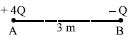
Two fixed charges $4\,Q$ (positive) and $Q$ (negative) are located at $A$ and $B$, the distance $AB$ being $3$ $m$.
- A
The point $P$ where the resultant field due to both is zero is on $AB$ outside $AB$.
- B
If a negative charge is placed at $P$ and displaced slightly along $AB $ it will execute oscillations.
- C
If a positive charge is placed at $P$ and displaced slightly along $AB$ it will execute oscillations.
- ✓
$A$ and $B$ both
AnswerCorrect option: D. $A$ and $B$ both
d
The resultant electric field will be zero at point closer to $\mathrm{B}$ and outside $\mathrm{AB}$ (by analysing directions of field and magnitudes)
If a positive charge is placed at $P$ and distributed, the positive charge either goes towards, $-Q$ or moves away from $-Q$ but won't oscillate
$\left(\because \frac{d^{2} v_{p}}{d x^{2}}>0\right)$
(unstable equilibrium) while negative charge oscillate
$\left(\because \frac{d^{2} U_{n}}{d^{2} x}\right.$$\left.=-\frac{\mathrm{d}^{2} \mathrm{U}_{\mathrm{P}}}{\mathrm{d}^{2} \mathrm{x}}<0\right)$ (Stable equilibrium)
View full question & answer→MCQ 411 Mark
Two identical charges $+Q $ are kept fixed some distance apart. A small particle $P $ with charge $q$ is placed midway between them. If $P$ is given a small displacement $\Delta$ , it will undergo simple harmonic motion if
- A
$q$ is positive and $\Delta$ is along the line joining the charges.
- B
$q$ is positive and $\Delta$ is perpendicular to the line joining the charges.
- C
$q$ is negative and $\Delta$ is perpendicular to the line joining the charges.
- ✓
$A$ and $C$ both
AnswerCorrect option: D. $A$ and $C$ both
d
$\mathrm{q}$ is $+ ve$ then there will be net repulsive force which will send the charge particle back to its original position so it will be an $S.H.M.$
$\mathrm{q}$ is $-ve$ then there will be net attractice force which will send the charge particle back to its original position so it will be an $S.H.M.$
View full question & answer→MCQ 421 Mark
Two identical conducting spheres having unequal positive charges $q_1$ and $q_2$ separated by distance $r$. If they are made to touch each other and then separated again to the same distance, the electrostatic force between them in this case will be :-
Answerc
Since the two spheres are identical, final charge on each of them after contact $q=\frac{\left(q_{1}+q_{2}\right)}{2}$
$F_{1}=\frac{K q_{1} q_{2}}{r^{2}}$
$F_{2}=\frac{K q^{2}}{r^{2}}=\frac{K}{r^{2}}\left(\frac{q_{1}+q_{2}}{2}\right)^{2}$
$F_{2}-F_{1}=\frac{K}{r^{2}}\left\{\left(\frac{q_{1}+q_{2}}{2}\right)^{2}-q_{1} q_{2}\right\}$
$=\frac{K}{4 r^{2}}\left(q_{1}-q_{2}\right)^{2} \Rightarrow F_{2}-F_{1}>0$ or $F_{2}>F_{1}$
View full question & answer→MCQ 431 Mark
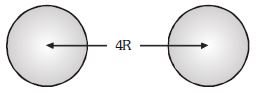
Two identical spheres each of radius $R$ are kept at center-to-center spacing $4R$ as shown in the figure. They are charged and the electrostatic force of interaction between them is first calculated assuming them point like charges at their centers and the force is also measured experimentally. The calculated and measured forces are denoted by $F_c$ and $F_m$ respectively.
($F_c$ and $F_m$ denote magnitude of force)
- A
When they carry charges of the same sign $F_c > F_m$ and when they carry charges of opposite signs $F_c < F_m$ only when they are insulator.
- B
When they carry charges of the same sign $F_c > F_m$ and when they carry charges of opposite signs $F_c < F_m$ only when they are conductor.
- C
When they carry charges of the same sign $F_c < F_m$ and when they carry charges of opposite signs $F_c > F_m$ irrespective of their material.
- ✓
When they carry charges of the same sign $F_c > F_m$ and when they carry charges of opposite signs $F_c < F_m$ irrespective of their material.
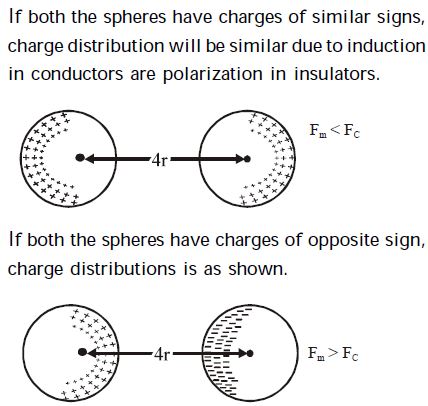
AnswerCorrect option: D. When they carry charges of the same sign $F_c > F_m$ and when they carry charges of opposite signs $F_c < F_m$ irrespective of their material.
d
View full question & answer→MCQ 441 Mark
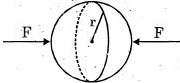
Two identical non-conducting thin hemispherical shells each of radius $R$ are brought in contact to make a complete sphere . If a total charge $Q$ is uniformly distributed on them, how much minimum force $F$ will be required to hold them together
- A
$F = \frac{{{Q^2}}}{{16\pi {\varepsilon _0}{R^2}}}$
- ✓
$F = \frac{{{Q^2}}}{{32\pi {\varepsilon _0}{R^2}}}$
- C
$F = \frac{{{Q^2}}}{{64\pi {\varepsilon _0}{R^2}}}$
- D
$\frac{{{Q^2}}}{{32\pi {\varepsilon _0}{R^2}}} >F> \frac{{{Q^2}}}{{64\pi {\varepsilon _0}{R^2}}}$
AnswerCorrect option: B. $F = \frac{{{Q^2}}}{{32\pi {\varepsilon _0}{R^2}}}$
b
$\mathrm{F}=$ (Electric pressure) $\times$ (Projected area)
$=\frac{\sigma^{2}}{2 \varepsilon_{0}}\left(\pi r^{2}\right)=\left(\frac{Q}{4 \pi R^{2}}\right)^{2}\left(\frac{1}{2 \varepsilon_{0}}\right) \pi R^{2}$
$\left[ {\frac{{{{\rm{Q}}^2}}}{{32\pi {\varepsilon _0}{{\rm{R}}^2}}}} \right]$
View full question & answer→MCQ 451 Mark
Select the correct alternative
- A
The charge gained by the uncharged body from a charged body due to conduction is equal to half of the total charge initially present
- B
The magnitude of charge increases with the increase in velocity of charge
- C
Charge can exist without matter although matter can not exist without charge
- ✓
Between two non-magnetic substances repulsion is the true test of electrification (electrification means body has net charge)
AnswerCorrect option: D. Between two non-magnetic substances repulsion is the true test of electrification (electrification means body has net charge)
d
$(1)$ Charging by conduction has charge distribution depending on size of bodies.
$(2)$ Charge is invariant with velocity
$(3)$ Charge requires mass for existance
$(4)$ Repultion shows charge of both bodies because attraction can be there between charged and uncharged body.
View full question & answer→MCQ 461 Mark
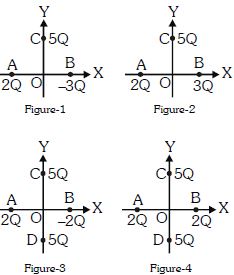
The diagrams depict four different charge distributions. All the charged particles are at same distance from origin $(i.e. OA = OB = OC = OD)$ $F_1$ , $F_2$ , $F_3$ and $F_4$ are the magnitude of electrostatic force experienced by a point charge $q_0$ kept at origin in figure $-1$ , figure $-2$ , figure $-3$ and figure $-4$ respectively. Choose the correct statement.
- ✓
$F_1 > F_2 > F_3 > F_4$
- B
$F_1 < F_2 < F_3 < F_4$
- C
$F_1 > F_3 > F_2 > F_4$
- D
$F_3 > F_1 > F_4 > F_2$
AnswerCorrect option: A. $F_1 > F_2 > F_3 > F_4$
a
$F = q_0E$
and $E_1 > E_2 > E_3 > E_4$
View full question & answer→MCQ 471 Mark
Two charges $q$ and $-3q$ are placed fixed on $x-axis$ separated by distance $'d'$. Where should a third charge $2q$ be placed such that it will not experience any force ?
- ✓
$\frac{d}{2}\left( {1 + \sqrt 3 } \right)$ from $q$
- B
$\frac{d}{2}\left( {1 + \sqrt 3 } \right)$ from $-3q$
- C
$d\left( {1 + \sqrt 3 } \right)$ from $q$
- D
$d\left( {1 + \sqrt 3 } \right)$ from $-2q$
AnswerCorrect option: A. $\frac{d}{2}\left( {1 + \sqrt 3 } \right)$ from $q$
a
At $P:$ on $2 \mathrm{q}$, Force due to $\mathrm{q}$ is to the left and that due to $-3 \mathrm{q}$ is to the right.
$\therefore \frac{2 q^{2}}{4 \pi \varepsilon_{0} x^{2}}=\frac{6 q^{2}}{4 \pi \varepsilon_{0}(d+x)^{2}}$
$\therefore(d+x)^{2}=3 x^{2}$
$\therefore 2 x^{2}-2 d x-d^{2}=0$
$x=\frac{d}{2} \pm \frac{\sqrt{3} d}{2}$
($-ve$ sign would be between $\mathrm{q}$ and $-3 \mathrm{q}$ and hence is unacceptable.)
$x=\frac{d}{2}+\frac{\sqrt{3} d}{2}=\frac{d}{2}(1+\sqrt{3})$ to the left of $q$
View full question & answer→MCQ 481 Mark
Two identical conducing spheres having unequal positive charges $q_1$ and $q_2$ separated by distance $r$. If they are made to touch each other and then separated again to the same distance. The electrostatic force between the spheres in this case will be (neglect induction of charges)
Answerc
$\mathrm{F}_{1} \propto \mathrm{q}_{1} \mathrm{q}_{2}$
$\mathrm{F}_{2} \propto\left(\frac{\mathrm{q}_{1}+\mathrm{q}_{2}}{2}\right)^{2}$
So $\mathrm{F}_{2}>\mathrm{F}_{1}$
View full question & answer→MCQ 491 Mark
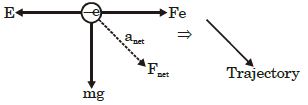
A negatively charged particle $p$ is placed, initially at rest, in $a$ constant, uniform gravitational field and $a$ constant, uniform electric field as shown in the diagram. What qualitatively, is the shape of the trajectory of the electron?

Answerd
View full question & answer→MCQ 501 Mark
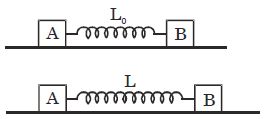
$A$ and $B$ are two identical blocks made of a conducting material. These are placed on a horizontal frictionless table and connected by a light conducting spring of force constant $‘K’$. Unstretched length of the spring is $L_0$. Charge $Q/2$ is given to each block. Consequently, the spring stretches to an equilibrium length $L$. Value of $Q$ is
- A
$\sqrt {4\pi {\varepsilon _0}KL} $
- B
$L\sqrt {\frac{K}{{4\pi {\varepsilon _0}\left( {L - {L_0}} \right)}}} $
- ✓
$2L\sqrt {4\pi {\varepsilon _0}K\left( {L - {L_0}} \right)} $
- D
$4\pi {\varepsilon _0}K\left( {L - {L_0}} \right)$
AnswerCorrect option: C. $2L\sqrt {4\pi {\varepsilon _0}K\left( {L - {L_0}} \right)} $
c
$\frac{\frac{1}{4 \pi \varepsilon_{0}}\left(\frac{Q}{2}\right)^{2}}{(L)^{2}}=K\left(L-L_{0}\right)$
$Q=2 L \sqrt{4 \pi \varepsilon_{0} K\left(L-L_{0}\right)}$
View full question & answer→


