Question
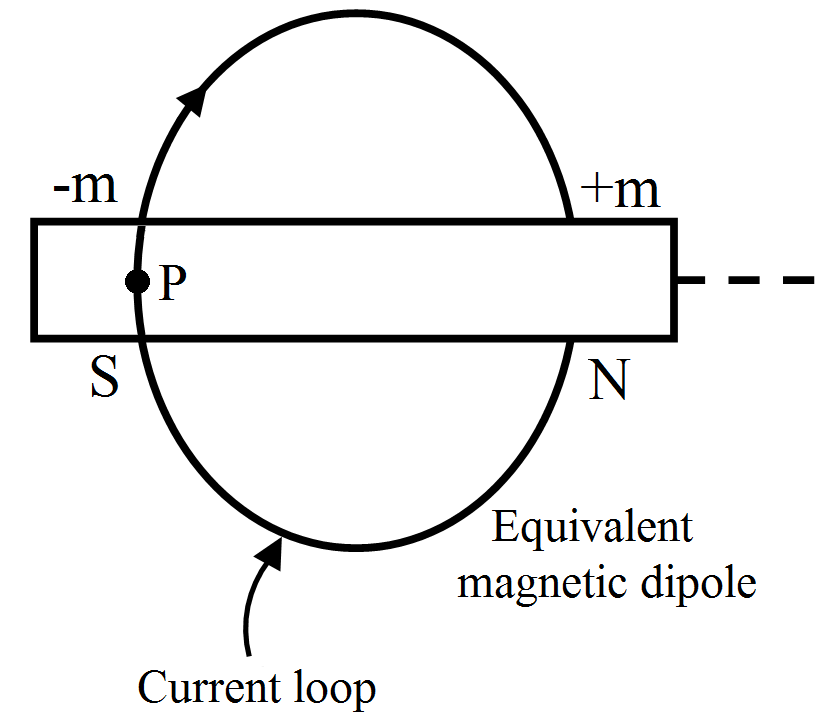
A circular loop carrying a current is replaced by an equivalent magnetic dipole. A point on the loop is in:

Answer

  1. Broadside-on position.
Explanation:

The position of the points lying on the equator of a magnetic dipole is called the broadside-on position. In our case, the point on the loop (after replacement of the circular loop with an equivalent magnetic dipole) lies on the equatorial position of the equivalent magnetic dipole. Hence, the point lies on the broadside-on position.
If P was the point on the loop, then it is clear from the figure that point P lies on the broadside-on position of the equivalent magnetic dipole.

Need a full question paper?

Generate a complete, print-ready paper with questions like this in minutes — across 16+ boards, with answer keys.
Start Generating Free

Similar questions

Which of the following is an atom donor impurity?
An alternating current is given by $\text{i}=\text{i}_1\cos\omega\text{t}+\text{i}_2\sin\omega\text{t}.$ The rms current is given by:
  1. $\frac{\text{i}_1+\text{i}_2}{\sqrt{2}}$
  2. $\frac{|\text{i}_1+\text{i}_2|}{\sqrt{2}}$
  3. $\sqrt{\frac{\text{i}_1^2+\text{i}_2^2}{2}}$
  4. $\sqrt{\frac{\text{i}_1^2+\text{i}_2^2}{\sqrt{2}}}$
The equivalent resistance of resistors connected in series is always (a) Equal to the mean of component resistors(b) Less than the lowest of component resistors(c) In between the lowest and the highest of component resistors(d) Equal to sum of component resistors


Unit of e.m.f. of a cell is:
Consider a collision between an oxygen molecule and a hydrogen molecule in a mixture of oxygen and hydrogen kept at room temperature. Which of the following are pcssible?
  1. The kinetic energies of both the molecules increase.
  2. The kinetic energies of both the molecules decrease.
  3. The Kinetic energy of the oxygen molecule increases and that of the hydrogen molecule decreases.
  4. The kinetic energy of the hydrogen molecule increases and that of the oxygen molecule decreases.
Which of the following properties of light conclusively support wave theory of light?
The$ X-$rays produced in a coolidge tube of potential difference $40V$ have minimum wavelength of
Two particles $X$ and $Y$ having equal charges, after being accelerated through the same potential difference, enter a region of uniform magnetic field and describes circular path of radius  $R_1$ and $R_2$ respectively. The ratio of mass of $X$ to that of $Y$ is
What is the ratio of heat generated in $R$ and $2R$
A convex lens is dipped in a liquid whose refractive index is equal to the refractive index of the lens. Then its focal length will: