Question
A circular loop of string rotates about its axis on a frictionless horizontal plane at a uniform rate so that the tangential speed of any particle of the string is v. If a small transverse disturbance is produced at. a point of the loop, with what speed (relative to the string) will this disturbance travel on the string?
Answer

m = mass per unit length of the string

R = Radius of the loop
$\omega=$ angular velocity, V = linear velocity of the string

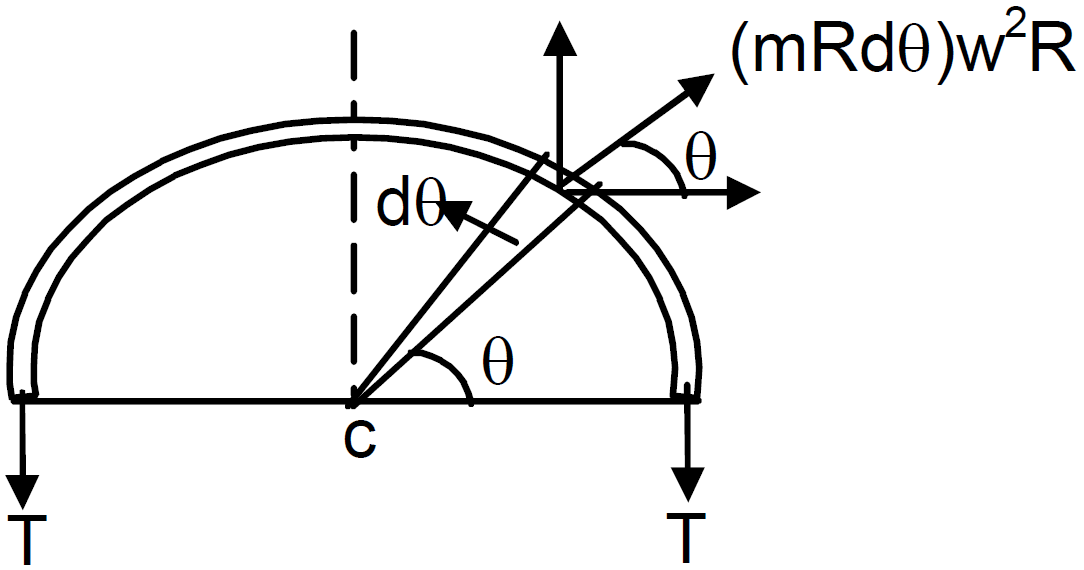
Consider one half of the string as shown in figure.

The half loop experiences cetrifugal force at every point, away from centre, which is balanced by tension 2T.

Consider an element of angular part $\text{d}\theta$ at angle $\theta.$ Consider another element symmetric to this centrifugal force experienced by the element $=(\text{mRd}\theta)\omega^2\text{R}.$

$\big($Length of element $=\text{Rd}\theta,\ \text{mass}=\text{mRd}\theta\big)$

Resolving into rectangular components net force on the two symmetric elements,

$\text{DF}=2\text{mR}^2\text{d}\theta\omega^2\sin\theta$ [horizontal components cancels each other]

So, total $\text{F}=\int\limits_0^{\frac{\pi}{2}}2\text{mR}^2\omega^2\sin\theta\text{d}\theta=2\text{mR}^2\omega^2[-\cos]\Rightarrow2\text{mR}^2\omega^2$

Again, $2\text{T}=2\text{mR}^2\omega^2\ \Rightarrow\text{T}=\text{mR}^2\omega^2$

Velocity of transverse vibration $\text{v}=\sqrt{\frac{\text{T}}{\text{m}}}=\omega\text{R}=\text{v}$

Need a full question paper?

Generate a complete, print-ready paper with questions like this in minutes — across 16+ boards, with answer keys.

Start Generating Free

Similar questions

A particle with a charge of 5.0 µC and a mass of 5.0 × 10⁻¹²kg is projected with a speed of 1.0km s-1 in a magnetic field of magnitude 5.0mT. The angle between the magnetic field and the velocity is sin-1 (0.90). Show that the path of the particle will be a helix. Find the diameter of the helix and its pitch.
Critically analyse bar magnet and solenoid and calculate the value of magnetic field generated on the axial point of the solenoid.
The electric potential existing m space is V(x, y, z) = A(xy + yz + zx).
  1. Write the dimensional formula of A.
  2. Find the expression for the electric field.
  3. If A is 10 SI units, find the magnitude of the electric field at (1m, 1m, 1m).
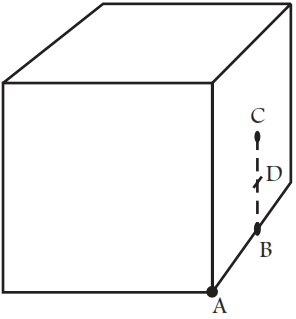
What will be the total flux through the faces of the cube (Fig.) with side of length a if a charge q is placed at:

  1. A: a corner of the cube.
  2. B: mid-point of an edge of the cube.
  3. C: centre of a face of the cube.
  4. D: mid-point of B and C.

A calorimeter contains 50g of water at 50°C. The temperature falls to 45°C in 10 minutes. When the calorimeter contains 100g of water·at 50°0, it takes 18 minutes for the temperature to become 45°C. Find the water equivalent of the calorimeter.
A radioactive isotope has a half-life of T years. How long will it take the activity to reduce to
  1. 3.125%,
  2. 1% of its original value?
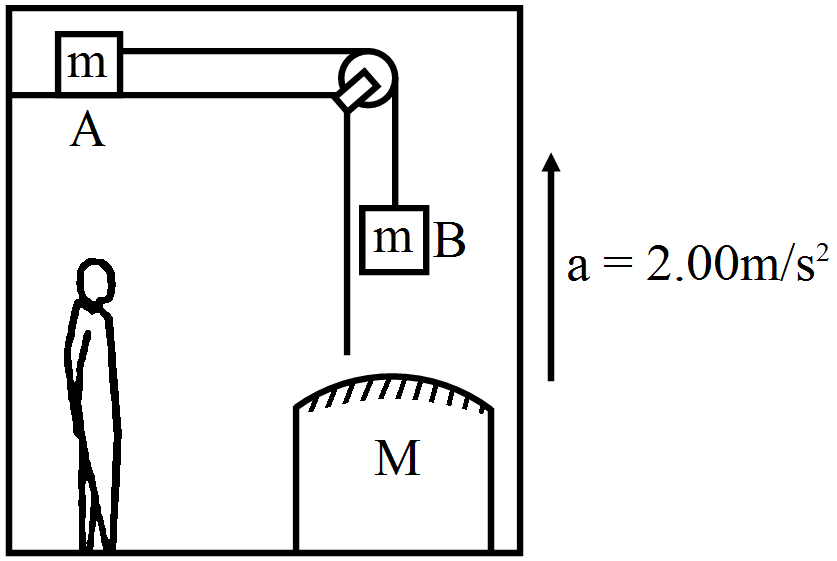
Consider the situation shown in figure. The elevator is going up with an acceleration of 2.00m/s2 and the focal length of the mirror is 12.0cm. All the surfaces are smooth and the pulley is light. The mass-pulley system is released from rest (with respect to the elevator) at t = 0 when the distance of B from the mirror is 42.0cm. Find the distance between the image of the block B and the mirror at t = 0.200s. Take g = 10m/s2.

Two coherent point sources S1 and S2 vibrating in phase emit light of wavelength $\lambda$. The separation between the sources is $2\lambda$. Consider a line passing through S2 and perpendicular to the line S1S2. What is the smallest distance from S2 where a minimum of intensity occurs?
A ball is thrown horizontally from a point 100m above the ground with a speed of 20m/s. Find:
  1. The time it takes to reach the ground.
  2. The horizontal distance it travels before reaching the ground.
  3. The velocity (direction and magnitude) with which it strikes the ground.
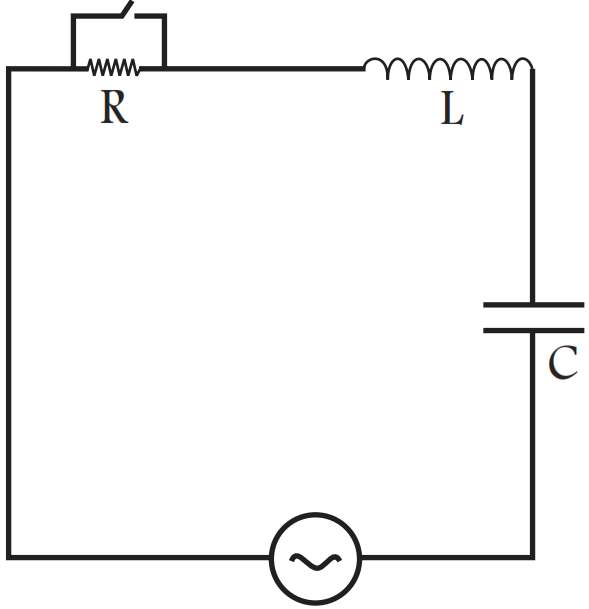
In the LCR circuit shown in Fig, the ac driving voltage is $\text{v}=\text{v}_\text{m}\sin\omega\text{t}$.

  1. Write down the equation of motion for q(t).
  2. At t = t0, the voltage source stops and R is short circuited. Now write down how much energy is stored in each of L and C.
  3. Describe subsequent motion of charges