Question
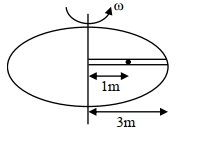
A circular table is rotating with an angular velocity of $\omega \mathrm{rad} / \mathrm{s}$ about its axis (see figure). There is a smooth groove along a radial direction on the table. A steel ball is gently placed at a distance of $1 \mathrm{~m}$ on the groove. All the surface are smooth. If the radius of the table is $3 \mathrm{~m}$, the radial velocity of the ball w.r.t. the table at the time ball leaves the table is $x \sqrt{2} \omega \mathrm{m} / \mathrm{s}$, where the value of $x$ is............
Answer

$a_c=\omega^2 x$

$\frac{v d v}{d x}=\omega^2 x$

$\int_0^v v d v=\int_1^3 \omega^2 x d x$

$\frac{v^2}{2}=\omega^2\left[\frac{x^2}{2}\right]$

$\frac{v^2}{2}=\frac{\omega^2}{2}\left[3^2-1^2\right]$

$v=2 \sqrt{2} \omega$

$x=2$

Need a full question paper?

Generate a complete, print-ready paper with questions like this in minutes — across 16+ boards, with answer keys.

Start Generating Free

Similar questions

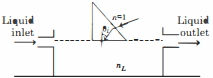
A right-angled isosceles prism is held on the surface of a liquid composed of miscible solvents $A$ and $B$ of refractive index $n_{A}=1.5$ and $n_{B}=1.3$, respectively. The refractive index of prism is $n_{p}=1.5$ and that of the liquid is given by $n_{L}=C_{A} n_{A}+\left(1-C_{A}\right) n_{B}$, where, $C_{A}$ is the percentage of solvent $A$ in the liquid. If $\theta_{C}$ is the critical angle at pris m-liquid interface, the plot which best represents the variation of the critical angle with the percentage of solvent is
Time taken by light to travel in two different materials $A$ and $B$ of refractive indices $\mu_{A}$ and $\mu_{B}$ of same thickness is $t_{1}$ and $t_{2}$ respectively. If $t_{2}-t_{1}=5 \times 10^{-10}$ s and the ratio of $\mu_{A}$ to $\mu_{B}$ is $1: 2$. Then the thickness of material, in meter is: (Given $v_{A}$ and $v_{B}$ are velocities of light in $A$ and $B$ materials respectively).
The angular speed of a fly-wheel making $120\, revolution/minute$ is
An electric kettle takes $4\, A$ current at $220\, V$. How much time will it take to boil $1\, kg$ of water from room temperature $20\,^\circ C$ ? The temperature of boiling water is $100\,^\circ C$ .................. $minutes$
A particle moves along a circle of radius $\left( {\frac{{20}}{\pi }} \right)\,m$ with constant tangential acceleration. If the velocity of the particle is $80 \,m/s$ at the end of the second revolution after motion has begin, the tangential acceleration is
An electron accelerated through a potential difference $V$ enters a uniform transverse magnetic field and experiences a force $F$. If the accelerating potential is increased to $2V$, the electron in the same magnetic field will experience a force
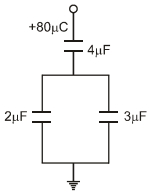
In the given circuit, a charge of $+80 \ \mu C$ is given to the upper plate of the $4 \ \mu F$ capacitor. Then in the steady state, the charge on the upper plate of the $3 \ \mu F$ capacitor is :
A beam of light composed of red and green rays is incident obliquely at a point on the face of a rectangular glass slab. When coming out on the opposite parallel face, the red and green rays emerge from
A particle of mass $500 \,gm$ is moving in a straight line with velocity $v=b x^{5 / 2}$. The work done by the net force during its displacement from $x=0$ to $x =4 \,m$ is ...................$J$ (Take $b =0.25 \,m ^{-3 / 2} s ^{-1}$ )
Given below are two statements:

Statement$- I$ : Susceptibilities of paramagnetic and ferromagnetic substances increase with decrease in temperature.

Statement$- II$: Diamagnetism is a result of orbital motions of electrons developing magnetic moments opposite to the applied magnetic field. Choose the $CORRECT$ answer from the options given below : -