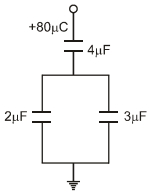
In the given circuit, a charge of $+80 \ \mu C$ is given to the upper plate of the $4 \ \mu F$ capacitor. Then in the steady state, the charge on the upper plate of the $3 \ \mu F$ capacitor is :
IIT 2012, Diffcult


Download our appand get started for free
Experience the future of education. Simply download our apps or reach out to us for more information. Let's shape the future of learning together!No signup needed.*
Similar Questions
- 1How much work is required to carry a $6$ $\mu C$ charge from the negative terminal to the positive terminal of a $9\, V$ batteryView Solution
- 2A capacitor of capacitance $C$ is charged with the help of a $200 \,V$ battery. It is then discharged through a small coil of resistance wire embedded in a thermally insulated block of specific heat capacity $2.5 \times 10^2 \,J / kg$ and mass $0.1 \,kg$. If the temperature of the block rises by $0.4 \,K$, the value of $C$ isView Solution
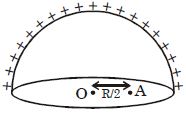
- 3A hemispherical bowl of mass $m$ is uniformly charged with charge density $'\sigma '$ . Electric potential due to charge distribution at a point $'A'$ is (which lies at centre of radius as shown).View Solution
- 4A parallel plate capacitor has plates of area $A$ separated by distance $d$ between them. It is filled with a dielectric which has a dielectric constant that varies as $\mathrm{k}(\mathrm{x})=\mathrm{K}(1+\alpha \mathrm{x})$ where $\mathrm{x}$ is the distance measured from one of the plates. If $(\alpha \text {d)}<<1,$ the total capacitance of the system is best given by the expressionView Solution
- 5A capacitor with capacitance $5\,\mu F$ is charged to $5\,\mu C.$ If the plates are pulled apart to reduce the capacitance to $2\,\mu F,$ how much work is done?View Solution
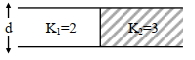
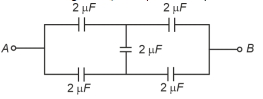
- 6In the following circuit, the equivalent capacitance between terminal $A$and terminal $B$ is :View Solution
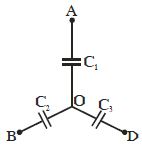
- 7Three uncharged capacitors of capacitance $C_1$, $C_2$ and $C_3$ are connected as shown in figure to one another and to points $A$, $B$ and $D$ at potentials $V_A$, $V_B$ and $V_D$. Then the potential at $O$ will beView Solution
- 8An $\alpha$ particle and a proton are accelerated from rest through the same potential difference. The ratio of linear momenta acquired by above two particals will be.View Solution
- 9The electric potential at a point on the axis of an electric dipole depends on the distance $r$ of the point from the dipole asView Solution
- 10A capacitor of $10 \mu \mathrm{F}$ capacitance whose plates are separated by $10 \mathrm{~mm}$ through air and each plate has area $4 \mathrm{~cm}^2$ is now filled equally with two dielectric media of $\mathrm{K}_1=2, \mathrm{~K}_2=3$ respectively as shown in figure. If new force between the plates is $8 \mathrm{~N}$. The supply voltage is . . . .. . .V.View Solution