Question
$a.$ Derive the expression for the current flowing in an ideal capacitor and its reactance when connected to an ac source of voltage $V = V _{ o } \sin \omega t$.
$b.$ Draw its phasor diagram.
$c.$ If resistance is added in series to capacitor what changes will occur in the current flowing in the circuit and phase angle between voltage and current.

Answer

$a.$ We have $V = V _{ o } \sin \omega t$.
Also, $v =\frac{q}{c} ; q =$ charge on capacitor
$v _0 \sin \omega t=\frac{q}{c}$
or, $q = cv _0 \sin \omega t$
$\therefore I =\frac{d q}{d t}=\frac{d}{d t}\left( CV _0 \sin \omega t\right)= cv _0 \sin \omega t \cdot \omega$
$\therefore I =\frac{ v _0}{\frac{1}{\omega t}} \sin \left(\omega t+\frac{\pi}{2}\right)$
Max. current, $I _{ o }=\frac{ v _o}{1} \times 1$ when $\sin \left(\omega t+\frac{\pi}{2}\right)=1$
Comparing with ohm's law: $I =\frac{V}{R}$ to equation $I _{ o }=\frac{ v _o}{\frac{1}{ uc }}$ 
We have, capacitive reactance, $x _{ C }=\frac{1}{\omega c}$
$b.$ Phasor diagram: 
Image

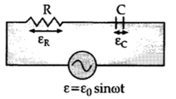
$c.$ A resistor is now connected with the capacitor in series: 
Image

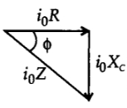
Peak voltage drop across $R$ is $i_0 R$
Peak voltage drop across $C$ is $i_0 X_C$.
Voltage a cross $R$ is in phase with the current.
Voltage across $C$ lags the current by $90^{\circ}$.
So, the voltage drops across $R$ and across $C$ are not in phase.
They are out of phase by $90^{\circ}$.
$\text { So, } \varepsilon_0=\sqrt{\left(i_0 R\right)^2+\left(i_0 X_C\right)^2}$
$\therefore i _0=\frac{V_0}{\sqrt{R^2+X_C^2}}$
The phase angle is
Image

Phase Angle $=\phi=\tan ^{-1} \frac{X_C}{R}$

Need a full question paper?

Generate a complete, print-ready paper with questions like this in minutes — across 16+ boards, with answer keys.

Start Generating Free

Similar questions

Consider a $20W$ bulb emitting light of wavelength $5000\mathring{\text{A}}$ and shining on a metal surface kept at a distance $2\ m$. Assume that the metal surface has work function of $2eV$ and that each atom on the metal surface can be treated as a circular disk of radius $1.5\mathring{\text{A}}$.
  1. Estimate no. of photons emitted by the bulb per second. $[$Assume no other losses$]$
  2. Will there be photoelectric emission?
  3. How much time would be required by the atomc disk to receive energy equal to work function $(2eV)$?
  4. How many photons would atomic disk receive within time duration calculated in $(iii)$  above?
  5. Can you explain how photoelectric effect was observed instantaneously?
Hint: Time calculated in part $(iii)$ is from classical consideration and you may further take the target of surface area say $1\ cm^2$ and estimate what would happen?
  1. Draw a labelled diagram of a moving coil galvanometer. Describe briefly its principle and working.
  2. Answer the following:
  1. Why is it necessary to introduce a cylindrical soft iron core inside the coil of a galvanometer?
  2. Increasing the current sensitivity of a galvanometer may not necessarily increase its voltage sensitivity. Explain, giving reason.
When a dielectric is placed in an electric field, it gets polarized. The electric field in a polarized material is less than the applied field. When a paramagnetic substance is kept in a magnetic field, the field in the substance is more than the applied field. Explain the reason of this opposite behaviour.
Three equal masses m are placed at the three corners of an equilateral triangle of side a. Find the force exerted by this system on another particle of mass m placed at,
  1. The mid-point of a side,
  2. At the centre of the triangle.
An eye can distinguish between two points of an object if they are separated by more than $0.22\ mm$ when the object is placed at $25\ cm$ from the eye. The object is now seen by a compound microscope having a $20D$ objective and $10D$ eyepiece separated by a distance of $20\ cm$. The final image is formed at $25\ cm$ from the eye. What is the minimum separation between two points of the object which can now be distinguished?
A capacitor stores $50\mu\text{C}$ charge when connected across a battery. When the gap between the plates is filled with a dielectric, a charge of $100\mu\text{C}$ flows through the battery. Find the dielectric constant of the material inserted.
Draw the output signals $C_1$ and $C_2$ in the given combination of gates $(Fig.).$
A gas is enclosed in a cylindrical can fitted with a piston. The walls of the can and the piston are adiabatic. The initial pressure, volume and temperature of the gas are $100kPa, 400\ cm^3$ and $300K,$ respectively. The ratio of the specific heat capacities of the gas is $\frac{\text{C}_\text{P}}{\text{C}_\text{V}}=1.5.$ Find the pressure and the temperature of the gas if it is,
  1. Suddenly compressed.
  2. Slowly compressed to $100\ cm^3.$
A compound microscope consists of an objective lens of focal length $2.0 \ cm$ and an eyepiece of focal length $6.25 \ cm$ separated by a distance of $15 \ cm$. How far from the objective should an object be placed in order to obtain the final image at
a.the least distance of distinct vision $(25 \ cm),$ and
$b$. at infinity?
What is the magnifying power of the microscope in each case?
An inductor-coil of resistance $10\Omega$ and induetanes 120mH is connected across a battery of emf 6V and Internal resistance $2\Omega.$ Find the charge which flows through the inductor in:
  1. 10ms
  2. 20ms
  3. 100 ms after the connections are made.