Question
(a) Derive the expression for the magnetic energy stored in a evil.
(b) Derive the expression for the mutual inductance between two plane coils.

Answer

(a) Magnetic Energy Stored in a coil: When a current is established in an inductor (coil) by connected, a source of emf across its ends then an emf is induced in it due to self induction. This emf opposses the rise of current through the coil. Hence work has to be done by the current to get its steady value against the induced emf.
The energy for this work is obtained from the source of emf connected across the coil and this energy is stored as magnetic energy in the coil.
Let dW be the work done in establishing a current I in the coil in time dt.
Then, work $dW = eIdt$, where e is the induced emf
$dW = [L(\frac{dI}{dt})]Idt = LIdI$ ($\because$ $e = L\frac{dI}{dt}$)
Total work done in maintaining a steady current $I_{0}$ in the coil is given by
$W = \int dW = \int_{0}^{I_{0}} LIdI = L[\frac{I^{2}}{2}]_{0}^{I_{0}} = \frac{1}{2}LI_{0}^{2}$
Magnetic Energy stored in the coil :
$U=W \Rightarrow U=\frac{1}{2}LI_{0}^{2}$
(b) Mutual Inductance between two plane coils:
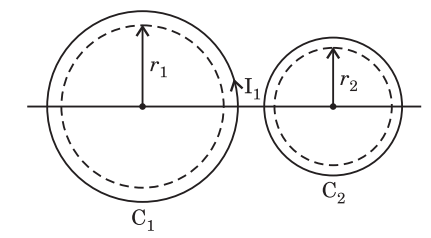
In adjoining figure two plane coils C1 and C2 are kept coaxially near each other. Let N1 be the number of turns in primary and N2 in secondary coil. If I1 current is flowing in primary coil, the magnetic field at the centre of the coil is given by :
Image
$B _1=\frac{\mu_0 N_1 I _1}{2 r_1}$
where $r_1$ is the radius of the primary coil. The magnetic field lines are treating uniformerly into the secondary coil. Hence magnetic flux passing through each turn of secondary coil will be $\Phi_2= B _1 \times A _2$
where $A_2$ = Area of cross-section of secondary coil =
$\pi r_2^2$ in which $r_2$ is the radius of the secondary coil
$\therefore \quad \Phi_2=\left(\frac{\mu_0 N_1 I _1}{2 r_1}\right) \times \pi r_2^2$
or $\Phi_2=\left(\frac{\mu_0 \pi r_2^2}{2 r_1}\right) N _1 I _1$
But coefficient inductance between these two coils is given by
$M =\frac{ N _2 \Phi_2}{ I _1}$
$\therefore \quad M =\frac{ N _2\left(\frac{\mu_0 \pi r_2^2}{2 r_1}\right) \cdot N _1 I _1}{ I _1}$
$\Rightarrow \quad M =\left(\frac{\mu_0 \pi r_2^2}{ 2 r_1}\right) N _1 N _2$ ...(1)
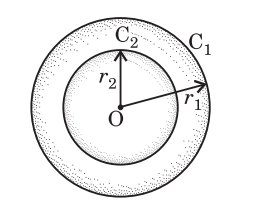
If the two coils are placed concentrically as shown in adjoining figure and $I_1$ be the current passed through coil C1 then magnetic field at the centre of this coil will be given by :
Image
$B _1=\frac{\mu_0 N_1 I _1}{2 r_1}$
where, N1= Number of turns in this coil C1
r₁ = Radius of this coil C1
Since coil C2 is small, the magnetic field B1 may be considered uniform throughout the area of cross-section of C2.
∴ Magnetic flux linked with the coil $C _2$ is given by :
$\Phi_2= B _1 A_2=\frac{\mu_0 N_1 I _1}{2 r_1} \times \pi r_2^2$
$\Rightarrow \quad \Phi_2=\left(\frac{\mu_0 \pi r_2^2}{2 r_1}\right) N _1 I _1$
where, r2 = Radius of inner coil C2.
But coefficient of mutual induction between these two coils is given by :
$M =\frac{ N _2 \Phi_2}{ I _1}=\frac{ N _2\left(\frac{\mu_0 \pi r_2^2}{2 r_1}\right) N _1 I _1}{ I _1}$
$\Rightarrow \quad M =\left(\frac{\mu_0 \pi r_2^2}{ 2 r _1}\right) N _1 N _2$ ...(2)
where, N2 = Number of turns in the inner coil. Thus formula for M is the same as formula (1).
In this way formula for M in both the situation is the same.

Need a full question paper?

Generate a complete, print-ready paper with questions like this in minutes — across 16+ boards, with answer keys.
Start Generating Free

Similar questions

A block of mass $2.0\ kg$ moving at $2.0m/s$ collides head on with another block of equal mass kept at rest.
  1. Find the maximum possible loss in kinetic energy due to the collision.
  2. If the actual loss in kinetic energy is half of this maximum, find the coefficient of restitution.
  1. Using Biot-Savart’s law, derive an expression for the magnetic field at the centre of a circular coil of radius R, number of turns N, carrying current i.
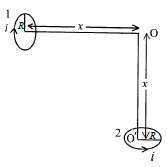
  2. Two small identical circular coils marked 1, 2 carry equal currents and are placed with their geometric axes perpendicular to each other as shown in the figure. Derive an expression for the resultant magnetic field at O.
 
Consider a circular ring of radius r, uniformly charged with linear charge density $\lambda.$ Find the electric potential at a point on the axis at a distance x from the centre of the ring. Using this expression for the potential, find the electric field at this point.
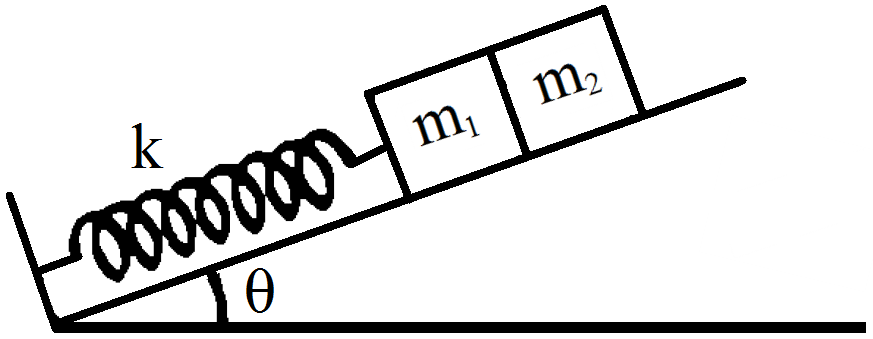
The block of mass $m_1$ shown in figure is fastened to the spring and the block of mass $m_2$ is placed against it.
  1. Find the compression of the spring in the equilibrium position.
  2. The blocks are pushed a further distance $\big(\frac{2}{\text{k}}\big)(\text{m}_1+\text{m}_2)\text{g}\sin\theta$ sine against the spring and released. Find the position where the two blocks separate.
  3. What is the common speed of blocks at the time of separation?
$a$. Derive the expression for the electric potential due to an electric dipole at a point on its axial line.
$b$. Depict the equipotential surfaces due to an electric dipole.
Answer the following question:
The small ozone layer on top of the stratosphere is crucial for human survival. Why?
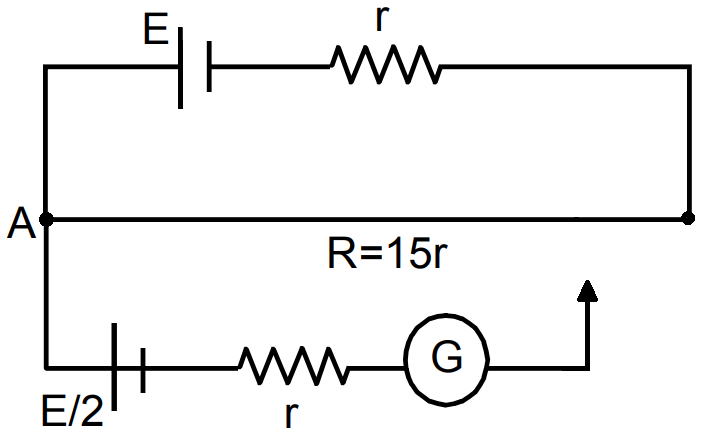
Consider the potentiometer circuit as arranged in the figure. The potentiometer wire is $600\ cm$ long. $(a)$ At what distance from the point $A$ should the jockey touch the wire to get zero deflection in the galvanometer? $(b)$ If the jockey touches the wire at a distance of $560\ cm$ from $A,$ what will be the current in the galvanometer?
When a Coolidge tube is operated for some time it becomes hot. Where does the heat come from?
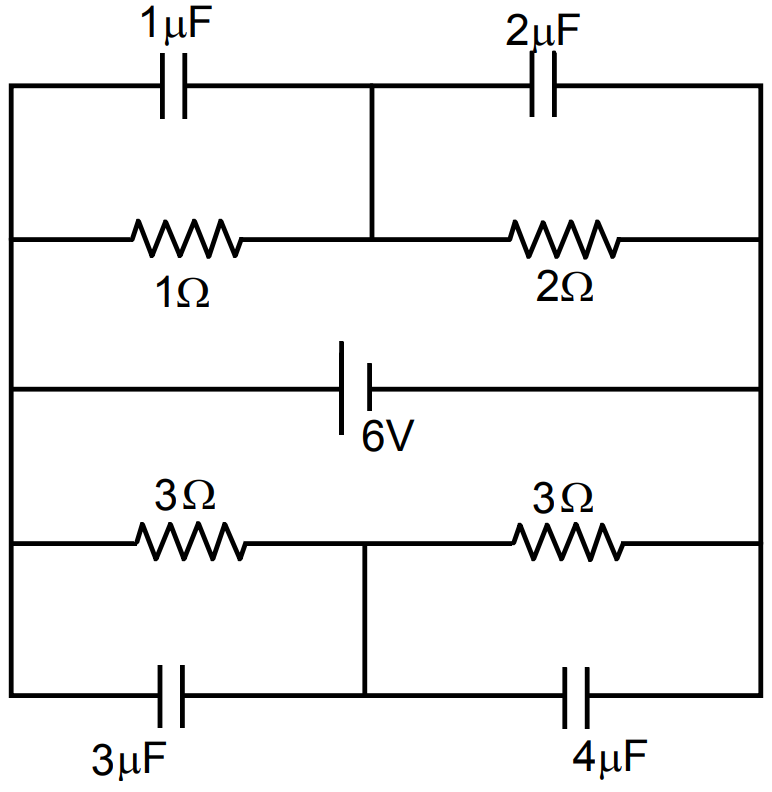
Find the charges on the four capacitors of capacitances $1\mu\text{F},2\mu\text{F},3\mu\text{F}$ and $4\mu\text{F}$ shown in the figure.
A student is studying a book placed near the edge of a circular table of radius $R$. A point source of light is suspended directly above the centre of the table. What should be the height of the source above the table so as to produce maximum illuminance at the position of the book?