Question
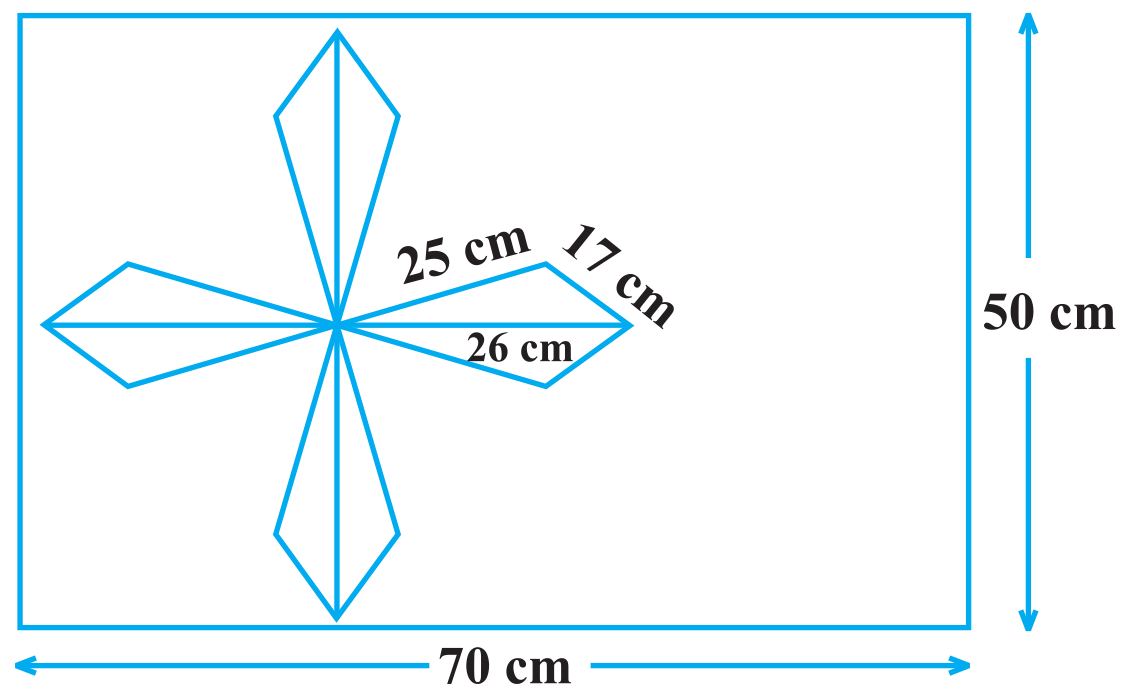
A design is made on a rectangular tile of dimensions 50cm × 70cm as shown in the design shows 8 triangles, each of sides 26cm, 17cm and 25cm. Find the total area of the design and the remaining area of the tile.
Answer

Given, tha dimension of rectangular lile is 50cm × 70cm
Area of rectangular tile = 50 × 70 = 3500cm2
The sides of a design of one triangle be,
a = 25cm, b = 17cm and c = 26cm
Now, semi-perimeter, $\text{s}=\frac{\text{a}+\text{b}+\text{c}}{2}=\frac{25+17+26}{2}=\frac{68}{2}=34$
$\therefore$ Area of one triangle $=\sqrt{\text{s}(\text{s}-\text{a})(\text{s}-\text{b})(\text{s}-\text{c})}$ [by Heron's formula]
$=\sqrt{34\times9\times17\times8}$
$=\sqrt{17\times2\times3\times3\times17\times2\times2\times2}$
$=17\times3\times2\times2=204\text{cm}^2$
$\therefore$ Total area of eight triangles = 204 × 8 = 1632cm
Now, area of the desion = Total area of eight triangles
= 1632cm2
Also, remaining area of the tile = Area of the rectangle - Area of the design
= 3500 - 1632
= 1868cm
Hence, the total area of the design is 1632cm2 and the remaining area of the tile is 1868cm2

Need a full question paper?

Generate a complete, print-ready paper with questions like this in minutes — across 16+ boards, with answer keys.
Start Generating Free

Similar questions

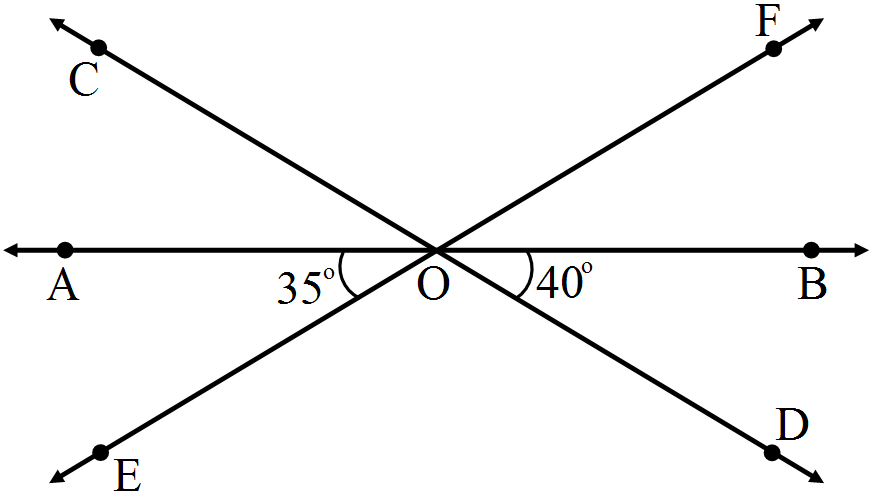
In the given figure, three lines AB, CD and EF intersect at a point O such that $\angle\text{AOE}=35^\circ$ and $\angle\text{BOD}=40^\circ.$ Find the measure of $\angle\text{AOC},\angle\text{BOF},\angle\text{COF}$ and $\angle\text{DOE}.$

Find the cost of sinking a tube well 280m deep, having diameter 3m at the rate of ₹ 3.60 per cubic metre. Find also the cost of cementing its inner curved surface at ₹ 2.50 per square metre.
Find the area of the triangle whose sides are 42cm, 34cm and 20cm in length. Hence, find the height corresponding to the longest side.
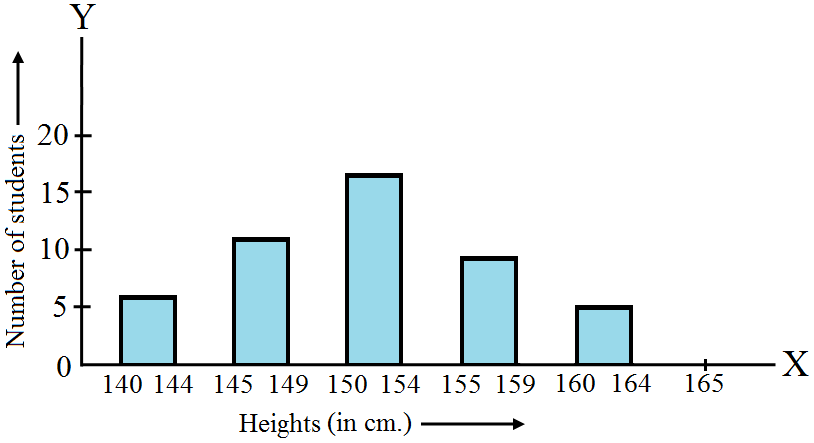
The following bar graph represents the heights (in cm) of 50 students of Class XI of a particular school. Study the graph and answer the following questions:

  1. What percentage of the total number of students have their heights more than 149cm?
  2. How many students in the class are in the range of maximum height of the class?
  3. The school wants to provide a particular type of tonic to each student below the height of 150cm to improve his height. If the cost of the tonic for each student comes out to be Rs. 55, how much amount of money is required?
  4. How many students are in the range of shortest height of the class?
  5. State whether true or false:
  1. There are 9 students in the class whose heights are in the range of 155-159cm.
  2. Maximum height (in cm) of a student in the class is 17.
  3. There are 29 students in the class whose heights are in the range of 145-154cm.
  4. Minimum height (in cm) of a student is the class is in the range of 140-144cms.
  5. The number of students in the class having their heights less than 150cm is 12.
  6. There are 14 students each of whom has height more than 154cm.
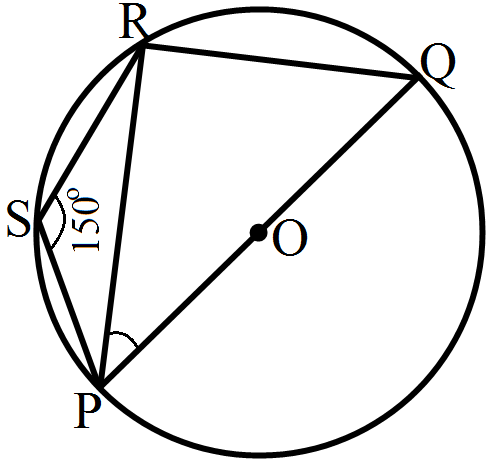
In the given figure, POQ is a diameter and PQRS is a cyclic quadrilateral. If $\angle\text{PSR}=150^\circ,$ find $\angle\text{RPQ}.$

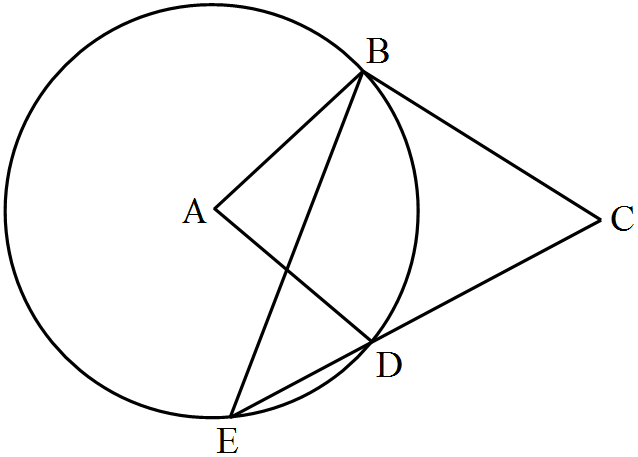
In the given figure, A is the centre of the circle. ABCD is a parallelogram and CDE is a straight line. Find $\angle\text{BCD}:\angle\text{ABE}.$

The table given below shows the ages of 75 teachers in a school.
Age (in years)
18 - 29
30 - 39
40 - 49
50 - 59
Number of teachers
3
27
37
8
A teacher from this school is chosen at random. What is the probability that the selected teacher is:
  1. 40 or more than 40 years old?
  2. Of an age lying between 30 - 39 years (including both)?
  3. 18 years or more and 49 years or less?
  4. 18 years or more old?
  5. Above 60 years of age?
Note: Here 18 - 29 means 18 or more but less than or equal to 29.
Bisectors of interior $\angle\text{B}$ and exterior $\angle\text{ACD}$ of a $\Delta\text{ABC}$ intersect at the point T. Prove that,
$\angle\text{BTC}=\frac{1}{2}\angle\text{BAC}.$
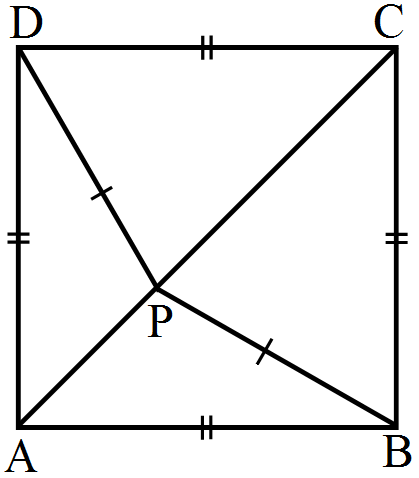
In the given figure, ABCD is a square and P is a point inside it such that PB = PD. Prove that CPA is a straight line.

If $\text{x}+\frac{1}{\text{x}}=3,$ calculate $\text{x}^2+\frac{1}{\text{x}^2},\ \text{x}^3+\frac{1}{\text{x}^3}$ and $\text{x}^4+\frac{1}{\text{x}^4}.$