Question
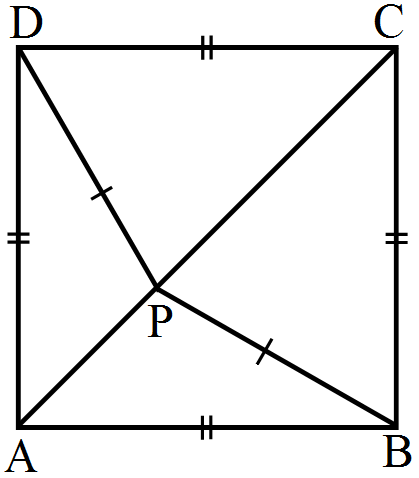
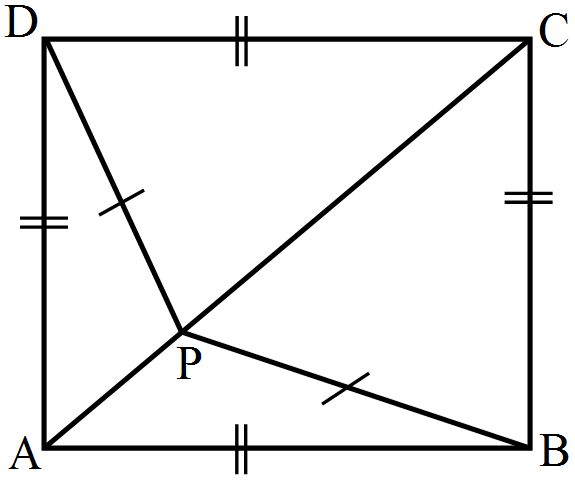
In the given figure, ABCD is a square and P is a point inside it such that PB = PD. Prove that CPA is a straight line.
Answer

Given: ABCD is a sqaure and P is a point inside it such that PB = PD

To Prove: CPA is a straight line.
Proof: In $\triangle\text{APD}$ and $\triangle\text{APB}$
$\text{DA = AB}$ [$\therefore$ ABCD is a square]
$\text{AP = AP}$ [Common]
and, $\text{PB = PD}$ [Given]
Thus by Side-Side-Side criterion of congruence, we have
$\triangle\text{APD}\cong\triangle\text{APB}$
The corresponding parts of the congruent triangles are equal.
$\therefore\angle\text{APD}=\angle\text{APB}...(1)$
Now consider the triangles, $\triangle\text{CPD}$ and $\triangle\text{CPB}.$
$\text{CD = CB}$ [$\therefore$ ABCD is a square]
$\text{CP = CP}$ [Common]
and, $\text{PB = PD}$ [Given]
Thus by Side-Side-Side criterion of congruence, we have
$\triangle\text{CPD}\cong\triangle\text{CPB}$
The corresponding parts of the congruents triangle are equal.
Hence we have
$\angle\text{CPD}=\angle\text{CPB}....(2)$
Adding both sides of (1) and (2) we get
$\angle\text{APD}+\angle\text{CPD}=\angle\text{APB}+\angle\text{CPB}...(3)$
Angles aronud the point P add upto 360°,
$\Rightarrow\angle\text{APD}+\angle\text{CPD}+\angle\text{APB}+\angle\text{CPB}=360^{\circ}$
$\Rightarrow\angle\text{APB}+\angle\text{CPB}=360^{\circ}-(\angle\text{APD}+\angle\text{CPD})...(4)$
Substituting (4) in (3) we get,
$\angle\text{APD}+\angle\text{CPD}=360^{\circ}-(\angle\text{APD}+\angle\text{CPD})$
i.e. $2(\angle\text{APD}+\angle\text{CPD})=360^{\circ}$
$\angle\text{APD}+\angle\text{CPD}=\frac{360}{2}=180^{\circ}$
This proves that CPA is a straight line.

Need a full question paper?

Generate a complete, print-ready paper with questions like this in minutes — across 16+ boards, with answer keys.

Start Generating Free

Similar questions

The perimeter of an isoscale triangle is 42cm and its base is $1\frac{1}{2}$ times each of the equal sides. Find:
  1. The length of each side of the triangle
  2. The area of the triangle
  3. The height of the triangle.
$\big(\text{Given}\sqrt{7}=2.64\big)$
The daily wages of 50 workers in a factory are given below:
Daily wages (in Rs.)
340-380
380-420
420-460
460-500
500-540
540-580
Number of workers
16 
9
12
2
7
4
Construct a histogram to represent the above frequency distribution.
If x3 - 3x2 + 3x - 7 = (x + 1)(ax2 + bx + c), then a + b + c =
  1. 4
  2. 12
  3. -10
  4. 3
Simplify the following products:
$\Big(\frac{\text{x}}{2}-\frac{2}{5}\Big)\Big(\frac{2}{5}-\frac{\text{x}}{2}\Big)-\text{x}^2+2\text{x}$
The factors of x3 - x2y - xy2 + y3 are:
  1. (x + y)(x2 - xy + y2)
  2. (x + y)(x2 + xy + y2)
  3. (x + y)2(x - y)
  4. (x - y)2(x + y)
Find the value of p, when the mean of the following distribution is 20.
x
15
17
19
20 + p
23
f
2
3
4
5p
6
AB and AC are two chords of a circle of radius r such that AB = 2AC. If p and q are the distances of AB and AC from the centre then prove that 4q2 = p2 + 3r2.
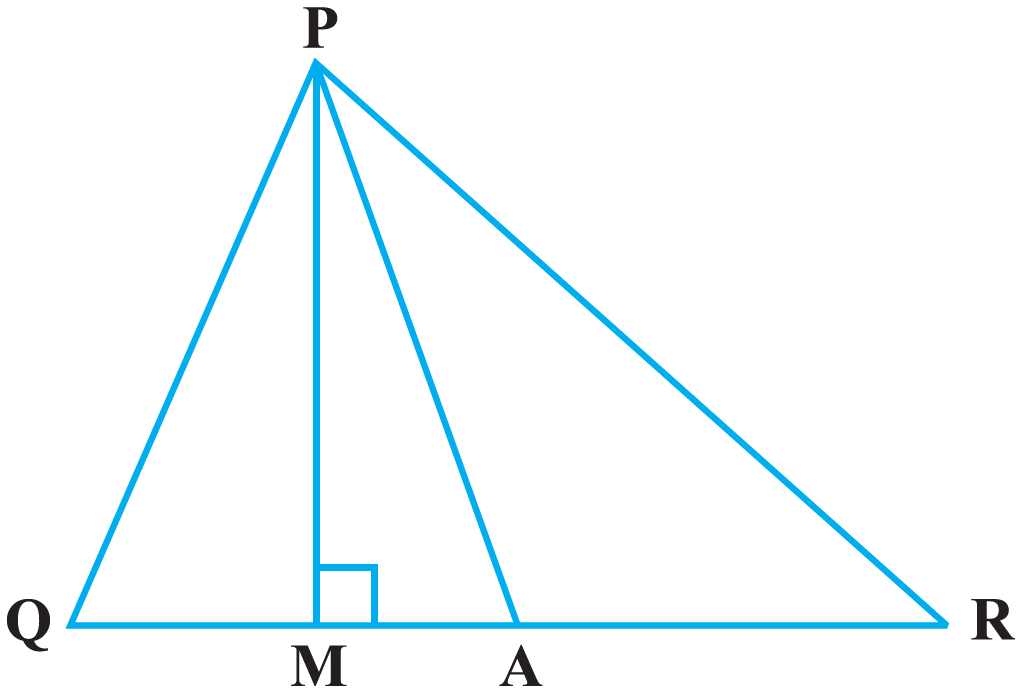
In Fig. $\angle\text{Q}>\angle\text{R},$ PA is the bisector of $\angle\text{QPR}$ and $\text{PM}\perp\text{QR}$ Prove that $\angle\text{APM}=\frac{1}{2}(\angle\text{Q}-\angle\text{R}).$

Show that the quadrilateral formed by joining the midpoints of the pairs of adjacent sides of a square is a square.
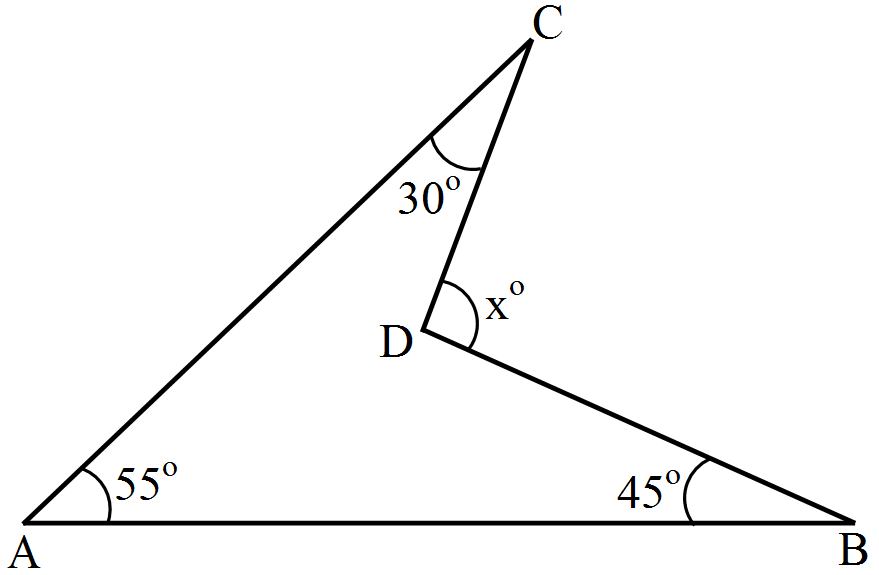
Calculate the value of x in the given figure.