MCQ
A diatomic ideal gas undergoes a thermodynamic change according to the $P-V$ diagram shown in the figure. The heat given the gas in $AB$
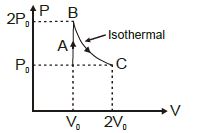
  • $2.5\,\, P_0\,V_0$
  • B
    $1.4\,\, P_0\,V_0$
  • C
    $3.9\,\, P_0\,V_0$
  • D
    $1.1\,\, P_0\,V_0$

Answer

Correct option: A.
$2.5\,\, P_0\,V_0$
a
$\mathrm{AB} \rightarrow \Delta \mathrm{Q}=\mu \mathrm{C}_{\mathrm{v}} \Delta \mathrm{T}$

$=\mu \frac{1}{2} \mathrm{R}\left(2 \mathrm{T}_{0}-\mathrm{T}_{0}\right)$

$=\frac{5}{2} \mathrm{P}_{0} \mathrm{V}_{0}$

Need a full question paper?

Generate a complete, print-ready paper with questions like this in minutes — across 16+ boards, with answer keys.

Start Generating Free

Similar questions

Calculate the relative errors in measurement of mass $1.02\text{g}\pm0.01\text{g}$ and $9.89\text{g}\pm0.01\text{g}$
Five moles of helium are mixed with two moles of hydrogen to form a mixture. Take molar mass of helium $M_1=4\ g$ and that of hydrogen $M_2=2\ g$ The equivalent molar mass of the mixture is 
A particle which is constrained to move along the $x-$axis, is subjected to a force in the same direction which varies with the distance $x$ of the particle from the origin as $F(x) = - kx + a{x^3}$. Here k and a are positive constants. For $x \ge 0$, the functional from of the potential energy $U(x)$ of the particle is
A cylinder made of perfectly non conducting material closed at both ends is divided into two equal parts by a heat proof piston. Both parts of the cylinder contain the same masses of a gas at a temperature $t_0 = 27^o$ and pressure $P_0 = 1$ atm. Now if the gas in one of the parts is slowly heated to $t = 57^oC$ while the temperature of first part is maintained at $t_0$ the distance moved by the piston from the middle of the cylinder will be.... $cm$ (length of the cylinder $= 84\,\, cm$)
The displacement due to a wave moving in the positive $x-$direction is given by $y = \frac{1}{{(1 + {x^2})}}$ at time $t = 0$ and by $y = \frac{1}{{[1 + {{(x - 1)}^2}]}}$ at $t = 2$ seconds, where $x$ and $y$ are in metres. The velocity of the wave in $m/s$ is
Which one of the following graph for a body moving along a straight line is possible?
Position $x$ of a particle at any instant is related with velocity as $v = \sqrt {2x + 9}$ . The particle starts from origin. Then initial acceleration and velocity are
The wettability of a surface by a liquid depends primarily on
A person sitting in the ground floor of a building notices through the window, of height $1.5 \;m ,$ a ball dropped from the roof of the building crosses the window in $0.1 \;s$. What is the velocity (In $m/s$) of the ball when it is at the topmost point of the window $?\left( g =10\, m / s ^{2}\right)$
A car of mass $m$ starts from rest and acquires a velocity along east $\text{v}=\text{v}\hat{\text{i}}(\text{v}>\text{0})$ in two seconds. Assuming the car moves with uniform acceleration, the force exerted on the car is: