Question
A dietician has to develop a special diet using two foods P and Q. Each packet (containing 30g) of food P contains 12 units of calcium, 4 units of iron, 6 units of cholesterol and 6 units of vitamin A. Each packet of the same quantity of food Q contains 3 units of calcium, 20 units of iron, 4 units of cholesterol and 3 units of vitamin A. The diet requires atleast 240 units of calcium, atleast 460 units of iron and at most 300 units of cholesterol. How many packets of each food should be used to minimise the amount of vitamin A in the diet? What is the minimum Amount of vitamin A.
Answer

Let x packets of food P and y packets of food Q be used to make the diet.
Each packet of food P contains 6 units of vitamin A and each packet of food Q contains 3 units of vitamin A.
Therefore, x packets of food P and y packets of food Q contains (6x + 3y) units of vitamin A.
Since each packet of food P contains 12 units of calcium and each packet of food Q contains 3 units of calcium, therefore, x packets food P and y packets of food Q will contain (12x + 4y) units of calcium.
But, the diet should contain atleast 240 units of calcium.
$\therefore12\text{x}+3\text{y}\geq240$
$\Rightarrow4\text{x}+\text{y}\geq80$
Similarly, x packets of food P and y packets of food Q will contain (4x + 207) units of iron. But, the diet should contain atleast 460 units of iron.
$\therefore4\text{x}+20\text{y}\geq460$
$\Rightarrow\text{x}+5\text{y}\geq115$
Also, x packets of food P and y packets of food Q will contain (6x + 4y) units of cholesterol.
But, the diet should contain atmost 300 units of cholesterol.
$\therefore6\text{x}+4\text{y}\leq300$
$3\text{x}+2\text{y}\leq150$
Thus, the given linear programming problem is
Minimise Z = 6x + 3y
subject to the constraints
$4\text{x}+\text{y}\geq80$
$\text{x}+5\text{y}\geq115$
$3\text{x}+2\text{y}\leq150$
$\text{x},\text{y}\geq0$
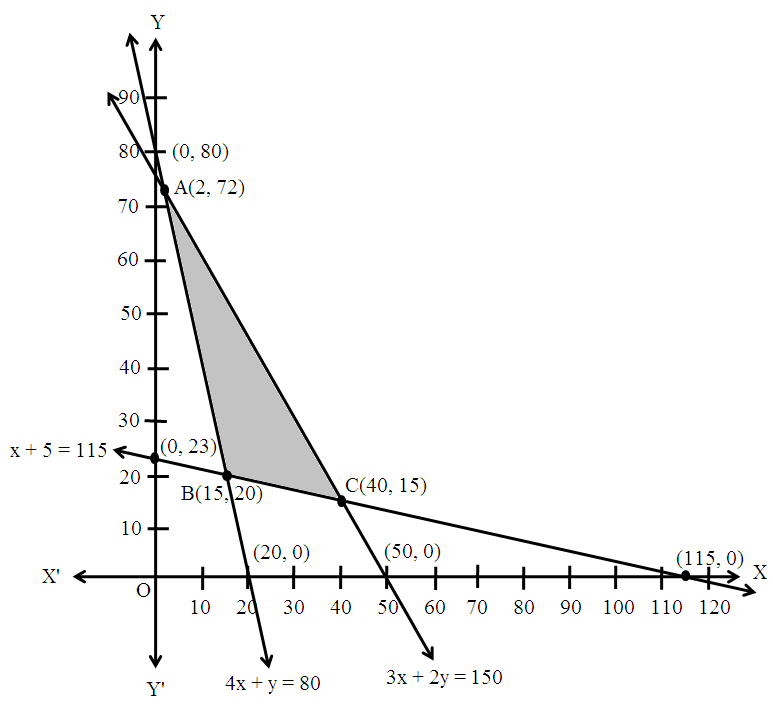
The feasible region determined by the given constraints can be diagrammatically represented as,

The coordinates of the corner points of the feasible region are A(2, 72), B(15, 20) and C(40, 15).
The value of the objective function at these points are given in the following table.
Corner Point
Z = 6x + 3y
(2, 72)
6 × 0 + 3 × 72 = 216
(15, 20)
6 × 15 + 3 × 20 = 150
(40, 15) 6 × 40 + 3 × 15 = 285
The smallest value of Z is 150 which is obtained at x = 15 and y = 20.
It can be verified that the open half-plane represented by $6\text{x}+3\text{y}\leq150$ has no common points with the feasible region.
Thus, 15 packets of food P and 20 packets of food Q should be used to minimise the amount of vitamin A in the diet.
Hence, the minimum amount of vitamin A is 150 units.

Need a full question paper?

Generate a complete, print-ready paper with questions like this in minutes — across 16+ boards, with answer keys.

Start Generating Free

Similar questions

Solve the following determinant equations:
$\begin{vmatrix}1&1&\text{x}\\\text{p}+1&\text{p}+1&\text{p}+\text{x}\\3&\text{x}+1&\text{x}+2\end{vmatrix}=0$
If $\text{x}=\text{a}\sec\theta,\text{y}=b\tan\theta$ prove that $\frac{\text{d}^2\text{y}}{\text{dx}^2}=-\frac{\text{b}^4}{\text{a}^2\text{y}^3}$
A firm has to transport at least 1200 packages daily using large vans which carry 200 packages each and small vans which can take 80 packages each. The cost of engaging each large van is Rs 400 and each small van is Rs 200. Not more than Rs 3000 is to be spent daily on the job and the number of large vans cannot exceed the number of small vans. Formulate this problem as a LPP given that the objective is to minimize cost.
For the matrix $\text{A}=\begin{bmatrix}1 & -1 & 1 \\2 & 3 & 0 \\ 18 & 2 & 10 \end{bmatrix},$ show that A (adjoint A) = 0.
A pair of dice is thrown. Let E be the event that the sum is greater than or equal to 10 and F be the event "5 appears on the first-die". Find $\text{P}\Big(\frac{\text{E}}{\text{F}}\Big)$. If F is the event "5 appears on at least one die", find $\text{P}\Big(\frac{\text{E}}{\text{F}}\Big)$.
If $\text{x}=\text{a}(\cos\text{t}+\text{t}\sin\text{t})\ \text{and}\ \text{y}=\text{a}(\sin\text{t}-\text{t}\cos\text{t}),$ find the value of $\frac{\text{d}^2\text{y}}{\text{dx}^2}\ \text{at}\ \text{t}=\frac{\pi}{4}.$
Solve the following systems of linear equations by cramer's rule:
2x - y = 17,
3x + 5y = 6
Evaluate the following intregals: $\int\frac{\text{x}}{(\text{x}^2-\text{a}^2)(\text{x}^2-\text{b}^2)}\ \text{dx}$
If $\text{f}\text{(x)}=\begin{cases}\frac{1-\cos\text{kx}}{\text{x}\sin\text{x}}, & \text{x} \neq 0\\\frac{1}{2}, & \text{x}= 0\end{cases}$ is continuous at x = 0. find k.
If $\text{x}=\text{a}(\cos\theta+\theta\sin\theta),\text{y}=\text{a}(\sin\theta-\theta\cos\theta)$ prove that $\frac{\text{d}^2\text{x}}{\text{d}\theta^2}=\text{a}(\cos\theta-\theta\sin\theta),\frac{\text{d}^2}{\text{d}\theta^2}$ $=\text{a}(\sin\theta-\theta\cos\theta)\ \text{and}\ \frac{\text{d}^2\text{y}}{\text{dx}^2}=\frac{\sec^3\theta}{\text{a}\theta}$