Question 15 Marks
There are two types of fertilisers 'A' and 'B'. 'A' consists of 12 % nitrogen and 5 % phosphoric acid whereas 'B' consists of 4 % nitrogen and 5 % phosphoric acid. After testing the soil conditions, farmer finds that he needs at least 12 kg of nitrogen and 12 kg of phosphoric acid for his crops. If 'A' costs 10 per kg and 'B' cost 8 per kg, then graphically determine how much of each type of fertiliser should be used so that nutrient requirements are met at a minimum cost.
Answer
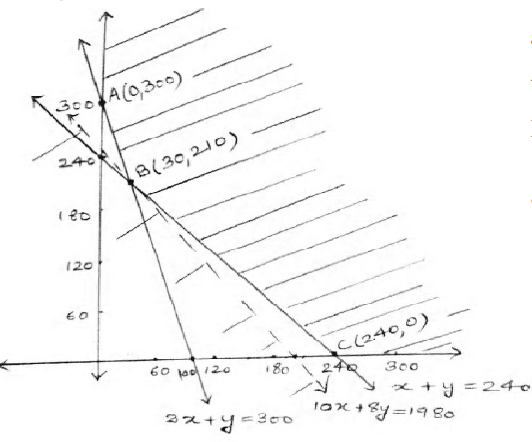 Let x kg of fertiliser A be used
and y kg of fertiliser B be used
then the linear programming problem is:
Minimise cost: $\text{z = 10x + 8y}$
Subject to $ \begin{matrix} \frac{12\text{x}}{100} + \frac{\text{4y}}{100} \geq12\Rightarrow\text{3x + y}\geq300 \\ \frac{\text{5x}}{100} + \frac{\text{5y}}{100}\geq12\Rightarrow \text{x + y} \geq 240 \\ \text{x, y}\geq0 \end{matrix} $
Value of Z at corners of the unbounded region ABC:
$ \begin{matrix} \frac{\text{Corner}}{\text{A(0, 300)}} & \frac{\text{Value of Z}}{2400} \\ \text{B(30,210)} & \text{1980 (Minimum)} \\ \text{C (240, 0)} & 2400 \end{matrix} $
The region of $\text{10x + 8y < 1980 or 5x + 4y < 990}$ has no point in common to the feasible region. Hence, minimum cost $\text{= 1980 at x = 30 and y = 210}$ View full question & answer→Question 25 Marks
A trust invested some money in two type of bonds. The first bond pays 10% interest and bond pays 12% interest. The trust received 2,800 as interest. However, if trust had interchanged money in bonds, they would have got 100 less as interest. Using matrix method, find the amount invested by the trust. Which value is reflected in this question?
Answerlet ₹ x be invested in first bond and, ₹ y be invested in second bond then in the system of equations is:$\begin{matrix} \frac{10\text{x}}{100} + \frac{12\text{y}}{100} = 2800 & \\ \frac{\text{12x}}{100} + \frac{10\text{y}}{100} = 2700 & \\ \end{matrix}\Rightarrow\begin{matrix} \text{5x + 6y = 140000}\\ \text{6x + 5y = 135000}\\ \end{matrix}$
$\text{let A} = \begin{bmatrix} 5 & 6 \\ 6 & 5 \\ \end{bmatrix} ;\text{X} = \begin{bmatrix} \text{x} \\ \text{y} \\ \end{bmatrix};\text{B} = \begin{bmatrix} \text{140000} \\ \text{135000} \\ \end{bmatrix} $
$|\text{A}| = -11; \text{A}^{-1} =\frac{1}{-11} \begin{bmatrix} 5& -6 \\ -6& 5 \\ \end{bmatrix} $
$\therefore \text{Solution is X = A}^{-1}\text{B} \Rightarrow \begin{bmatrix} \text{x} \\ \text{y} \\ \end{bmatrix} = \frac{1}{-11} \begin{bmatrix} 5& -6 \\ -6& 5 \\ \end{bmatrix} \begin{bmatrix} \text{140000} \\ \text{135000} \\ \end{bmatrix} = \begin{bmatrix} \text{10000} \\ \text{15000} \\ \end{bmatrix}$
$ \therefore\text{x = 10000, y = 15000,}\therefore\text{Amount invested} =\text{₹ } 25000 $
Value: caring elders
View full question & answer→Question 35 Marks
There are 2 families A and B. There are 4 men, 6 women and 2 children in family A, and 2 men, 2 women and 4 children in family B. The recommended daily amount of calories is 2400 for men, 1900 for women, 1800 for children and 45 grams of proteins for men, 55 grams for women and 33 grams for children. Represent the above information using matrices. Using matrix multiplication, calculate the total requirement of calories and proteins for each of the 2 families. What awareness can you create among people about the balanced diet from this question?
Answer$ \begin{matrix} \text{Family} &\text{A} & \Rightarrow \\ \text{Family} & \text{B} & \Rightarrow \\ \end{matrix} \begin{bmatrix} 4 & 6 & 2 \\ 2 & 2 & 4 \\ \end{bmatrix} \begin{bmatrix} 2400 & 45 \\ 1900 & 55 \\ 1800 & 33 \end{bmatrix} $
Writing Matrix Multiplication as $ \begin{bmatrix} 24600 & 576 \\ 15800 & 332 \\ \end{bmatrix} $
Writing about awareness of balanced diet.
View full question & answer→Question 45 Marks
Solve the following linear programming problem graphically.Minimise $\text{z = 3x + 5y}$
subject to the constraints
$\text{x + 2y}\geq 10$
$\text{x + y}\geq 6$
$\text{3x + y}\geq 8$
$\text{x, y}\geq 0.$
Answer
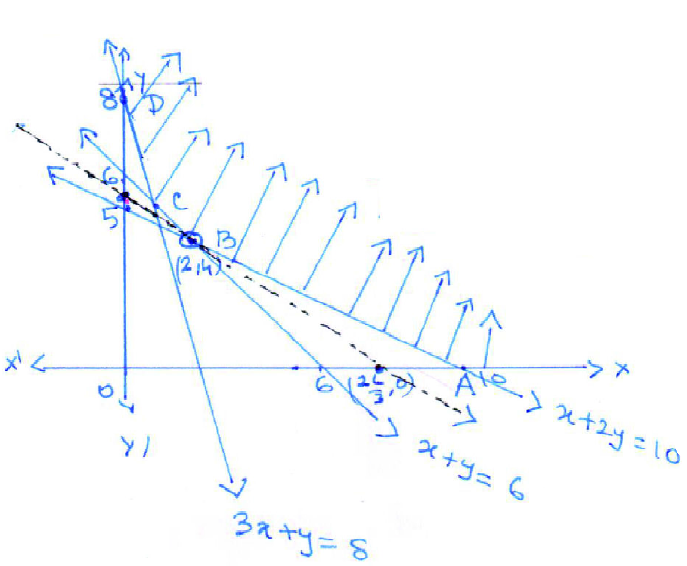
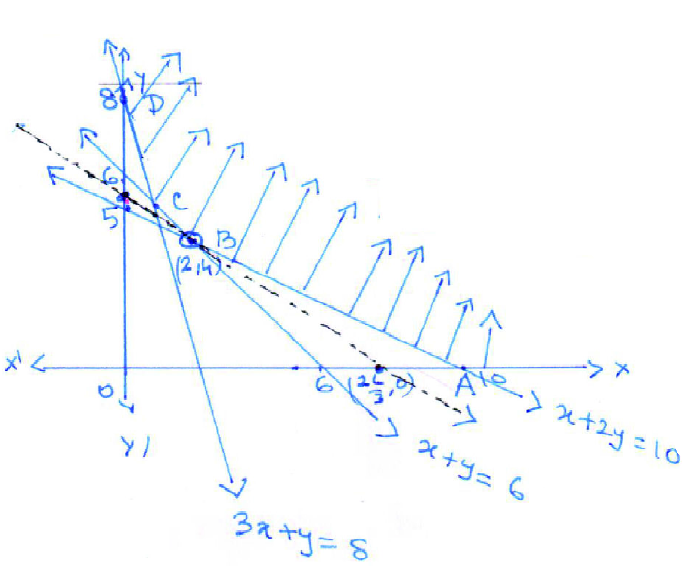 Vertices are A (10, 0), 2, 4 ), C(1, 5) & D (0, 8)$\text{Z = 3 x + 5y}$ is minimum
at B (2, 4) and the minimum Value is 26.
on Ploting $\text{(3x + 5y < 26)}$
since these it no common point with the feasible
region, Hence, $\text{x = 2, y = 4}$ gives minimum Z View full question & answer→Question 55 Marks
Solve the following linear programming problem graphically:
Maximise Z = 7x + 10y
subject to the constraints
4x + 6y $\leq$ 240
6x + 3y $\leq$ 240
x $\geq$ 10
x $\geq$ 0, y $\geq$ 0
Answer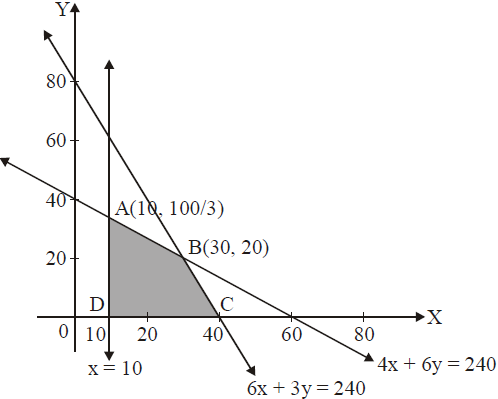
Maximise z = 7x + 10y, subject to 4x + 6y $\leq$ 240;
6x + 3y $\leq$ 240; x $\geq$ 10, x $\geq$ 0, y $\geq$ 0
Correct graph of three lines
For correct shading
$\text{Z}(\text{A})=\text{Z}\Big(10,\frac{200}{6}\Big)=70+10\times\frac{100}{3}=403\frac{1}{3}$
Z(B) = Z(30, 20) = 210 + 200 = 410
Z(C) = Z(40, 0) = 280 + 0 = 280
Z(D) = Z(10, 0) = 70 + 0 = 70
⇒ Max (= 410) at x = 30, y = 20 View full question & answer→Question 65 Marks
A trust invested some money in two type of bonds. The first bond pays 10% interest and bond pays 12% interest. The trust received 2,800 as interest. However, if trust had interchanged money in bonds, they would have got 100 less as interest. Using matrix method, find the amount invested by the trust. Which value is reflected in this question?
Answerlet ₹ x be invested in first bond and, ₹ y be invested in second bond then in the system of equations is:$\begin{matrix} \frac{10\text{x}}{100} + \frac{12\text{y}}{100} = 2800 & \\ \frac{\text{12x}}{100} + \frac{10\text{y}}{100} = 2700 & \\ \end{matrix}\Rightarrow\begin{matrix} \text{5x + 6y = 140000}\\ \text{6x + 5y = 135000}\\ \end{matrix}$
$\text{let A} = \begin{bmatrix} 5 & 6 \\ 6 & 5 \\ \end{bmatrix} ;\text{X} = \begin{bmatrix} \text{x} \\ \text{y} \\ \end{bmatrix};\text{B} = \begin{bmatrix} \text{140000} \\ \text{135000} \\ \end{bmatrix} $
$|\text{A}| = -11; \text{A}^{-1} =\frac{1}{-11} \begin{bmatrix} 5& -6 \\ -6& 5 \\ \end{bmatrix} $
$\therefore \text{Solution is X = A}^{-1}\text{B} \Rightarrow \begin{bmatrix} \text{x} \\ \text{y} \\ \end{bmatrix} = \frac{1}{-11} \begin{bmatrix} 5& -6 \\ -6& 5 \\ \end{bmatrix} \begin{bmatrix} \text{140000} \\ \text{135000} \\ \end{bmatrix} = \begin{bmatrix} \text{10000} \\ \text{15000} \\ \end{bmatrix}$
$ \therefore\text{x = 10000, y = 15000,}\therefore\text{Amount invested} =\text{₹ } 25000 $
Value: caring elders
View full question & answer→Question 75 Marks
There are two types of fertilisers 'A' and 'B'. 'A' consists of 12 % nitrogen and 5 % phosphoric acid whereas 'B' consists of 4 % nitrogen and 5 % phosphoric acid. After testing the soil conditions, farmer finds that he needs at least 12 kg of nitrogen and 12 kg of phosphoric acid for his crops. If 'A' costs 10 per kg and 'B' cost 8 per kg, then graphically determine how much of each type of fertiliser should be used so that nutrient requirements are met at a minimum cost.
Answer
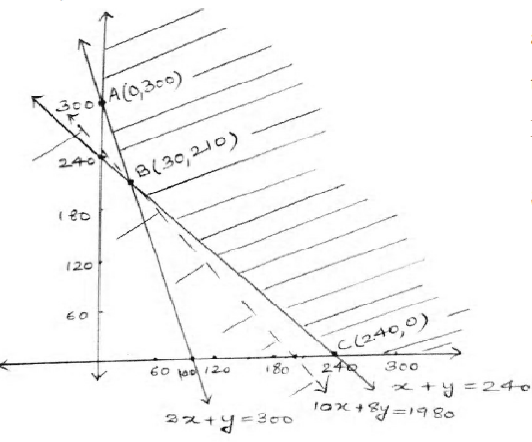 Let x kg of fertiliser A be used
and y kg of fertiliser B be used
then the linear programming problem is:
Minimise cost: $\text{z = 10x + 8y}$
Subject to $ \begin{matrix} \frac{12\text{x}}{100} + \frac{\text{4y}}{100} \geq12\Rightarrow\text{3x + y}\geq300 \\ \frac{\text{5x}}{100} + \frac{\text{5y}}{100}\geq12\Rightarrow \text{x + y} \geq 240 \\ \text{x, y}\geq0 \end{matrix} $
Value of Z at corners of the unbounded region ABC:
$ \begin{matrix} \frac{\text{Corner}}{\text{A(0, 300)}} & \frac{\text{Value of Z}}{2400} \\ \text{B(30,210)} & \text{1980 (Minimum)} \\ \text{C (240, 0)} & 2400 \end{matrix} $
The region of $\text{10x + 8y < 1980 or 5x + 4y < 990}$ has no point in common to the feasible region. Hence, minimum cost $\text{= 1980 at x = 30 and y = 210}$ View full question & answer→Question 85 Marks
Solve the following linear programming problem graphically.Minimise $\text{z = 3x + 5y}$
subject to the constraints
$\text{x + 2y}\geq 10$
$\text{x + y}\geq 6$
$\text{3x + y}\geq 8$
$\text{x, y}\geq 0.$
Answer
 Vertices are A (10, 0), 2, 4 ), C(1, 5) & D (0, 8)$\text{Z = 3 x + 5y}$ is minimum
at B (2, 4) and the minimum Value is 26.
on Ploting $\text{(3x + 5y < 26)}$
since these it no common point with the feasible
region, Hence, $\text{x = 2, y = 4}$ gives minimum Z View full question & answer→Question 95 Marks
There are 2 families A and B. There are 4 men, 6 women and 2 children in family A, and 2 men, 2 women and 4 children in family B. The recommended daily amount of calories is 2400 for men, 1900 for women, 1800 for children and 45 grams of proteins for men, 55 grams for women and 33 grams for children. Represent the above information using matrices. Using matrix multiplication, calculate the total requirement of calories and proteins for each of the 2 families. What awareness can you create among people about the balanced diet from this question?
Answer$ \begin{matrix} \text{Family} &\text{A} & \Rightarrow \\ \text{Family} & \text{B} & \Rightarrow \\ \end{matrix} \begin{bmatrix} 4 & 6 & 2 \\ 2 & 2 & 4 \\ \end{bmatrix} \begin{bmatrix} 2400 & 45 \\ 1900 & 55 \\ 1800 & 33 \end{bmatrix} $
Writing Matrix Multiplication as $ \begin{bmatrix} 24600 & 576 \\ 15800 & 332 \\ \end{bmatrix} $
Writing about awareness of balanced diet.
View full question & answer→Question 105 Marks
Solve the following linear programming problem graphically :
Maximise Z = 34x + 45y
under the following constraints
x + y $\leq$ 300
2x + 3y$\leq$ 70
x $\geq$ 0, y $\geq$ 0
Answer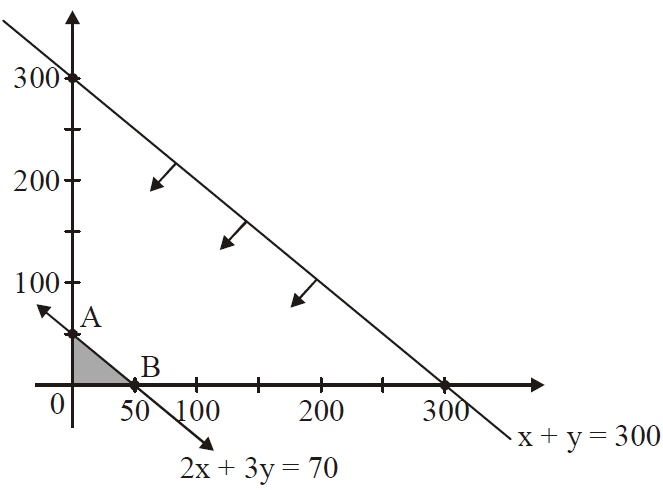
Maximise: z = 34x + 45y subject to x + y $\leq$ 300,
2x + 3y $\leq$ 70, x $\geq$ 0, y $\geq$ 0
Plotting the two lines.
Correct shading
$\text{Z(A)}=\text{Z}\Big(0,\frac{70}{3}\Big)=1050$
$\text{Z(B)}=\text{Z}(35,0)=1190$
⇒ max (1190) at x = 35, y = 0. View full question & answer→Question 115 Marks
A trust invested some money in two type of bonds. The first bond pays 10% interest and bond pays 12% interest. The trust received 2,800 as interest. However, if trust had interchanged money in bonds, they would have got 100 less as interest. Using matrix method, find the amount invested by the trust. Which value is reflected in this question?
Answerlet ₹ x be invested in first bond and, ₹ y be invested in second bond then in the system of equations is:$\begin{matrix} \frac{10\text{x}}{100} + \frac{12\text{y}}{100} = 2800 & \\ \frac{\text{12x}}{100} + \frac{10\text{y}}{100} = 2700 & \\ \end{matrix}\Rightarrow\begin{matrix} \text{5x + 6y = 140000}\\ \text{6x + 5y = 135000}\\ \end{matrix}$
$\text{let A} = \begin{bmatrix} 5 & 6 \\ 6 & 5 \\ \end{bmatrix} ;\text{X} = \begin{bmatrix} \text{x} \\ \text{y} \\ \end{bmatrix};\text{B} = \begin{bmatrix} \text{140000} \\ \text{135000} \\ \end{bmatrix} $
$|\text{A}| = -11; \text{A}^{-1} =\frac{1}{-11} \begin{bmatrix} 5& -6 \\ -6& 5 \\ \end{bmatrix} $
$\therefore \text{Solution is X = A}^{-1}\text{B} \Rightarrow \begin{bmatrix} \text{x} \\ \text{y} \\ \end{bmatrix} = \frac{1}{-11} \begin{bmatrix} 5& -6 \\ -6& 5 \\ \end{bmatrix} \begin{bmatrix} \text{140000} \\ \text{135000} \\ \end{bmatrix} = \begin{bmatrix} \text{10000} \\ \text{15000} \\ \end{bmatrix}$
$ \therefore\text{x = 10000, y = 15000,}\therefore\text{Amount invested} =\text{₹ }25000 $
Value: caring elders
View full question & answer→Question 125 Marks
There are two types of fertilisers 'A' and 'B'. 'A' consists of 12 % nitrogen and 5 % phosphoric acid whereas 'B' consists of 4 % nitrogen and 5 % phosphoric acid. After testing the soil conditions, farmer finds that he needs at least 12 kg of nitrogen and 12 kg of phosphoric acid for his crops. If 'A' costs 10 per kg and 'B' cost 8 per kg, then graphically determine how much of each type of fertiliser should be used so that nutrient requirements are met at a minimum cost.
Answer
 Let x kg of fertiliser A be used
and y kg of fertiliser B be used
then the linear programming problem is:
Minimise cost: $\text{z = 10x + 8y}$
Subject to $ \begin{matrix} \frac{12\text{x}}{100} + \frac{\text{4y}}{100} \geq12\Rightarrow\text{3x + y}\geq300 \\ \frac{\text{5x}}{100} + \frac{\text{5y}}{100}\geq12\Rightarrow \text{x + y} \geq 240 \\ \text{x, y}\geq0 \end{matrix} $
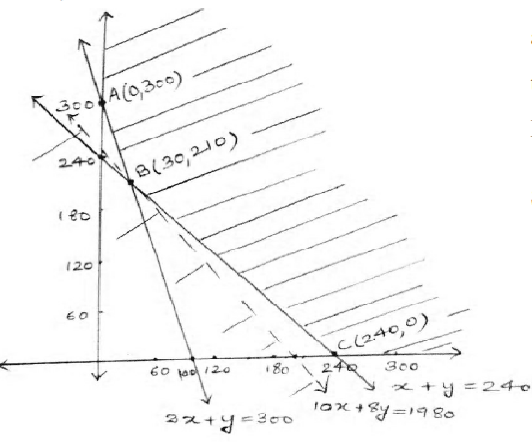
Value of Z at corners of the unbounded region ABC:
$ \begin{matrix} \frac{\text{Corner}}{\text{A(0, 300)}} & \frac{\text{Value of Z}}{2400} \\ \text{B(30,210)} & \text{1980 (Minimum)} \\ \text{C (240, 0)} & 2400 \end{matrix} $
The region of $\text{10x + 8y < 1980 or 5x + 4y < 990}$ has no point in common to the feasible region. Hence, minimum cost $\text{= 1980 at x = 30 and y = 210}$ View full question & answer→Question 135 Marks
Solve the following linear programming problem graphically.Minimise $\text{z = 3x + 5y}$
subject to the constraints
$\text{x + 2y}\geq 10$
$\text{x + y}\geq 6$
$\text{3x + y}\geq 8$
$\text{x, y}\geq 0.$
Answer
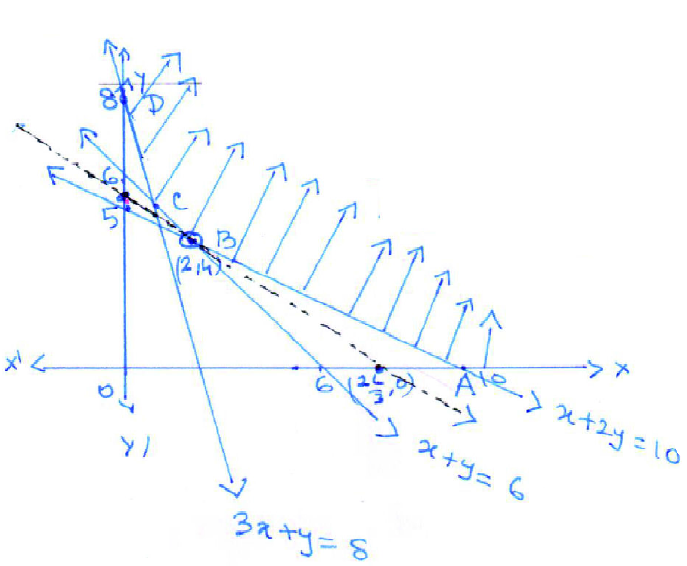 Vertices are A (10, 0), 2, 4 ), C(1, 5) & D (0, 8)$\text{Z = 3 x + 5y}$ is minimum
at B (2, 4) and the minimum Value is 26.
on Ploting $\text{(3x + 5y < 26)}$
since these it no common point with the feasible
region, Hence, $\text{x = 2, y = 4}$ gives minimum Z View full question & answer→Question 145 Marks
There are 2 families A and B. There are 4 men, 6 women and 2 children in family A, and 2 men, 2 women and 4 children in family B. The recommended daily amount of calories is 2400 for men, 1900 for women, 1800 for children and 45 grams of proteins for men, 55 grams for women and 33 grams for children. Represent the above information using matrices. Using matrix multiplication, calculate the total requirement of calories and proteins for each of the 2 families. What awareness can you create among people about the balanced diet from this question?
Answer$ \begin{matrix} \text{Family} &\text{A} & \Rightarrow \\ \text{Family} & \text{B} & \Rightarrow \\ \end{matrix} \begin{bmatrix} 4 & 6 & 2 \\ 2 & 2 & 4 \\ \end{bmatrix} \begin{bmatrix} 2400 & 45 \\ 1900 & 55 \\ 1800 & 33 \end{bmatrix} $
Writing Matrix Multiplication as $ \begin{bmatrix} 24600 & 576 \\ 15800 & 332 \\ \end{bmatrix} $
Writing about awareness of balanced diet.
View full question & answer→Question 155 Marks
Maximise Z = x + 2y
subject to the constraints
$\text{x + 2y} \geq 100\\ \text{2x - y} \leq 0\\ \text{2x + y} \leq 200\\ \text{x, y} \geq 0$
Solve the above LPP graphically.
Answer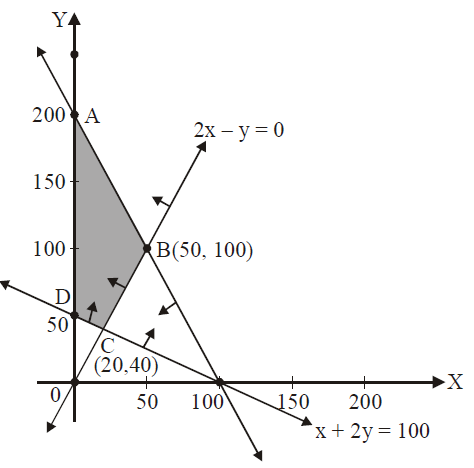
$\text{Z = x + 2y s.t x + 2y} \geq 100, \text{2x - y} \leq 0, \text{2x + y} \leq 200, \text{x, y} \geq 0$
Z(A) = 0 + 400 = 400
Z(B) = 50 + 200 = 250
Z(C) = 20 + 80 = 100
Z(D) = 0 + 100 = 100
$\therefore$ Max (= 400) at x = 0, y = 200 View full question & answer→Question 165 Marks
A manufacturer considers that men and women workers are equally efficient and so he pays them at the same rate. He has 30 and 17 units of workers (male and female) and capital respectively, which he uses to produce two types of goods A and B. To produce one unit of A, 2 workers and 3 units of capital are required while 3 workers and 1 unit of capital is required to produce one unit of B. If A and B are priced at

100 and

120 per unit respectively, how should he use his resources to maximise the total revenue? Form the above as an LPP and solve graphically. Do you agree with this view of the manufacturer that men and women workers are equally efficient and so should be paid at the same rate?
AnswerLet x, y unit of goods A and B are produced respectively.
Let Z be total revenue
Here Z = 100x + 120y - - - - - (i)
Also 2x + 3y $\le$ 30 - - - -- (ii)
3x + y $\le$ 17 - - - - - -- (iii)
x $\ge$ 0 - - - -- - -- - (iv)
y $\ge$ 0 - - - -- - (v)
On plotting graph of above constants or inequalities (ii), (iii), (iv) and (v). We get shaded region as feasible region having corner points A, O, B and C.
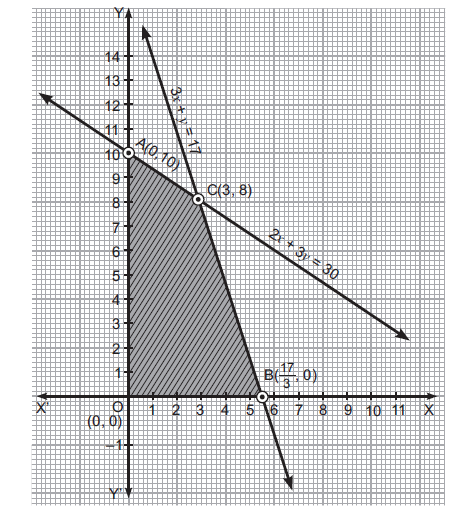
For co-ordinate of 'C'
Two equations (ii) and (iii) are solved and we get coordinate of C = (3, 8)
Now the value of Z is evaluated at corner point as:
| Corner point |
Z = 100x + 120y |
| (0, 10) |
1200 |
| (0,0) |
0 |
| $\bigg(\frac{17}{3},0\bigg)$ |
$\frac{1700}{3}$ |
| (3,8) |
1260 $\leftarrow\text{ Maximum}$ |
Therefore maximum revenue is 1,260 when 2 workers and 8 units capital are used for production.
Yes, although women workers have less physical efficiency but it can be managed by her other efficiency. View full question & answer→Question 175 Marks
A dietician wishes to mix two types of foods in such a way that the vitamin contents of the mixture contains at least $8$ units of vitamin $A$ and $10$ units of vitamin $C.$ Food I contains $2$ units/kg of vitamin $A$ and $1$ unit/kg of vitamin $C$ while Food $II$ contain $1$ unit/kg of vitamin $A$ and $2$ units/kg of vitamin $C.$ It costs $₹\ 5$ per kg to purchase Food $I$ and $₹\ 7$ per kg to purchase Food $II.$ Determine the minimum cost of such a mixture. Formulate the above as a $LPP$ and solve it graphically.
AnswerLet the mixture contain $x \ kg$ of food $I$ and $y \ kg$ of food $II$ Getting the objective function as
$Z = 5x + 7y$
Getting the constraints
$2x + y > 8$
$x + 2y > 10$
$x, y > 0$
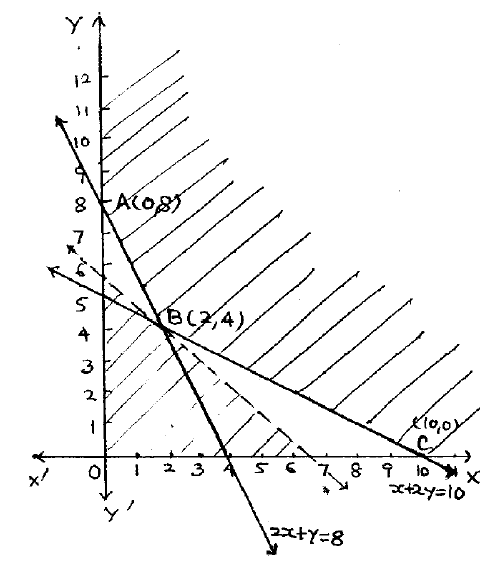
Getting the corners of feasible
region as $A(0, 8), B (2, 4), C (10, 0)$
$Z_A= 5 \times 0 + 7 \times 8 = 56$
$Z_B = 5 \times 2 + 7 \times 4 = 38$ minimum
$Z_C = 5 \times 10 + 7 \times 10 = 50$
since $5x + 7y < 38$ has
no common regionwith the feasible region
$\therefore$ For minimum cost
$x = 2 \ kg$ and $y = 4 \ kg.$ View full question & answer→Question 185 Marks
A merchant plans to sell two types of personal computers - a desktop model and a portable, model that will costRs. 25,000 andRs. 40,000 respectively. He estimates that the total monthly demand of computers will not exceed 250 units. Determine the number of units of each type of computers which the merchant should stock to get maximum profit if he does not want to invest more than Rs. 70 lakhs and his profit on the desktop model is Rs. 4,500 and on the portable model is Rs. 5,000. Make an L.P.P. and solve it graphically.
AnswerLet the number of desktop models, he stock be x and the number of portable model be yL.P.P. is,Maximise P = 4500 x + 5000y
subject to x + y < 250
25000 x + 40000 y < 7000000
(or 5x + 8y < 1400)
x > 0, y > 0
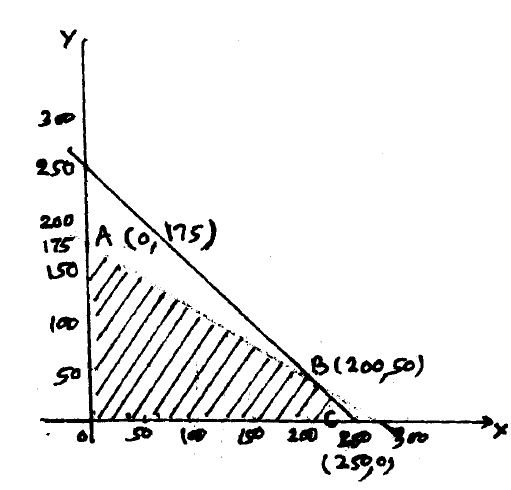 Vertices of feasible region are
A (0, 175), B (200, 50), C (250, 0)
P(A) = Rs. 875000
P(B) = Rs. 900000 + 250000 = Rs. 1150000
P(C) = Rs. 1125000
$\therefore$ For max. Profit destop model = 200
Portable Model = 50. View full question & answer→Question 195 Marks
One kind of cake requires 300 g of flour and 15 g of fat, another kind of cake requires 150 g of flour and 30 g of fat. Find the maximum number of cakes which can be made from 7.5 kg of flour and 600 g of fat, assuming that there is no shortage of the other ingradients used in making the cakes. Make it as an L.P.P. and solve it graphically.
AnswerLet x cakes of first type and y cakes of second type are made Maximise S = x + y 1 subject to 300x + 150y < 7500 or 2x + y < 50 15x + 30y < 600 or x + 2y < 40 x > 0, y > 0
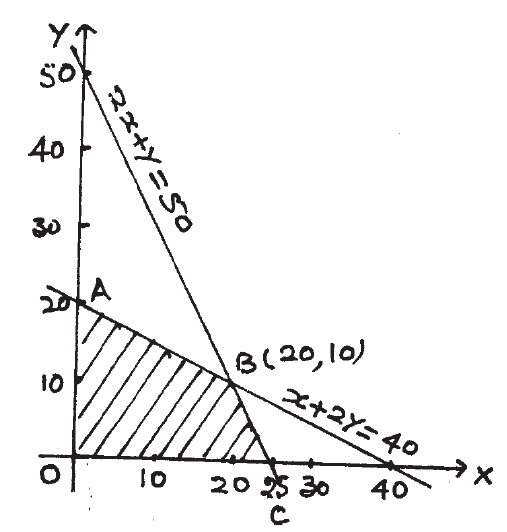
Vertices of feasible region are A (0, 20), B (20, 10) C (25, 0) Maximum cakes = 20 + 10 = 30
View full question & answer→Question 205 Marks
A diet for a sick person must contain at least $4000$ units of vitamins, $50$ units of minerals and $1400$ units of calories. Two foods $A$ and $B$ are available at a cost of $Rs. 5$ and $Rs. 4$ per unit respectively. One unit of the food $A$ contains $200$ units of vitamins, $1$ unit of minerals and $40$ units of calories, while one unit of the food $B$ contains $100$ units of vitamins, $2$ units of minerals and $40$ units of calories. Find what combination of the foods $A$ and $B$ should be used to have least cost, but it must satisfy the requirements of the sick person. Form the question as $LPP$ and solve it graphically.
Answer
| Contents |
Food |
|
Requirement $($in units$)$ |
| of food |
$A$ |
$B$ |
|
| Vitamins |
$200$ |
$100$ |
$4000$ |
| Minerals |
$1$ |
$2$ |
$50$ |
| Calories |
$40$ |
$40$ |
$1400$ |
| Cost $($per unit$)$ |
$Rs 5$ |
$Rs 4$ |
|
Let $x$ units of Food $A$ and $y$ units of Food $B$ are taken
Getting the constraints
$200x + 100y > 4000 $
$\Rightarrow 2x + y > 40$
$x + 2y > 50 $
$\Rightarrow x + 2y > 50$
$40 (x + y) > 1400 $
$\Rightarrow x + y > 35$
$x > 0, y > 0$
Cost $C = 5x + 4y$
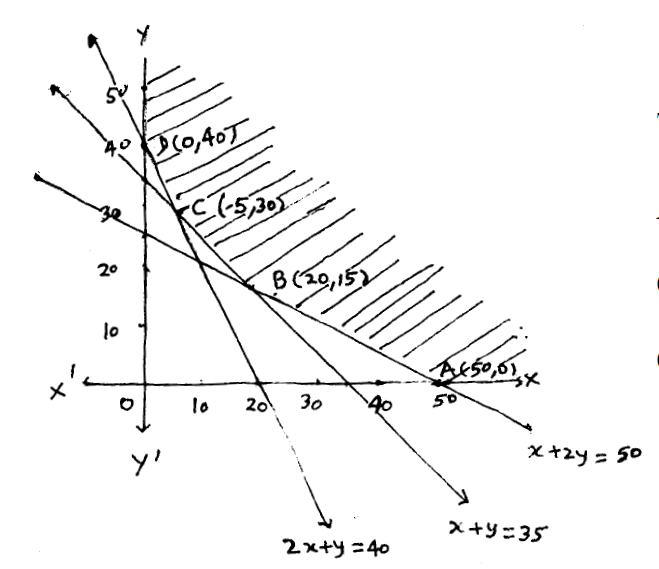
The vertices of feasible region are
$A (50, 0), B (20, 15), C (5, 30), D (0, 40)$
$C_A = 250, C_B = 160, C_C = 145, C_D = 160$
Cost is least at $x = 5, y = 30$
$\therefore 5$ units of Food $A$ and $30$ units of Food $B$ be
mixed for minimum cost meeting the requirements. View full question & answer→Question 215 Marks
David wants to invest at most $Rs. 12,000$ in Bonds $A$ and $B.$ According to the rule, he has to invest at least $Rs. 2,000$ in Bond A and at least $Rs. 4,000$ in Bond $B.$ If the rates of interest on Bonds $A$ and $B$ respectively are $8\%$ and $10\%$ per annum, formulate the problem as $L.P.P.$ and solve it graphically for maximum interest. Also determine the maximum interest received in a year.
AnswerLet Amount invested in Bonds $A = Rs. x$
And Amount invested in Bonds $B = Rs. y$
$\therefore L.P.P. $ becomes:
Maximise $I = \frac{\text{8x}}{100}+\frac{\text{10y}}{100}$
Subject to: $x + y < 12000x > 2000$
$y > 4000$
$x > 0, y > 0$
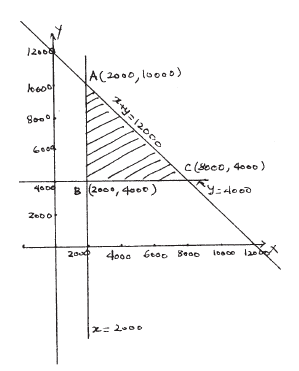
$I_A = 160 + 1000 = 1160$
$I_B = 160 + 400 = 560 $
$I_C = 640 + 400 = 1040$
$\therefore$ For Maximum Interest Amount invested in Bond $A = Rs. 2000$
Amount invested in Bond $B = Rs. 10,000$
Maximum Interest recieved $= Rs. 1160.$ View full question & answer→Question 225 Marks
Solve the following LPP graphically:
Maximise Z = 105x + 90y
subject to the constraints
x + y $\leq$ 50
2x + y $\leq$80
x $\geq$ 0, y $\geq$ 0.
Answer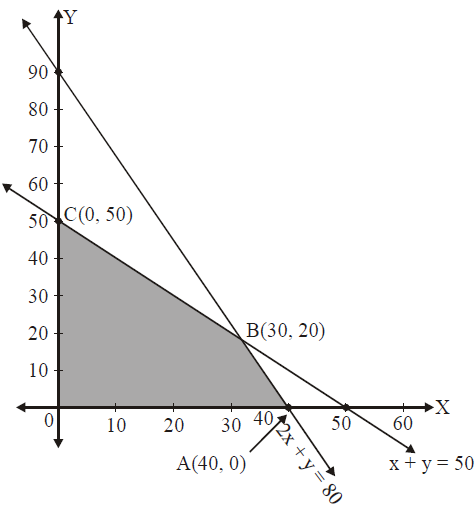
Z(O) = 0
Z(A) = 4200
Z(B) = 4950
Z(C) = 4500
$\therefore\ $Maximum value of Z is 4950
at x = 30, y = 20 View full question & answer→Question 235 Marks
In order to supplement daily diet, a person wishes to take $X$ and $Y$ tablets. The contents $($in milligrams per tablet$)$ of iron, calcium and vitamins in $X$ and $Y$ are given as below:
| Tablets |
Iron |
Calcium |
Vitamin |
| $X$ |
$6$ |
$3$ |
$2$ |
| $Y$ |
$2$ |
$3$ |
$4$ |
The person needs to supplement at least $18$ milligrams of iron, $21$ milligrams of calcium and $16$ milligrams of vitamins. The price of each tablet of $X$ and $Y$ is $₹ 2$ and $₹1$ respectively. How many tablets of each type should the person take in order to satisfy the above requirement at the minimum cost? Make an $LPP$ and solve graphically. Answer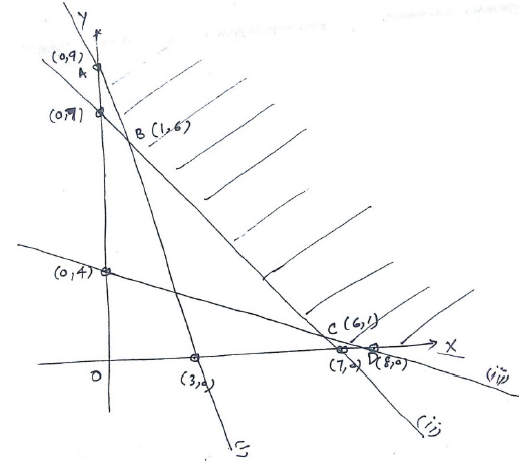
Let $x$ tablets of type $X$ and $y$ tablets of type $Y$ are taken
Minimise $C = 2x + y$
subjected to
$\text{6x + 2y}\geq 18\\ \text{3x + 3y} \geq 21\\ \text{2x + 4y} \geq 16\\ \text{x, y} \geq 0$
$C|_{A(0, 9)} = 9$
$C|_{B (1, 6)} = 8 \leftarrow$ Minimum value
$C|_{C (6, 1)} = 13$
$C|_{D (8, 0)} = 16$
$2x + y < 8$ does not pass through unbounded region.
Thus, minimum value of $C = 8$ at $x = 1, y = 6.$ View full question & answer→Question 245 Marks
Solve the following LPP graphically:
Minimise Z = 3x + 9y
subject to the constraints
x + 3y $\leq$ 60
x + y $\geq$ 10
x $\leq$ y
x $\geq$ 0, y $\geq$ 0.
Answer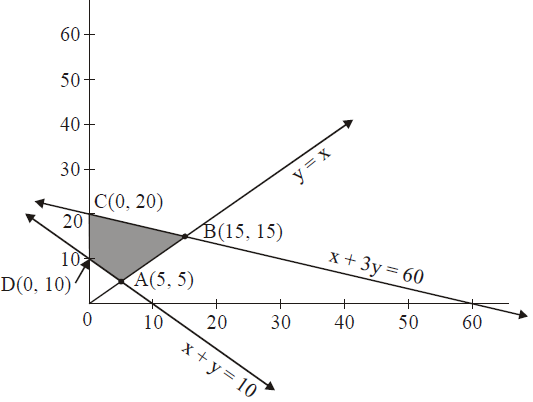
Z(A) = 60
Z(B) = 180
Z(C) = 180
Z(D) = 90
$\therefore $ Minimum value of z is 60 when x = 5, y = 5 View full question & answer→Question 255 Marks
In order to supplement daily diet, a person wishes to take $X$ and $Y$ tablets. The contents $($in milligrams per tablet$)$ of iron, calcium and vitamins in $X$ and $Y$ are given as below:
| Tablets |
Iron |
Calcium |
Vitamin |
| $X$ |
$6$ |
$3$ |
$2$ |
| $Y$ |
$2$ |
$3$ |
$4$ |
The person needs to supplement at least $18$ milligrams of iron, $21$ milligrams of calcium and $16$ milligrams of vitamins. The price of each tablet of $X$ and $Y$ is $₹ 2$ and $₹1$ respectively. How many tablets of each type should the person take in order to satisfy the above requirement at the minimum cost? Make an $LPP$ and solve graphically. Answer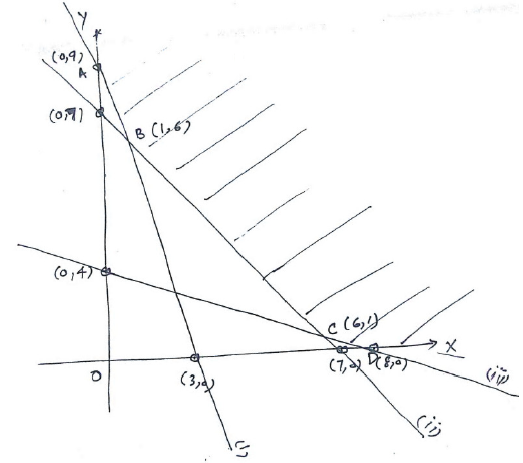
Let $x$ tablets of type $X$ and $y$ tablets of type $Y$ are taken
Minimise $C = 2x + y$
subjected to
$\text{6x + 2y}\geq 18\\ \text{3x + 3y} \geq 21\\ \text{2x + 4y} \geq 16\\ \text{x, y} \geq 0$
$C|_{A(0, 9)} = 9$
$C|_{B (1, 6)} = 8 \leftarrow$ Minimum value
$C|_{C (6, 1)} = 13$
$C|_{D (8, 0)} = 16$
$2x + y < 8$ does not pass through unbounded region.
Thus, minimum value of $C = 8$ at $x = 1, y = 6.$ View full question & answer→Question 265 Marks
Solve the following LPP graphically:
Maximise Z = 1000x + 600y
subject to the constraints
$\text{ }\text{x + y} \leq 200\\ \text{ }\text{ }\text{ }\text{ }\text{ }\text{ }\text{ }\text{ }\text{ }\text{ }\text{x} \geq 20\\ \text{ }\text{ }\text{ }\text{ }\text{y - 4x} \geq 0\\ \text{ }\text{ }\text{ }\text{ }\text{ }\text{ }\text{ }\text{x, y} \geq 0. $
Answer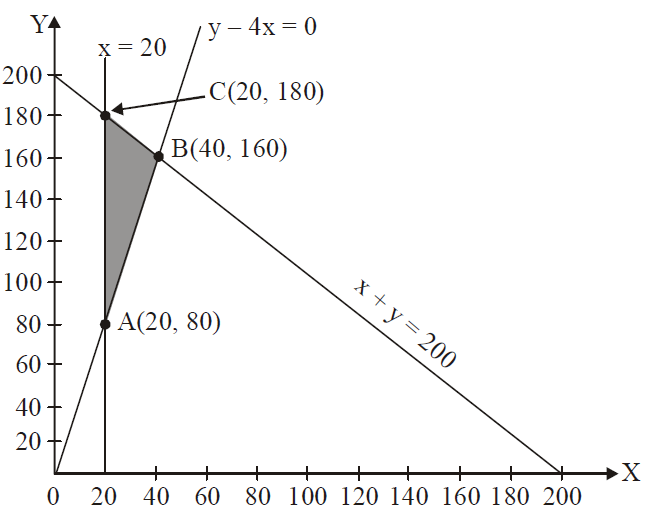 Z(A) = 68,0000
Z(B) = 1,36,000
Z(C) = 1,28,000
$\therefore$ Maximum value of Z = 1,36,000 at x = 40, y = 160 View full question & answer→Question 275 Marks
In order to supplement daily diet, a person wishes to take $X$ and $Y$ tablets. The contents $($in milligrams per tablet$)$ of iron, calcium and vitamins in $X$ and $Y$ are given as below:
| Tablets |
Iron |
Calcium |
Vitamin |
| $X$ |
$6$ |
$3$ |
$2$ |
| $Y$ |
$2$ |
$3$ |
$4$ |
The person needs to supplement at least $18$ milligrams of iron, $21$ milligrams of calcium and $16$ milligrams of vitamins.
The price of each tablet of $X$ and $Y$ is $₹ 2$ and $₹1$ respectively.
How many tablets of each type should the person take in order to satisfy the above requirement at the minimum cost? Make an $LPP$ and solve graphically. Answer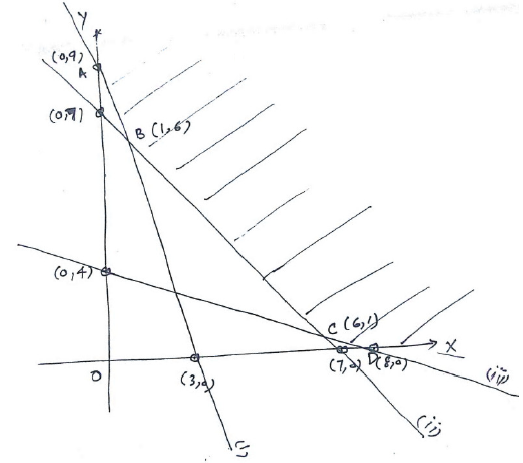
Let $x$ tablets of type $X$ and $y$ tablets of type $Y$ are taken
Minimise $C = 2x + y$
subjected to
$\text{6x + 2y}\geq 18\\ \text{3x + 3y} \geq 21\\ \text{2x + 4y} \geq 16\\ \text{x, y} \geq 0$
$C|_{A(0, 9)} = 9$
$C|_{B (1, 6)} = 8 \leftarrow$ Minimum value
$C|_{C (6, 1)} = 13$
$C|_{D (8, 0)} = 16$
$2x + y < 8$ does not pass through unbounded region.
Thus, minimum value of $C = 8$ at $x = 1, y = 6.$ View full question & answer→Question 285 Marks
Solve the following $L.P.P.$ graphically:
Maximise $Z = 20x + 10y$
Subject to the following constraints $x + 2y \leq 28,$
$3x + y \leq 24,$
$x \geq 2,$
$x, y \geq 0$
Answer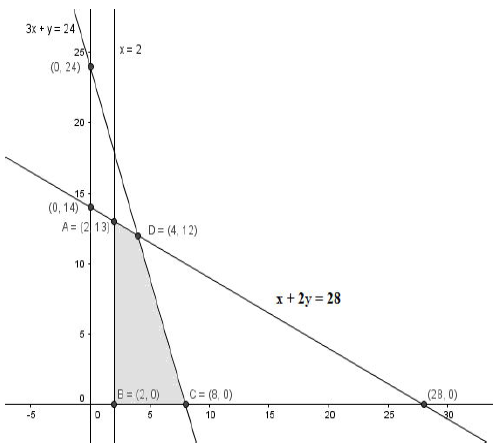
$Z = 20x + 10y$
$Z|_{A(2, 13)} = 170$
$Z|_{B(2, 0)} = 40$
$Z|_{C(8, 0)} = 160$
$Z|_{D(4, 12}) = 200$
Miximum value of $Z = 200$ at $x = 4, y = 12$ View full question & answer→Question 295 Marks
A manufacturer produces two products A and B. Both the products are processed on two different machines. The available capacity of first machine is 12 hours and that of second machine is 9 hours per day. Each unit of product A requires 3 hours on both machines, and each unit of product B requires 2 hours on first machine and 1 hour on second machine. Each unit of product A is sold at ₹ 7 profit and that of B at a profit of ₹ 4. Find the production level per day for maximum profit graphically.
Answer
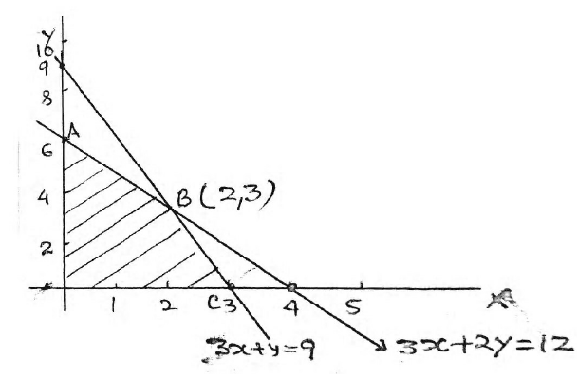 Let production of A, B (per day) be x, y respectively
Maximise $\text{P = 7x + 4y} $
$\text{Subject to} \begin{matrix} \text{3x} + & \text{2y}\leq & 12 \\ \text{3x} + & \text{y}\leq & 9 \\ \text{x} \geq 0 & \text{y}\geq & 0 \end{matrix} $
$\text{P(A)} = 24$
$\text{P(B)} = 26$
$\text{P(C)} = 21$
$\therefore$ 2 units of product A and 3 units of product B for maximum profit. View full question & answer→Question 305 Marks
Three schools A, B and C organised a mela for collecting funds for helping the rehabilitation of flood victims. They sold hand made fans, mats and plates from recycled material at a cost of
₹ 25,
₹ 100 and
₹ 50 each. The number of articles sold are given below:
| School |
A |
B |
C |
| Article |
| Hand - fans |
40 |
25 |
35 |
| Mats |
50 |
40 |
50 |
| Plates |
20 |
30 |
40 |
Find the funds collected by each school separately by selling the above articles. Also find the total funds collected for the purpose.
Write one value generated by the above situation.
Answer
| $\begin{bmatrix} \text{A}\\ \text{B} \\ \text{C} \end{bmatrix}$ |
$ \begin{bmatrix} \text{HF.} & \text{M} & \text{T}\\ 40 & 50 & 20 \\25 & 40 & 30 \\ 35 & 50 & 40 \end{bmatrix}$ |
$\begin{bmatrix} 25 \\ 100 \\ 50 \end{bmatrix}$ |
= |
$\begin{bmatrix} 7000\\ 6125 \\ 7875 \end{bmatrix} $ |
Funds collected by school A: Rs. 7000,
School B: Rs. 6125, School C: Rs. 7875
Total collected: Rs. 21000
For writing one value View full question & answer→Question 315 Marks
Find graphically, the maximum value of $\text{z = 2x + 5y},$ subject to constraints given below:
$2x + 4y \leq 8$
$3x + y \leq 6$
$x + y \leq 4$
$x\geq 0, y\geq 0$
Answer
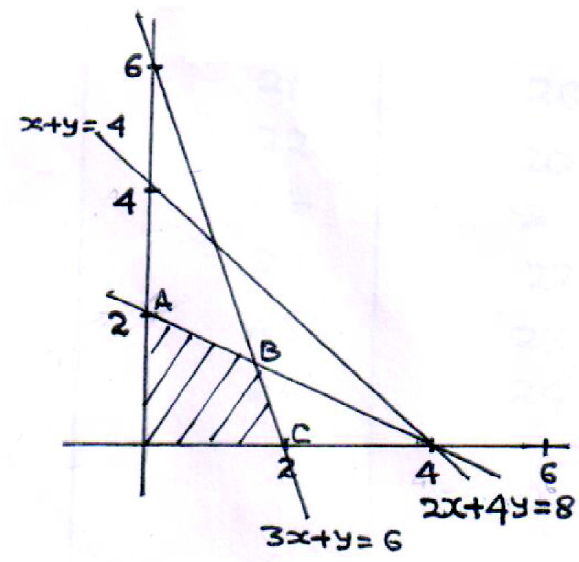 Vertices are:
$\text{A (0, 2), B(1.6, 1.2), C (2, .0)}$
$\text{Z = 2x + 5y is maximum}$
at A (0, 2) and maximum value = 10 View full question & answer→Question 325 Marks
A dealer in rural area wishes to purchase a number of sewing machines. He has only ₹ 5,760 to invest and has space for at most 20 items for storage. An electronic sewing machine costs him ₹ 360 and a manually operated sewing machine ₹ 240. He can sell the sewing machine at a profit of ₹ 22 and a manually operated sewing machine at a profit of ₹ 18. Assuming that he can sell all the items that he can buy, how should he invest his money in order to maximize his profit? Make it as an LPP and solve it graphically.
AnswerLet x and y be electronic and manually operated sewing machines purchased respectively,
$\therefore\text{ L.P.P. is Maximize P} = 22\text{x} + 18\text{y}$
subject to 360x + 240y $\leq$ 5760
or 3x + 2y $\leq$ 48
x + y $\leq$ 20
x $\geq$ 0, y $\geq$ 0
vertices of the feasible region are
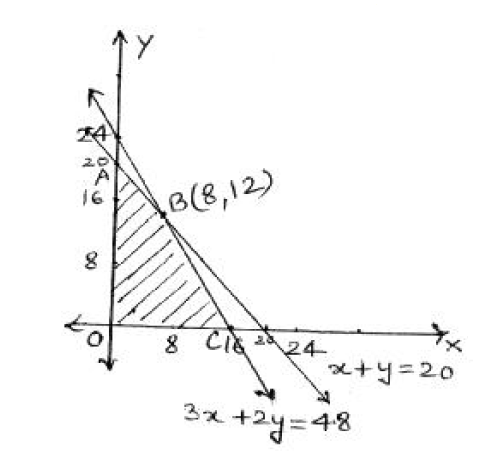
A (0, 20), B(8, 12), C(16, 0) & O(0, 0)
P(A) = 360, P(B) = 392, P(C) = 352
$\therefore$ For Maximum P,Electronic machines = 8
Manual machines = 12. View full question & answer→Question 335 Marks
Solve the following $L.P.P.$ graphically:
$\text{Miximise}\ \ \ \ \ \ \ \ \ \ \ \ \ \ \ \ \ \ \ \ \ \ \ \ \ \ \ \ \ \ \ \ \ \ \ \ \ \ \ \text{ }\text{ }\text{ }\text{Z} = 4x + \text{y}\\ \text{Subect to following constraints} \text{ }\text{ }\text{ }\text{ }\text{ }x + \text{y} \leq 50\\ \ \ \ \ \ \ \ \ \ \ \ \text{}\text{} \text{ }\ \ \ \ \ \ \ \ \ \ \ \ \ \ \ \ \ \ \ \ \ \ \ \ \ \ \ \ \ \ \ \ \ \ \ \ \ \ \ \ \ \ \ \ \ \ 3x + \text{y} \leq 90\\ \text{ }\text{ }\text{ }\text{ }\text{ }\text{ }\text{ }\text{ }\text{ }\text{ }\text{ }\text{ }\text{ }\text{ }\text{ }\text{ }\text{ }\text{ }\text{ }\text{ }\text{ }\ \ \ \ \ \ \ \ \ \ \ \ \ \ \ \ \ \ \ \ \ \ \ \ \ \ \ \ \ \ \ \ \ \ \ \ \ x \ \geq 10\\ \text{ }\text{ }\text{ }\text{ }\text{ }\text{ }\ \ \ \ \ \ \ \ \ \ \ \ \ \ \ \ \ \ \ \ \ \ \ \ \ \ \ \ \ \ \ \ \ \ \ \ \ \ \ \ \ \ \ \ \ \ \ \ \ \ \ \ x, \text{y} \geq 0$
Answer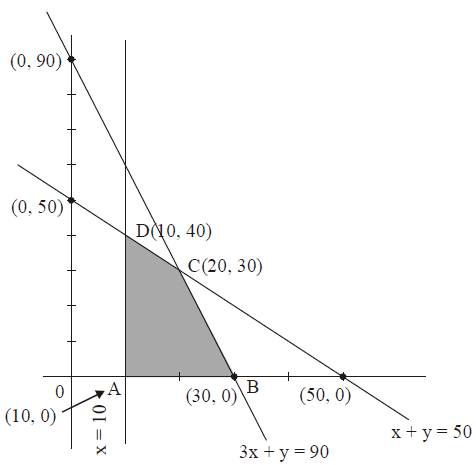
$Z|_{A(10, 0)} = 40$
$Z|_{B(30, 0)} = 120$
$Z|_{C(20, 30)} = 110$
$Z|_{D(10, 40)} = 80$
Minimum value of $Z = 120$ at $(30, 0)$ View full question & answer→Question 345 Marks
A manufacturer produces two products A and B. Both the products are processed on two different machines. The available capacity of first machine is 12 hours and that of second machine is 9 hours per day. Each unit of product A requires 3 hours on both machines, and each unit of product B requires 2 hours on first machine and 1 hour on second machine. Each unit of product A is sold at ₹ 7 profit and that of B at a profit of ₹ 4. Find the production level per day for maximum profit graphically.
Answer
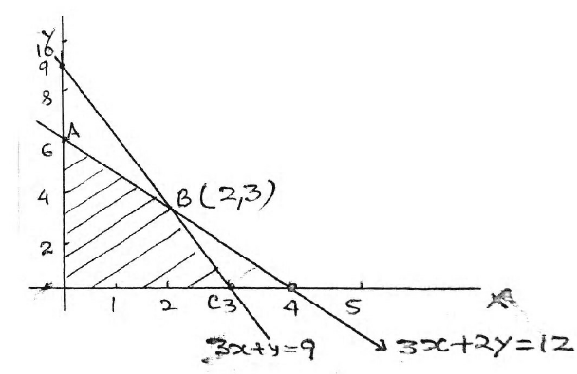 Let production of A, B (per day) be x, y respectively
Maximise $\text{P = 7x + 4y} $
$\text{Subject to} \begin{matrix} \text{3x} + & \text{2y}\leq & 12 \\ \text{3x} + & \text{y}\leq & 9 \\ \text{x} \geq 0 & \text{y}\geq & 0 \end{matrix} $
$\text{P(A)} = 24$
$\text{P(B)} = 26$
$\text{P(C)} = 21$
$\therefore$ 2 units of product A and 3 units of product B for maximum profit. View full question & answer→Question 355 Marks
Three schools A, B and C organised a mela for collecting funds for helping the rehabilitation of flood victims. They sold hand made fans, mats and plates from recycled material at a cost of
₹ 25,
₹ 100 and
₹ 50 each. The number of articles sold are given below:
| School |
A |
B |
C |
| Article |
| Hand - fans |
40 |
25 |
35 |
| Mats |
50 |
40 |
50 |
| Plates |
20 |
30 |
40 |
Find the funds collected by each school separately by selling the above articles. Also find the total funds collected for the purpose.
Write one value generated by the above situation.
Answer
| $\begin{bmatrix} \text{A}\\ \text{B} \\ \text{C} \end{bmatrix}$ |
$ \begin{bmatrix} \text{HF.} & \text{M} & \text{T}\\ 40 & 50 & 20 \\25 & 40 & 30 \\ 35 & 50 & 40 \end{bmatrix}$ |
$\begin{bmatrix} 25 \\ 100 \\ 50 \end{bmatrix}$ |
= |
$\begin{bmatrix} 7000\\ 6125 \\ 7875 \end{bmatrix} $ |
Funds collected by school A: Rs. 7000,
School B: Rs. 6125, School C: Rs. 7875
Total collected: Rs. 21000
For writing one value View full question & answer→Question 365 Marks
Find graphically, the maximum value of $\text{z = 2x + 5y},$ subject to constraints given below:
$2x + 4y \leq 8$
$3x + y \leq 6$
$x + y \leq 4$
$x\geq 0, y\geq 0$
Answer
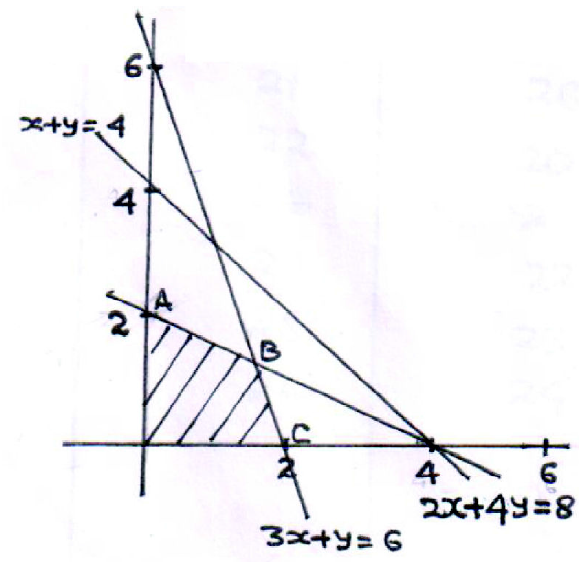 Vertices are:
$\text{A (0, 2), B(1.6, 1.2), C (2, .0)}$
$\text{Z = 2x + 5y is maximum}$
at A (0, 2) and maximum value = 10 View full question & answer→Question 375 Marks
A dealer in rural area wishes to purchase a number of sewing machines. He has only ₹ 5,760 to invest and has space for at most 20 items for storage. An electronic sewing machine costs him ₹ 360 and a manually operated sewing machine ₹ 240. He can sell the sewing machine at a profit of ₹ 22 and a manually operated sewing machine at a profit of ₹ 18. Assuming that he can sell all the items that he can buy, how should he invest his money in order to maximize his profit? Make it as an LPP and solve it graphically.
AnswerLet x and y be electronic and manually operated sewing machines purchased respectively,
$\therefore\text{ L.P.P. is Maximize P} = 22\text{x} + 18\text{y}$
subject to 360x + 240y $\leq$ 5760
or 3x + 2y $\leq$ 48
x + y $\leq$ 20
x $\geq$ 0, y $\geq$ 0
vertices of the feasible region are
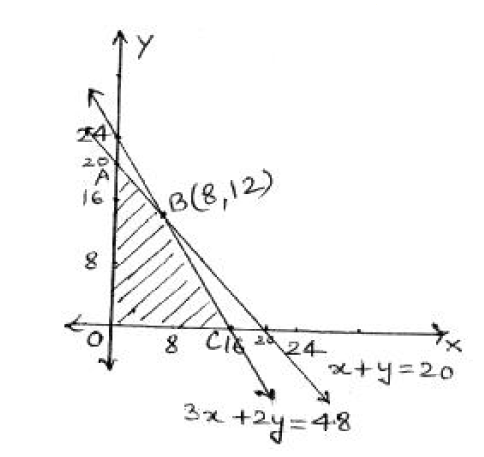
A (0, 20), B(8, 12), C(16, 0) & O(0, 0)
P(A) = 360, P(B) = 392, P(C) = 352
$\therefore$ For Maximum P,Electronic machines = 8
Manual machines = 12. View full question & answer→Question 385 Marks
Solve the following $L.P.P.$ graphically:
$\text{Minimise} \text{ }\text{ }\text{ }\text{Z} = 5x + 10\text{y}\\\text{Subect to} \text{ }\text{ }\text{ }\text{ }\text{ }x + \text{2y} \leq 120\\\text{Constraints} \text{ }x + \text{y} \geq 60\\\text{ }\text{ }\text{ }\text{ }\text{ }\text{ }\text{ }\text{ }\text{ }\text{ }\text{ }\text{ }\text{ }\text{ }\text{ }\text{ }\text{ }\text{ }\text{ }\text{ }\text{ }x - \text{2y} \geq 0\\\text{ }\text{ }\text{ }\text{ }\text{ }\text{ }\text{and}\text{ }\text{ }\text{ }\text{ }\text{ }\text{ }\text{ }\text{ }x, \text{y} \geq 0$
Answer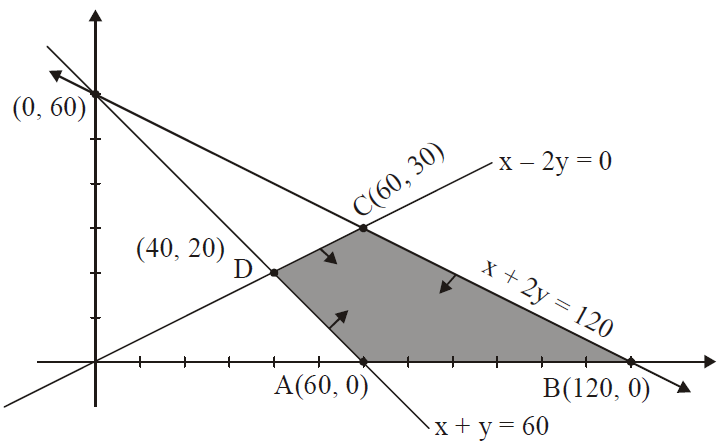
$Z = 5x + 10y$
$Z|_{A(60, 0)} = 300$
$Z|_{B(120, 0)} = 600$
$Z|_{C(60, 30)} = 60$
$Z|_{D(40, 20)} = 400$
Minimum value of $Z = 300$ at $x = 60, y = 0$ View full question & answer→Question 395 Marks
A manufacturer produces two products A and B. Both the products are processed on two different machines. The available capacity of first machine is 12 hours and that of second machine is 9 hours per day. Each unit of product A requires 3 hours on both machines, and each unit of product B requires 2 hours on first machine and 1 hour on second machine. Each unit of product A is sold at ₹ 7 profit and that of B at a profit of ₹ 4. Find the production level per day for maximum profit graphically.
Answer
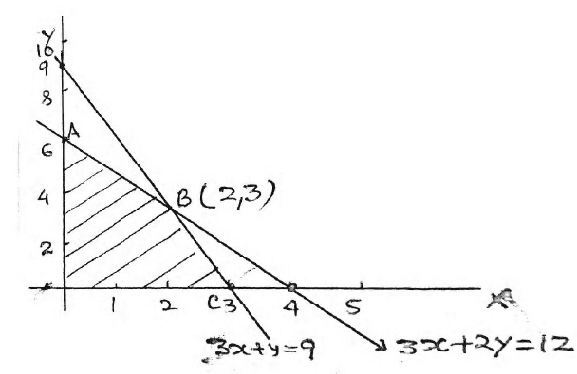 Let production of A, B (per day) be x, y respectively
Maximise $\text{P = 7x + 4y} $
$\text{Subject to} \begin{matrix} \text{3x} + & \text{2y}\leq & 12 \\ \text{3x} + & \text{y}\leq & 9 \\ \text{x} \geq 0 & \text{y}\geq & 0 \end{matrix} $
$\text{P(A)} = 24$
$\text{P(B)} = 26$
$\text{P(C)} = 21$
$\therefore$ 2 units of product A and 3 units of product B for maximum profit. View full question & answer→Question 405 Marks
Find graphically, the maximum value of $\text{z = 2x + 5y},$ subject to constraints given below:
$2x + 4y \leq 8$
$3x + y \leq 6$
$x + y \leq 4$
$x\geq 0, y\geq 0$
Answer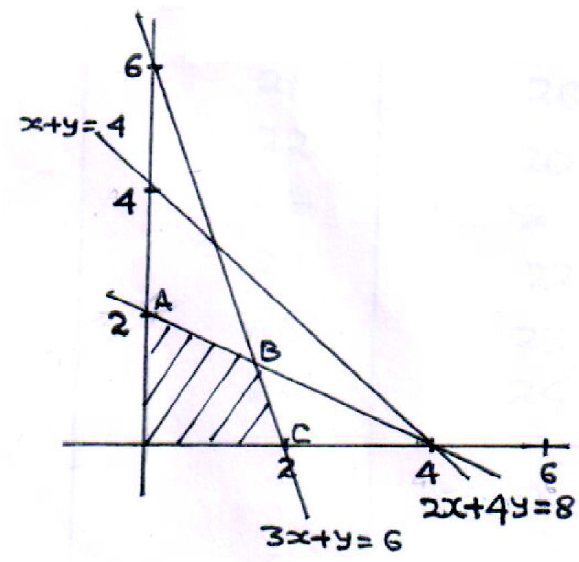
Vertices are:
$\text{A (0, 2), B(1.6, 1.2), C (2, .0)}$
$\text{Z = 2x + 5y is maximum}$
at A (0, 2) and maximum value = 10 View full question & answer→Question 415 Marks
Three schools A, B and C organised a mela for collecting funds for helping the rehabilitation of flood victims. They sold hand made fans, mats and plates from recycled material at a cost of
₹ 25,
₹ 100 and
₹ 50 each. The number of articles sold are given below:
| School |
A |
B |
C |
| Article |
| Hand - fans |
40 |
25 |
35 |
| Mats |
50 |
40 |
50 |
| Plates |
20 |
30 |
40 |
Find the funds collected by each school separately by selling the above articles. Also find the total funds collected for the purpose.
Write one value generated by the above situation.
Answer
| $\begin{bmatrix} \text{A}\\ \text{B} \\ \text{C} \end{bmatrix}$ |
$ \begin{bmatrix} \text{HF.} & \text{M} & \text{T}\\ 40 & 50 & 20 \\25 & 40 & 30 \\ 35 & 50 & 40 \end{bmatrix}$ |
$\begin{bmatrix} 25 \\ 100 \\ 50 \end{bmatrix}$ |
= |
$\begin{bmatrix} 7000\\ 6125 \\ 7875 \end{bmatrix} $ |
Funds collected by school A: Rs. 7000,
School B: Rs. 6125, School C: Rs. 7875
Total collected: Rs. 21000
For writing one value View full question & answer→Question 425 Marks
A dealer in rural area wishes to purchase a number of sewing machines. He has only ₹ 5,760 to invest and has space for at most 20 items for storage. An electronic sewing machine costs him ₹ 360 and a manually operated sewing machine ₹240. He can sell the sewing machine at a profit of ₹ 22 and a manually operated sewing machine at a profit of ₹ 18. Assuming that he can sell all the items that he can buy, how should he invest his money in order to maximize his profit? Make it as an LPP and solve it graphically.
AnswerLet x and y be electronic and manually operated sewing machines purchased respectively,
$\therefore\text{ L.P.P. is Maximize P} = 22\text{x} + 18\text{y}$
subject to 360x + 240y $\leq$ 5760
or 3x + 2y $\leq$ 48
x + y $\leq$ 20
x $\geq$ 0, y $\geq$ 0
vertices of the feasible region are
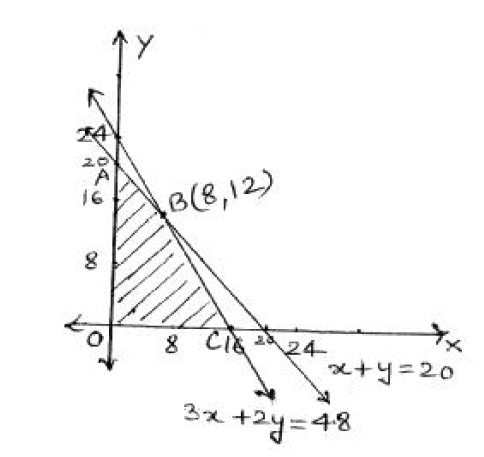
A (0, 20), B(8, 12), C(16, 0) & O(0, 0)
P(A) = 360, P(B) = 392, P(C) = 352
$\therefore$ For Maximum P,Electronic machines = 8
Manual machines = 12. View full question & answer→Question 435 Marks
A manufacturer produces nuts and bolts. It takes 1 hour of work on machine A and 3 hours on machine B to produce a package of nuts. It takes 3 hours on machine A and 1 hour on machine B to produce a package of bolts. He earns a profit of

17.50 per package on nuts and

7 per package of bolts. How many packages of each should be produced each day so as to maximise his profits if he operates his machines for at the most 12 hours a day? Form the above as a linear programming problem and solve it graphically.
AnswerLet x packages of nuts and y packages of bolts be produced each day a
LPP is maximise P = 17.5x + 7y
subject to x + 3y < 12
3x + y < 12
x > 0, y > 0
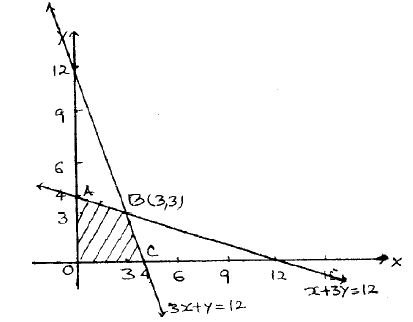
vertices of feasible region are A(0, 4), B (3, 3), C (4, 0).
Profit is Maximum at B(3, 3) i.e 3 packages of nuts and 3 packages of bolts.
View full question & answer→Question 445 Marks
A factory makes tennis rackets and cricket bats.A tennis racket takes 1.5 hours of machine time and 3 hours of craftman's time in its making while a cricket bat takes 3 hours of machine time and 1 hour of craftman's time. In a day, the factory has the availability of not more than 42 hours of machine time and 24 hours of craftsman's time. If the profit on a racket and on a bat is Rs. 20 and Rs. 10 respectively, find the number of tennis rackets and crickets bats that the factory must manufacture to earn the maximum profit.Make it as an L.P.P. and solve graphically.
AnswerLet number of tennis rackets be 'x' and cricket bats be 'y'$\therefore$ LLP is
Maximise z = 20x + 10y
s.t. 1.5x + 3y $\leq$ 42
3x + y $\leq$ 24
x $\geq$ 0, y$\geq$ 0
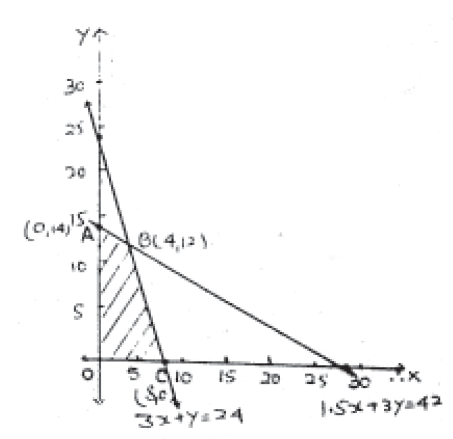
Vertices of feasible region are
A(0, 14), B(4, 12), C(8, 0)
P(A) = Rs. 140, P(B) = Rs. 200, P(C) = Rs.160
For Maximum profit
Number of Rackets = 4
Number of bats = 12. View full question & answer→Question 455 Marks
A small firm manufactures gold rings and chains. The total number of rings and chains manufactured per day is atmost $24.$ It takes $1$ hour to make a ring and $30$ minutes to make a chain. The maximum number of hours available per day is $16.$ If the profit on a ring is $Rs. 300$ and that on a chain is $Rs. 190,$ find the number of rings and chains that should be manufactured per day, so as to earn the maximum profit. Make it as an $L.P.P.$ and solve it graphically.
AnswerLet $x$ be the number of gold rings and $y,$ the number of chains.
The objective function is $Z = 300 x + 190 y$ Constraints are:
$x + y < 24$
$2x + y < 32$
$x > 0, y > 0$
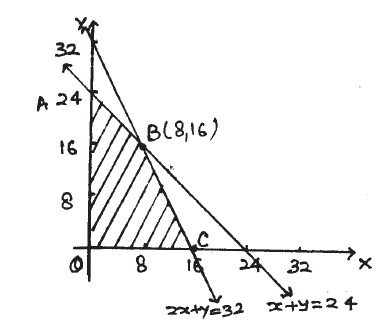
Getting corners of feasible region as
$A (0, 24), B (8, 16)$
$C (16, 0), O (0, 0)$
$Z_{(0, 0)} = 0, Z_A = 45 60, Z_C = 4800$
$Z_B = 300 \times 8 + 190 \times 16 = 2400 + 3040 = 5440$
$\therefore Z$ is maximum at $B (8. 16)$
$\therefore$ For maximum profit, Rings $= 8,$ chains $= 16.$ View full question & answer→Question 465 Marks
A factory owner purchases two types of machines, $A$ and $B$ for his factory. The requirements and the limitations for the machines are-as follows:
|
Machine
|
Area occupied
|
Labour force
|
Daily output $($in units$)$
|
| $A$ |
$1000m^2$ |
$12$ men
|
$60$ |
| $B$ |
$1200m^2$ |
$8$ men
|
$40$ |
He has maximum area of $9000 \text{m}^{2}$ available, and $72$ skilled labourers who can operate both the machines. How many machines of each type should he buy to maximise the daily output $?$ Answer
|
|
Machine $A$
|
Machine $B$
|
Max available
|
|
Area needed
|
$1000m^2$ |
$1200m^2$ |
$9000m^2$ |
|
Labour Force
|
$12$ |
$8$ |
$72$ |
|
Daily Outpit
|
$60$ units
|
$40$ units
|
|
Let $x$ and $y$ be the number of machines $A$ and $B$ respectively Getting the constraints
$\text{1000 x + 1200 y} \leq 9000$
$\Rightarrow \text{5x+ 6y} \leq 45 $
$\text{12 x + 8 y} \leq 72$
$\Rightarrow \text{3x + 2y} \leq 18$
$\text{x} \geq 0, 60\text{x} + 40{\text{y}}$
The vertices of feasible region are
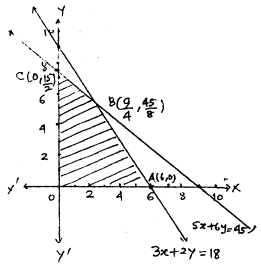
$0(0, 0), \text{A}(6,0), \text{B} \bigg(\frac{9}{4}, \frac{45}{8}\bigg), \text{c} \bigg(0, \frac{15}{2}\bigg)$
Correct graph
$\text{P (0, 0) = 0}$
$\text{P(6, 0) = 360}$
$\text{P} \bigg(0, \frac{15}{2}\bigg) = 300$
$\text{P} \bigg(\frac{9}{4}, \frac{45}{8}\bigg) = 60\times \frac{9}{4} + \frac{45}{8 } \times 40$
$= 135 + 225 = 360$
$\therefore \text{P is equal 360 at A and B}$ View full question & answer→Question 475 Marks
If a young man rides his motorcycle at 25 km/hour, he had to spend Rs. 2 per km on petrol. If he rides at a faster speed of 40 km/hour, the petrol cost increases at Rs. 5 per km. He has Rs. 100 to spend on petrol and wishes to find what is the maximum distance he can travel within one hour. Express this as an LPP and solve it graphically.
AnswerLet x km be the distance covered at 25 km/hour, and y km be the distance covered at 40 km/hour
We have to Maximise $\text{z = x + y}$
Subjext to $2x + 5y \leq 100$
and $8x + 5y \leq 200, y \geq 0, y\geq 0$
For Correct graph with shade
Vertices of feasible region are:
$\text{A} \bigg(\frac{50}{3}, \frac{40}{3} \bigg) B (0, 20), C (25, 0)$
$\text{Z}_{A} = \bigg(\frac{50}{3} + \frac{40}{3} \bigg) \text{km = 30 km}$
$\text{Z}_{B} = (0 + 20) \text{km = 20 km}$
$\text{Z}_{C} = (25 + 0) \text{km = 25 km}$
$\therefore \text{Z is maximum (30 km) at x} = \frac{50}{3} \text{km, y} =\frac{40}{3}\text{km}$
View full question & answer→Question 485 Marks
A and B are partners sharing profits and losses in the ratio 3 : 4 respectively. They admit C as a new partner, the new profit sharing ratio being 2 : 2 : 3 between A, B and C respectively. C pays Rs. 12,000 as premium for goodwill. Find the amount of premium shared by A and B.
AnswerProfit sharing ratio of A and B initially $= 3:4 $$A = \frac{3}{7}, B = \frac{4}{7}$
Profit sharing ratio after joining of C $= 2 : 2 : 3$
$A = \frac{2}{7}, B =\frac{2}{7}, C = \frac{3}{7}$
$\therefore$ Sacrificing ratio of A and B $= \frac{3}{7} -\frac{2}{7} : \frac{4}{7}- \frac{2}{7} $
$= 1 : 2$
$\therefore$ Share of A in premium = Rs. 4000
$\therefore$ Share of B in premium = Rs. 8000
View full question & answer→Question 495 Marks
Find the present worth of an ordinary annuity of Rs. 1,200 per annum for 10 years at 12% per annum, compounded annually.$\text[ {Use} : ( 1.12)^{-10} = 0.03221]$
AnswerWe have $V = R \bigg[\frac{1- (1 + r)^{-n}}{r}\bigg]$Here $R = 1200, n = 10, r = 0.12$
$\therefore V = 1200 \times \bigg[\frac{1 - (1.12)^{-10}}{0.10}\bigg]= 1200 \times \bigg[\frac{1-0.3221}{0.12}\bigg]$
$= \frac{1200 \times 0.6779}{0.12} = 6779$
$\therefore$ Present value of ordinary annuity is Rs 6779
View full question & answer→Question 505 Marks
A dealer wishes to purchase a number of fans and sewing machines. He has only Rs. 5,760 to invest and has space for at most 20 items. A fan and sewing machine cost Rs. 360 and Rs. 240 respectively. He can sell a fan at a profit of Rs. 22 and sewing machine at a profit of Rs. 18. Assuming that he can sell whatever he buys, how should he invest his money in order to maximise his profit ? Translate the problem into LPP and solve it graphically.
Answer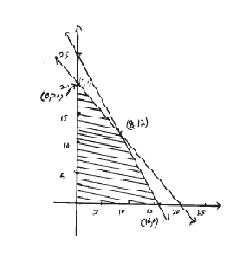 Profit function P = 22 x +18 y, where x is the number 1 m of fans sold and y the number of sewing machines sold.
Constraints are $x + y \leq 20, 360x + 240y \leq 5760 $
$x \geq 0, y^{.} \geq 0$
Graphing of problem and getting feasible region as (0, 0), (16, 0) (8, 12) (0, 20)
$P_{(0,0)} = 0, P_{16,0} = 352, P_{(8,12)} = 392$
$P_{(0, 20)} = 360$
$\therefore$ P is maximum for 8 fans and 12 sewing machines. View full question & answer→