Question
A differential equation is said to be in the variable separable form if it is expressible in the form $f(x) dx = g(y) dy.$
The solution of this equation is given by
$\int\text{f(x)dx}=\int\text{g(y)dy}+\text{c},$ where $c$ is the constant of integration.
Based on the above information, answer the following questions.

  1. If the solution of the differential equation $\frac{\text{dy}}{\text{dx}}=\frac{\text{ax+3}}{\text{2y+f}}$ represents a circle, then the value of $'a\ '$ is:
  1. $2$
  2. $-2$
  3. $3$
  4. $-4$
  1. The differential equation $\frac{\text{dy}}{\text{dx}}=\frac{\sqrt{1-\text{y}^2}}{\text{y}}$ determines a family of circle with.
  1. Variable radii and fixed centre $(0, 1)$
  2. Variable radii and fixed centre $(0, -1)$
  3. Fixed radius $1$ and variable centre on $x-$ axis
  4. Fixed radius $1$ and variable centre on $y-$ axis
  1. If $= y'+ 1, y(0) = 1,$ then $y (In 2) =$
  1. $1$
  2. $2$
  3. $3$
  4. $4$
  1. The solution of the differential equation $\frac{\text{dy}}{\text{dx}}=\text{e}^\text{x-y}+\text{x}^2\text{e}^\text{-y}$ is:
  1. $\text{e}^\text{x}=\frac{\text{y}^3}{3}+\text{e}^\text{y}+\text{c}$
  2. $\text{e}^\text{y}=\frac{\text{x}^2}{3}+\text{e}^\text{x}+\text{c}$
  3. $\text{e}^\text{y}=\frac{\text{x}^3}{3}+\text{e}^\text{x}+\text{c}$
  4. None of these
  1. If $\frac{\text{dy}}{\text{dx}}=\text{y}\sin2\text{x},\ \text{y}(0)=1,$ then its solution is:
  1. $\text{y}=\text{e}^{\sin^2}\text{x}$
  2. $\text{y}={\sin^2}\text{x}$
  3. $\text{y}={\cos^2}\text{x}$
  4. $\text{y}=\text{e}^{\cos^2}\text{x}$

Answer

  1. $(b)\  -2$
We have, $\frac{\text{dy}}{\text{dx}}=\frac{\text{ax+3}}{\text{2y+f}}$
$\Rightarrow\ \ (\text{ax+3})\text{dx}=(2\text{y}+\text{f})\text{dy}$
$\Rightarrow\text{a}\frac{\text{x}^2}{2}+\text{3x}=\text{y}^2+\text{fy}+\text{c} \ ($Integrating$)$
$\Rightarrow-\frac{\text{a}}{2}\text{x}^2+\text{y}^2-\text{3x}+\text{fy}+\text{C}=0$
This will represent a circle, if $\frac{-\text{a}}{2}=1$
$\Rightarrow\text{a}=-2$
$[\therefore$ In circle, coefficient of $x^2 =$ coefficient of $y^2)$
  1. $(c)$ Fixed radius $1$ and variable centre on $x-$ axis
We have, $\frac{\text{ydy}}{\sqrt{1-\text{y}^2}}=\text{dx}$
On integration, we get $-\sqrt{1-\text{y}^2}=\text{x+c}$
$\Rightarrow 1 - y^2 = (x + c)^2$
$\Rightarrow ^(x + c)^{2 }+ y^{2 }= 1$ which represents a circle with radius $I$ and centre on the $x-$ axis.​​​​​​​
  1. $(c)\ 3$
$\text{y}'=\text{y}+1$
$\Rightarrow\frac{\text{dy}}{\text{y}+1}=\text{dx}$
$\Rightarrow In (y + 1) = x + c \ ($integrating$)$
Now $, y(0) = 1.$
$\Rightarrow c = In 2$
$\therefore \ \text{In}\Bigg(\frac{\text{y}+1}{2}\Bigg)=\text{x}$
$\Rightarrow y + 1 = 2e^x$
So $, y (In 2) = -1 + 2e^{In 2} = -1 + 4 = 3​​​​​​​$​​​​​​​
  1. $(c)\  \text{e}^\text{y}=\frac{\text{x}^3}{3}+\text{e}^\text{x}+\text{c}$
From the given differential equation, we have
$\frac{\text{dy}}{\text{dx}}=\frac{\text{e}^\text{x}+\text{x}^\text{2}}{\text{e}^\text{y}}$
$\Rightarrow\ \text{e}^\text{y}\text{dy}=(\text{e}^\text{x}+\text{x}^2)\text{dx}$
Integrating, we get $\text{e}^\text{y}=\text{e}^\text{x}+\frac{\text{x}^3}{3}+\text{c}$
  1. $(a)\ \text{y}=\text{e}^{\sin^2}\text{x}$
We have, $\frac{\text{dy}}{\text{dx}}=\text{y}\sin2\text{x}$
$\Rightarrow\ \frac{\text{dy}}{\text{y}}=\sin2\text{x}\ \text{dx}$
$\Rightarrow\ \log\text{y}=-\frac{\cos2\text{x}}{2}+\text{c}$
Since $x = 0, y = 1$
therefore $\text{C}=\frac{1}{2}$
Now $, \log\text{y}=\frac{1}{2}(1-\cos2\text{x})$
$\Rightarrow\ \log\text{y}=\sin^2\text{x}$
​​​​​​​$\Rightarrow\text{y}=\text{e}^{\sin^2}\text{x}$

Need a full question paper?

Generate a complete, print-ready paper with questions like this in minutes — across 16+ boards, with answer keys.

Start Generating Free

Similar questions

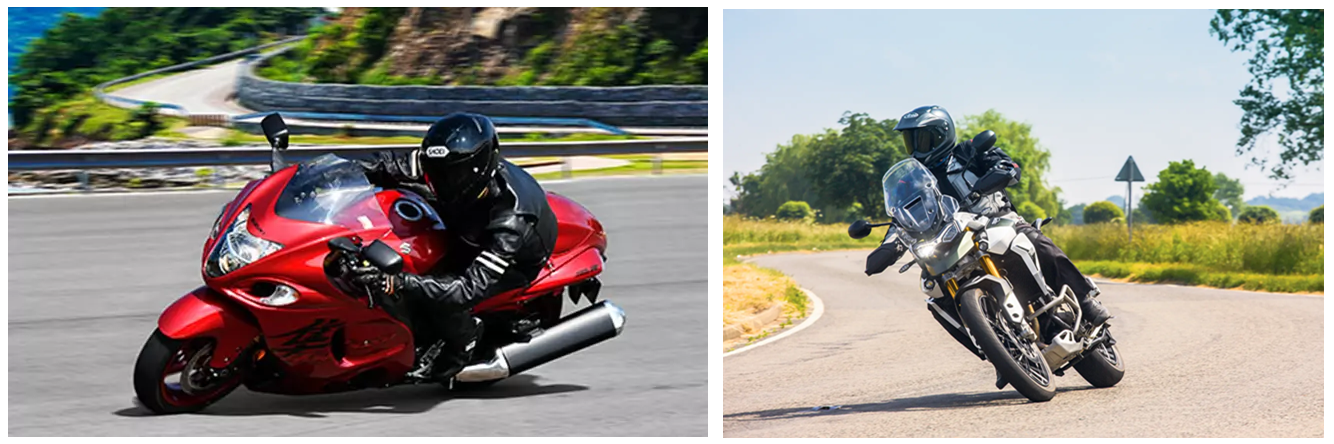
Two motorcycles A and Bare running at the speed more than allowed speed on the road along the lines $\vec{\text{r}}=\lambda(\hat{\text{i}}+2\hat{\text{j}}-\hat{\text{k}})$ and $\vec{\text{r}}=3\hat{\text{i}}+3\hat{\text{j}}+\mu(2\hat{\text{i}+\hat{\text{j}}+\hat{\text{k}}}),$ respectively. Based on the above information, answer the following questions.

  1. The cartesian equation of the line along which motorcycle A is running is:
  1. $\frac{\text{x}+1}{1}=\frac{\text{y}+1}{2}=\frac{\text{z}-1}{-1}$
  2. $\frac{\text{x}}{1}=\frac{\text{y}}{2}=\frac{\text{z}}{-1}$
  3. $\frac{\text{x}}{1}=\frac{\text{y}}{2}=\frac{\text{z}}{1}$
  4. None of these
  1. The direction cosines of line along which motorcycle A is running, are:
  1. < 1, -2, 1 >
  2. < I, 2, -1 >
  3. $<\frac{1}{\sqrt{6}},\frac{-2}{\sqrt{6}},\frac{1}{\sqrt{6}}>$
  4. $<\frac{1}{\sqrt{6}},\frac{2}{\sqrt{6}},\frac{-1}{\sqrt{6}}>$
  1. The direction ratios of line along which motorcycle Bis running, are:
  1. < 1, 0, 2 >
  2. < 2, 1, 0 >
  3. < 1, 1, 2 >
  4. < 2, 1, 1 >
  1. The shortest distance between the gives lines is:
  1. 4 units
  2. $2\sqrt{3}\text{ units}$
  3. $3\sqrt{2}\text{ units}$
  4. 0 units
  1. The motorcycles will meet with an accident at the point:
  1. (-1, 1, 2)
  2. (2, 1, -1)
  3. (1, 2, -1)
  4. Does not exist
Two schools $A$ and $B$ want to award their selected students on the values of Honesty, Hard work and Punctuality. The school $A$ wants to award $₹\ x$ each, $₹\ y$ each and $₹\ z$ each for the three respective values to its $3, 2$ and $1$ students respectively with a total award money of $₹\ 2200.$ School $B$ wants to spend $₹\ 3100$ to award its $4, 1$ and $3$ students on the respective values $($by giving the same award money to the three values as school $A).$ The total amount of award for one prize on each value is $₹\ 1200.$

Using the concept of matrices and determinants, answer the following questions.
  1. What is the award money for Honesty?
  1. $₹\ 350$
  2. $₹\ 300$
  3. $₹\ 500$
  4. $₹\ 400$
  1. What is the award money for Punctuality?
  1. $₹\ 300$
  2. $₹\ 280$
  3. $₹\ 450$
  4. $₹\ 500$
  1. What is the award money for Hard work?
  1. $₹\ 500$
  2. $₹\ 400$
  3. $₹\ 300$
  4. $₹\ 550$
  1. If a matrix $P$ is both symmetric and skew$-$symmetric, then $|P|$ is equal to:
  1. $1$
  2. $-1$
  3. $0$
  4. None of these.
  1. If P and Qare two matrices such that $PQ = Q$ and $QP = P,$ then $|Q^2|$ is equal to:
  1. $|Q|$
  2. $|P|$
  3. $1$
  4. $0$
Consider 2 families A and B. Suppose there are 4 men, 4 women and 4 children in family A and 2 men, 2 women and 2 children in family B. The recommended daily amount of calories is 2400 for a man, 1900 for a woman, 1800 for children and 45 grams of proteins for a man, 55 grams for a woman and 33 grams for children.

Image

(i) Represent the requirement of calories and proteins for each person in matrix form.

(ii) Find the requirement of calories of family A and requirement of proteins of family B.

(iii) Represent the requirement of calories and proteins If each person increases the protein intake by $5 \%$ and decrease the calories by $5 \%$ in matrix form.

OR

If $\mathrm{A}$ and $\mathrm{B}$ are two matrices such that $\mathrm{AB}=\mathrm{B}$ and $\mathrm{BA}=\mathrm{A}$, then find $\mathrm{A}^2+\mathrm{B}^2$ in terms of $\mathrm{A}$ and $\mathrm{B}$.

Let x = f(t) and y = g(t) be parametric forms with t as a parameter, then
$\frac{\text{dy}}{\text{dx}}=\frac{\text{dy}}{\text{dt}}\times\frac{\text{dt}}{\text{dx}}=\frac{\text{g}'(\text{t})}{\text{f}'(\text{t})},$ where $\text{f}'(\text{t})\neq0.$
On the basis of above information, answer the following questions.
  1. The derivative of $\text{f}(\tan\text{x})\text{w.r.t.}\text{ g}(\sec\text{x})\text{ at}\text{ x}=\frac{\pi}{4},$ where f'(1) = 2 and $\text{g}'(\sqrt{2})=4,$ is:
  1. $\frac{1}{\sqrt{2}}$
  2. ${\sqrt{2}}$
  3. 1
  4. 0
  1. The derivative of $\sin^{-1}\Big(\frac{2\text{x}}{1+\text{x}^2}\Big)$ with respect to $\cos^{-1}\Big(\frac{1-\text{x}^2}{1+\text{x}^2}\Big)$ is:
  1. -1
  2. 1
  3. 2
  4. 4
  1. The derivative of $\text{e}^{\text{x}^3}$ with respect to log x is:
  1. $\text{e}^{\text{x}^3}$
  2. $3\text{x}^22\text{e}^{\text{x}^3}$
  3. $3\text{x}^3\text{e}^{\text{x}^3}$
  4. $3\text{x}^2\text{e}^{\text{x}^3}+3\text{x}$
  1. The derivative of $\cos^{-1}(2\text{x}^2-1)\text{w.r.t.}\cos^{-1}\text{x}$ is:
  1. $2$
  2. $\frac{-1}{2\sqrt{1-\text{x}^2}}$
  3. $\frac{2}{\text{x}}$
  4. $1-\text{x}^2$
  1. If $\text{y}=\frac{1}{4}\mu^4$ and $\mu=\frac{2}{3}\text{x}^3+5,$ then $\frac{\text{dy}}{\text{dx}}=$
  1. $\frac{2}{27}\text{x}^2(2\text{x}^3+15)^3$
  2. $\frac{2}{7}\text{x}^2(2\text{x}^3+15)^3$
  3. $\frac{2}{27}\text{x}(2\text{x}^3+5)^3$
  4. $\frac{2}{7}(2\text{x}^3+15)^3$
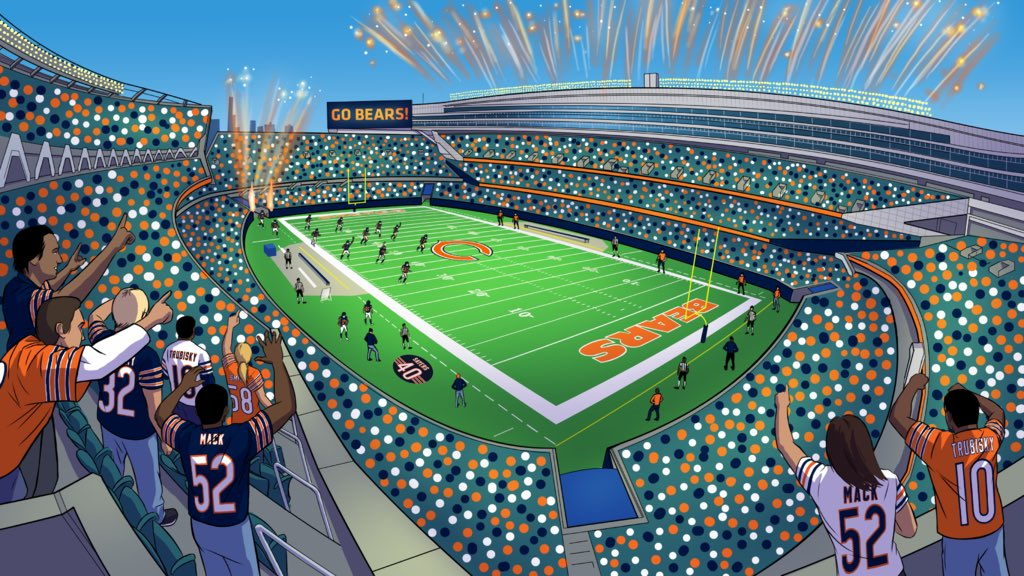
A football match is organised between students of class XII of two schools, say school A and school B. For which a team from each school is chosen. Remaining students of class XII of school A and Bare respectively sitting 
on the plane represented by the equation$ \vec{\text{r}}.(\hat{\text{i}}+\hat{\text{j}}+\hat{2\text{k}})=5$ and $ \vec{\text{r}}.(\hat{2\text{i}}-\hat{\text{j}}+\hat{\text{k}})=6$ to cheer up the team of their respective schools. 
Based on the above information, answer the following questions. 
  1. The cartesian equation of the plane on which students of school A are seated is:
  1. 2x - y + z = 8
  2. 2x + y + z = 8
  3. x + y + 2z = 5
  4. x + y + z = 5
  1. The magnitude of the normal to the plane on which students of school Bare seated, is:
  1. $\sqrt{5}$
  2. $\sqrt{6}$
  3. $\sqrt{3}$
  4. $\sqrt{2}$
  1. The intercept form of the equation of the plane on which students of school Bare seated is:
  1. $\frac{\text{x}}{6}+\frac{\text{y}}{6}+\frac{\text{z}}{6}=1$
  2. $\frac{\text{x}}{3}+\frac{\text{y}}{(-6)}+\frac{\text{z}}{6}=1$
  3. $\frac{\text{x}}{3}+\frac{\text{y}}{6}+\frac{\text{z}}{6}=1$
  4. $\frac{\text{x}}{3}+\frac{\text{y}}{6}+\frac{\text{z}}{3}=1$
  1. Which of the following is a student of school B?
  1. Mohit sitting at (1, 2, 1)
  2. Ravi sitting at (0, 1, 2)
  3. Khushi sitting at (3, 1, 1)
  4. Shewta sitting at (2, -1, 2)
  1. The distance of the plane, on which students of school Bare seated, from the origin is:
  1. 6 units
  2. $\frac{1}{\sqrt{6}}\text{ units}$
  3. $\frac{5}{\sqrt{6}}\text{ units}$
  4. $\sqrt{6}\text{ units}$
Read the following text carefully and answer the questions that follow:
If two vectors are represented by the two sides of a triangle taken in order, then their sum is represented by the third side of the triangle taken in opposite order and this is known as triangle law of vector addition
$i.$ If $\vec{p}, \vec{q}, \vec{r}$ are the vectors represented by the sides of a triangle taken in order, then find $\vec{q}+\vec{r}. (1)$
$ii.$ If $\text{ABCD}$ is a parallelogram and $A C$ and $B D$ are its diagonals, then find the value of $\overrightarrow{A C}+\overrightarrow{B D}$.
$iii.$ If $\text{ABCD}$ is a parallelogram, where $\overrightarrow{A B}=2 \vec{a}$ and $\overrightarrow{B C}=2 \vec{b}$, then find the value of $\overrightarrow{A C}-\overrightarrow{B D}. (2)$
$OR$
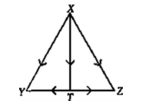
If $T$ is the mid point of side $YZ$ of $\triangle XYZ$, then what is the value of $\overrightarrow{X Y}+\overrightarrow{X Z}. (2)$
Image
Consider the following equations of curves $\text{y}=\cos\text{x},\text{y}=\text{x}+1$ and y = 0.
On the basis of above information, answer the following questions.

  1. The curves $\text{y}=\cos\text{x}$ and y = x + 1 meet at:
  1. (1, 0)
  2. (0, 1)
  3. (1, 1)
  4. (0, 0)
  1. $\text{y}=\cos\text{x}$ meet the x-axis at:
  1. $\Big(\frac{-\pi}{2},0\Big)$
  2. $\Big(\frac{\pi}{2},0\Big)$
  3. Both (a) and (b).
  4. None of these.
  1. Value of the integral $\int\limits_{-1}^{0}(\text{x}+1)\text{dx}$ is:
  1. $\frac{1}{2}$
  2. $\frac{2}{3}$
  3. $\frac{3}{4}$
  4. $\frac{1}{3}$
  1. Value of the integral $\int\limits_{0}^{\frac{\pi}{2}}\cos\text{x dx}$ is:
  1. 0
  2. -1
  3. 2
  4. 1
  1. Area bounded by the given curves is:
  1. $\frac{1}{2}\text{ sq}.\text{units}$
  2. $\frac{3}{2}\text{ sq}.\text{units}$
  3. $\frac{3}{4}\text{ sq}.\text{units}$
  4. $\frac{1}{4}\text{ sq}.\text{units}$
If there is a statement involving the natural number $n$ such that:
  1. The statement is true for $n = 1$
  2. When the statement is true for $n = k ($where $k$ is some positive integer$),$ then the statement is also true for $n = k + 1.$
Then, the statement is true for all natural numbers $n.$
Also, if $A$ is a square matrix of order $n,$ then $A^2$ is defined as $AA.$ In general, $A^m = AA .... A (m$ times$).$
where $m$ is any positive integer. Based on the above information, answer the following questions.
  1. If $\text{A}=\begin{bmatrix}3&-4\\1&-1\end{bmatrix},$ then for any positive integer $n,$
  1. $\text{A}^\text{n}=\begin{bmatrix}3\text{n}&-4\text{n}\\\text{n}&-\text{n}\end{bmatrix}$
  2. $\text{A}^\text{n}=\begin{bmatrix}1+2\text{n}&-4\text{n}\\\text{n}&1-2\text{n}\end{bmatrix}$
  3. $\text{A}^\text{n}=\begin{bmatrix}3\text{n}&-8\text{n}\\1&-\text{n}\end{bmatrix}$
  4. $\text{A}^\text{n}=\begin{bmatrix}1+3\text{n}&-4\text{n}\\\text{n}&1-3\text{n}\end{bmatrix}$
  1. If $\text{A}=\begin{bmatrix}1&2\\0&1\end{bmatrix},$ then $|A^n|,$ where $\text{n}\epsilon\text{ N},$ is equal to:
  1. $2^n$
  2. $3^n$
  3. $n$
  4. $1$
  1. If $\text{A}=\begin{bmatrix}1&0\\1&1\end{bmatrix}$ and $\text{I}=\begin{bmatrix}1&0\\0&1\end{bmatrix}$ then which of the following holds for all natural numbers $\text{n}\geq1?$
  1. $A^{n }= nA - (n - 1)I$
  2. $A^n = 2^{n-1} A - (n - 1)I$
  3. $A^{n }= nA + (n - 1)I$
  4. $A^n = 2^{n-1} A + (n - 1)I$
  1. Let $\text{A}=\begin{bmatrix}\text{a}&0&0\\0&\text{a}&0\\0&0&\text{a}\end{bmatrix}$ and $\text{A}^\text{n}=[\text{a}_{\text{ij}}]_{3\times3}$ for some positive integer $n,$ then the cofactor of $a_{13}$ is:
  1. $a^n$
  2. $-a^n$
  3. $2a^n$
  4. $0$
  1. If $A$ is a square matrix such that $|A| = 2,$ then for any positive integer $n, |A^n|$ is equal to:
  1. $0$
  2. $2n$
  3. $2^n$
  4. $n^2$
In a city there are two factories A and B. Each factory produces sports clothes for boys and girls. There are three types of clothes produced in both the factories, type I, II and III. For boys the number of units of types I, II and III respectively are 80, 70 and 65 in factory A and 85, 65 and 72 are in factory B. For girls the number of units of types I, II and III respectively are 80, 75, 90 in factory A and 50, 55, 80 are in factory B.

Based on the above information, answer the following questions:
  1. If P represents the matrix of number of units of each type produced by factory A for both boys and girls, then P is given by:
  1. $\begin{matrix}&\text{Boys}&\text{Girls}\end{matrix}\\\begin{matrix}\text{I}\\\text{II}\\\text{III}\end{matrix}\begin{bmatrix}85&50\\65&55\\72&80\end{bmatrix}$
  2. $\begin{matrix}&&&\text{I}\ \ \ &\text{II}&\text{III}\end{matrix}\\\begin{matrix}\text{Boys}\\\text{Girls}\end{matrix}\begin{bmatrix}50&55&80\\85&65&72\end{bmatrix}$
  3. $\begin{matrix}&&&\text{I}\ \ \ &\text{II}&\text{III}\end{matrix}\\\begin{matrix}\text{Boys}\\\text{Girls}\end{matrix}\begin{bmatrix}80&75&90\\80&70&65\end{bmatrix}$
  4. $\begin{matrix}&\text{Boys}&\text{Girls}\end{matrix}\\\begin{matrix}\text{I}\\\text{II}\\\text{III}\end{matrix}\begin{bmatrix}80&80\\70&75\\65&90\end{bmatrix}$
  1. If Q represents the matrix of number of units of each type produced by factory B for both boys and girls, then Q is given by:
  1. $\begin{matrix}&\text{Boys}&\text{Girls}\end{matrix}\\\begin{matrix}\text{I}\\\text{II}\\\text{III}\end{matrix}\begin{bmatrix}85&50\\65&55\\72&80\end{bmatrix}$
  2. $\begin{matrix}&&&\text{I}\ \ \ &\text{II}&\text{III}\end{matrix}\\\begin{matrix}\text{Boys}\\\text{Girls}\end{matrix}\begin{bmatrix}80&75&90\\80&70&65\end{bmatrix}$
  3. $\begin{matrix}&&&\text{I}\ \ \ &\text{II}&\text{III}\end{matrix}\\\begin{matrix}\text{Boys}\\\text{Girls}\end{matrix}\begin{bmatrix}80&75&90\\80&70&65\end{bmatrix}$
  4. $\begin{matrix}&\text{Boys}&\text{Girls}\end{matrix}\\\begin{matrix}\text{I}\\\text{II}\\\text{III}\end{matrix}\begin{bmatrix}80&80\\70&75\\65&90\end{bmatrix}$
  1. The total production of sports clothes of each type for boys is given by the matrix.
  1. $\begin{matrix}\ \ \text{I}&\ \ \ \ \text{II}&\ \ \ \text{III}\end{matrix}\\\begin{matrix}[165&130&137]\end{matrix}\\$
  2. $\begin{matrix}\ \ \text{I}&\ \ \ \ \text{II}&\ \ \ \text{III}\end{matrix}\\\begin{matrix}[130&165&137]\end{matrix}\\$
  3. $\begin{matrix}\ \ \text{I}&\ \ \ \ \text{II}&\ \ \ \text{III}\end{matrix}\\\begin{matrix}[165&135&137]\end{matrix}\\$
  4. $\begin{matrix}\ \ \text{I}&\ \ \ \ \text{II}&\ \ \ \text{III}\end{matrix}\\\begin{matrix}[137&135&165]\end{matrix}\\$
  1. The total production of sports clothes of each type for girls is given by the matrix.
  1. $\begin{matrix}\ \ \text{I}&\ \ \ \ \text{II}&\ \ \ \text{III}\end{matrix}\\\begin{matrix}[130&130&170]\end{matrix}\\$
  2. $\begin{matrix}\ \ \text{I}&\ \ \ \ \text{II}&\ \ \ \text{III}\end{matrix}\\\begin{matrix}[170&130&130]\end{matrix}\\$
  3. $\begin{matrix}\ \ \text{I}&\ \ \ \ \text{II}&\ \ \ \text{III}\end{matrix}\\\begin{matrix}[130&170&130]\end{matrix}\\$
  4. None of these
  1. Let R be a 3 × 2 matrix that represent the total production of sports dothes of each type for boys and girls, then transpose of R is:
  1. $\begin{bmatrix}165 & 135 & 137\\130 & 130 & 170 \end{bmatrix}$
  2. $\begin{bmatrix}130 & 130 & 170\\165 & 135 & 138 \end{bmatrix}$
  3. $\begin{bmatrix}165 & 132 \\135 & 130 \\137 & 170 \end{bmatrix}$
  4. $\begin{bmatrix}130 & 168 \\130 & 135 \\170 & 137 \end{bmatrix}$
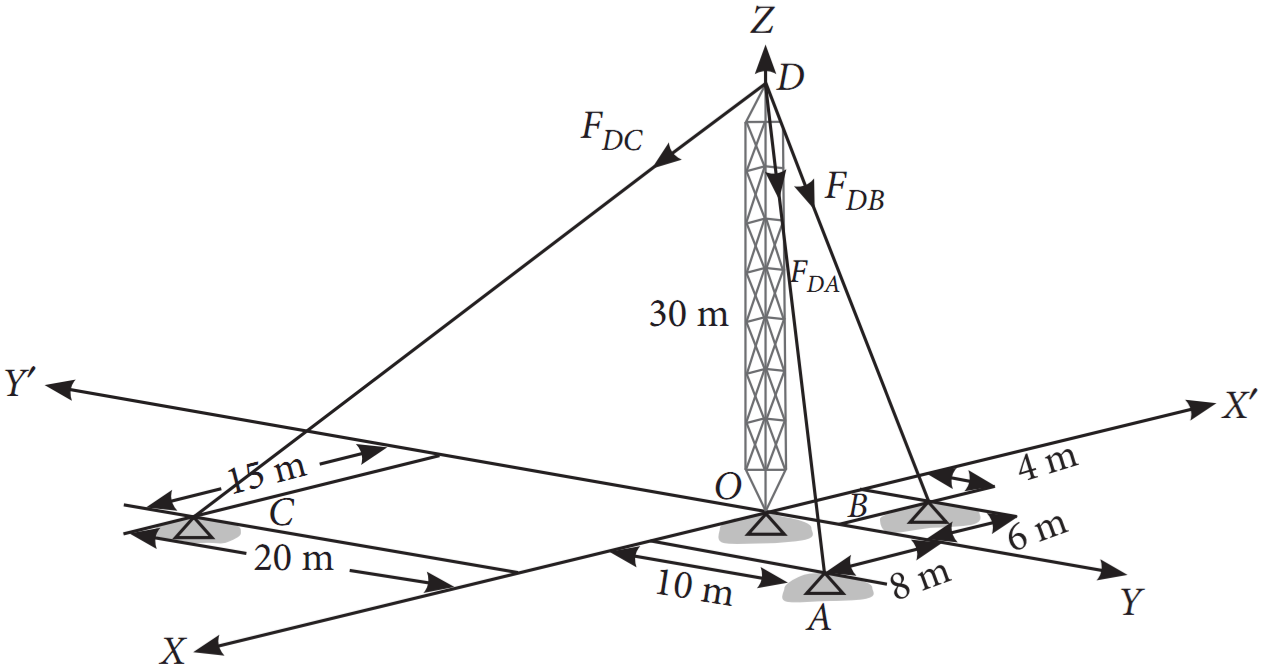
Consider the following diagram, where the forces in the cable are given. Based on the above information, answer the following questions.
  1. The equation of line along the cable AD is:
  1. $\frac{\text{x}}{5}=\frac{\text{y}}{4}=\frac{\text{z}-30}{15}$
  2. $\frac{\text{x}}{4}=\frac{\text{y}}{5}=\frac{\text{z}-30}{15}$
  3. $\frac{\text{x}}{5}=\frac{\text{y}}{4}=\frac{30-\text{z}}{15}$
  4. $\frac{\text{x}}{4}=\frac{\text{y}}{5}=\frac{30-\text{z}}{15}$
  1. The length of cable DC is:
  1. $4\sqrt{61}\text{m}$
  2. $5\sqrt{61}\text{m}$
  3. $6\sqrt{61}\text{m}$
  4. $7\sqrt{61}\text{m}$
  1. The vector DB is:
  1. $-6\hat{\text{i}}+4\hat{\text{j}}-30\hat{\text{k}}$
  2. $6\hat{\text{i}}-4\hat{\text{j}}+30\hat{\text{k}}$
  3. $6\hat{\text{i}}+4\hat{\text{j}}+30\hat{\text{k}}$
  4. None of these
  1. The sum of vectors along the cables is:
  1. $17\hat{\text{i}}+6\hat{\text{j}}+90\hat{\text{k}}$
  2. $17\hat{\text{i}}-6\hat{\text{j}}-90\hat{\text{k}}$
  3. $17\hat{\text{i}}+6\hat{\text{j}}-90\hat{\text{k}}$
  4. None of these
  1. The sum of distances of points A, B and C from the origin, i.e., OA + OB + OC is:
  1. $\sqrt{164}+\sqrt{52}+\sqrt{625}$
  2. $\sqrt{52}+\sqrt{625}+\sqrt{48}$
  3. $\sqrt{164}+\sqrt{625}+\sqrt{49}$
  4. None of these