Question
Let x = f(t) and y = g(t) be parametric forms with t as a parameter, then
$\frac{\text{dy}}{\text{dx}}=\frac{\text{dy}}{\text{dt}}\times\frac{\text{dt}}{\text{dx}}=\frac{\text{g}'(\text{t})}{\text{f}'(\text{t})},$ where $\text{f}'(\text{t})\neq0.$
On the basis of above information, answer the following questions.
  1. The derivative of $\text{f}(\tan\text{x})\text{w.r.t.}\text{ g}(\sec\text{x})\text{ at}\text{ x}=\frac{\pi}{4},$ where f'(1) = 2 and $\text{g}'(\sqrt{2})=4,$ is:
  1. $\frac{1}{\sqrt{2}}$
  2. ${\sqrt{2}}$
  3. 1
  4. 0
  1. The derivative of $\sin^{-1}\Big(\frac{2\text{x}}{1+\text{x}^2}\Big)$ with respect to $\cos^{-1}\Big(\frac{1-\text{x}^2}{1+\text{x}^2}\Big)$ is:
  1. -1
  2. 1
  3. 2
  4. 4
  1. The derivative of $\text{e}^{\text{x}^3}$ with respect to log x is:
  1. $\text{e}^{\text{x}^3}$
  2. $3\text{x}^22\text{e}^{\text{x}^3}$
  3. $3\text{x}^3\text{e}^{\text{x}^3}$
  4. $3\text{x}^2\text{e}^{\text{x}^3}+3\text{x}$
  1. The derivative of $\cos^{-1}(2\text{x}^2-1)\text{w.r.t.}\cos^{-1}\text{x}$ is:
  1. $2$
  2. $\frac{-1}{2\sqrt{1-\text{x}^2}}$
  3. $\frac{2}{\text{x}}$
  4. $1-\text{x}^2$
  1. If $\text{y}=\frac{1}{4}\mu^4$ and $\mu=\frac{2}{3}\text{x}^3+5,$ then $\frac{\text{dy}}{\text{dx}}=$
  1. $\frac{2}{27}\text{x}^2(2\text{x}^3+15)^3$
  2. $\frac{2}{7}\text{x}^2(2\text{x}^3+15)^3$
  3. $\frac{2}{27}\text{x}(2\text{x}^3+5)^3$
  4. $\frac{2}{7}(2\text{x}^3+15)^3$

Answer

  1. (a) $\frac{1}{\sqrt{2}}$
Solution:
Now, $\frac{\text{df}(\tan\text{x})}{\text{dg}(\sec\text{x})}=\frac{\text{f}'(\tan \text{x})\sec^2\text{x}}{\text{g}'(\sec\text{x})\sec\text{x}\tan \text{x}}$
$=\frac{\text{f}'(\tan \text{x})\sec\text{x}}{\text{g}'(\sec\text{x})\tan \text{x}}$
$\therefore\Big[\frac{\text{df}(\tan\text{x})}{\text{dg}(\sec\text{x})}\Big]_{\text{x}=\frac{\pi}{4}}=\frac{\text{f}'(1)\sqrt{2}}{\text{g}'(\sqrt{2})\cdot1}=\frac{2\sqrt{2}}{4\cdot1}=\frac{1}{\sqrt{2}}$
  1. (b) 1
  1. (c) $3\text{x}^3\text{e}^{\text{x}^3}$
Solution:
Let $\text{y}=\text{e}^{\text{x}^3},\text{z}=\log\text{x}$
Differentiating w.r.t. x, we get
$\frac{\text{dy}}{\text{dx}}=\text{e}^{\text{x}^3}(3\text{x}^2)=3\text{x}^2\text{e}^{\text{x}^3}$ and $\therefore\frac{\text{dy}}{\text{dz}}=\frac{\frac{\text{dy}}{\text{dx}}}{\frac{\text{dz}}{\text{dx}}}=\frac{3\text{x}^2\text{e}^{\text{x}^3}}{\Big(\frac{1}{\text{x}}\Big)}=3\text{x}^3\text{e}^{\text{x}^3}$
  1. (a) $2$
Solution:
Let $\text{y}=\cos^{-1}(2\text{x}^2-1)=2\cos^{-1}\text{x}$
Differentiating w.r.t. $\cos^{-1}\text{x},$ we get
$\frac{\text{dy}}{\text{d}(\cos^{-1}\text{x})}=\frac{2\text{d}(\cos^{-1}\text{x})}{\text{d}(\cos^{-1}\text{x})}=2$
  1. (a) $\frac{2}{27}\text{x}^2(2\text{x}^3+15)^3$
Solution:
We have, $\text{y}=\frac{1}{4}\text{u}^4\Rightarrow\frac{\text{dy}}{\text{du}}=\frac{1}{4}\cdot4\text{u}^3=\text{u}^3$
and $\text{u}=\frac{2}{3}\text{x}^3+5\Rightarrow\frac{\text{du}}{\text{dx}}=\frac{2}{3}\cdot3\text{x}^2=2\text{x}^2$
$\therefore\frac{\text{dy}}{\text{dx}}=\frac{\text{dy}}{\text{du}}\cdot\frac{\text{du}}{\text{dx}}=\text{u}^3\cdot2\text{x}^2=\Big(\frac{2}{3}\text{x}^3+5\Big)^3(2\text{x})^2$
$=\frac{2}{27}\text{x}^2(2\text{x}^3+15)^3$

Need a full question paper?

Generate a complete, print-ready paper with questions like this in minutes — across 16+ boards, with answer keys.

Start Generating Free

Similar questions

A trust fund has $₹ 35000$ that must be invested in two different types of bonds, say $\mathrm{X}$ and $\mathrm{Y}$. The first bond pays $10 \%$ interest p.a. which will be given to an old age home and second one pays $8 \%$ interest p.a. which will be given to WWA (Women Welfare Association). Let A be a $1 \times 2$ matrix and B be a $2 \times 1$ matrix, representing the investment and interest rate on each bond respectively.

Image

(i) Represent the given information in matrix algebra.

(ii) If ₹ 15000 is invested in bond $\mathrm{X}$, then find total amount of interest received on both bonds?

(iii) If the trust fund obtains an annual total interest of ₹ 3200 , then find the investment in two bonds.

OR

If the amount of interest given to old age home is ₹500, then find the amount of investment in bond Y.

In pre-board examination of class XII, commerce stream with Economics and Mathematics of a particular school, 50% of the students failed in Economics, 35% failed in Mathematics and 25% failed in both Economics and Mathematics. A student is selected at random from the class. Based on the above information, answer the following questions.
  1. The probability that the selected student has failed in Economics, if it is known that he has failed in Mathematics, is:
  1. $\frac{3}{10}$
  2. $\frac{12}{25}$
  3. $\frac{1}{4}$
  4. $\frac{5}{7}$
  1. The probability that the selected student has failed in Mathematics, if it is known that he has failed in Economics, is:
  1. $\frac{22}{25}$
  2. $\frac{12}{25}$
  3. $\frac{1}{2}$
  4. $\frac{3}{25}$
  1. The probability that the selected student has passed in at least one of the two subjects, is:
  1. $\frac{1}{4}$
  2. $\frac{1}{2}$
  3. $\frac{3}{4}$
  4. None of these.
  1. The probability that the selected student has failed in at least one of the two subjects, is:
  1. $\frac{3}{5}$
  2. $\frac{22}{25}$
  3. $\frac{2}{5}$
  4. $\frac{43}{100}$
  1. The probability that the selected student has passed in Mathematics, if it is known that he has failed in Economics, is:
  1. $\frac{2}{5}$
  2. $\frac{3}{4}$
  3. $\frac{1}{3}$
  4. $\frac{1}{2}$ 
Read the following text carefully and answer the questions that follow:
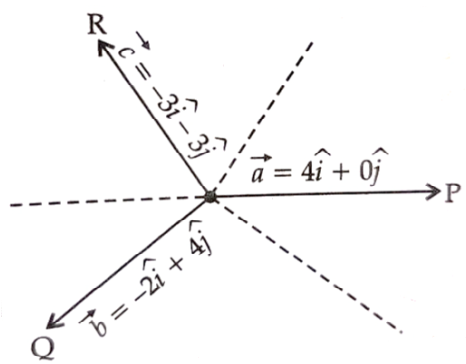
Team $\text{P, Q, R}$ went for playing a tug of war game. .
Teams $\text{P, Q, R}$ have attached a rope to a metal ring and is trying to pull the ring into their own areas $($team areas when in the given figure below$)$.
Team $P$ pulls with force$F _1=4 \hat{i}+0 \hat{j} KN$
Team $Q$ pull with force $F _2=-2 \hat{i}+4 \hat{j} KN$
Team $R$ pulls with force $F _3=-3 \hat{i}-3 \hat{j} KN$
Image
$i.$ What is the magnitude of the teams combined force? $(1)$
$ii.$ Find the magnitude of Team $B. (1)$
$iii.$ Which team will win the game? $(2)$​​​​​​​
$OR$
Find the probability that she gets grade $A$ in at least one subject. $(2)$
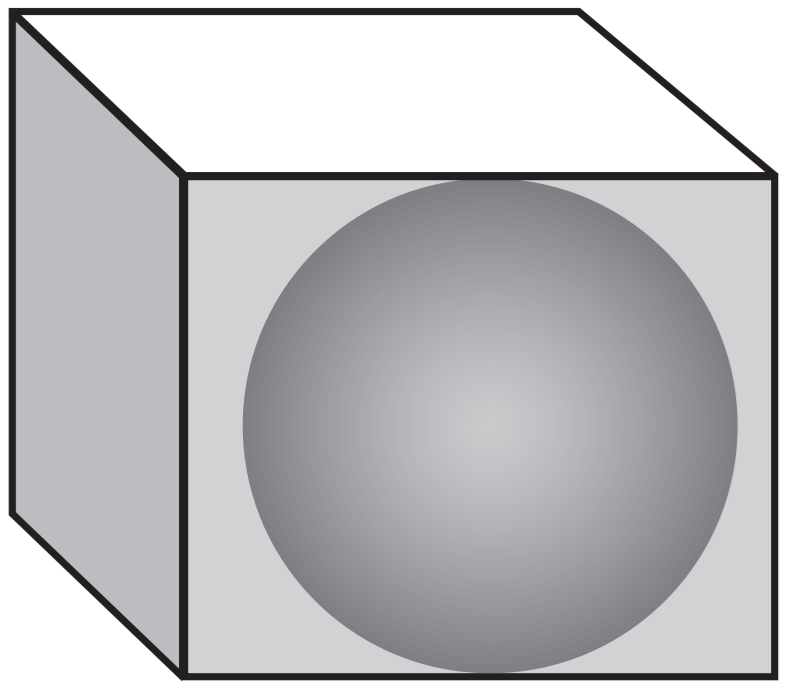
Shreya got a rectangular parallelepiped shaped box and spherical ball inside it as return gift. Sides of the box are $x, 2x,$ and $\frac{\text{x}}{3},$ while radius of the ball is $r.$

Based on the above information, answer the following questions.
  1. If $S$ represents the sum of volume of parallelepiped and sphere, then Scan be written as.
  1. $\frac{4\text{x}^3}{3}+\frac{2}{2}\pi\text{r}^2$
  2. $\frac{2\text{x}^2}{3}+\frac{4}{3}\pi\text{r}^2$
  3. $\frac{2\text{x}^3}{3}+\frac{4}{3}\pi\text{r}^3$
  4. $\frac{2}{3}\text{x}+\frac{4}{3}\pi\text{r}$
  1. If sum of the surface areas of box and ball are given to be constant $k^2$ then $x$ is equal to.
  1. $\sqrt{\frac{\text{k}^2-4\pi\text{r}^2}{6}}$
  2. $\sqrt{\frac{\text{k}^2-4\pi\text{r}}{6}}$
  3. $\sqrt{\frac{\text{k}^2-4\pi}{6}}$
  4. $\text{None of these}$
  1. The radius of the ball, when Sis minimum, is.
  1. $\sqrt{\frac{\text{k}^2}{54+\pi}}$
  2. $\sqrt{\frac{\text{k}^2}{54+4}}$
  3. $\sqrt{\frac{\text{k}^2}{64+3\pi}}$
  4. $\sqrt{\frac{\text{k}^2}{4\pi+3}}$
  1. Relation between length of the box and radius of the ball can be represented as.
  1. $\text{x} = \frac{2}{\text{r}}$
  2. $\text{x}=\frac{\text{r}}{2}$
  3. $\text{x}=\frac{2}{\text{r}}$
  4. $\text{x}=3\text{r}$
  1. Minimum value of $S$ is.
  1. $\frac{\text{k}^2}{2(3\pi+54)^\frac{2}{3}}$
  2. $\frac{\text{k}}{2(3\pi+54)^\frac{3}{2}}$
  3. $\frac{\text{k}^3}{2(4\pi+54)^\frac{1}{2}}$
  4. $\text{None of these}$
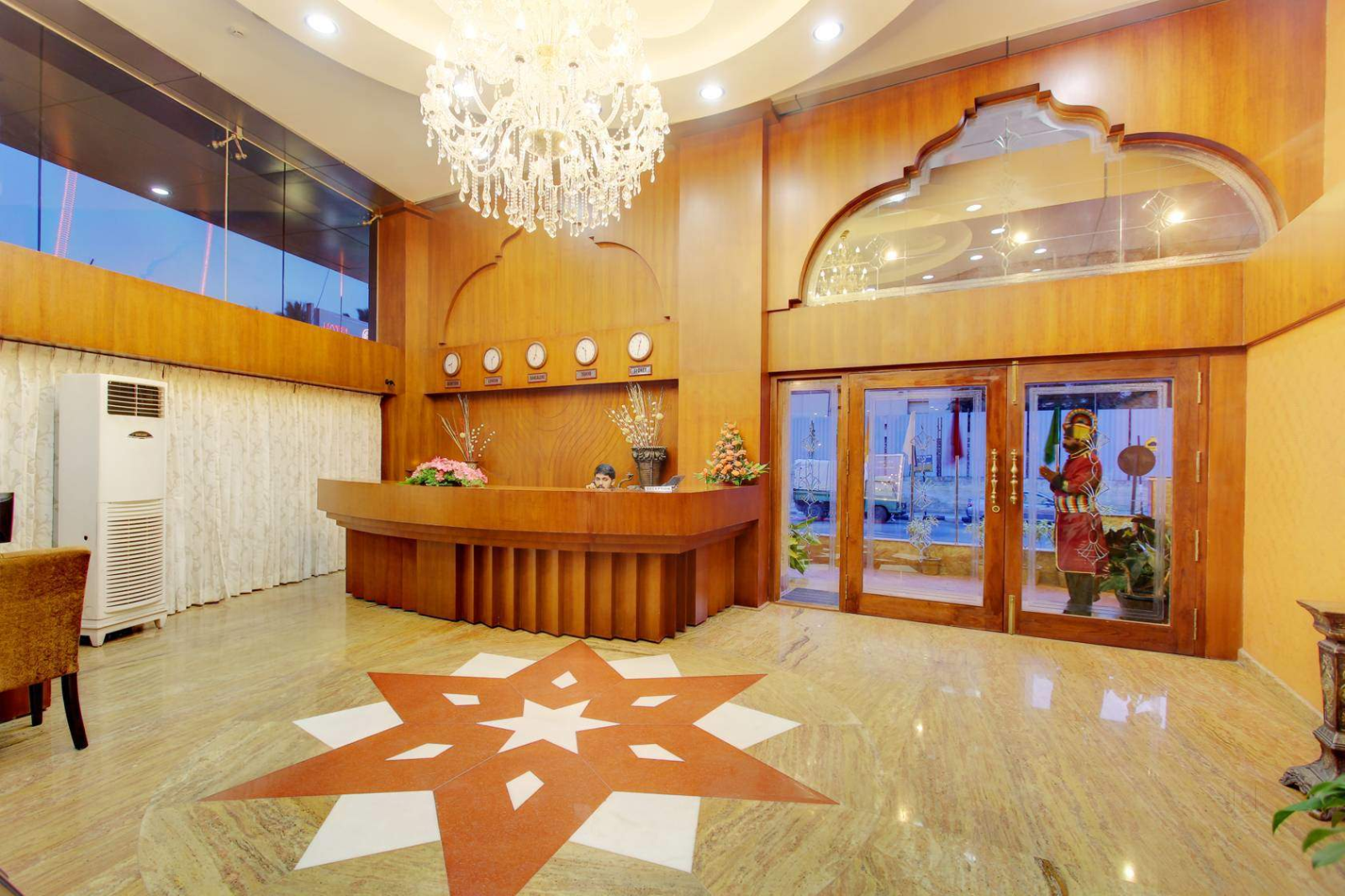
Suppose the floor of a hotel is made up of mirror polished Kota stone. Also, there is a large crystal chandelier attached at the ceiling of the hotel. Consider the floor of the hotel as a plane having equation $x - 2y + 2z = 3$ and crystal chandelier at the point $(3, -2, 1)$. Based on the above information, answer the following questions.

  1. The $d.r\ '$. of the perpendicular from the point $(3, -2, 1)$ to the plane $x - 2y + 2z = 3,$ is:
  1. $ < 1, 2, 2 > $
  2. $ < 1, -2, 2 > $
  3. $ < 2, 1, 2 > $
  4. $ < 2, -1, 2 > $
  1. The length of the perpendicular from the point $(3, -2, 1)$ to the plane $x - 2y + 2z = 3,$ is:
  1. $\frac{2}{3}$ units
  2. $3$ units
  3. $2$ units
  4. None of these
  1. The equation of the perpendicular from the point $(3, -2, 1)$ to the plane $x - 2y + 2z = 3,$ is:
  1. $\frac{\text{x}-3}{1}=\frac{\text{y}-2}{-2}=\frac{\text{z}-1}{2}$
  2. $\frac{\text{x}-3}{1}=\frac{\text{y}+2}{-2}=\frac{\text{z}-1}{2}$
  3. $\frac{\text{x}+3}{1}=\frac{\text{y}+2}{-2}=\frac{\text{z}-1}{2}$
  4. None of these
  1. The equation of plane parallel to the plane $x - 2y + 2z = 3,$ which is at a unit distance from the point $(3, -2, 1)$ is:
  1. $x - 2y + 2z = 0$
  2. $x - 2y + 2z = 6$
  3. $x - 2y + 2z = 12$
  4. Both $(b)$ and $(c)$
  1. The image of the point $(3, -2, 1)$ in the given plane is:
  1. $\Big(\frac{5}{3},\frac{2}{3},\frac{-5}{3}\Big)$
  2. $\Big(\frac{-5}{3},\frac{-2}{3},\frac{5}{3}\Big)$
  3. $\Big(\frac{-5}{3},\frac{2}{3},\frac{5}{3}\Big)$
  4. None of these
A doctor is to visit a patient. From the past experience, it is known that the probabilities that he will come by cab, metro, bike or by other means of transport are respectively $0.3, 0.2, 0.1$ and $0.4.$ 'Tile probabilities that he will be late are $0.25, 0.3, 0.35$ and $0.1$ if he comes by cab, metro, bike and other means of
transport respectively. Based on the above information, answer the following questions.

  1. When the doctor arrives late, what is the probability that he comes by metro?
  1. $\frac{5}{14}$
  2. $\frac{2}{7}$
  3. $\frac{5}{21}$
  4. $\frac{1}{6}$
  1. When the doctor arrives late, what is the probability that he comes by cab?
  1. $\frac{4}{21}$
  2. $\frac{1}{7}$
  3. $\frac{5}{14}$
  4. $\frac{2}{21}$
  1. When the doctor arrives late, what is the probability that he comes by bike?
  1. $\frac{5}{21}$
  2. $\frac{4}{7}$
  3. $\frac{5}{6}$
  4. $\frac{1}{6}$
  1. When the doctor arrives late, what is the probability that he comes by other means of transport?
  1. $\frac{6}{7}$
  2. $\frac{5}{14}$
  3. $\frac{4}{21}$
  4. $\frac{2}{7}$
  1. What is the probability that the doctor is late by any means?
  1. $1$
  2. $0$
  3. $\frac{1}{2}$
  4. $\frac{1}{4}$
Consider the mapping $f: A \rightarrow B$ is defined by $f(x) = x - 1$ such that $f$ is a bijection.
Based on the above information, answer the following questions.
  1. Domain of $f$ is:
  1. $R - {2}$
  2. $R$
  3. $R - {1, 2}$
  4. $R - {0}$
  1. Range of $f$ is:
  1. $R$
  2. $R - {2}$
  3. $R - {0}$
  4. $R - {1, 2}$
  1. If $g: R - {2} \rightarrow R - {1}$ is defined by $g(x) = 2f(x) - 1,$ then $g(x)$ in terms of $x$ is:
  1. $\frac{\text{x}+2}{\text{x}}$
  2. $\frac{\text{x}+1}{\text{x}-2}$
  3. $\frac{\text{x}-2}{\text{x}}$
  4. $\frac{\text{x}}{\text{x}-2}$
  1. The function $g$ defined above, is:
  1. One$-$one
  2. Many$-$one
  3. into
  4. None of these
  1. A function $f(x)$ is said to be one$-$one iff.
  1. $\ce{f(x_1) = f(x_2) \Rightarrow -x_{1 }= x_2}$
  2. $\ce{f(-x_1) = f(-x_2) \Rightarrow -x_1 = x_2}$
  3. $\ce{f(x_1) = f(x_2) \Rightarrow x_1 = x_2}$
  4. None of these
In pre-board examination of class XII, commerce stream with Economics and Mathematics of a particular school, 50% of the students failed in Economics, 35% failed in Mathematics and 25% failed in both Economics and Mathematics. A student is selected at random from the class. Based on the above information, answer the following questions.
  1. The probability that the selected student has failed in Economics, if it is known that he has failed in Mathematics, is:
  1. $\frac{3}{10}$
  2. $\frac{12}{25}$
  3. $\frac{1}{4}$
  4. $\frac{5}{7}$
  1. The probability that the selected student has failed in Mathematics, if it is known that he has failed in Economics, is:
  1. $\frac{22}{25}$
  2. $\frac{12}{25}$
  3. $\frac{1}{2}$
  4. $\frac{3}{25}$
  1. The probability that the selected student has passed in at least one of the two subjects, is:
  1. $\frac{1}{4}$
  2. $\frac{1}{2}$
  3. $\frac{3}{4}$
  4. None of these.
  1. The probability that the selected student has failed in at least one of the two subjects, is:
  1. $\frac{3}{5}$
  2. $\frac{22}{25}$
  3. $\frac{2}{5}$
  4. $\frac{43}{100}$
  1. The probability that the selected student has passed in Mathematics, if it is known that he has failed in Economics, is:
  1. $\frac{2}{5}$
  2. $\frac{3}{4}$
  3. $\frac{1}{3}$
  4. $\frac{1}{2}$ 
 In a wedding ceremony, consists of father, mother, daughter and son line up at random for a family photograph, as shown in figure.
Based on the above information, answer the following questions.
  1. Find the probability that daughter is at one end, given that father and mother are in the middle.
  1. $1$
  2. $\frac{1}{2}$
  3. $\frac{1}{3}$
  4. $\frac{2}{3}$
  1. Find the probability that mother is at right end, given that son and daughter are together.
  1. $\frac{1}{2}$
  2. $\frac{1}{3}$
  3. $\frac{1}{4}$
  4. $0$
  1. Find the probability that father and mother are in the middle, given that son is at right end.
  1. $\frac{1}{4}$
  2. $\frac{1}{2}$
  3. $\frac{1}{3}$
  4. $\frac{2}{3}$
  1. Find the probability that father and son are standing together, given that mother and daughter are standing together.
  1. $0$
  2. $1$
  3. $\frac{1}{2}$
  4. $\frac{2}{3}$
  1. Find the probability that father and mother are on either of the ends, given that son is at second position from the right end.
  1. $\frac{1}{3}$
  2. $\frac{2}{3}$
  3. $\frac{1}{4}$
  4. $\frac{2}{5}$  
An organization conducted bike race under $2$ different categories$-$boys and girls. In all, there were $250$ participants. Among all of them finally three from Category $1$ and two from Category $2$ were selected for the final race. Ravi forms two sets $B$ and $G$ with these participants for his college project.
Let $B =\left\{b_1, b_2, b_3\right\}, G =\left\{g_1, g_2\right\}$ where $B$ represents the set of boys selected and $G$ the set of girls who were selected for the final race.
Ravi decides to explore these sets for various types of relations and functions.
On the basis of the above information, answer the following questions:
$(i)$ Ravi wishes to form all the relations possible from $B$ to $G$. How many such relations are possible?
$(ii)$ Among these relations, how many are functions from $B$ to $G$ ?
$OR$
$(iii) (b)$ If the track of the final race $($for the biker $b_1)$ follows the curve
$x^2=4 y ;($ where $0 \leq x \leq 20 \sqrt{2} \ 0 \leq y \leq 200)$,then state whether the track represents a one$-$one and onto function or not. $($Justify$).$