Question
A differential equation is said to be in the variable separable form if it is expressible in the form f(x) dx = g(y) dy.
The solution of this equation is given by
$\int\text{f(x)dx}=\int\text{g(y)dy}+\text{c},$ where c is the constant of integration.
Based on the above information, answer the following questions.
  1. If the solution of the differential equation $\frac{\text{dy}}{\text{dx}}=\frac{\text{ax+3}}{\text{2y+f}}$ represents a circle, then the value of 'a' is:
  1. 2
  2. -2
  3. 3
  4. -4
  1. The differential equation $\frac{\text{dy}}{\text{dx}}=\frac{\sqrt{1-\text{y}^2}}{\text{y}}$ determines a family of circle with.
  1. Variable radii and fixed centre (0, 1)
  2. Variable radii and fixed centre (0, -1)
  3. Fixed radius 1 and variable centre on x-axis
  4. Fixed radius 1 and variable centre on y-axis
  1. If = y'+ 1, y(0) = 1, then y (In 2) =
  1. 1
  2. 2
  3. 3
  4. 4
  1. The solution of the differential equation $\frac{\text{dy}}{\text{dx}}=\text{e}^\text{x-y}+\text{x}^2\text{e}^\text{-y}$ is:
  1. $\text{e}^\text{x}=\frac{\text{y}^3}{3}+\text{e}^\text{y}+\text{c}$
  2. $\text{e}^\text{y}=\frac{\text{x}^2}{3}+\text{e}^\text{x}+\text{c}$
  3. $\text{e}^\text{y}=\frac{\text{x}^3}{3}+\text{e}^\text{x}+\text{c}$
  4. None of these
  1. If $\frac{\text{dy}}{\text{dx}}=\text{y}\sin2\text{x},\ \text{y}(0)=1,$ then its solution is:
  1. $\text{y}=\text{e}^{\sin^2}\text{x}$
  2. $\text{y}={\sin^2}\text{x}$
  3. $\text{y}={\cos^2}\text{x}$
  4. $\text{y}=\text{e}^{\cos^2}\text{x}$
Answer

  1. (b) -2

Solution:

We have, $\frac{\text{dy}}{\text{dx}}=\frac{\text{ax+3}}{\text{2y+f}}$

$\Rightarrow\ \ (\text{ax+3})\text{dx}=(2\text{y}+\text{f})\text{dy}$

$\Rightarrow\text{a}\frac{\text{x}^2}{2}+\text{3x}=\text{y}^2+\text{fy}+\text{c}$ (Integrating)

$\Rightarrow-\frac{\text{a}}{2}\text{x}^2+\text{y}^2-\text{3x}+\text{fy}+\text{C}=0$

This will represent a circle, if $\frac{-\text{a}}{2}=1\Rightarrow\text{a}=-2$

[ $\therefore$ In circle, coefficient of x2 = coefficient of y2)

  1. (c) Fixed radius 1 and variable centre on x-axis

Solution:

We have, $\frac{\text{ydy}}{\sqrt{1-\text{y}^2}}=\text{dx}$

On integration, we get $-\sqrt{1-\text{y}^2}=\text{x+c}$

⇒ 1 - y2 = (x + c)2 (x + c)+ y= 1 which represents a circle with radius I and centre on the x-axis.

  1. (c) 3

Solution:

$\text{y}'=\text{y}+1\Rightarrow\frac{\text{dy}}{\text{y}+1}=\text{dx}$

⇒ In (y + 1) = x + c (integrating)

Now, y(0) = 1 ⇒ c = In 2

$\therefore \ \text{In}\Bigg(\frac{\text{y}+1}{2}\Bigg)=\text{x}$

⇒ y + 1 = 2ex

So, y (In 2) = -1 + 2eIn 2 = -1 + 4 = 3

  1. (c) $\text{e}^\text{y}=\frac{\text{x}^3}{3}+\text{e}^\text{x}+\text{c}$

Solution:

From the given differential equation, we have

$\frac{\text{dy}}{\text{dx}}=\frac{\text{e}^\text{x}+\text{x}^\text{2}}{\text{e}^\text{y}}$

$\Rightarrow\ \text{e}^\text{y}\text{dy}=(\text{e}^\text{x}+\text{x}^2)\text{dx}$

Integrating, we get $\text{e}^\text{y}=\text{e}^\text{x}+\frac{\text{x}^3}{3}+\text{c}$

  1. (a) $\text{y}=\text{e}^{\sin^2}\text{x}$

Solution:

We have, $\frac{\text{dy}}{\text{dx}}=\text{y}\sin2\text{x}$

$\Rightarrow\ \frac{\text{dy}}{\text{y}}=\sin2\text{x}\ \text{dx}$

$\Rightarrow\ \log\text{y}=-\frac{\cos2\text{x}}{2}+\text{c}$

Since x = 0, y = 1

therefore $\text{C}=\frac{1}{2}$

Now, $\log\text{y}=\frac{1}{2}(1-\cos2\text{x})$

$\Rightarrow\ \log\text{y}=\sin^2\text{x}\Rightarrow\text{y}=\text{e}^{\sin^2}\text{x}$

Need a full question paper?

Generate a complete, print-ready paper with questions like this in minutes — across 16+ boards, with answer keys.

Start Generating Free

Similar questions

Linear programming is a method for finding the optimal values (maximum or minimum) of quantities subject to the constraints when relationship is expressed as linear equations or inequations.

Based on the above information, answer the following questions.
  1. The optimal value of the objective function is attained at the points:
  1. On X-axis.
  2. On Y-axis.
  3. Which are comer points of the feasible region.
  4. None of these.
  1. The graph of the inequality 3x + 4y < 12 is:
  1. Half plane that contains the origin.
  2. Half plane that neither contains the origin nor the points of the line 3x + 4y = 12.
  3. Whole XOY-plane excluding the points on line 3x + 4y = 12.
  4. None of these.
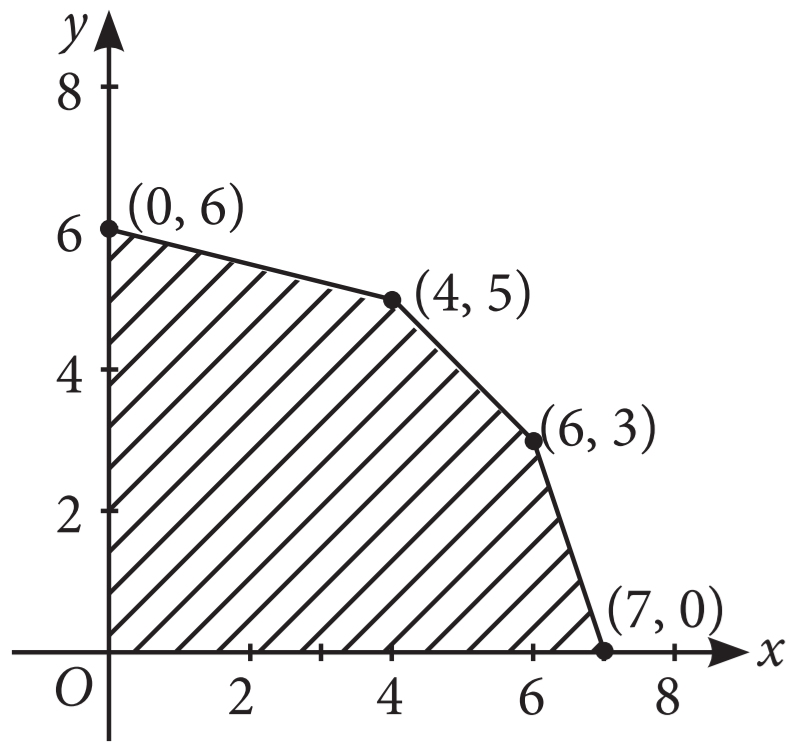
  1. The feasible region for an LPP is shown in the figure. Let Z = 2x + 5y be the objective function. Maximum of Z occurs at:

  1. (7, 0)
  2. (6, 3)
  3. (0, 6)
  4. (4, 5)
  1. The corner points of the feasible region determined by the system of linear constraints are (0, 10), (5, 5), (15, 15), (0, 20). Let Z = px + qy, where p, q > 0. Condition on p and q so that the maximum of Z occurs at both the points ( 15, 15) and (0, 20) is:
  1. p = q
  2. p = 2q
  3. q = 2p
  4. q = 3p
  1. The comer points of the feasible region determined by the system of linear constraints are (0, 0), (0, 40), (20, 40), (60, 20), (60, 0). The objective function is Z = 4x + 3y.

Compare the quantity in Column A and Column B

Column A
Column B
Maximum of Z
325
  1. The quantity in column A is greater.
  2. The quantity in column Bis greater.
  3. The two quantities are equal.
  4. The relationship cannot be determined on the basis of the information supplied.
Corner points of the feasible region for an LPP are (0, 3), (5, 0), (6, 8), (0, 8). Let Z = 4x - 6y be the objective function.

Based on the above information, answer the following questions.
  1. The minimum value of Z occurs at:
  1. (6, 8)
  2. (5, 0)
  3. (0, 3)
  4. (0, 8)
  1. Maximum value of Z occurs at:
  1. (5, 0)
  2. (0, 8)
  3. (0, 3)
  4. (6, 8)
  1. Maximum of Z - Minimum of Z =
  1. 58
  2. 68
  3. 78
  4. 88
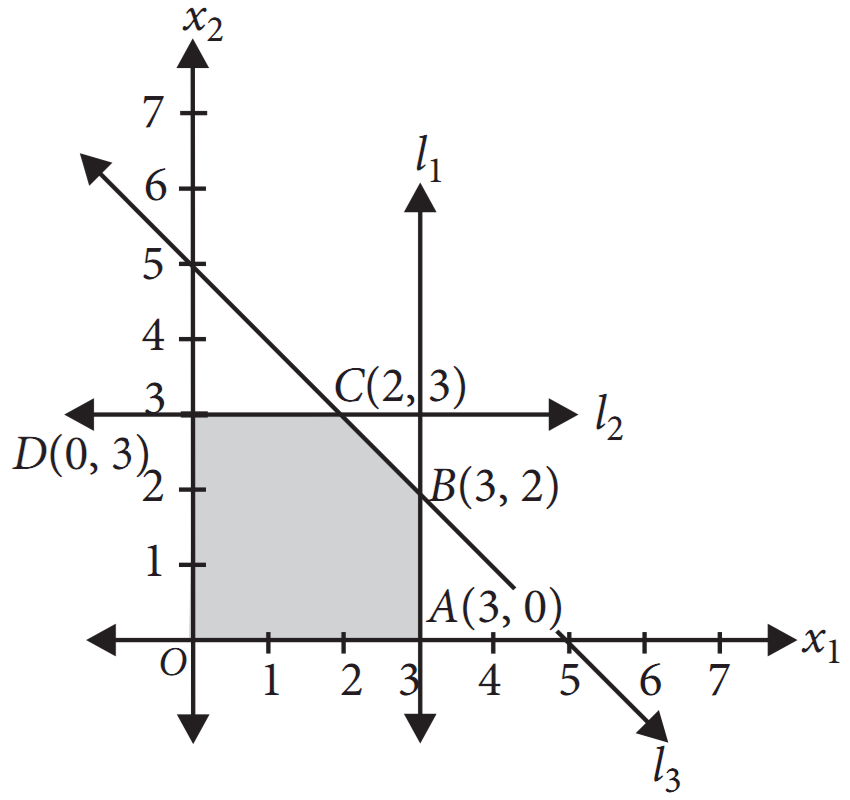
  1. The corner points of the feasible region determined by the system of linear inequalities are:

  1. (0, 0), (-3, 0), (3, 2). (2, 3)
  2. (3, 0), (3, 2), (2, 3), (0, -3)
  3. (0, 0), (3, 0), (3, 2), (2, 3), (0, 3)
  4. None of these
  1. The feasible solution of LPP belongs to:
  1. First and second quadrant.
  2. First and third quadrant.
  3. Only second quadrant.
  4. Only first quadrant.
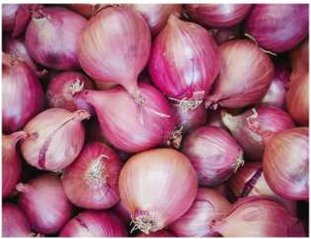
The Government declare that farmers can get ₹ 300 per quintal for their onions on 1st July and after that, the price will be dropped by ₹ 3 per quintal per extra day. Govind's father has 80 quintals of onions in the field on 1st July and he estimates that the crop is increasing at the rate of 1 quintal per day.

Image

(i) If $x$ is the number of days after $1^{\text {st }}$ July, then express price and quantity of onion and the revenue as a function of $x$.

(ii) Find the number of days after 1st July, when Govind's father attains maximum revenue.

(iii) On which day should Govind's father harvest the onions to maximize his revenue?

OR

Find the maximum revenue collected by Govind's father.

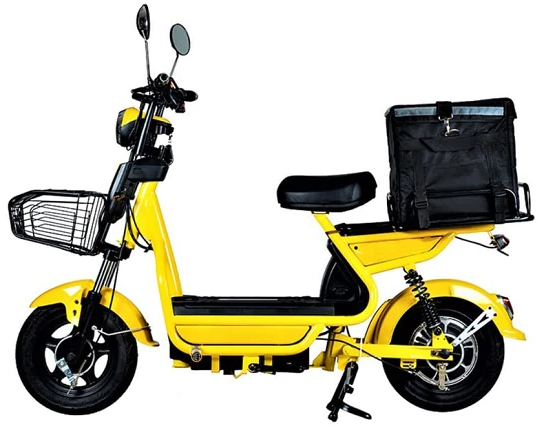
An owner of an electric bike rental company have determined that if they charge customers ₹ x per day to rent a bike, where 50 < x < 200, then number of bikes (n), they rent per day can be shown by linear function n(x) = 2000 - 10x. If they charge ₹ 50 per day or less, they will rent all their bikes. If they charge ₹ 200 or more per day, they will not rent any bike.

Based on the above information, answer the following questions.
  1. Total revenue R as a function of x can be represented as.
  1. 2000x - 10x2
  2. 2000x + 10x2
  3. 2000 - 10x
  4. 2000 - 5x2
  1. If R(x) denote the revenue, then maximum value of R(x) occur when x equals.
  1. 10
  2. 100
  3. 1000
  4. 50
  1. At x = 260, the revenue collected by the company is.
  1. ₹ 10
  2. ₹ 500
  3. ₹ 0
  4. ₹ 1000
  1. The number of bikes rented per day, if x = 105 is.
  1. 850
  2. 900
  3. 950
  4. 1000
  1. Maximum revenue collected by company is.
  1. ₹ 40,000
  2. ₹ 50,000
  3. ₹ 75,000
  4. ₹ 1,00,000
Consider 2 families A and B. Suppose there are 4 men, 4 women and 4 children in family A and 2 men, 2 women and 2 children in family B. The recommended daily amount of calories is 2400 for a man, 1900 for a woman, 1800 for children and 45 grams of proteins for a man, 55 grams for a woman and 33 grams for children.

Image

(i) Represent the requirement of calories and proteins for each person in matrix form.

(ii) Find the requirement of calories of family A and requirement of proteins of family B.

(iii) Represent the requirement of calories and proteins If each person increases the protein intake by $5 \%$ and decrease the calories by $5 \%$ in matrix form.

OR

If $\mathrm{A}$ and $\mathrm{B}$ are two matrices such that $\mathrm{AB}=\mathrm{B}$ and $\mathrm{BA}=\mathrm{A}$, then find $\mathrm{A}^2+\mathrm{B}^2$ in terms of $\mathrm{A}$ and $\mathrm{B}$.

In a family there are four children. All of them have to work in their family business to earn their livelihood at the age of 18.

Based on the above information, answer the following questions.

  1. Probability that all children are girls, if it is given that elder child is a boy, is:
  1. $\frac{3}{8}$

  2. $\frac{1}{8}$

  3. $\frac{5}{8}$

  4. None of these.

  1. Probability that all children are boys, if two elder children are boys, is:
  1. $\frac{1}{4}$

  2. $\frac{3}{4}$

  3. $\frac{1}{2}$

  4. None of these.

  1. Find the probability that two middle children are boys, if it is given that eldest child is a girl.
  1. $0$

  2. $\frac{3}{4}$

  3. $\frac{1}{4}$

  4. None of these.

  1. Find the probability that all children are boys, if it is given that at most one of the children is a girl.
  1. $0$

  2. $\frac{1}{5}$

  3. $\frac{2}{5}$

  4. $\frac{4}{5}$

  1. Find the probability that all children are boys, if it is given that at least three of the children are boys.
  1. $\frac{1}{5}$

  2. $\frac{2}{5}$

  3. $\frac{3}{5}$

  4. $\frac{4}{5}$

A telephone company in a town has 500 subscribers on its list and collects fixed charges of Rs. 300/- per subscriber per year. The company proposes to increase the annual subscription and it is believed that for every increase of Re 1/- one subscriber will discontinue the service. Find what increase will bring maximum profit?
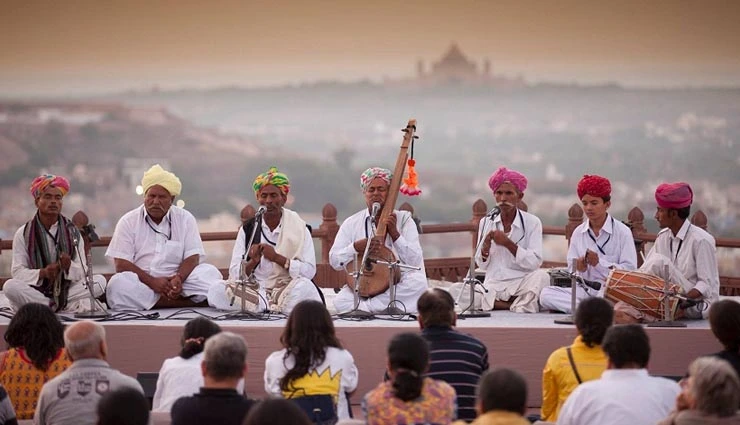
 One day, a sangeet mahotsav is to be organised in an open area of Rajasthan. ln recent years, it has rained only 6 days each year. Also, it is given that when it actually rains, the weatherman correctly forecasts rain 80% of the time. When it doesn't rain, he incorrectly forecasts rain 20% of the time.

If leap year is considered, then answer the following questions.

  1. The probability that it rains on chosen day is:
  1. $\frac{1}{366}$

  2. $\frac{1}{73}$

  3. $\frac{1}{60}$

  4. $\frac{1}{61}$

  1. The probability that it does not rain on chosen day is:
  1. $\frac{1}{366}$

  2. $\frac{5}{366}$

  3. $\frac{360}{366}$

  4. None of these.

  1. The probability that the weatherman predicts correctly is:
  1. $\frac{5}{6}$

  2. $\frac{7}{8}$

  3. $\frac{4}{5}$

  4. $\frac{1}{5}$

  1. The probability that it will rain on the chosen day, if weatherman predict rain for that day, is:
  1. 0.0625
  2. 0.0725
  3. 0.0825
  4. 0.0925
  1. The probability that it will not rain on the chosen day, if weatherman predict rain for that day, is:
  1. 0.94
  2. 0.84
  3. 0.74
  4. 0.64 
A company produces three products every day. Their production on certain day is 45 tons. It is found that the production of third product exceeds the production of first product by 8 tons while the total production of first and third product is twice the production of second product.

Using the concepts of matrices and determinants, answer the following questions.
  1. If x, y and z respectively denotes the quantity (in tons) of first, second and third product produced, then which of the following is true?
  1. x + y + z = 45
  2. x + 8 = z
  3. x - 2y + z = 0
  4. All of these.
  1. If $\begin{pmatrix}1&1&1\\1&0&-2\\1&-1&1\end{pmatrix}^{-1}=\frac{1}{6}\begin{pmatrix}2&2&2\\3&0&-3\\1&-2&1\end{pmatrix}$ then the inverse of $\begin{pmatrix}1&1&1\\1&0&-1\\1&-2&1\end{pmatrix}$ is:
  1. $\begin{pmatrix}\frac{1}{3}&\frac{1}{3}&\frac{1}{3}\\\frac{1}{2}&0&\frac{-1}{2}\\\frac{1}{6}&\frac{-1}{3}&\frac{1}{6}\end{pmatrix}$
  2. $\begin{pmatrix}\frac{1}{2}&0&-\frac{1}{2}\\\frac{1}{3}&\frac{1}{3}&\frac{1}{3}\\\frac{1}{6}&\frac{-1}{3}&\frac{1}{6}\end{pmatrix}$
  3. $\begin{pmatrix}\frac{1}{3}&\frac{1}{2}&\frac{1}{6}\\\frac{1}{3}&0&\frac{-1}{3}\\\frac{1}{3}&\frac{-1}{2}&\frac{1}{6}\end{pmatrix}$
  4. None of these.
  1. x : y : z is equal to:
  1. 12 : 13 : 20
  2. 11 : 15 : 19
  3. 15 : 19 : 11
  4. 13 : 12 : 20
  1. Which of the following is not true?
  1. |A| = |A'|
  2. (A')-1 = (A-1)'
  3. A is skew synunetric matrix of odd order, then |A| = 0
  4. |AB| = |A| + |B|
  1. Which of the following is not true in the given determinant of A, where A $=[\text{a}_\text{ij}]_{3\times3}?$
  1. Order of minor is less than order of the det (A).
  2. Minor of an element can never be equal to cofactor of the same element.
  3. Value of a determinant is obtained by multiplying elements of a row or column by corresponding cofactors.
  4. Order of minors and cofactors of same elements of A is same.
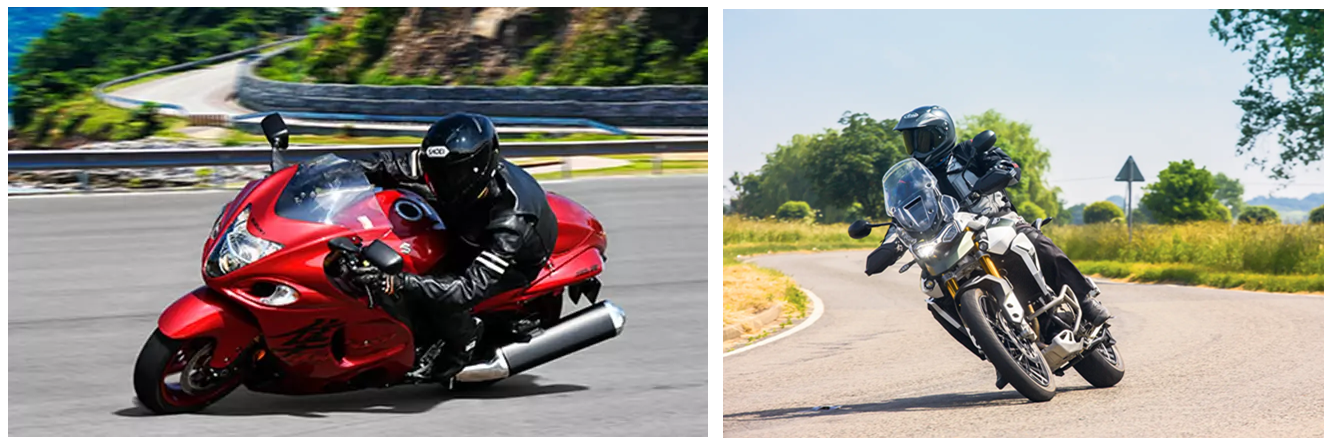
Two motorcycles A and Bare running at the speed more than allowed speed on the road along the lines $\vec{\text{r}}=\lambda(\hat{\text{i}}+2\hat{\text{j}}-\hat{\text{k}})$ and $\vec{\text{r}}=3\hat{\text{i}}+3\hat{\text{j}}+\mu(2\hat{\text{i}+\hat{\text{j}}+\hat{\text{k}}}),$ respectively.

Based on the above information, answer the following questions.

  1. The cartesian equation of the line along which motorcycle A is running is:
  1. $\frac{\text{x}+1}{1}=\frac{\text{y}+1}{2}=\frac{\text{z}-1}{-1}$

  2. $\frac{\text{x}}{1}=\frac{\text{y}}{2}=\frac{\text{z}}{-1}$

  3. $\frac{\text{x}}{1}=\frac{\text{y}}{2}=\frac{\text{z}}{1}$

  4. None of these
  1. The direction cosines of line along which motorcycle A is running, are:
  1. < 1, -2, 1 >
  2. < I, 2, -1 >
  3. $<\frac{1}{\sqrt{6}},\frac{-2}{\sqrt{6}},\frac{1}{\sqrt{6}}>$

  4. $<\frac{1}{\sqrt{6}},\frac{2}{\sqrt{6}},\frac{-1}{\sqrt{6}}>$

  1. The direction ratios of line along which motorcycle Bis running, are:
  1. < 1, 0, 2 >
  2. < 2, 1, 0 >
  3. < 1, 1, 2 >
  4. < 2, 1, 1 >
  1. The shortest distance between the gives lines is:
  1. 4 units
  2. $2\sqrt{3}\text{ units}$

  3. $3\sqrt{2}\text{ units}$

  4. 0 units
  1. The motorcycles will meet with an accident at the point:
  1. (-1, 1, 2)
  2. (2, 1, -1)
  3. (1, 2, -1)
  4. Does not exist