Question
Linear programming is a method for finding the optimal values (maximum or minimum) of quantities subject to the constraints when relationship is expressed as linear equations or inequations.

Based on the above information, answer the following questions.

  1. The optimal value of the objective function is attained at the points:
  1. On X-axis.
  2. On Y-axis.
  3. Which are comer points of the feasible region.
  4. None of these.
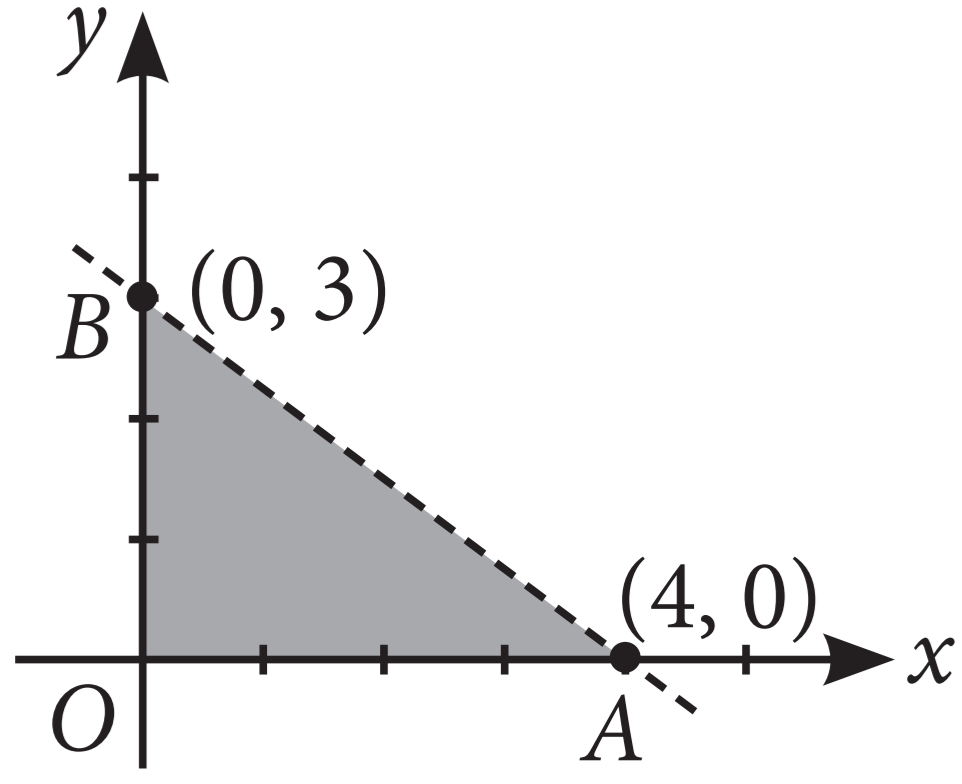
  1. The graph of the inequality 3x + 4y < 12 is:
  1. Half plane that contains the origin.
  2. Half plane that neither contains the origin nor the points of the line 3x + 4y = 12.
  3. Whole XOY-plane excluding the points on line 3x + 4y = 12.
  4. None of these.
  1. The feasible region for an LPP is shown in the figure. Let Z = 2x + 5y be the objective function. Maximum of Z occurs at:
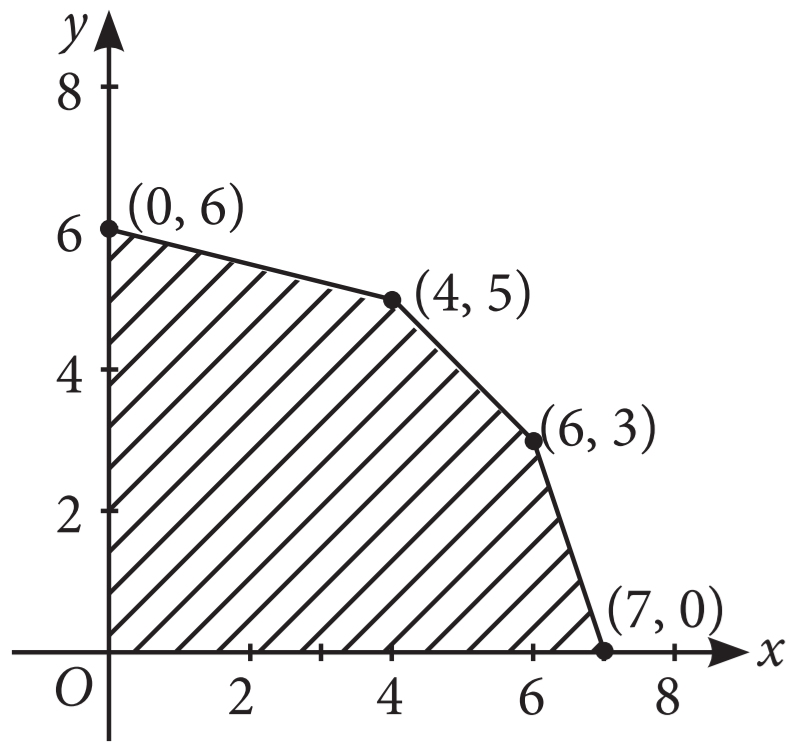
  1. (7, 0)
  2. (6, 3)
  3. (0, 6)
  4. (4, 5)
  1. The corner points of the feasible region determined by the system of linear constraints are (0, 10), (5, 5), (15, 15), (0, 20). Let Z = px + qy, where p, q > 0. Condition on p and q so that the maximum of Z occurs at both the points ( 15, 15) and (0, 20) is:
  1. p = q
  2. p = 2q
  3. q = 2p
  4. q = 3p
  1. The comer points of the feasible region determined by the system of linear constraints are (0, 0), (0, 40), (20, 40), (60, 20), (60, 0). The objective function is Z = 4x + 3y.

Compare the quantity in Column A and Column B

Column A
Column B
Maximum of Z
325
  1. The quantity in column A is greater.
  2. The quantity in column Bis greater.
  3. The two quantities are equal.
  4. The relationship cannot be determined on the basis of the information supplied.
Answer

  1. (c) Which are comer points of the feasible region.

Solution:

When we solve an L.P.P. graphically, the optimal (or optimum) value of the objective function is attained at comer points of the feasible region.

  1. (d) None of these.

Solution:

From the graph of 3x + 4y < 12, it is clear that it contains the origin but not the points on the line 3x + 4y = 12.

  1. (d) (4, 5)

Solution:

Maximum of objective function occurs at corner points.

Corner Points
Value of Z = 2x + 5y
(0, 0)
0
(7, 0)
14
(6, 3)
27
(4, 5)
$33\leftarrow\text{Maximum}$
(0, 6)
30
  1. (d) q = 3p

​​​​​​​​​​​​​​Solution:

Value of Z = px + qy at ( 15, 15)= 15p + 15q and that at (0, 20) = 20q. According to given condition, we have 15p + 15q = 20q ⇒ 15p = Sq ⇒ q = 3p.

  1. (b) The quantity in column Bis greater.

​​​​​​​​​​​​​​​​​​​​​​​​​​​​​​​​​​​Solution:

Construct the following table of values of the objective function:

Corner Points
Value of Z = 4x + 3y
(0, 0)
4 × 0 + 3 × 0 = 0
(0, 40)
4 × 0 + 3 × 40 = 120
(20, 40)
4 × 20 + 3 × 40 = 200
(60, 20)
$4\times60+3\times20=300\leftarrow\text{Maximum}$
(60, 0)
4 × 60 + 3 × 0 = 240

Need a full question paper?

Generate a complete, print-ready paper with questions like this in minutes — across 16+ boards, with answer keys.

Start Generating Free

Similar questions

A factory has three machines A, B and C to manufacture bolts. Machine A manufacture 30%, machine B manufacture 20% and machine C manufacture 50% of the bolts respectively. Out of their respective outputs 5%, 2% and 4% are defective. A bolt is drawn at random from total production and it is found to be defective.

Based on the above information, answer the following questions.

  1. Probability that defective bolt drawn is manufactured by machine A, is:
  1. $\frac{4}{13}$

  2. $\frac{5}{13}$

  3. $\frac{6}{13}$

  4. $\frac{9}{13}$
  1. Probability that defective bolt drawn is manufactured by machine B, is:
  1. 0.3
  2. 0.1
  3. 0.2
  4. 0.4
  1. Probability that defective bolt drawn is manufactured by machine C, is:
  1. $\frac{16}{39}$

  2. $\frac{17}{39}$

  3. $\frac{20}{39}$

  4. $\frac{15}{39}$

  1. Probability that defective bolt is not manufactured by machine B, is:
  1. $\frac{35}{39}$

  2. $\frac{61}{39}$

  3. $\frac{41}{39}$

  4. None of these.

  1. Probability that defective bolt is not manufactured by machine C, is:
  1. 0.03
  2. 0.09
  3. 0.5
  4. 0.9 
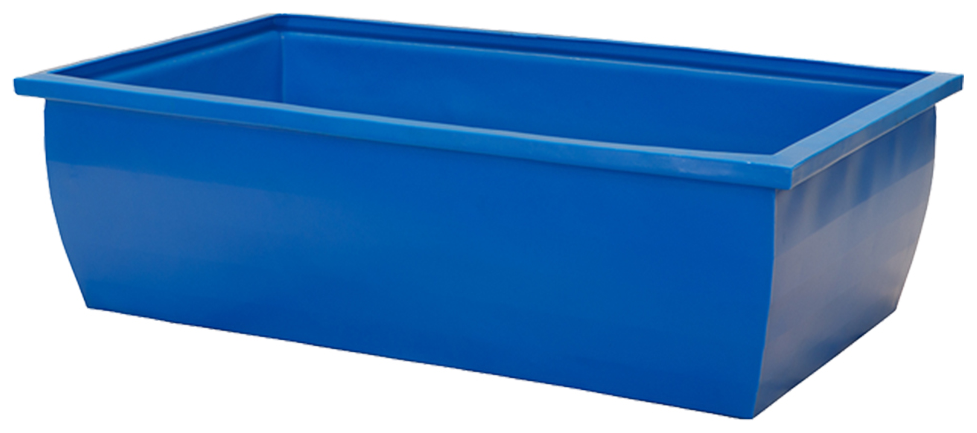
Nitin wants to construct a rectangular plastic tank for his house that can hold 80 ft3 of water. The top of the tank is open. The width of tank will be 5 ft but the length and heights are variables. Building the tank cost? ₹ 20 per sq. foot for the base and ₹ 10 per sq. foot for the side.

Based on the above information, answer the following questions.
  1. In order to make a least expensive water tank, Nitin need to minimize its.
  1. Volume
  2. Base
  3. Curved surface area
  4. Cost
  1. Total cost of tank as a function of h can be represented as.
  1. c(h) = 100h - 320 - 1600/ h
  2. c(h) = 100h - 320h - 720h2
  3. c(h) = 100 + 320h + 1600h2
  4. $\text{c}\big(\text{h}\big)=100\text{h}+320+\frac{1600}{\text{h}}$
  1. Range of h is.
  1. (3, 5)
  2. $\big(0,\infty\big)$
  3. (0, 8)
  4. (0, 3)
  1. Value of hat which c(h) is minimum, is.
  1. 4
  2. 5
  3. 6
  4. 6, 7
  1. The cost of least expensive tank is.
  1. ₹ 1020
  2. ₹ 1100
  3. ₹ 1120
  4. ₹ 1220
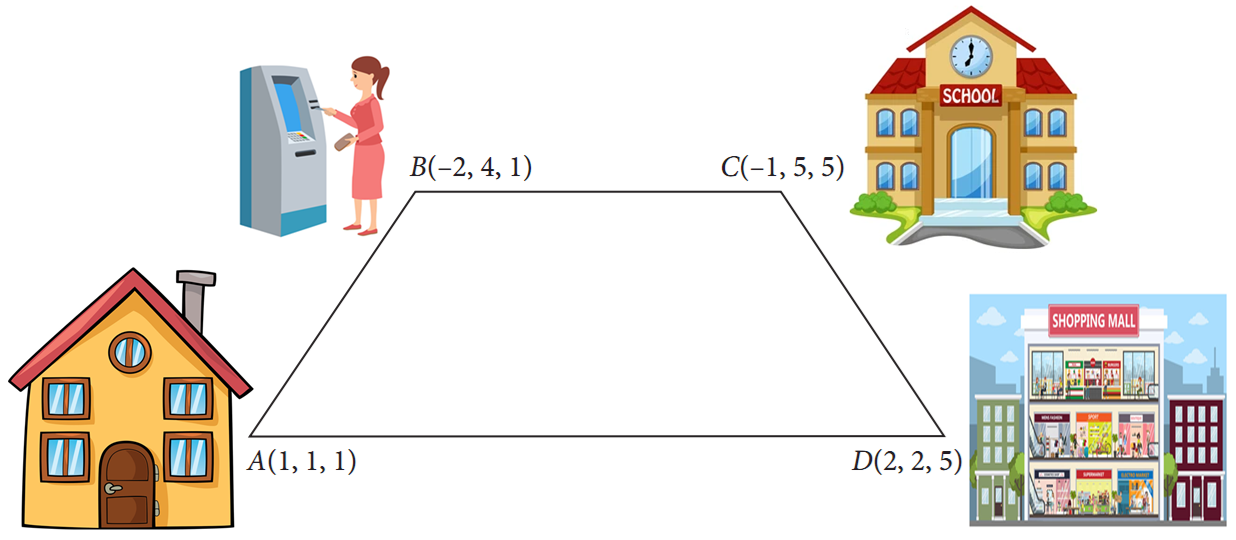
Ritika starts walking from his house to shopping mall. Instead of going to the mall directly, she first goes to a ATM, from there to her daughter's school and then reaches the mall. ln the diagram, A, B, C, and D represent the coordinates of House, ATM, School and Mall respectively.

Based on the above information, answer the following questions.
  1. Distance between House (A) and ATM (B) is:
  1. $3\text{ units}$
  2. $3\sqrt{2}\text{ units}$
  3. $\sqrt{2}\text{ units}$
  4. $4\sqrt{2}\text{ units}$
  1. Distance between ATM (B) and School (C) is:
  1. $\sqrt{2}\text{ units}$
  2. $2\sqrt{2}\text{ units}$
  3. $3\sqrt{2}\text{ units}$
  4. $4\sqrt{2}\text{ units}$
  1. Distance between School (C) and Shopping mall (D) is:
  1. $3\sqrt{2}\text{ units}$
  2. $5\sqrt{2}\text{ units}$
  3. $7\sqrt{2}\text{ units}$
  4. $10\sqrt{2}\text{ units}$
  1. What is the total distance travelled by Ritika:
  1. $4\sqrt{2}\text{ units}$
  2. $6\sqrt{2}\text{ units}$
  3. $8\sqrt{2}\text{ units}$
  4. $9\sqrt{2}\text{ units}$
  1. What is the extra distance travelled by Ritika in reaching the shopping mall?
  1. $3\sqrt{2}\text{ units}$
  2. $5\sqrt{2}\text{ units}$
  3. $6\sqrt{2}\text{ units}$
  4. $7\sqrt{2}\text{ units}$
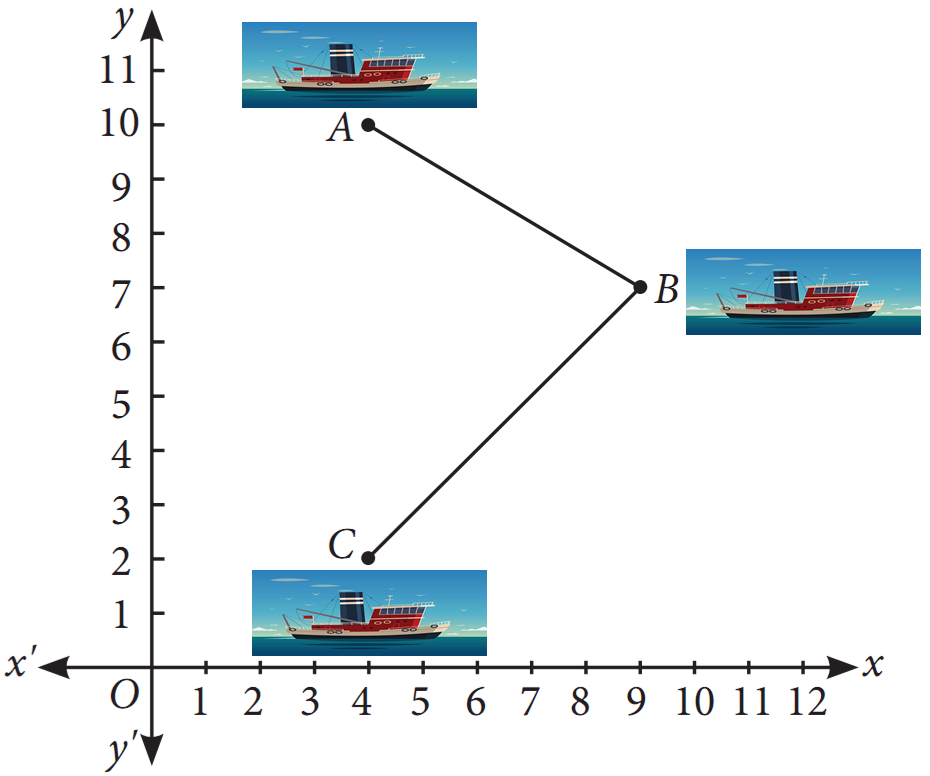
A barge is pulled into harbour by two tug boats as shown in the figure.

Based on the above information, answer the following questions.

  1. Position vector of A is:
  1. $4\hat{\text{i}}+2\hat{\text{j}}$

  2. $4\hat{\text{i}}+10\hat{\text{j}}$

  3. $4\hat{\text{i}}-10\hat{\text{j}}$

  4. $4\hat{\text{i}}-2\hat{\text{j}}$

  1. Position vector of B is:
  1. $4\hat{\text{i}}+4\hat{\text{j}}$

  2. $6\hat{\text{i}}+6\hat{\text{j}}$

  3. $9\hat{\text{i}}+7\hat{\text{j}}$

  4. $3\hat{\text{i}}+3\hat{\text{j}}$

  1. Find the vector $\overline{\text{AC}}$ in terms of $\hat{\text{i}},\hat{\text{j}}.$
  1. $8\hat{\text{j}}$

  2. $-8\hat{\text{j}}$

  3. $8\hat{\text{i}}$

  4. None of these
  1. If $\vec{\text{A}}=\hat{\text{i}}+2\hat{\text{j}}+3\hat{\text{k}},$ then its unit vector is:
  1. $\frac{\hat{\text{i}}}{\sqrt{14}}+\frac{2\hat{\text{j}}}{\sqrt{14}}+\frac{3\hat{\text{k}}}{\sqrt{14}}$

  2. $\frac{3\hat{\text{i}}}{\sqrt{14}}+\frac{2\hat{\text{j}}}{\sqrt{14}}+\frac{\hat{\text{k}}}{\sqrt{14}}$

  3. $\frac{2\hat{\text{i}}}{\sqrt{14}}+\frac{3\hat{\text{j}}}{\sqrt{14}}+\frac{\hat{\text{k}}}{\sqrt{14}}$

  4. None of these
  1. If $\vec{\text{A}}=4\hat{\text{i}}+3\hat{\text{j}}$ and $\vec{\text{B}}=3\hat{\text{i}}+4\hat{\text{j}},$ then $|\vec{\text{A}}|+|\vec{\text{B}}|=$
  1. 12
  2. 13
  3. 14
  4. 10
Shama is studying in class XII. She wants do graduate in chemical engineering. Her main subjects are mathematics, physics, and chemistry. In the examination, her probabilities of getting grade A in these subjects are $0.2,0.3$, and 0.5 respectively.

Image

(i) Find the probability that she gets grade A in all subjects.

(ii) Find the probability that she gets grade A in no subjects.

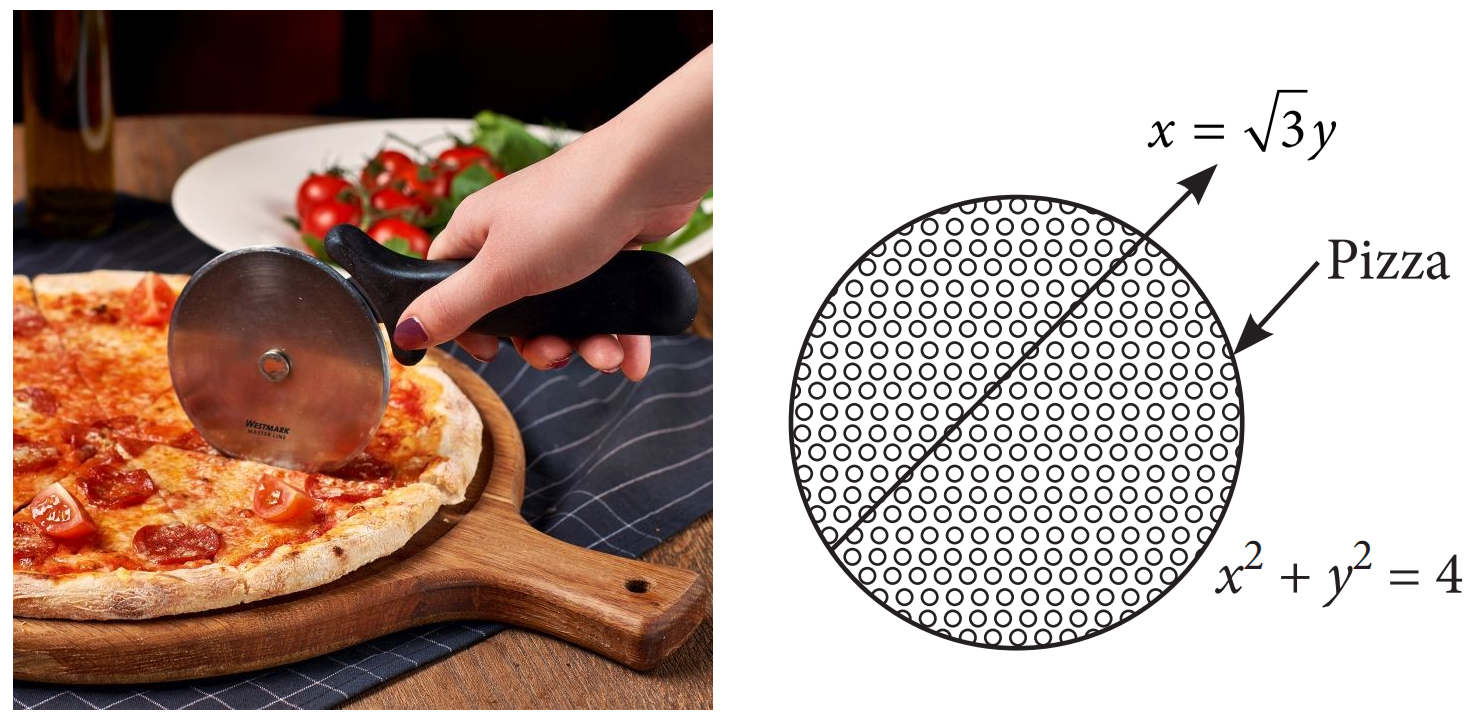
A child cut a pizza with a knife. Pizza is circular in shape which is represented by x2 + y2 = 4 and sharp edge of knife represents a straight line given by $\text{x}=\sqrt{3\text{y}}$

Based on the above information, answer the following questions.

  1. The point(s) of intersection of the edge of knife (line) and pizza shown in the figure is (are).
  1. $(1, \sqrt{3}),(-1,-\sqrt{3})$

  2. $(\sqrt{3},1),(-\sqrt{3,}-1)$

  3. $(\sqrt{2,}0),(0,\sqrt{3})$

  4. $(-\sqrt{3,}),(1,-\sqrt{3})$

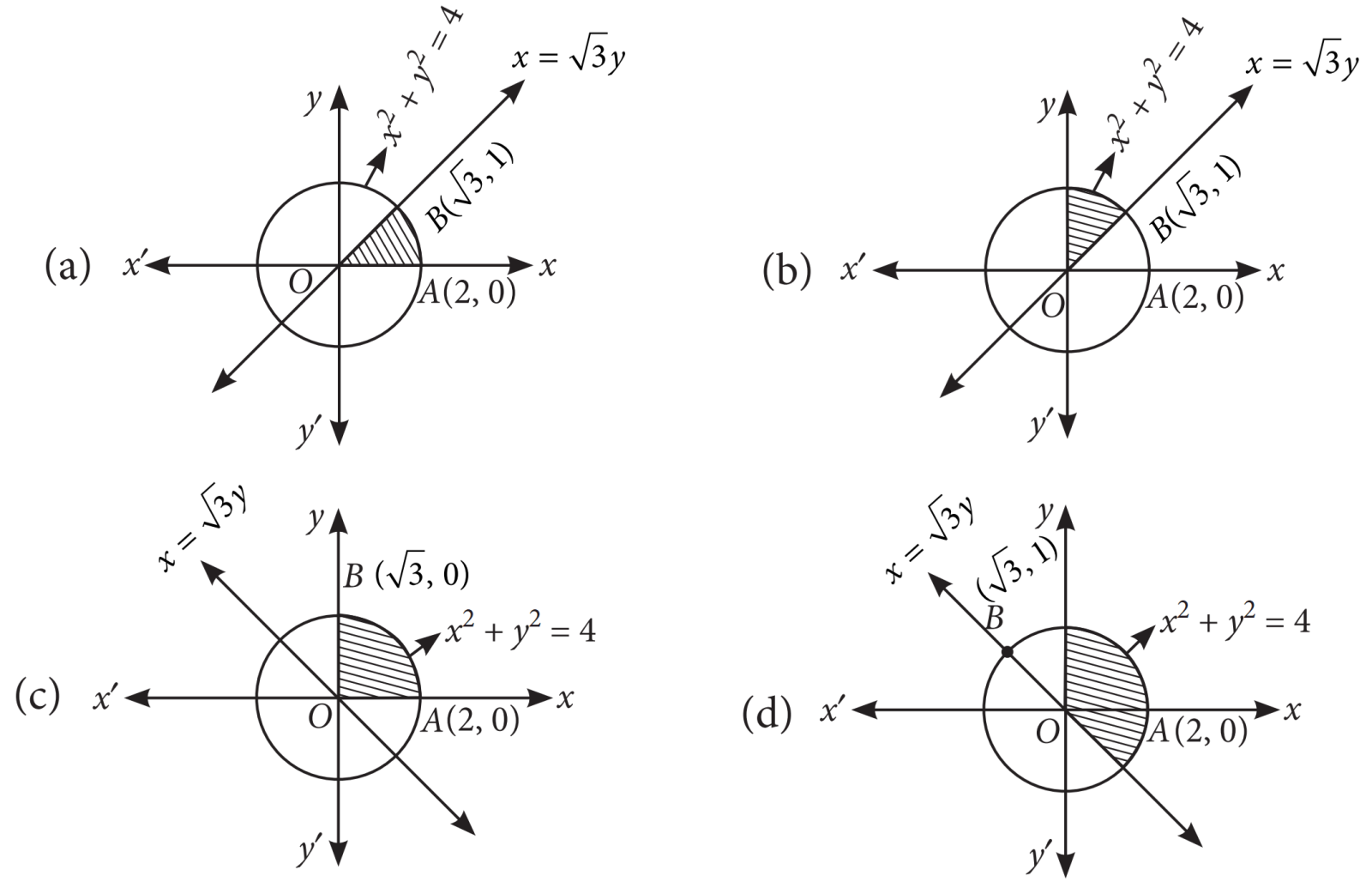
  1. Which of the following shaded portion represent the smaller area bounded by pizza and edge of knife in first quadrant?

  1. Value of area of the region bounded by circular pizza and edge of knife in first quadrant is.
  1. $\frac{\pi}{2}\text{ sq.units}$

  2. $\frac{\pi}{3}\text{ sq.units}$

  3. $\frac{\pi}{5}\text{ sq.units}$

  4. $\pi\text{ sq.units}$

  1. Area of each slice of pizza when child cut the pizza into 4 equal pieces is.
  1. $\pi\text{ sq.units}$

  2. $\frac{\pi}{2}\text{ sq.units}$

  3. $3\pi\text{ sq.units}$

  4. $2\pi\text{ sq.units}$

  1. Area of whole pizza is.
  1. $3\pi\text{ sq.units}$

  2. $2\pi\text{ sq.units}$

  3. $5\pi\text{ sq.units}$

  4. $4\pi\text{ sq.units}$

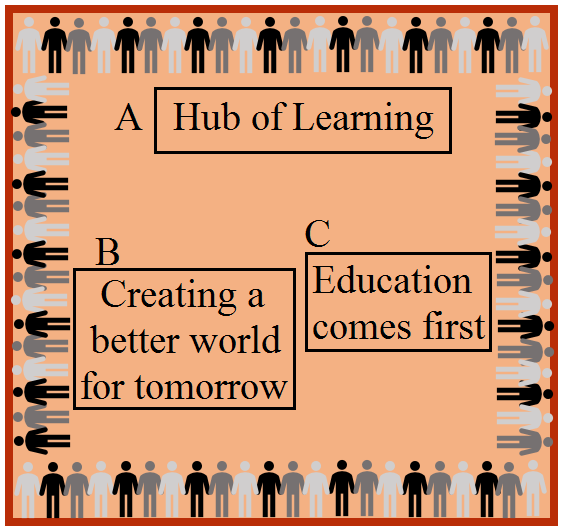
Three slogans on chart papers are to be placed on a school bulletin board at the points A, Band C displaying A (Hub of Learning), B (Creating a better world for tomorrow) and C (Education comes first). The coordinates of these points are (1, 4, 2), (3, -3, -2) and (-2, 2, 6) respectively.

Based on the above information, answer the following questions.
  1. Let $\vec{\text{a}},\vec{\text{b}}$ and $\vec{\text{c}}$ be the position vectors of points A, B and C respectively, then $\vec{\text{a}}+\vec{\text{b}}+\vec{\text{c}}$ is equal to:
  1. $2\hat{\text{i}}+3\hat{\text{j}}+6\hat{\text{k}}$
  2. $2\hat{\text{i}}-3\hat{\text{j}}-6\hat{\text{k}}$
  3. $2\hat{\text{i}}+8\hat{\text{j}}+3\hat{\text{k}}$
  4. $2(7\hat{\text{i}}+8\hat{\text{j}}+3\hat{\text{k}})$
  1. Which of the following is not true?
  1. $\overline{\text{AB}}+\overline{\text{BC}}+\overline{\text{CA}}=\vec{0}$
  2. $\overline{\text{AB}}+\overline{\text{BC}}-\overline{\text{AC}}=\vec{0}$
  3. $\overline{\text{AB}}+\overline{\text{BC}}-\overline{\text{CA}}=\vec{0}$
  4. $\overline{\text{AB}}-\overline{\text{CB}}+\overline{\text{CA}}=\vec{0}$
  1. Area of $\triangle\text{ABC}$ is:
  1. 19 sq. units
  2. $\sqrt{1937}\text{sq}.\text{units}$
  3. $\frac{1}{2}\sqrt{1937}\text{sq}.\text{units}$
  4. $\sqrt{1837}\text{sq}.\text{units}$
  1. Suppose, if the given slogans are to be placed on a straight line, then the value of $|\vec{\text{a}}\times\vec{\text{b}}+\vec{\text{b}}\times\vec{\text{c}}+\vec{\text{c}}\times\vec{\text{a}}|$ will be equal to:
  1. -1
  2. -2
  3. 2
  4. 0
  1. If $\vec{\text{a}}=2\hat{\text{i}}+3\hat{\text{j}}+6\hat{\text{k}},$ then unit vector in the direction of vector $\vec{\text{a}}$ is:
  1. $\frac{2}{7}\hat{\text{i}}-\frac{3}{7}\hat{\text{j}}-\frac{6}{7}\hat{\text{k}}$
  2. $\frac{2}{7}\hat{\text{i}}+\frac{3}{7}\hat{\text{j}}+\frac{6}{7}\hat{\text{k}}$
  3. $\frac{3}{7}\hat{\text{i}}+\frac{2}{7}\hat{\text{j}}+\frac{6}{7}\hat{\text{k}}$
  4. None of these
If the equation is of the form $\frac{\text{dy}}{\text{dx}}=\frac{\text{f(x, y)}}{\text{g(x, y)}}$or $\frac{\text{dy}}{\text{dx}}=\text{F}\Big(\frac{\text{y}}{\text{x}}\Big),$ where f(x, y), g(x, y) are homogeneous functions of the same degree in x and y, then put y = vx and $\frac{\text{dy}}{\text{dx}}=\text{v+x}\Big(\frac{\text{dv}}{\text{dx}}\Big),$ so that the dependent variable y is changed to another variable v and then apply variable separable method.
Based on the above information, answer the following questions.
  1. The general solution of $\text{x}^2\frac{\text{dy}}{\text{dx}}=\text{x}^2+\text{xy}+\text{y}^2$ is:
  1. $\tan^{-1}\frac{\text{x}}{\text{y}}=\log|\text{x}|+\text{c}$
  2. $\tan^{-1}\frac{\text{y}}{\text{x}}=\log|\text{x}|+\text{c}$
  3. $\text{y}=\text{x}\log|\text{x}|+\text{c}$
  4. $\text{x}=\text{y}\log|\text{y}|+\text{c}$
  1. Solution of the differential equation $2\text{xy}\frac{\text{dy}}{\text{dx}}=\text{x}^2+3\text{y}^2$ is:
  1. x3 + y2 = cx2
  2. $\frac{\text{x}^2}{2}+\frac{\text{y}^3}{3}=\text{y}^2+\text{c}$
  3. x2 + y3 = cx2
  4. x2 + y2 = cx3
  1. General solution of the differential equation (x2 + 3xy + y2) dx - x2 dy = 0 is:
  1. $\frac{\text{x+y}}{\text{y}}-\log\text{x = c}$
  2. $\frac{\text{x+y}}{\text{y}}+\log\text{x = c}$
  3. $\frac{\text{x}}{\text{x+y}}-\log\text{x = c}$
  4. $\frac{\text{x}}{\text{x+y}}+\log\text{x = c}$
  1. General solution of the differential equation $\frac{\text{dy}}{\text{dx}}=\frac{\text{y}}{\text{x}}\bigg\{\log\Big(\frac{\text{y}}{\text{x}}\Big)+1\bigg\}$ is:
  1. $\log(\text{xy})=\text{c}$
  2. $\log\text{y}=\text{cx}$
  3. $\log\frac{\text{y}}{\text{x}}=\text{cx}$
  4. $\log\text{x}=\text{cy}$
  1. Solution of the differential equation $\Big(\text{x}\frac{\text{dy}}{\text{dx}}-\text{y}\Big)\text{e}^\frac{\text{y}}{\text{x}}=\text{x}^2\ \cos\text{x}$ is:
  1. $\text{e}^\frac{\text{y}}{\text{x}}-\sin\text{x = c}$
  2. $\text{e}^\frac{\text{y}}{\text{x}}+\sin\text{x = c}$
  3. $\text{e}^\frac{\text{-y}}{\text{x}}-\sin\text{x = c}$
  4. $\text{e}^\frac{\text{-y}}{\text{x}}+\sin\text{x = c}$
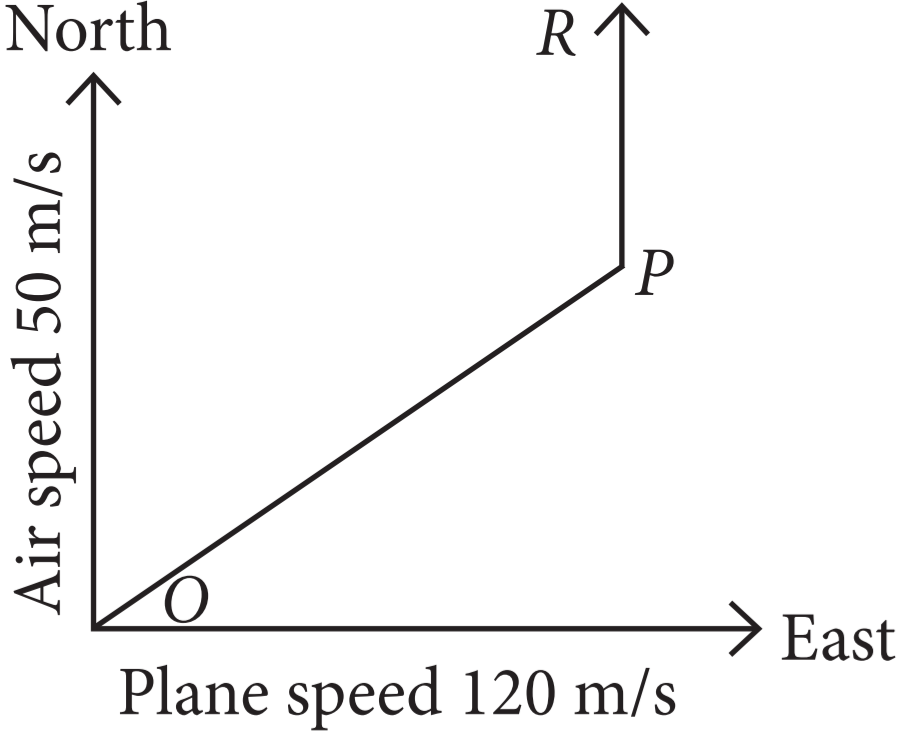
A plane started from airport situated at O with a velocity of 120m/s towards east. Air is blowing at a velocity of 50m/ s towards the north as shown in the figure.
The plane travelled 1hr in OP direction with the resultant velocity. From P to R the plane travelled 1hr keeping velocity of 120m/s and finally landed at R.

Based on the above information, answer the following questions.
  1. What is the resultant velocity from O to P?
  1. 100m/ s
  2. 130m/ s
  3. 126m/ s
  4. 180m/ s
  1. What is the direction of travel of plane from O to P with East?
  1. $\tan^{-1}\Big(\frac{5}{12}\Big)$
  2. $\tan^{-1}\Big(\frac{12}{3}\Big)$
  3. 50
  4. 80
  1. What is the displacement from O to P?
  1. 600km
  2. 468km
  3. 532km
  4. 500km
  1. What is the resultant velocity from P to R?
  1. 120m/ s
  2. 70m/ s
  3. 170m/ s
  4. 200m/ s
  1. What is the displacement from P to R?
  1. 450km
  2. 532km
  3. 610km
  4. 612km
Two farmers Shyam and Balwan Singh cultivate only three varieties of pulses namely Urad, Masoor and Mung. The sale (in ₹) of these varieties of pulses by both the farmers in the month of September and October are given by the following matrices A and B.

September sales (in ₹)
$\begin{matrix}\ \ \ \ \ \ \ \ \ \ \text{Urad}&\text{Masoor}&\text{Mung}\end{matrix}\\\text{A}=\begin{bmatrix}10000&20000&30000\\50000&30000&10000\end{bmatrix}\begin{matrix}\text{Shayam}\\\text{Balwan singh}\end{matrix}$
October sales (in ₹)
$\begin{matrix}\ \ \ \ \ \ \ \ \ \ \text{Urad}&\text{Masoor}&\text{Mung}\end{matrix}\\\text{B}=\begin{bmatrix}10000&20000&30000\\50000&30000&10000\end{bmatrix}\begin{matrix}\text{Shayam}\\\text{Balwan singh}\end{matrix}$
Using algebra of matrices, answer the following questions.
  1. The combined sales of Masoor in September and October, for farmer Balwan Singh, is:
  1. ₹ 80000
  2. ₹ 90000
  3. ₹ 40000
  4. ₹ 135000
  1. The combined sales of Urad in September and October, for farmer Shyam is:
  1. ₹ 20000
  2. ₹ 30000
  3. ₹ 36000
  4. ₹ 15000
  1. Find the decrease in sales of Mung from September to October, for the farmer Shyam.
  1. ₹ 24000
  2. ₹ 10000
  3. ₹ 30000
  4. No change
  1. If both farmers receive 2% profit on gross sales, compute the profit for each farmer and for each variety sold in October.
  1. $\begin{matrix} \ \text{Urad}&\text{Masoor}&\text{Mung}\end{matrix}\\\begin{bmatrix}100&\ \ \ \ \ \ 200&\ \ \ \ \ 220\\400&\ \ \ \ \ \ 300&\ \ \ \ \ 200\end{bmatrix}\begin{matrix}\text{Shayam}\\\text{Balwan singh}\end{matrix}$
  2. $\begin{matrix} \ \text{Urad}&\text{Masoor}&\text{Mung}\end{matrix}\\\begin{bmatrix}100&\ \ \ \ \ \ 200&\ \ \ \ \ 120\\400&\ \ \ \ \ \ 200&\ \ \ \ \ 200\end{bmatrix}\begin{matrix}\text{Shayam}\\\text{Balwan singh}\end{matrix}$
  3. $\begin{matrix} \ \text{Urad}&\text{Masoor}&\text{Mung}\end{matrix}\\\begin{bmatrix}150&\ \ \ \ \ \ 200&\ \ \ \ \ 220\\400&\ \ \ \ \ \ 200&\ \ \ \ \ 280\end{bmatrix}\begin{matrix}\text{Shayam}\\\text{Balwan singh}\end{matrix}$
  4. $\begin{matrix} \ \text{Urad}&\text{Masoor}&\text{Mung}\end{matrix}\\\begin{bmatrix}100&\ \ \ \ \ \ 200&\ \ \ \ \ 120\\250&\ \ \ \ \ \ 200&\ \ \ \ \ 220\end{bmatrix}\begin{matrix}\text{Shayam}\\\text{Balwan singh}\end{matrix}$
  1. Which variety of pulse has the highest selling value in the month of September for the farmer Balwan Singh?
  1. Urad
  2. Masoor
  3. Mung
  4. All of these have the same price