Question
A dimensionless quantity:
  1. Never has a unit.
  2. Always has a unit
  3. May have a unit.
  4. Does not exist.

Answer

  1. May have a unit.
Explanation:

Dimensionless quantities may have units.

Need a full question paper?

Generate a complete, print-ready paper with questions like this in minutes — across 16+ boards, with answer keys.
Start Generating Free

Similar questions

A car driver going at some speed v suddenly finds a wide wall at a distance r. Should he apply brakes or turn the car in a circle of radius r to avoid hitting the wall?
Find the change in the volume of 1.0 litre kerosene when it is subjected to an extra pressure of $2.0 \times 10^5 \mathrm{~N} / \mathrm{m}^2$ from the following data. Density of kerosene $=800 \mathrm{~kg} / \mathrm{m}^3$ and speed of sound in kerosene $=1330 \mathrm{~m} / \mathrm{s}$.
Certain collisions are referred to as elastic collisions. Elastic collisions are collisions in which both momentum and kinetic energy are conserved. The total system kinetic energy before the collision equals the total system kinetic energy after the collision. If total kinetic energy is not conserved, then the collision is referred to as an inelastic collision.
The coefficient of restitution, denoted by (e), is the measure of degree elasticity of collision. It is defined as the ratio of the final to inital relative speed between two objects after they collide. It normally ranges from 0 to 1 where 1 would be a perfectly elastic collision. A perfectly inelastic collision has a coefficient of 0 . In real life most of the collisions are neither perfectly elastic nor perfectly inealstic and $0< e <1$.

1. The following are the data of a collision between a truck and a car.
Mass of the car $=1000 kg$
Mass of the truck $=3000 kg$
Mass of the truck Before collision:
Speed of the car $=20 m / s$
Momentum of the car $=20000 kg m / s$
Speed of the truck $=20 m / s$
Momentum of the truck $=60000 kg m / s$
After collision:
Speed of the car $=40 m / s$ in the opposite direction
Momentum of the car $=40000 kg m / s$ in the opposite direction
Speed of the truck $=0$
Momentum of the truck $=0$
The collision is
(a) Both elastic since kinetic energy and momentum is conserved
(b) Elastic since momentum is conserved
(c) Inelastic since kinetic energy is conserved
(d) Elastic since kinetic energy is conserved
2. The coefficient of restitution is the measure of
(a) Malleability of a substance    (b) Conductivity of a substance
(c) degree of elasticity of collision    (d) Elasticity of a substance
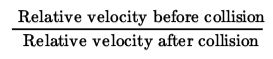
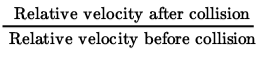
3. Coefficient of restitution is defined as
(a) 
Image
(b) Relative velocity after collision x relative velocity before collision
(c) Relative velocity after collision + relative velocity before collision
(d) 
Image
OR
In real life most of the collisions are
(a) Range of coefficient of restitution is 0 < e < 1
(b) both neither perfectly nor perfectly inelastic and range of coefficient of restitution is 0 < e < 1.
(c) neither perfectly elastic nor perfectly inelastic
(d) perfectly inelastic
4. For perfectly elastic and perfectly inelastic collision, the value of coefficient of restitution are respectively
(a) $+1,-1$    (b) 0,1    (c) $0,-1$    (d) 1,0
Read the passage given below and answer the following questions from 1 to 5. Simple Harmonic Motion Simple harmonic motion is the simplest form of oscillation. A particular type of periodic motion in which a particle moves to and fro repeatedly about a mean position under the influence of a restoring force is termed as simple harmonic motion (S.H.M). A body is undergoing simple harmonic motion if it has an acceleration which is directed towards a fixed point, and proportional to the displacement of the body from that point. Acceleration $\text{a}\propto-\text{x}$$\Rightarrow\text{a}=-\text{kx}$ or $\frac{\text{d}^2\text{x}}{\text{dt}^2}=-\text{kx},$
where x = displacement at any instant t.
  1. Which of the following is not a characteristics of simple harmonic motion?
  1. The motion is periodic.
  2. The motion is along a straight line about the mean position.
  3. The oscillations are responsible for the energy conversion.
  4. The acceleration of the particle is directed towards the extreme position.
  1. The equation of motion of a simple harmonic motion is:
  1. $\frac{\text{d}^2\text{x}}{\text{dt}^2}=-\omega^2\text{x}$
  2. $\frac{\text{d}^2\text{x}}{\text{dt}^2}=-\omega^2\text{t}$
  3. $\frac{\text{d}^2\text{x}}{\text{dt}^2}=-\omega\text{x}$
  4. $\frac{\text{d}^2\text{x}}{\text{dt}^2}=-\omega\text{t}$
  1. Which of the following expressions does not represent simple harmonic motion?
  1. $\text{x}=\text{A}\cos\omega\text{t}+\text{B}\sin\omega\text{t}$
  2. $\text{x}=\text{A}\cos(\omega\text{t}+\alpha)$
  3. $\text{x}=\text{B}\sin(\omega\text{t}+\beta)$
  4. $\text{x}=\text{A}\sin\omega\text{t}\cos^2\omega\text{t}$
  1. The time period of simple harmonic motion depends upon:
  1. Amplitude
  2. Energy
  3. Phase constant
  4. Mass
  1. Which of the following motions is not simple harmonic?
  1. Vertical oscillations of a spring
  2. Motion of a simple pendulum
  3. Motion of planet around the Sun
  4. Oscillation of liquid in a U-tube
A ladder is resting with one end on a vertical wall and the other end on a horizontal floor. Is it more likely to slip when a man stands near the bottom or near the top?
Read the passage given below and answer the following questions from $1$ to $5.$ Friction: Let us return to the example of a body of mass m at rest on a horizontal table. The force of gravity $(mg)$ is cancelled by the normal reaction force $(N)$ of the table. Now suppose a force F is applied horizontally to the body. We know from experience that a small applied force may not be enough to move the body. But if the applied force F were the only external force on the body, it must move with acceleration F/m, however small. Clearly, the body remains at rest because some other force comes into play in the horizontal direction and opposes the applied force F, resulting in zero net force on the body. This force fs parallel to the surface of the body in contact with the table is known as frictional force, or simply friction. When there is no applied force, there is no static friction. It comes into play the moment there is an applied force. As the applied force $F$ increases, fs also increases, remaining equal and opposite to the applied force $($up to a certain limit$),$ keeping the body at rest. Hence, it is called static friction. Static friction opposes impending motion. The term impending motion means motion that would take place $($but does not actually take place$)$ under the applied force, if friction were absent. It is found experimentally that the limiting value of static friction $(fs )$ max f is independent of the area of contact and varies with the normal force$(N)$ approximately as: $(\text{f}_{\text{s}})\text{max}=\mu\text{N}$ where μs is a constant of proportionality depending only on the nature of the surfaces in contact. The constant μs is called the coefficient of static friction. The law of static friction may thus be written as $(\text{f}_{\text{s}})\leq\mu\text{sN}$ Frictional force that opposes relative motion between surfaces in contact is called kinetic or sliding friction and is denoted by $fk$. Kinetic friction, like static friction, is found to be independent of the area of contact. Further, it is nearly independent of the velocity. It satisfies a law similar to that for static friction: $(\text{f}_{\text{k}})=\mu_{\text{k}}\text{N}$
  1. Force of static friction is directly proportional to:
  1. Normal reaction
  2. Force by gravity
  3. Velocity of body
  4. None of these
  1. Coefficient of kinetic friction is independent of area of contact. True or false?
  1. True
  2. False
  1. Give formula for law of static friction
  1. Explain law of static friction
  1. Explain kinetic friction.
The gain factor of an amplifier in increased from 10 to 12 as the load resistance is changed from $4\text{k}\Omega\text{ to }8\text{k}\Omega$ Calculate (a) the amplification factor and (b) the plate resistance.
If you are walking on the moon, can you hear the sound of stones cracking behind you? Can you hear the sound of your own footsteps?
Read the passage given below and answer the following questions from (i) to (v). There are no physical examples of absolutely pure simple harmonic motion. In practice we come across systems that execute simple harmonic motion approximately under certain conditions. Oscillations due to a spring: The simplest observable example of simple harmonic motion is the small oscillations of a block of mass m fixed to a spring, which in turn is fixed to a rigid wall. The block is placed on a frictionless horizontal surface. If the block is pulled on one side and is released, it then executes a to and fro motion about the mean position. Let x = 0, indicate the position of the centre of the block when the spring is in equilibrium. The positions marked as –A and +A indicate the maximum displacements to the left and the right of the mean position. We have already learnt that springs have special properties, which were first discovered by the English physicist Robert Hooke. He had shown that such a system when deformed is subject to a restoring force, the magnitude of which is proportional to the deformation or the displacement and acts in opposite direction. This is known as Hooke’s law. It holds good for displacements small in comparison to the length of the spring. At any time t, if the displacement of the block from its mean position is x, the restoring force F acting on the block is, F(x) = –k x The constant of proportionality, k, is called the spring constant, its value is governed by the elastic properties of the spring. A stiff spring has large k and a soft spring has small k. Equation is same as the force law for SHM and therefore the system executes a simple harmonic motion.Damped oscillations
We know that the motion of a simple pendulum, swinging in air, dies out eventually. Why does it happen? This is because the air drag and the friction at the support oppose the motion of the pendulum and dissipate its energy gradually. The pendulum is said to execute damped oscillations. In damped oscillations, the energy of the system is dissipated continuously; but, for small damping, the oscillations remain approximately periodic. The dissipating forces are generally the frictional forces. The damping force is generally proportional to velocity of the bob and acts opposite to the direction of velocity. If the damping force is denoted by $F_d$, we have $F_d = –b_v$ where the positive constant b depends on characteristics of the medium (viscosity, for example) and the size and shape of the block, is usually valid only for small velocity.
  1. Damping force is directly proportional to:
  1. Velocity
  2. Area
  3. Acceleration
  4. None of these
  1. Oscillations due to spring performs SHM for:
  1. Only small oscillations of spring
  2. Only for large oscillations of spring
  3. Both large as well as small oscillations of spring
  4. None of these
  1. Give expression for restoring force in spring while performing small SHM oscillations.
  2. Explain damped oscillations.
  3. Explain oscillations due to spring.
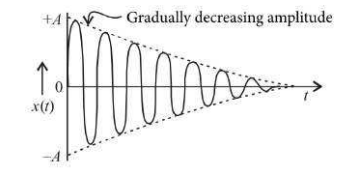
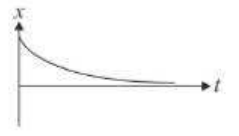
Read the passage given below and answer the following questions from 1 to 4. Damped Simple Harmonic Motion The oscillations in presence of dissipative force where the amplitude decreases gradually with the passage of time are called damped oscillations. A part of the energy of the oscillating system is lost in the form of heat, in overcoming these resistive forces, As a result, the amplitude of such oscillations decreases exponentially with time, as shown in figure. Eventually, these oscillations die out. In these oscillations, the amplitude of oscillation decreases exponentially due to damping forces like frictional force, viscous force, etc. Due to decrease in amplitude, the energy of the oscillator also goes on decreasing exponentially.

 The force producing a resistance to the oscillation is called damping force.
  1. particle oscillating under force $\overrightarrow{\text{F}}=-\text{k}\overrightarrow{\text{x}}-\text{b}\overrightarrow{\text{v}}$ is a (k and b are constants)
  1. Simple harmonic oscillator
  2. Linear oscillator
  3. Damped oscillator
  4. Forced oscillator
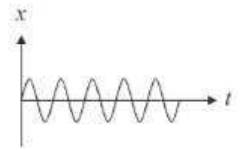
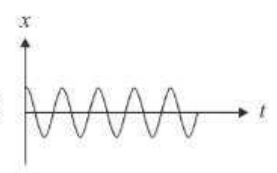
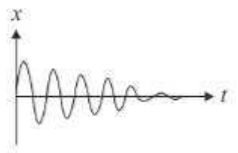
  1. Which of the following displacement-time graphs represent damped harmonic oscillation?
  1. In case of a force vibration, the resonance wave becomes very sharp when the
  1. Applied periodic force is small
  2. Quality factor is small
  3. Damping force is small
  4. Restoring force is small
  1. The S.I. unit of damping constant is:
  1. $kg s$
  2. $kg^2s$
  3. $kg m/s$
  4. $kg/s$