Question
The gain factor of an amplifier in increased from 10 to 12 as the load resistance is changed from $4\text{k}\Omega\text{ to }8\text{k}\Omega$ Calculate (a) the amplification factor and (b) the plate resistance.

Answer

Voltage gain $=\frac{\mu}{1+\frac{\text{r}_\text{p}}{\text{R}_\text{L}}}$ When $\text{A}=10,\ \text{R}_\text{L}=4\text{K}\Omega$$10=\frac{\mu}{1+\frac{\text{r}_\text{p}}{4\times10^{3}}}$
$10=\frac{\mu\times4\times\times10^{3}}{4\times10^{3}+\text{r}_\text{p}}$
$40\times10^{3}\times10\text{r}_\text{p}=4\times10^{3}\mu\ ....(\text{i})$
When $\text{A}=12,\text{R}_\text{L}=8\text{K}\Omega$$12=\frac{\mu}{1+\frac{\text{r}_\text{p}}{8\times10^{3}}}$
$12=\frac{\mu\times8\times10^{3}}{8\times10^{3}+\text{r}_\text{p}}$
$96\times10^{3}+12\text{r}_\text{p}=8\times10^{3}\mu\ ...(\text{ii})$
Multiplying (ii) in equation (i) and equating with equation (ii)$2(40\times10^{3}+10\text{r}_\text{p})=96\times10+3+12\text{r}_\text{p}$
$\text{r}_\text{p}=2\times10^{3}\Omega=2\text{K}\Omega$
Putting the value in equation (i)$40\times10^{3}+10(2\times10^{3})=4\times10^{3}\mu$
$40\times10^{3}+20\times10^{3}=4\times10^{3}\mu$
$\mu=\frac{60}{4}=15$

Need a full question paper?

Generate a complete, print-ready paper with questions like this in minutes — across 16+ boards, with answer keys.
Start Generating Free

Similar questions

The dynamic plate resistance of a triode value is $10\text{k}\Omega$ Find the change in the plate current if the plate voltage is changed from 200V to 220V.
Two fat astronauts each of mass 120kg are travelling in a closed spaceship moving at a speed of 15km/s in the outer space far removed from all other material objects. The total mass of the spaceship and its contents including the astronauts is 660kg. If the astronauts do slimming exercise and thereby reduce their masses to 90kg each, with what velocity will the spaceship move?
On a winter day, the outside temperature is 0°C and relative humidity 40%. The air from outside comes into a room and is heated to 20°C. What is the relative humidity in the room? The saturation vapour pressure at 0°C is 4.6mm of mercury and at 20°C it is 18mm of mercury.
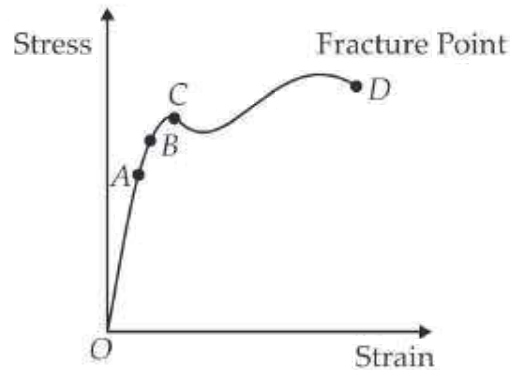
Read the passage given below and answer the following questions from 1 to 5. Stress-Strain Curve The graph shown below shows qualitatively the relation between the stress and the strain as the deformation gradually increases. Within Hooke’s limit for a certain region stress and strain relation is linear. Beyond that up to a certain value of strain the body is still elastic and if deforming forces are removed the body recovers its original shape.
  1. If deforming forces are removed up to which point the curve will be retraced?
  1. Upto OA only
  2. Upto OB
  3. Upto C
  4. Never retraced its path
  1. In the above question, during loading and unloading the force exerted by the material are conservative up to:
  1. OA only
  2. OB only
  3. OC only
  4. OD only
  1. During unloading beyond B, say C, the length at zero stress in now equal to:
  1. Less than original length
  2. Greater than original length
  3. Original length
  4. Can’t be predicted
  1. The breaking stress for a wire of unit cross - section is called:
  1. Yield point
  2. Elastic fatigue
  3. Tensile strength
  4. Young’s modulus
  1. Substances which can be stretched to cause large strains are called:
  1. Isomers
  2. Plastomers
  3. Elastomers
  4. Polymers
Read the passage given below and answer the following questions from 1 to 5. Work
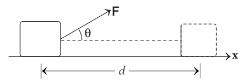
A farmer ploughing the field, a construction worker carrying bricks, a student studying for a competitive examination, an artist painting a beautiful landscape, all are said to be working. In physics, however, the word ‘Work’ covers a definite and precise meaning. Work refers to the force and the displacement over which it acts. Consider a constant force F acting on an object of mass m. The object undergoes a displacement d in the positive x-direction as shown in figure.

 The work done by the force is defined to be the product of component of the force in the direction of the displacement and the magnitude of this displacement, thus
$\text{W}=(\text{F}\cos\theta) \text{ D}=\text{F}.\text{D}.$
  1. The earth is moving around the sun in a circular orbit, is acted upon by a force and hence work done on the earth by the force is:
  1. zero
  2. positive
  3. negative
  4. None of the above
  1. In which case, work done will be zero?
  1. A weight-lifter while holding a weight of 100 kg on his shoulders for 1 min
  2. A locomotive against gravity is running on a level plane with a speed of 60 kmh - 1
  3. A person holding a suitcase on his head and standing at a bus terminal
  4. All of the above
  1. Find the angle between force $\text{F}=(3\hat{\text{i}}+4\hat{\text{j}}-5\hat{\text{k}})$ unit and displacement $\text{d}=(5\hat{\text{i}}+4\hat{\text{j}}+3\hat{\text{k}})$ unit.
  1. $\cos ^{-1}(0.49)$
  2. $\cos ^{-1}(0.32)$
  3. $\cos^{-1}(0.60)$
  4. $\cos^{-1}(0.90)$
  1. Which of the following statement(s) is/ are correct for work done to be zero?
  1. I. If the displacement is zero.
  2. II. If force applied is zero.
  3. III. If force and displacement are mutually perpendicular to each other.
(a) Only I (b) I and II
(c) Only II (d) I, II and III
  1. A proton is kept at rest. A positively charged particle is released from rest at a distance d in its field. Consider two experiments; one in which the charged particle is also a proton and in another, a positron. In same time t, the work done on the two moving charged particles is:
  1. same as the same force law is involved in the two experiments
  2. less for the case of a positron, as the positron moves away more rapidly and the force on it weakens
  3. more for the case of a positron, as the positron moves away a larger distance
  4. same as the work is done by charged particle on the stationary proton
Mr. Verma $(50kg)$ and Mr. Mathur $(60kg)$ are sitting at the two extremes of a $4m$ long boat $(40kg)$ standing still in water. To discuss a mechanics problem, they come to the middle of the boat. Neglecting friction with water, how far does the boat move on the water during the process?
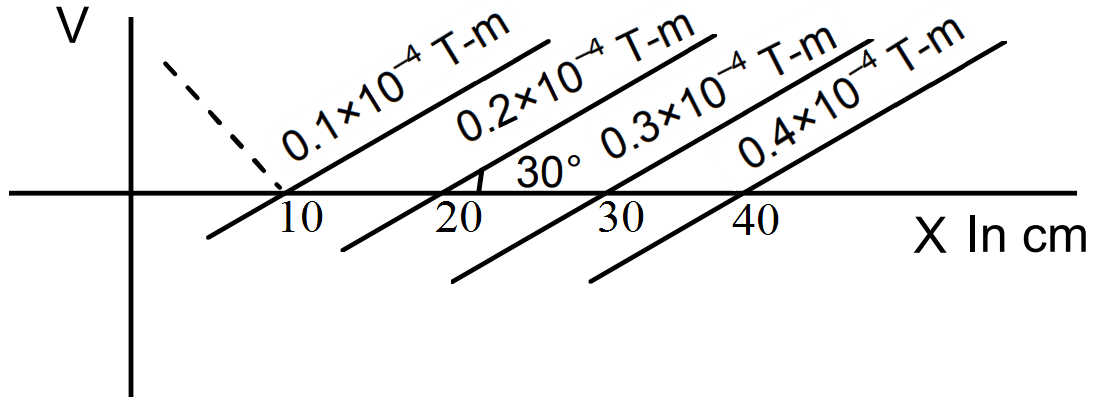
Figure shows some of the quipotential surfaces of the magnetic scalar potential. Fmd the magnetic field B at a point in the region.
Why don't we have interference when two candles are placed close to each other and the intensity is seen at a distant screen? What happens if the candles are replaced by laser sources?
Suppose you are inside the water in a swimming pool near an edge. A friend is standing on the edge. Do you find your friend taller or shorter than his usual height?
The magnetic field due to the earth has a horizontal component of $26\mu\text{T}$ at a place where the dip is 60°. Find the vertical component and the magnitude of the field.