Question
A dimensionless quantity:
  1. Never has a unit.
  2. Always has a unit
  3. May have a unit.
  4. Does not exist.

Answer

  1. May have a unit.

Explanation:

Dimensionless quantities may have units.

Need a full question paper?

Generate a complete, print-ready paper with questions like this in minutes — across 16+ boards, with answer keys.

Start Generating Free

Similar questions

A car driver going at some speed v suddenly finds a wide wall at a distance r. Should he apply brakes or turn the car in a circle of radius r to avoid hitting the wall?
The plate resistance and amplification factor of a triode are $10\text{k}\Omega$ and 20. The tube is operated at plate voltage 250V and grid voltage -7.5V. The plate current is 10mA. (a) To what value should the grid voltage be changed so as to increase the plate current to 15mA? (b) To what value should the plate voltage be changed to take the plate current back to 10mA?
The household supply of electricity is at 220V (rms value) and 50Hz. Find the peak voltage and the least possible time in which the voltage can change from the rms value to zero.
In a testing experiment on a model aeroplane in a wind tunnel, the flow speeds on the upper and lower surfaces of the wing are $70 m s ^{-1}$ and 63 m $s^{-1}$ respectively. What is the lift on the wing if its area is $2.5 m^2$ ? Take the density of air to be $1.3 kg m ^{-3}$.
In an experiment on the specific heat of a metal, a 0.20 kg block of the metal at $150^{\circ} C$ is dropped in a copper calorimeter (of water equivalent 0.025 kg ) containing $150 cm^3$. of water at $27^{\circ} C$. The final temperature is $40^{\circ} C$. Compute the specific heat of the metal. If heat losses to the surroundings are not negligible, is your answer greater or smaller than the actual value for specific heat of the metal?
The oxygen molecule has a mass of 5.30 × $10^{-28} kg$ and a moment of inertia of $1.94 \times 10^{-46} kg m ^2$ about an axis through its centre perpendicular to the lines joining the two atoms. Suppose the mean speed of such a molecule in a gas is $500 m / s$ and that its kinetic energy of rotation is two thirds of its kinetic energy of translation. Find the average angular velocity of the molecule.
Read the passage given below and answer the following questions from 1 to 5.
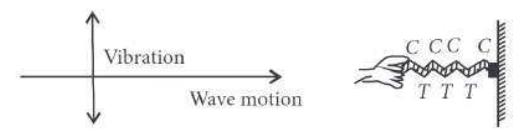
Transverse and Longitudinal Waves Transverse waves forms if the particles of the medium vibrate at right angle to the direction of wave motion energy propagation, the wave is called transverse wave. These are propagated as crests and troughs.

Longitudinal waves forms if the particles of the medium vibrate in the direction of wave motion, the wave is called longitudinal. These are propagated as compressions and rarefactions and wave is also known as pressure or compressional wave. Wave on spring or sound waves in air are examples of longitudinal waves.

  1. In a transverse wave, the particles of the medium:
  1. Vibrate in a direction perpendicular to the direction of the propagation.
  2. Vibrate in a direction parallel to the direction of the propagation.
  3. Move in circle.
  4. Move in ellipse.
  1. A transverse wave consists of:
  1. Only crests
  2. Only troughs
  3. Both crests and troughs
  4. Rarefactions and compressions
  1. Ultrasonic waves produced by a vibrating quartz crystal are:
  1. Only longitudinal.
  2. Only transverse.
  3. Both longitudinal and transverse.
  4. Neither longitudinal nor transverse.
  1. Sound waves travel fastest in:
  1. Solids
  2. Liquids
  3. Gases
  4. Vacuum
  1. Sound waves in air cannot be polarized because:
  1. Their speed is small
  2. They require medium
  3. They are longitudinal
  4. Their speed is temperature dependent
Why does thermionic emission not take place in non-conductors?
A brass rod of length 50 cm and diameter 3.0 mm is joined to a steel rod of the same length and diameter. What is the change in length of the combined rod at $250{ }^{\circ} C$, if the original lengths are at $40.0{ }^{\circ} C$ ? Is there a 'thermal stress' developed at the junction? The ends of the rod are free to expand (Co-efficient of linear expansion of brass $=2.0 \times 10^{-5} K^{-1}$, steel $=1.2 \times$ $\left.10^{-5} K^{-1}\right)$
The constant A in the Richardson-Dushman equation for tungsten is 60 × 104Am-2K-2. The work function of tungsten is 4.5eV. A tungsten cathode with a surface area 2.0 × 10⁻⁵m2 is heated by a 24W electric heater. In steady state, the heat radiated by the heater and the cathode equals the energy input by the heater and the temperature becomes constant. Assuming that the cathode radiates like a blackbody, calculate the saturation current due to thermions. Take Stefan's Constant $ 6 × 10^{-8}\omega/\text{m}^2-\text{K}^4.$ Assume that the thermions take only a small fraction of the heat supplied.