Question
Why does thermionic emission not take place in non-conductors?

Answer

For thermionic emission, material should have low work function and large number of free electrons. But nonconductor does not have free electrons and they have higher work function. So, thermionic emission does not takes place in non-conductors.

Need a full question paper?

Generate a complete, print-ready paper with questions like this in minutes — across 16+ boards, with answer keys.
Start Generating Free

Similar questions

Read the passage given below and answer the following questions from 1 to 5. First Law of Thermodynamics The first law of thermodynamics is the general law of conservation of energy applied to any system in which energy transfer from or to the surroundings (through heat and work) is taken into account. It states that the energy supplied to the system goes in partly to increase the internal energy of the system and the rest in work on the environment. Mathematically, $\triangle\text{Q}=\triangle\text{U}+\triangle\text{W}$ where $\triangle\text{Q}$ is the heat supplied to the system, $\triangle\text{W}$ is the work done by the system and $\triangle\text{U}$ is the change in internal energy of the system. $\triangle\text{Q}$ and $\triangle\text{W}$ depend on the path taken to go from initial to final states, but the combination $\triangle\text{Q}​​-​​\triangle\text{W}$ is path independent.

  1. The first law of thermodynamics is concerned with conservation of:
  1. Number of molecules
  2. Number of moles
  3. Energy
  4. Temperature
  1. Which of the following is not a path function?
  1. $\triangle\text{Q}$

  2. $\triangle\text{Q}​​+\triangle\text{W}$

  3. $\triangle\text{W}$

  4. $\triangle\text{Q}​​-​​\triangle\text{W}$

  1. An electric heater supplies heat to a system at a rate of 120W. If system performs work at a rate of 80 J s-1, the rate of increase in internal energy is:
  1. 30 J s-1
  2. 40 J s-1
  3. 50 J s-1
  4. 60 J s-1
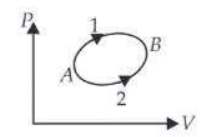
  1. Asystem goes from A to B by two different paths in the P - V diagram as shown in figure. Heat given to the system in path 1 is 1100 J, the work done by the system along path 1 is more than path 2 by 150 J. The heat exchanged by the system in path 2 is:

  1. 800 J
  2. 750 J
  3. 1050 J
  4. 950 J
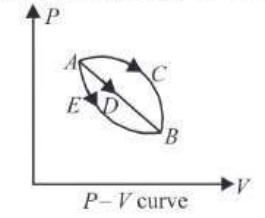
  1. A certain mass of gas is carried from A to B, along three paths via ACB, ADB and AEB. Which one of the following is correct?

  1. Work done via path ACB is minimum.
  2. Work done via path ADB is maximum.
  3. Work done via path ACB is maximum.
  4. Work done via path AEB is maximum.
In a microwave oven, the food is kept in a plastic container and the microwave is directed towards the food. The food is cooked without melting or igniting the plastic container. Explain.
A tungsten cathode and a thoriated-tungsten cathode have the same geometric dimensions and are operated at the same temperature. The thoriated-tungsten cathode gives 5000 times more current than the other cathode. Find the operating temperature. Take relevant data from the previous problem.
50cc of oxygen is collected in an inverted gas jar over water. The atmospheric pressure is 99.4kPa and the room temperature is 27°C. The water level in the jar is same as the level outside. The saturation vapour pressure at 27°C is 3.4kPa. Calculate the number of moles of oxygen collected in the jar.
Read the passage given below and answer the following questions from 1 to 5.
When a body is subjected to a deforming force, a restoring force is developed in the body. This restoring force is equal in magnitude but opposite in direction to the applied force. The restoring force per unit area is known as stress. If F is the force applied normal to the cross–section and A is the area of cross section of the body.
Magnitude of the stress $=\frac{\text{F}}{\text{A}}$
The SI unit of stress is N-m-2 or Pascal (Pa) and its dimensional formula is [ML-1 T-2]. The restoring force per unit area in this case is called tensile stress. If the cylinder is compressed under the action of applied forces, the restoring force per unit area is known as compressive stress. Tensile or compressive stress can also be termed as longitudinal stress. In both the cases, there is a change in the length of the cylinder. The change in the length ΔL to the original length L of the body is known as longitudinal strain.
The restoring force per unit area developed due to the applied tangential force is known as tangential or shearing stress.
  1. Restoring force per unit area is called as:
  1. Stress
  2. Strain
  3. Modulus of elasticity
  4. None of these
  1. Ratio of change in dimension to original dimension is called:
  1. Stress
  2. Strain
  3. Modulus of elasticity
  4. None of these
  1. Define shear stress.
  1. Define stress. Give its SI unit and dimension.
  1. Define strain. Give its SI unit and dimension
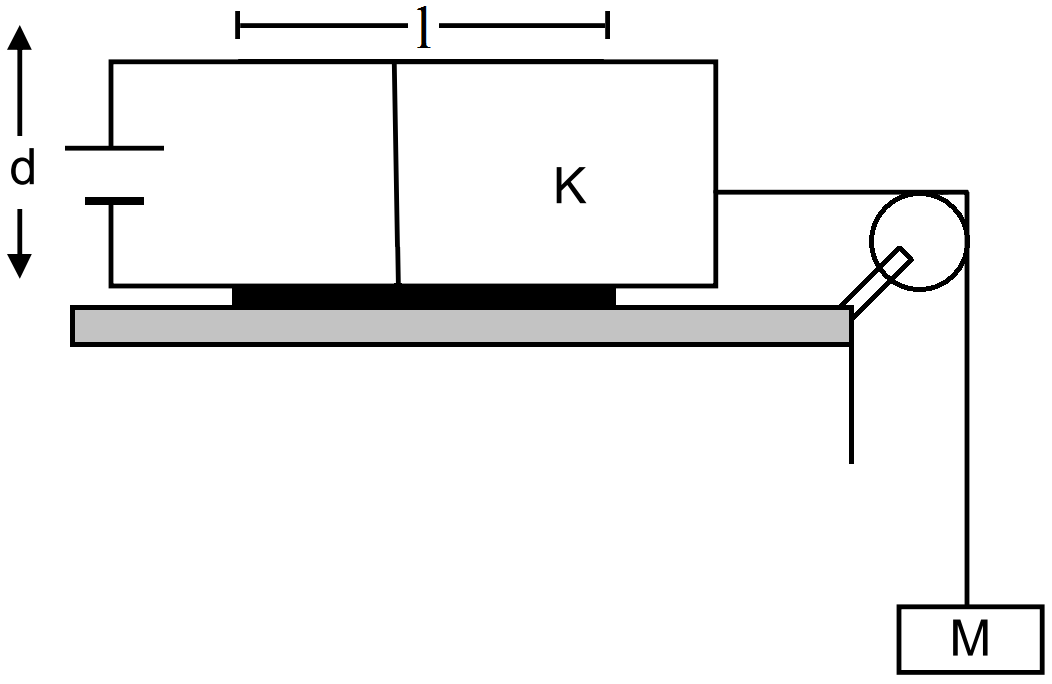
Consider the situation shown in figure. The width of each plate is b. The capacitor plates are rigidly clamped in the laboratory and connected to a battery of emf $\in.$ All surfaces are frictionless. Calculate the value of M for which the dielectric slab will stay in equilibrium.

Read the case study given below and answer any four subparts:
Potential energy is the energy stored within an object, due to the object's position, arrangement or state. Potential energy is one of the two main forms of energy, along with kinetic energy. Potential energy depends on the force acting on the two objects.

  1. A body is falling freely under the action of gravity alone in vacuum. Which of the following quantities remain constant during the fall?
    1. kinetic energy
    2. potential energy
    3. mechanical energy
    4. none of these
  2. Work done by a conservative force is positive, if
    1. potential energy decreases
    2. potential energy increases
    3. kinetic energy decreases
    4. kinetic energy increases
  3. When does the potential energy of a spring increases?
    1. only when spring is stretched
    2. only when spring is compressed 
    3. both a and b
    4. none of these
  4. Dimension of k/m is, here k is force constant
    1. T2
    2. T-2
    3. T1
    4. T-1
  5. A vehicle of mass 5000kg climbs up a hill of 10 m. The potential energy gained by it
    1. 5J
    2. 500J
    3. 5 × 104J
    4. 5 × 105J
The plate current in a diode is 20mA when the plate voltage is 50V or 60V. What will be the current if the plate voltage is 70V?
Mr. Verma (50kg) and Mr. Mathur (60kg) are sitting at the two extremes of a 4m long boat (40kg) standing still in water. To discuss a mechanics problem, they come to the middle of the boat. Neglecting friction with water, how far does the boat move on the water during the process?
To keep valuable instruments away from the earth's magnetic field, they are enclosed in iron boxes. Explain.