MCQ
A dip needle in a plane perpendicular to magnetic meridian will remain
  • Vertical
  • B
    Horizontal
  • C
    In any direction
  • D
    At an angle of dip to the horizontal

Answer

Correct option: A.
Vertical

Need a full question paper?

Generate a complete, print-ready paper with questions like this in minutes — across 16+ boards, with answer keys.
Start Generating Free

Similar questions

Energy of a quanta of frequency $10^{15} \mathrm{~Hz}$ and $h=6.6 \times 10^{-34} \mathrm{~J}-\mathrm{sec}$ will be
During an adiabatic process, the pressure of a gas is found to be proportional to the cube of its absolute temperature. The ratio $C_p / C_v$ for the gas is
Two capillary of length $L$ and $2 L$ and of radius $R$ and $2 R$ are connected in series. The net rate of flow of fluid through them will be (given rate of the flow through single capillary, $\left.X=\pi P R^4 / 8 \eta L\right)$
The oscillating frequency of acyclotron is $10\, MHz$. If the radius of its dee is $0.5\, m$, the kinetic energy of a proton, which is accelerated by the cyclotron is......$MeV$
If a photon has velocity $c$ and frequency $v$, then which of following represents its wavelength
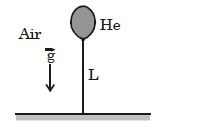
A light balloon filled with helium of density $\rho_{He}$ is tied to a light string of length $L.$ The string is tied to the ground forming an "inverted" simple pendulum (figure). If the balloon is displaced slightly from equilibrium as in figure and released, the period of the motion is. Take the density of air to be $\rho_{air}$. Assume the air applies a buoyant force on the balloon but does not otherwise affect its motion.)
The number of turns in primary and secondary coils of a transformer are 100 and 20 respectively. If an alternating potential of 200 volt is applied to the primary, the induced potential in secondary will be
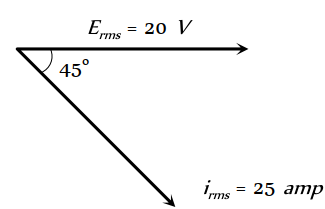
The vector diagram of current and voltage for a circuit is as shown. The components of the circuit will beImage
At a moment in a progressive wave, the phase of a particle executing S.H.M. is $\frac{\pi}{3}$. Then the phase of the particle $15 \mathrm{~cm}$ ahead and at the time $\frac{T}{2}$ will be, if the wavelength is $60 \mathrm{~cm}$
A galvanometer has a coil of resistance $100\, ohm$ and gives a full scale deflection for $30\, mA$ current. If it is to work as a voltmeter of $30\, volt$ range, the resistance required to be added will be.....$Ω$