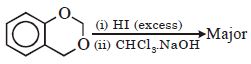
Question
A disc is rotating with an angular velocity $\omega _0. $  A constant retrarding torque is applied on it to stop the disc. The angular velocity becomes $(\omega _0/2)$  after $n$ rotations. How many more rotations will it make before coming to rest ?

Answer

$w^{2}=w_{0}^{2}-2 \alpha \theta$

$\left(w_{0} / 2\right)^{2}=w_{0}^{2}-2\alpha Q$

$\left(w_{0} / 2\right)^{2}=w_{0}^{2}-2 \alpha Q_{1}$                  

$0=\left(w_{0} / 2\right)^{2}-2 \alpha Q_{2}$

$Q_{2}=\frac{Q_{1}}{3}$

$\Rightarrow \frac {n}{3}$

Need a full question paper?

Generate a complete, print-ready paper with questions like this in minutes — across 16+ boards, with answer keys.

Start Generating Free

Similar questions

product:-
For a gas, the difference between the two specific heats is $4150\, J\, kg^{-1}\, K^{-1}$ and the ratio of the two specific heats is $1.4$. What is the specific heat of the gas at constant volume in units of $J\, kg^{-1}\, K^{-1}$ ?
Which one of the following pair cannot be the rectangular components of force vector of $10 \,N$ ?
A particle executing simple harmonic motion of amplitude $5\, cm$ has maximum speed of $31.4\, cm/s$. The frequency of its oscillation is ..... $Hz$
In a diode AM-detector, the output circuit consist of $R = 1k\Omega$ and $C = 10 pF$. A carrier signal of $100 \,kHz$ is to be detected. Is it good
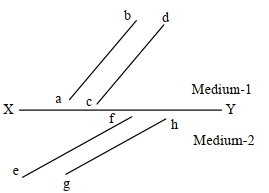
The figure shows a surface $XY$ separating two transparent media, medium -$1$ and medium -$2$. The lines $a b$ and cd represent wavefronts of a light wave travelling in medium-$1$ and incident on $XY$. The lines ef and gh represent wavefronts of the light wave in medium-$2$ after refraction.

$Image$

$1.$  Light travels as a

$(A)$ parallel beam in each medium

$(B)$ convergent beam in each medium

$(C)$ divergent beam in each medium

$(D)$ divergent beam in one medium and convergent beam in the other medium.

$2.$  The phases of the light wave at $\mathrm{c}, \mathrm{d}, \mathrm{e}$ and $\mathrm{f}$ are $\phi_{\mathrm{c}}, \phi_{\mathrm{d}}, \phi_{\mathrm{e}}$ and $\phi_{\mathrm{f}}$ respectively. It is given that $\phi_{\mathrm{c}} \neq \phi_{\mathrm{f}}$

$(A)$ $\phi_{\mathrm{c}}$ cannot be equal to $\phi_{\mathrm{d}}$

$(B)$ $\phi_{\mathrm{a}}$ can be equal to $\phi_{\mathrm{e}}$

$(C)$ $\left(\phi_{\mathrm{d}}-\phi_t\right)$ is equal to $\left(\phi_{\mathrm{c}}-\phi_{\mathrm{e}}\right)$

$(D)$ $\left(\phi_{\mathrm{d}}-\phi_c\right)$ is not equal to $\left(\phi_{\mathrm{f}}-\phi_e\right)$

$3.$  Speed of the light is

$(A)$ the same in medium-$1$ and medium-$2$

$(B)$ larger in medium-$1$ than in medium-$2$

$(C)$ larger in medium-$2$ than in medium-$1$

$(D)$ different at $\mathrm{b}$ and $\mathrm{d}$

Give the answer question $1, 2$ and $3.$
Velocity of sound measured at a given temperature in oxygen and hydrogen is in the ratio
The control rod in a nuclear reactor is made of
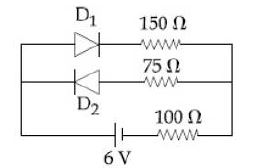
The circuit shown below contains two ideal diodes, each with a forward resistance of $50\,\Omega $. If the battery voltage is $6\,V$, the current through the $100\,\Omega $ resistance (in Amperes) is
A block slides down a smooth inclined plane when released from the top, while another falls freely from the same point