MCQ
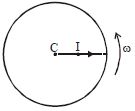
$A$ disc is rotating with constant angular velocity about an axis passing through centre $C$ and perpendicular to the plane of disc. An insect is moving over the disc along radial direction with constant velocity with respect to the disc. Acceleration of the insect at the instant when its distance from centre is $r$, will be :-
  • A
    $rw^2$ towards the centre
  • B
    $rw^2$ away from the centre
  • C
    Less than $rw^2$ in magnitude
  • Greater than $rw^2$ in magnitude

Answer

Correct option: D.
Greater than $rw^2$ in magnitude
d
As insect moves outwards its tangential speed (in ground frame) increases.

Need a full question paper?

Generate a complete, print-ready paper with questions like this in minutes — across 16+ boards, with answer keys.

Start Generating Free

Similar questions

A wire of area of cross-section ${10^{ - 6}}{m^2}$ is increased in length by $0.1\%$. The tension produced is $1000 N$. The Young's modulus of wire is
The relation between time ' $t$ ' and distance ' $x$ ' is $t=$ $\alpha x^2+\beta x$, where $\alpha$ and $\beta$ are constants. The relation between acceleration $(a)$ and velocity $(v)$ is:
Given below are two statements:

Statement $I :$ An electric dipole is placed at the centre of a hollow sphere. The flux of electric field through the sphere is zero but the electric field is not zero anywhere in the sphere.

Statement $II :$ If $R$ is the radius of a solid metallic sphere and $Q$ be the total charge on it. The electric field at any point on the spherical surface of radius $r ( < R )$ is zero but the electric flux passing through this closed spherical surface of radius $r$ is not zero.

In the light of the above statements, choose the correct answer from the options given below:

The ratio of the magnitude of the magnetic field and electric field intensity of a plane electromagnetic wave in free space of permeability $\mu_0$ and permittivity $\varepsilon_0$ is (Given that $c$ - velocity of light in free space)
The length of a potentiometer wire is $l$. $A$ cell of $\mathrm{emf}$ $E$ is balanced at a length $l/3$ from the positive end of the wire. If the length of the wire is increased by $l/2$. At what distance will the same cell give a balance point.
During an adiabatic process, the pressure of a gas is found to be proportional to the cube of its absolute temperature. The ratio of $\frac{C_p}{C_v}$ for the gas is:
Assertion : Kirchoff 's junction rule follows from conservation of charge.

Reason : Kirchoff 's loop rule follows from conservation of momentum.

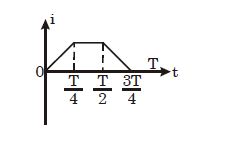
The current $i$ in a coil varies with times as shown in the figure. The variation of induced $emf$ with time would be
Let $R _1$ be the radius of the second stationary orbit and $R_2$ be the radius of the fourth stationary orbit of an electron in Bohr's model. The ratio $\frac{ R _1}{ R _2}$ is
In order to see diffraction the thickness of the film is