Assertion : Kirchoff 's junction rule follows from conservation of charge.
Reason : Kirchoff 's loop rule follows from conservation of momentum.
AIIMS 2017, Easy


Download our appand get started for free
Experience the future of education. Simply download our apps or reach out to us for more information. Let's shape the future of learning together!No signup needed.*
Similar Questions
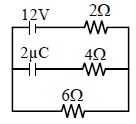
- 1Find the charge on the capacitor $C$ in the given circuit .................. $\mu C$View Solution
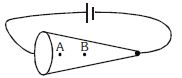
- 2View SolutionSuppose a current carrying wire has a cross-sectional area that, gradually become smaller along the wire, has the shape of a very long cone as shown in figure. Choose the correct statement
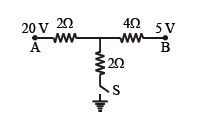
- 3As the switch $S$ is closed in the circuit shown in figure, current passing through it is ................ $\mathrm{A}$View Solution
- 4A galvanometer of resistance, $G,$ is connected in a circuit. Now a resistance $R$ is connected in series of galvanometer. To keep the main current in the circuit unchanged, the resistance to be put in parallel with the series combination of $G$ and $R$ isView Solution
- 5In a meter bridge experiment resistances are connected as shown in the figure. Initially resistance $P\, = 4\,\Omega $ and the neutral point $N$ is at $60\,cm$ from $A$. Now an unknown resistance $R$ is connected in series to $P$ and the new position of the neutral point is at $80\,cm$ from $A$ . The value of unknown resistance $R$ isView Solution
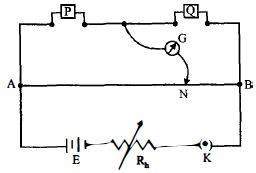
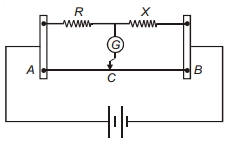
- 6In the meter bridge shown, the resistance $X$ has a negative temperature coefficient of resistance. Neglecting the variation in other resistors, when current is passed for some time, in the cirucit, balance point should shift towards.View Solution
- 7A wire of length $100\, cm$ is connected to a cell of emf $2\,V$ and negligible internal resistance. The resistance of the wire is $3\,\Omega $. The additional resistance required to produce a potential difference of $1\, mV/cm$ is ............. $\Omega$View Solution
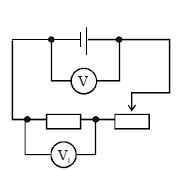
- 8If the rheostat slider were to move from the extreme right to the far left, How will the reading of voltmeter $V_1$ change?View Solution
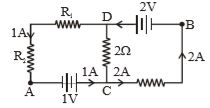
- 9In the circuit shown below, if the potential at point $A$ is taken to be zero, the potential at point $B$ is .............. $V$View Solution
- 10$A\,\,{5\,^o}C$ rise in the temperature is observed in a conductor by passing some current. When the current is doubled, then rise in temperature will be equal to ............. $^oC$View Solution