MCQ
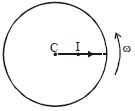
$A$ disc is rotating with constant angular velocity about an axis passing through centre $C$ and perpendicular to the plane of disc. An insect is moving over the disc along radial direction with constant velocity with respect to the disc. Acceleration of the insect at the instant when its distance from centre is $r$, will be :-
  • A
    $rw^2$ towards the centre
  • B
    $rw^2$ away from the centre
  • C
    Less than $rw^2$ in magnitude
  • Greater than $rw^2$ in magnitude

Answer

Correct option: D.
Greater than $rw^2$ in magnitude
d
As insect moves outwards its tangential speed (in ground frame) increases.

Need a full question paper?

Generate a complete, print-ready paper with questions like this in minutes — across 16+ boards, with answer keys.

Start Generating Free

Similar questions

Which of the following reaction will not produce "Acetaldehyde" ?
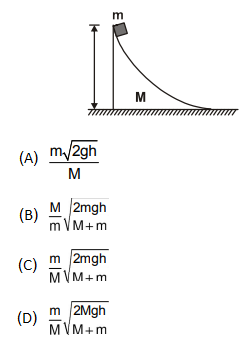
A mass m is placed at a height on the wedge of mass M shown in the figure. The ground is smooth. When the mass m reaches the ground, velocity of the wedge is (assume all smooth surfaces):
Image
A metallic rod of cross-sectional area $9.0\,\,cm^2$ and length $0.54 \,\,m$, with the surface insulated to prevent heat loss, has one end immersed in boiling water and the other in ice-water mixture. The heat conducted through the rod melts the ice at the rate of $1 \,\,gm$ for every $33 \,\,sec$. The thermal conductivity of the rod is ....... $ Wm^{-1} K^{-1}$
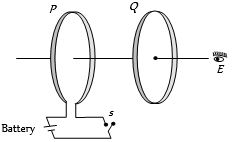
As shown in the figure,$P$ and $Q$ are two coaxial conducting loops separated by some distance. When the switch $S$ is closed, a clockwise current ${I_P}$ flows in $P$ (as seen by $E$) and an induced current ${I_{{Q_1}}}$ flows in $Q.$ The switch remains closed for a long time. When $S$ is opened, a current ${I_{{Q_2}}}$ flows in $Q$. Then the directions of ${I_{{Q_1}}}$ and ${I_{{Q_2}}}$ (as seen by $E$) are    
An ideal gas, initially in state $\left( P _{12}, V _1, T _1\right)$ is expanded isobarically to $\left( P _{12}, V _2, T _2\right)$, then adiabatically $\left( P _{34}, V _3, T _3\right)$. It is then contracted isobarically to $\left( P _{34}, V _4, T _4\right)$ and finally adiabatically back to the initial state. The efficiency of this cycle is
The height to which a cylindrical vessel be filled with a homogeneous liquid, to make the average force with which the liquid presses the side of the vessel equal to the force exerted by the liquid on the bottom of the vessel, is equal to
A satellite of mass $m$, initially at rest on the earth, is launched into a circular orbit at a height equal to the radius of the earth. The minimum energy required is
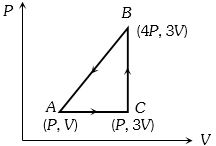
A sample of ideal monoatomic gas is taken round the cycle $ABCA$ as shown in the figure. The work done during the cycle is
The potential energy of a molecule on the surface of liquid compared to one inside the liquid is
The amount of energy required to form a bubble of radius 3 cm from a soap solution is nearly: (surface tension of soap solution = $0.05 N m ^{-1}$)