A metallic rod of cross-sectional area $9.0\,\,cm^2$ and length $0.54 \,\,m$, with the surface insulated to prevent heat loss, has one end immersed in boiling water and the other in ice-water mixture. The heat conducted through the rod melts the ice at the rate of $1 \,\,gm$ for every $33 \,\,sec$. The thermal conductivity of the rod is ....... $ Wm^{-1} K^{-1}$
Advanced


Download our appand get started for free
Experience the future of education. Simply download our apps or reach out to us for more information. Let's shape the future of learning together!No signup needed.*
Similar Questions
- 1View SolutionThe coefficient of thermal conductivity depends upon
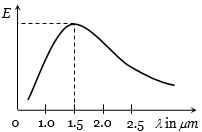
- 2In the figure, the distribution of energy density of the radiation emitted by a black body at a given temperature is shown. The possible temperature of the black body is ....... $K$View Solution
- 3Two spherical bodies $\mathrm{A}$ (radius $6 \mathrm{~cm}$ ) and $\mathrm{B}$ (radius $18 \mathrm{~cm}$ ) are at temperature $\mathrm{T}_1$ and $\mathrm{T}_2$, respectively. The maximum intensity in the emission spectrum of $\mathrm{A}$ is at $500 \mathrm{~nm}$ and in that of $\mathrm{B}$ is at $1500 \mathrm{~nm}$. Considering them to be black bodies, what will be the ratio of the rate of total energy radiated by $A$ to that of $B$ ?View Solution
- 4View SolutionEqual masses of two liquids are filled in two similar calorimeters. The rate of cooling will
- 5Two metal spheres have radil $r$ and $2 r$ and they emit thermal radiation with maximum intensities at wavelengths $\lambda$ and $2 \lambda$ respectively. The respective ratio of the radiant energy emitted by them per second will be .........View Solution
- 6If temperature of a black body increases from ${7^o}C$ to ${287^o}C$, then the rate of energy radiation increases byView Solution
- 7Wein's constant is $2892 \times {10^{ - 6}}$$MKS$ unit and the value of ${\lambda _m}$ from moon is $14.46$ microns. What is the surface temperature of moon ...... $K$View Solution
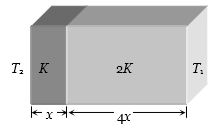
- 8The temperature of the two outer surfaces of a composite slab, consisting of two materials having coefficients of thermal conductivity $K$ and $2K$ and thickness $x$ and $4x$ , respectively are $T_2$ and $T_1$ ($T_2$ > $T_1$). The rate of heat transfer through the slab, in a steady state is $\left( {\frac{{A({T_2} - {T_1})K}}{x}} \right)f$, with $f $ which equal toView Solution
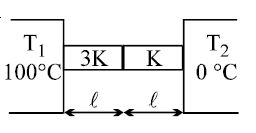
- 9Two rods $A$ and $B$ of same cross-sectional are $A$ and length $l$ connected in series between a source $(T_1 = 100^o C)$ and a sink $(T_2 = 0^o C)$ as shown in figure. The rod is laterally insulated If $G_A$ and $G_B$ are the temperature gradients across the rod $A$ and $B$, thenView Solution
- 10A black body at a temperature of $1640\,\,K$ has the wavelength corresponding to maximum emission equal to $1.75 \,\,\mu m.$ Assuming the moon to be a perfectly black body, the temperature of the moon, if the wavelength corresponding to maximum emission is $14.35\,\,\mu m$ is.......$K$View Solution