MCQ
A disc rotating about its axis from rest, acquires the angular speed $100 \,rev/s$ in $4$ second. The angle rotated by it during these four seconds (in radian) is ...... $\pi$
  • A
    $100$
  • B
    $200$
  • C
    $300$
  • $400$

Answer

Correct option: D.
$400$
d
(d)

Initial angular speed, $\omega_0=0 rad / s$

Final angular speed, $\omega=100 rps$

$\Rightarrow \omega=100 \times 2 \pi rad$ $\Rightarrow \omega=200 \pi rad / s$

Time, $t=4 s$

From kinematics:

$\omega =\omega_0+\alpha t$

$\Rightarrow 200 \pi=4 \alpha$

$\Rightarrow \alpha=\frac{200 \pi}{4} rad / s ^2$

where, $\alpha$ is angular acceleration.

Also,

$\theta =\omega_0 t+\frac{1}{2} \alpha t^2$

$\Rightarrow \theta =0+\frac{1}{2} \times \frac{200 \pi}{4} \times 16$

$\Rightarrow \theta =400 \pi$

Need a full question paper?

Generate a complete, print-ready paper with questions like this in minutes — across 16+ boards, with answer keys.
Start Generating Free

Similar questions

At temperatures close to $0\ K$ , the heat capacity $C$ of a certain solid is related to its temperature $T$ by the equation $C = aT^3$ , where a is a constant characteristic of the solid. Heat is supplied to the solid at a steady rate. Which graph best represents the variation of its temperature $T$ with time $t$ ?
A satellite revolves in the geostationary orbit but in a direction east to west. The time interval between its successive passing about a point on the equator is ........ $hrs$
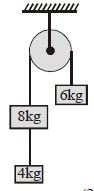
Three blocks of masses $4\,kg$, $6\,kg$ and $8\,kg$ are hanging over a fixed pulley as shown. The tension in the string connecting $8\,kg$ and $4\,kg$ block is
A raindrop with radius $R=0.2\, {mm}$ fells from a cloud at a height $h=2000\, {m}$ above the ground. Assume that the drop is spherical throughout its fall and the force of buoyance may be neglected, then the terminal speed attainde by the raindrop is : (In ${ms}^{-1}$)

[Density of water $f_{{w}}=1000\;{kg} {m}^{-3}$ and density of air $f_{{a}}=1.2\; {kg} {m}^{-3}, {g}=10 \;{m} / {s}^{2}$ Coefficient of viscosity of air $=18 \times 10^{-5} \;{Nsm}^{-2}$ ]

It is true for adiabatic change:
Four identical hollow cylindrical columns of mild steel support a big structure of mass $50 \times 10^{3} {kg}$, The inner and outer radii of each column are $50\; {cm}$ and $100 \;{cm}$ respectively. Assuming uniform local distribution, calculate the compression strain of each column. [Use $\left.{Y}=2.0 \times 10^{11} \;{Pa}, {g}=9.8\; {m} / {s}^{2}\right]$
The area of the hole of heat furnace is $10^{-4}\,m^2.$ It radiates $1.58\times 10^5\,cal$ of heat per hour. If the emissivity of the furnace is $0.80,$ then its temperature is .......... $K$
If $ V, R$ and $g$ denote respectively the escape velocity from the surface of the earth radius of the earth, and acceleration due to gravity, then the correct equation is
The top of a lake gets frozen at a place where the surrounding air is at a temperature of $-20\,^oC$. Then
If $V$ denotes the potential difference across the plates of a capacitor of capacitance $C$, the dimensions of $C{V^2}$are