MCQ
It is true for adiabatic change:
  • A
    $PV ^{\gamma-1}=$ Constant
  • $TV ^{\gamma^{-1}}=$ Constant
  • C
    $T ^{\gamma^{-1} V}=$ Constant
  • D
    TV ${ }^\gamma=$ Constant

Answer

Correct option: B.
$TV ^{\gamma^{-1}}=$ Constant
B

Need a full question paper?

Generate a complete, print-ready paper with questions like this in minutes — across 16+ boards, with answer keys.
Start Generating Free

Similar questions

Which of the following is best close to an ideal black body
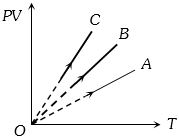
$PV$ versus $T$ graph of equal masses of ${H_2}$, $He$ and ${O_2}$ is shown in fig. Choose the correct alternative
A lift is coming from 8th floor and is just about to reach 4th floor. Taking ground floor as origin and positive direction upwards for all quantities, which one of the following is correct?
An electron is moving along the positive x-axis. You want to apply a magnetic field for a short time so that the electron may reverse its direction and move parallel to the negative x-axis. This can be done by applying the magnetic field along:
  1. y-axis.
  2. z-axis.
  3. y-axis only.
  4. z-axis only.
A black body radiates heat energy at the rate of $2\times10^5\, J/sm^2$ at temp. of $127\,^oC$. The temp of black body at which rate becomes $32\times10^5\, J/s-m^2%$ is ....... $^oC$
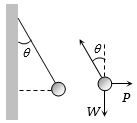
A metal sphere is hung by a string fixed to a wall. The sphere is pushed away from the wall by a stick. The forces acting on the sphere are shown in the second diagram. Which of the following statements is wrong
In a mixture of gases at a fixed temperature:
For a satellite in elliptical orbit which of the following quantities does not remain constant?
A swimmer can swim with velocity of $12 \,km / h$ in still water. Water flowing in a river has velocity $6\, km / h$. The direction with respect to the direction of flow of river water he should swim in order to reach the point on the other bank just opposite to his starting point is ........$^{\circ}$. (Round off to the Nearest Integer) (find the angle in degree)
A cannon ball is fired with a velocity $200\, m/sec$ at an angle of $60^o$ with the horizontal. At the highest point of its flight it explodes into $3$ equal fragments, one going vertically upwards with a velocity $100\, m/sec$, the second one falling vertically downwards with a velocity $100\, m/sec$. The third fragment will be moving with a velocity