Question
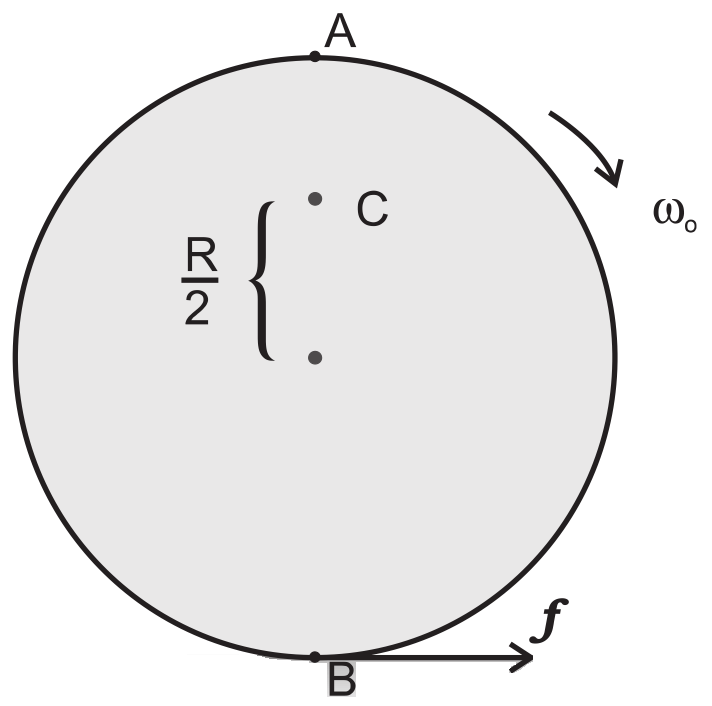
A disc rotating about its axis with angular speed $\omega_0$ is placed lightly (without any translational push) on a perfectly frictionless table. The radius of the disc is R. What are the linear velocities of the points A, B and C on the disc shown in will the disc roll in the direction indicated?
Answer

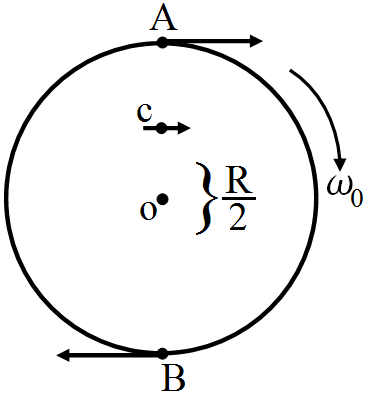
$\text{v}_{\text{A}}=\text{R}\omega_0,\text{ v}_\text{B}=\text{R}\omega_0,\text{ v}_\text{C}=\Big(\frac{\text{R}}{2}\Big)\omega_0$
The disc will not roll,
Angular speed of the disc $=\omega_0$
Radius of the disc = R
Using the relation for linear velocity, $\text{v}=\omega_0\text{R}$
For point A:
$\text{v}_{\text{A}}=\text{R}\omega_0,$ in the direction tangential to the right.
For point B:
$\text{v}_{\text{B}}=\text{R}\omega_0,$ in the direction tangential to the left.
For point C:
$\Big(\frac{\text{R}}{2}\Big)\omega_0$ in the direction same as that of vA.
The directions of motion of points A, B, and C on the disc are shown in the following figure:

Since the disc is placed on a frictionless table, it will not roll. This is because the presence of friction is essential for the rolling of a body.

Need a full question paper?

Generate a complete, print-ready paper with questions like this in minutes — across 16+ boards, with answer keys.

Start Generating Free

Similar questions

A truck starts from rest and accelerates uniformly at 2.0ms-2. At t = 10s, a stone is dropped by a person standing on the top of the truck (6m high from the ground). What are the (a) velocity, and (b) acceleration of the stone at t = 11s? (Neglect air resistance.)
A heavy ball is suspended from the ceiling of a motor car through a light string. A transverse pulse travels at a speed of 60cm/s on the string when the car is at rest and 62cm/s when the car accelerates on a horizontal road. Find the acceleration of the car. Take g = 10m/s2.
Explain why friction is necessary to make the disc in roll in the direction indicated.
  1. Give the direction of frictional force at B, and the sense of frictional torque, before perfect rolling begins.
  2. What is the force of friction after perfect rolling begins?
A rigid bar of mass 15kg is supported symmetrically by three wires each 2.0m long. Those at each end are of copper and the middle one is of iron. Determine the ratios of their diameters if each is to have the same tension.
Suppose the ends of the coil in the previous problem are connected to a resistance of $100\Omega.$ Neglecting the reaiatance of the coil, find the heat produced in the circuit in one minute.
Io, one of the satellites of Jupiter, has an orbital period of 1.769 days and the radius of the orbit is 4.22 × 10⁸m. Show that the mass of Jupiter is about one-thousandth that of the sun.
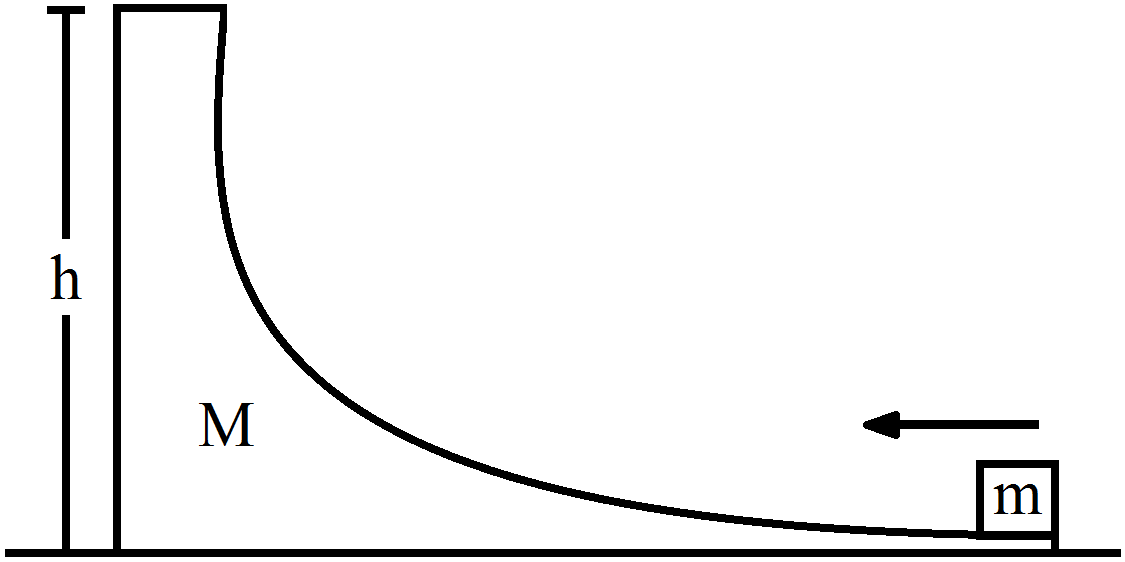
Figure shows a small body of mass m placed over a larger mass M whose surface is horizontal near the smaller mass and gradually curves to become vertical. The smaller mass is pushed on the longer one at a speed v and the system is left to itself. Assume that all the surfaces are frictionless.
  1. Find the speed of the larger block when the smaller block is sliding on the vertical part.
  2. Find the speed of the smaller mass when it breaks off the larger mass at height h.
  3. Find the maximum height (from the ground) that the smaller mass ascends.
  4. Show that the smaller mass will again land on the bigger one. Find the distance traversed by the bigger block during the time when the smaller block was in its flight under gravity.
​​​​​​​
Find the time period of small oscillations of the following systems.
  1. A metre stick suspended through the 20cm mark.
  2. A ring of mass in and radius r suspended through a point on its periphery.
  3. A uniform square plate of edge a suspended through a corner.
  4. A unifrom disc of mass m and radius r suspended through a point $\frac{\text{r}}{2}$ away from the centre.
The heavier block in an Atwood machine has a mass twice that of the lighter one. The tension in the string is 16.0N when the system is set into motion. Find the decrease in the gravitational potential energy during the first second after the system is released from rest.
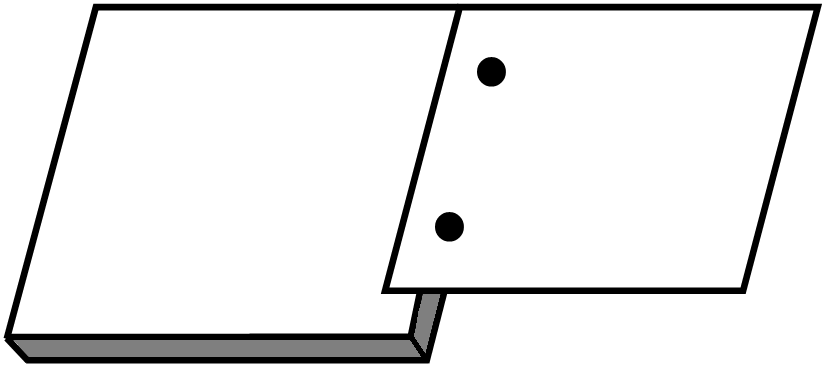
Two long metallic strips are joined together by two rivets each of radius 0.1cm (see Fig.).

Each rivet can withstand a maximum shearing stress of 3.0 × 10⁸Nm-2. Calculate the maximum tangential force a strip can exert.