Question

A diverging beam of light from a point source S having divergence angle a, falls symmetrically on a glass slab as shown.  The angles of incidence of the two extreme rays are equal.  If the thickness of the glass slab is t and the refractive index n, then the divergence angle of the emergent beam is
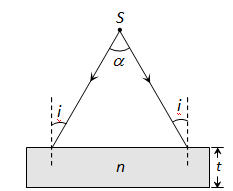
(a) Zero

(b) α

(c)  

(d) 2 

Answer

(b) α

Need a full question paper?

Generate a complete, print-ready paper with questions like this in minutes — across 16+ boards, with answer keys.

Start Generating Free

Similar questions

An element has number of proton = 7. Then what will be its atomic number?

Two infinite length wires carries currents 8A and 6A respectively and placed along X and Y-axis. Magnetic field at a point P(0, 0, d)m will be

(a)

(b)

(c)

(d)

A dielectric slab is inserted between the plates of a capacitor. The charge on the capacitor is Q and the magnitude of the induced charge on each surface of the dielectric is Q':
Figure shows a horizontal solenoid connected to a battery and a switch. A copper ring is placed on a frictionless track, the axis of the ring being along the axis of the solenoid. As the switch is closed, the ring will:

The photoelectric threshold wavelength for potassium (work function being 2eV ) is

(a) 310 nm

(b) 620 nm

(c) 1200 nm

(d) 2100 nm

In Young's experiment, light of wavelength 4000 Å is used to produce bright fringes of width 0.6 mm, at a distance of 2 meters. If the whole apparatus is dipped in a liquid of refractive index 1.5, then fringe width will be

(a) 0.2 mm

(b) 0.3 mm

(c) 0.4 mm

(d) 1.2 mm

A pendulum clock keeping correct time is taken to high altitudes:
  1. It will keep correct time.
  2. Its length should be increased to keep correct time.
  3. Its length should be decreased to keep correct time.
  4. It cannot keep correct time even if the length is changed.

A body of capacity 4μF is charged to 80 V and another body of capacity 6μF is charged to 30V. When they are connected the energy lost by 4 μF  capacitor is

(a) 7.8 mJ

(b) 4.6 mJ

(c) 3.2 mJ

(d) 2.5 mJ

As the electron in Bohr orbit of Hydrogen atom passes from state n = 2 to n = 1, the kinetic energy K and potential energy U change as

(a) K two-fold, U four-fold

(b) K four-fold, U two-fold

(c) K four-fold, U also four-fold  

(d) K two-fold, U also two-fold

There is a current of 20 amperes in a copper wire of  square metre area of cross-section. If the number of free electrons per cubic metre is , then the drift velocity is

(a) 125  

(b) 12.5  

(c) 1.25  

(d) 1.25