Questions · Page 1 of 11

M.C.Q (1 Marks)

🎯

Test yourself on this topic

50 questions · timed · auto-graded

Question 11 Mark

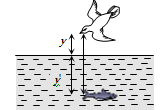
A fish rising vertically up towards the surface of water with speed 3 ms–1 observes a bird diving vertically down towards it with speed 9 ms–1. The actual velocity of bird is
(a) 4.5 ms–1

(b) 5. ms–1

(c) 3.0 ms–1

(d) 3.4 ms–1

Answer

(a) 4.5 ms–1

View full question & answer
Question 21 Mark
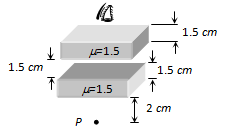
The image of point P when viewed from top of the slabs will be

(a) 2.0 cm above P

(b) 1.5 cm above P

(c) 2.0 cm below P

(d) 1 cm above P

Answer

(d) 1 cm above P

View full question & answer
Question 31 Mark

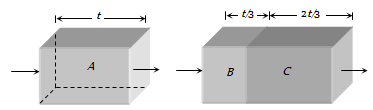
Two transparent slabs have the same thickness as shown. One is made of material A of refractive index 1.5. The other is made of two materials B and C with thickness in the ratio 1 : 2. The refractive index of C is 1.6. If a monochromatic parallel beam passing through the slabs has the same number of waves inside both, the refractive index of B is

(a) 1.1

(b) 1.2

(c) 1.3

(d) 1.4

Answer

(c) 1.3

View full question & answer
Question 41 Mark

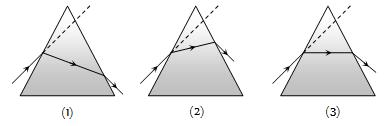
The figures represent three cases of a ray passing through a prism of angle A. The case corresponding to minimum deviation is

(a) 1 

(b) 2

(c) 3  

(d) None of these

Answer

(c) 3  

View full question & answer
Question 51 Mark

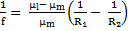
An achromatic prism is made by combining two prisms   and ; where μ  represents the refractive index. If the angle of the prism   is 10°,  then the angle of the prism P2 will be

(a) 5°

(b) 7.8°

(c) 10.6°  

(d) 20°

Answer

(a) 5°

View full question & answer
Question 61 Mark

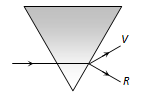
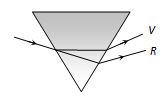
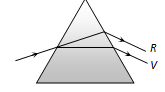
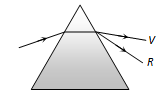
Which of the following diagrams, shows correctly the dispersion of white light by a prism

(a)

(b)

(c)

(d)

Answer

(b)

View full question & answer
Question 71 Mark

A double convex lens ( having focal length equal to the focal length of a concave mirror. The radius of curvature of the concave mirror is

(a) 10 cm

(b) 20 cm

(c) 40 cm

(d) 15 cm

Answer

(b) 20 cm

View full question & answer
Question 81 Mark

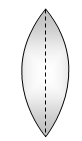
A convex lens has a focal length f.  It is cut into two parts along the dotted line as shown in the figure.  The focal length of each part will be

(a)  

(b) f

(c)  

(d) 2f

Answer

(d) 2f

View full question & answer
Question 91 Mark

Material A has critical angle   and material B has critical angle . Then which of the following is true

(i) Light can be totally internally reflected when it passes from B to A

(ii) Light can be totally internally reflected when it passes from A to B

(iii) Critical angle for total internal reflection is  

(iv) Critical angle between A and B is

(a) (i) and (iii)

(b) (i) and (iv)

(c) (ii) and (iii)

(d) (ii) and (iv)

Answer

(d) (ii) and (iv)

View full question & answer
Question 101 Mark

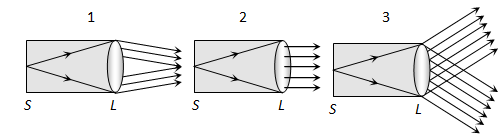
The slit of a collimator is illuminated by a source as shown in the adjoining figures. The distance between the slit S and the collimating lens L is equal to the focal length of the lens. The correct direction of the emergent beam will be as shown in figure

(a) 1

(b) 3

(c) 2

(d) None of the figures

Answer

(c) 2

View full question & answer
Question 111 Mark

A normally incident ray reflected at an angle of 90°. The value of critical angle is

(a) 45°

(b) 90°

(c) 65°

(d) 43.2°

Answer

(b) 90°

View full question & answer
Question 121 Mark

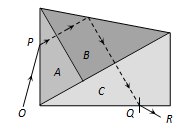
Three glass prisms A, B and C of same refractive index are placed in contact with each other as shown in figure, with no air gap between the prisms. Monochromatic ray of light OP passes through the prism assembly and emerges as QR. The conditions of minimum deviation is satisfied in the prisms

(a) A and C

(b) B and C

(c) A and B

(d) In all prisms A, B and C

Answer

(c) A and B

View full question & answer
Question 131 Mark

The critical angle for a medium is 60°. The refractive index of the medium is

(a)  

(b)

(c)

(d)

Answer

(a)  

View full question & answer
Question 141 Mark

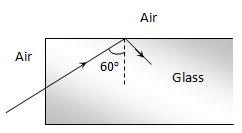
A light ray from air is incident (as shown in figure) at one end of a glass fiber (refractive index m = 1.5) making an incidence angle of 60o on the lateral surface, so that it undergoes a total internal reflection.  How much time would it take to traverse the straight fiber of length 1 km

(a) 3.33 m sec

(b) 6.67 m sec

(c) 5.77 m sec

(d) 3.85 m sec

Answer
(d) 3.85 m sec
View full question & answer
Question 151 Mark

Light travels through a glass plate of thickness t and having refractive index n. If c is the velocity of light in vacuum, the time taken by the light to travel this thickness of glass is

(a)  

(b) tnc

(c)         

(d)  

Answer

(c)         

View full question & answer
Question 161 Mark

If in compound microscope m1 and m2 be the linear magnification of the objective lens and eye lens respectively, then magnifying power of the compound microscope will be

(a)      

(b)    

(c)  

(d)    

Answer

(d)    

View full question & answer
Question 171 Mark

The relation between the linear magnification m, the object distance u and the focal length f is

(a)  

(b)

(c)

(d)

Answer

(b)

View full question & answer
Question 181 Mark

When a plane mirror is rotated through an angle θ then the reflected ray turns through the angle 2θ then the size of the image

(a) Is doubled

(b) Is halved

(c) Remains the same

(d) Becomes infinite

Answer

(c) Remains the same

View full question & answer
Question 191 Mark

Two plane mirrors are at right angles to each other. A man stands between them and combs his hair with his right hand. In how many of the images will he be seen using his right hand

(a) None   

(b) 1

(c) 2  

(d) 3

Answer

(b) 1

View full question & answer
Question 201 Mark

Assertion  :  The focal length of the mirror is f and distance of the object from the focus is u, the magnification of the mirror is f / u.

Reason      : Magnification =  

(a) If both assertion and reason are true and the reason is the correct explanation of the assertion.

(b) If both assertion and reason are true but reason is not the correct explanation of the assertion.

(c) If assertion is true but reason is false.

(d) If the assertion and reason both are false.

Answer

(a) If both assertion and reason are true and the reason is the correct explanation of the assertion.

View full question & answer
Question 211 Mark

Assertion  :  A double convex lens (m = 1.5) has focal length 10 cm. When the lens is immersed in water (m = 4/3) its focal length becomes 40 cm.

Reason      :  

(a) If both assertion and reason are true and the reason is the correct explanation of the assertion.

(b) If both assertion and reason are true but reason is not the correct explanation of the assertion.

(c) If assertion is true but reason is false.

(d) If the assertion and reason both are false.

Answer

(a) If both assertion and reason are true and the reason is the correct explanation of the assertion.

View full question & answer
Question 221 Mark

The refractive index of the material of the prism and liquid are 1.56 and 1.32 respectively.  What will be the value of q for the following refraction

(a) sinθ  ≥

(b) sinθ ≥

(c) sinθ ≥

(d) sinθ ≥

Answer

(b) sinθ ≥

View full question & answer
Question 231 Mark

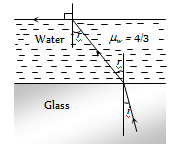
A ray of light is incident at the glass–water interface at an angle i, it emerges finally parallel to the surface of water, then the value of  would be

(a) (4/3) sin i

(b) 1/sin i

(c) 4/3

(d) 1

Answer

(b) 1/sin i

View full question & answer
Question 241 Mark

Assertion :  The refractive index of diamond is  and that of liquid is . If the light travels from diamond to the liquid, it will totally reflected when the angle of incidence is 30o.

Reason    :  μ =  where m is the refractive index of diamond with respect to liquid.

(a) If both assertion and reason are true and the reason is the correct explanation of the assertion.

(b) If both assertion and reason are true but reason is not the correct explanation of the assertion.

(c) If assertion is true but reason is false.

(d) If assertion is false but reason is true.

Answer

(d) If assertion is false but reason is true.

View full question & answer
Question 251 Mark

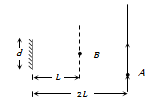
A point source of light B is placed at a distance L in front of the centre of a mirror of width d hung vertically on a wall. A man walks in front of the mirror along a line parallel to the mirror at a distance 2L from it as shown. The greatest distance over which he can see the image of the light source in the mirror is

(a) d/2

(b) d

(c) 2d

(d) 3d

Answer

(d) 3d

View full question & answer
Question 261 Mark

A man is 180 cm tall and his eyes are 10 cm  below the top of his head. In order to see his entire height right from toe to head, he uses a plane mirror kept at a distance of 1m from him. The minimum length of the plane mirror required is

(a) 180 cm

(b) 90 cm

(c) 85 cm

(d) 170 cm

Answer

(b) 90 cm

View full question & answer
Question 271 Mark

A ray is reflected in turn by three plain mirrors mutually at right angles to each other. The angle between the incident and the reflected rays is

(a) 90°

(b) 60°

(c) 180°   

(d) None of these

Answer

(c) 180°   

View full question & answer
Question 281 Mark

A ray of light incidents on a plane mirror at an angle of 30°.  The deviation produced in the ray is

(a) 30°

(b) 60°

(c) 90°

(d) 120°

Answer

(d) 120°

View full question & answer
Question 291 Mark

A hollow double concave lens is made of very thin transparent material.  It can be filled with air or either of two liquids L1 and L2 having refractive indices n1 and n2 respectively (n2 > n1 > 1).  The lens will diverge a parallel beam of light if it is filled with

(a) Air and placed in air

(b) Air and immersed in L1

(c) L1 and immersed in L2

(d) L2 and immersed in L1

Answer

(d) L2 and immersed in L1

View full question & answer
Question 301 Mark

Diameter of a plano–convex lens is 6 cm and thickness at the centre is 3 mm. If the speed of light in the material of the lens is 2 × 10⁸ m/sec, the focal length of the lens is

(a) 15 cm

(b) 20 cm

(c) 30 cm

(d) 10 cm

Answer

(c) 30 cm

View full question & answer
Question 311 Mark

A convex lens A of focal length 20 cm and a concave lens B of focal length 5 cm  are kept along the same axis with the distance d between them. If a parallel beam of light falling on  A leaves B as a parallel beam, then distance d in cm will be

(a) 25

(b) 15

(c) 30       

(d) 50

Answer
(b) 15 
View full question & answer
Question 321 Mark

Assertion  :  The cloud in sky generally appear to be whitish.

Reason      : Diffraction due to cloud is efficient in equal measure at all wavelengths.

(a) If both assertion and reason are true and the reason is the correct explanation of the assertion.

(b) If both assertion and reason are true but reason is not the correct explanation of the assertion.

(c) If assertion is true but reason is false.

(d) If the assertion and reason both are false.

Answer

(c) If assertion is true but reason is false.

View full question & answer
Question 331 Mark

Assertion :  The colour of the green flower seen through red glass appears to be dark.

Reason    : Red glass transmits only red light.

(a) If both assertion and reason are true and the reason is the correct explanation of the assertion.

(b) If both assertion and reason are true but reason is not the correct explanation of the assertion.

(c) If assertion is true but reason is false.

(d) If the assertion and reason both are false.

Answer

(a) If both assertion and reason are true and the reason is the correct explanation of the assertion.

View full question & answer
Question 341 Mark

Assertion  :  Different colours travel with different speed in vacuum.

Reason     : Wavelength of light depends on refractive index of medium.

(a) If both assertion and reason are true and the reason is the correct explanation of the assertion.

(b) If both assertion and reason are true but reason is not the correct explanation of the assertion.

(c) If assertion is true but reason is false.

(d) If assertion is false but reason is true.

Answer

(d) If assertion is false but reason is true.

View full question & answer
Question 351 Mark

Assertion :  The setting sun appears to be red.

Reason     :  Scattering of light is directly proportional to the wavelength.

(a) If both assertion and reason are true and the reason is the correct explanation of the assertion.

(b) If both assertion and reason are true but reason is not the correct explanation of the assertion.

(c) If assertion is true but reason is false.

(d) If the assertion and reason both are false.

Answer

(c) If assertion is true but reason is false.

View full question & answer
Question 361 Mark

Assertion   :  Blue colour of sky appears due to scattering of blue colour.

Reason      : Blue colour has shortest wave length in visible spectrum.

(a) If both assertion and reason are true and the reason is the correct explanation of the assertion.

(b) If both assertion and reason are true but reason is not the correct explanation of the assertion.

(c) If assertion is true but reason is false.

(d) If the assertion and reason both are false.

Answer

(a) If both assertion and reason are true and the reason is the correct explanation of the assertion.

View full question & answer
Question 371 Mark

It is desired to photograph the image of an object placed at a distance of 3m from the plane mirror. The camera which is at a distance of 4.5 m  from the mirror should be focussed for a distance of

(a) 3m

(b) 4.5m

(c) 6m

(d) 7.5 m

Answer

(d) 7.5 m

View full question & answer
Question 381 Mark

Critical angle is that angle of incidence in the denser medium for which the angle of refraction in rarer medium is

(a) 0°

(b) 57°

(c) 90°

(d) 180°

Answer

(c) 90°

View full question & answer
Question 391 Mark

A plane mirror makes an angle of 30° with horizontal. If a vertical ray strikes the mirror, find the angle between mirror and reflected ray

(a) 30°

(b) 45° 

(c) 60° 

(d) 90° 

Answer

(c) 60° 

View full question & answer
Question 401 Mark

A plane mirror produces a magnification of

(a) -1

(b) +1

(c) Zero

(d) Between 0 and +∞

Answer

(b) +1

View full question & answer
Question 411 Mark

A ray of light is incidenting normally on a plane mirror. The angle of reflection will be

(a) 0°

(b) 90°

(c) Will not be reflected

(d) None of the above

Answer

(a) 0°

View full question & answer
Question 421 Mark

An eye specialist prescribes spectacles having a combination of convex lens of focal length 40 cm in contact with a concave lens of focal length 25 cm. The power of this lens combination in diopters is

(a) + 1.5

(b) – 1.5

(c) + 6.67

(d) – 6.67

Answer

(b) – 1.5

View full question & answer
Question 431 Mark

Finger prints are observed by the use of

(a) Telescope 

(b) Microscope 

(c) Gallilean telescope 

(d)  Concave lens 

Answer

(b) Microscope 

View full question & answer
Question 441 Mark

When objects at different distances are seen by the eye, which of the following remains constant

(a) The focal length of the eye lens

(b) The object distance from the eye lens

(c) The radii of curvature of the eye lens

(d) The image distance from the eye lens

Answer

(d) The image distance from the eye lens

View full question & answer
Question 451 Mark

A person cannot see objects clearly beyond 2.0 m. The power of lens required to correct his vision will be

(a) + 2.0 D

(b) – 1.0 D

(c) + 1.0 D

(d) – 0.5 D

Answer

(d) – 0.5 D

View full question & answer
Question 461 Mark

Circular part in the centre of retina is called

(a)  Blind spot 

(b) Yellow spot 

(c) Red spot 

(d) None of the above 

Answer

(b) Yellow spot 

View full question & answer
Question 471 Mark

A person's near point is 50 cm and his far point is 3 m. Power of the lenses he requires for

(i)  reading and  (ii) for seeing distant stars are

(a) – 2 D and 0.33 D

(b) 2 D and – 0.33 D

(c) – 2 D and 3 D

(d) 2 D and – 3 D

Answer

(b) 2 D and – 0.33 D

View full question & answer
Question 481 Mark

A person wears glasses of power – 2.0 D. The defect of the eye and the far point of the person without the glasses will be

(a) Nearsighted, 50 cm

(b) Farsighted, 50 cm

(c) Nearsighted, 250 cm

(d) Astigmatism, 50 cm

Answer

(a) Nearsighted, 50 cm

View full question & answer
Question 491 Mark

The human eye has a lens which has a

(a) Soft portion at its centre

(b) Hard surface

(c) Varying refractive index

(d) Constant refractive index

Answer

(c) Varying refractive index

View full question & answer
Question 501 Mark

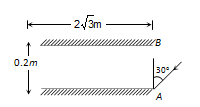
Two plane mirrors. A and B are aligned parallel to each other, as shown in the figure. A light ray is incident at an angle of 30°  at a point just inside one end of A. The plane of incidence coincides with the plane of the figure. The maximum number of times the ray undergoes reflections (including the first one) before it emerges out is

(a) 28

(b) 30

(c) 32

(d) 34

Answer

(b) 30

View full question & answer