MCQ
A drop of mercury of radius $2\, mm$ is split into $8$ identical droplets. Find the increase in surface energy ....... $\mu J$. (Surface tension of mercury is $0.465\;J/{m^2}$)
  • $23.4$
  • B
    $18.5$
  • C
    $26.8$
  • D
    $16.8$

Answer

Correct option: A.
$23.4$
a
(a) Increase in surface energy or work done in splitting a big drop $ = 4\pi {R^2}T({n^{1/3}} - 1)$

$ \Rightarrow W = 4\pi  \times {(2 \times {10^{ - 3}})^2} \times 0.465({8^{1/3}} - 1) = 23.4\;\mu \,J$

Need a full question paper?

Generate a complete, print-ready paper with questions like this in minutes — across 16+ boards, with answer keys.

Start Generating Free

Similar questions

Match List $I$ with List $II$

List $I$ List $II$
$A$ Spring constant $I$ $(T ^{-1})$
$B$ Angular speed $II$ $(MT ^{-2})$
$C$ Angular momentum $III$ $(ML ^2)$
$D$ Moment of Inertia $IV$ $(ML ^2 T ^{-1})$

Choose the correct answer from the options given below
The frequency of a whistle of an engine is $600\, cycles/sec$ is moving with the speed of $30 \,m/sec$ towards an observer. The apparent frequency will be .... $cps$ (velocity of sound $= 330 \,m/s$)
A drop of oil is placed on the surface of water. Which of the following statement is correct
The bob of a simple pendulum (mass m and length $ l$) dropped from a horizontal position strikes a block of the same mass elastically placed on a horizontal frictionless table. The K.E. of the block will be
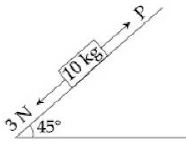
A block of mass $10\, kg$ is kept on a rough inclined plane as shown in the figure. A force of $3\, N$ is applied on the block. The coefficient of static friction between the plane and the block is $0.6$. What should be the minimum value of force $P$, such that the block does not move downward? (take $g = 10\, ms^{-2}$) ........ $N$
The gravitational field due to a mass distribution is $\text{I}=\frac{\text{K}}{\text{r}^3}$ in the $X-$direction. $(K$ is a constant$)$.Taking the gravitational potential to be zero at infinity, its value at a distance $x$ is:
A car moves for $60\ s$ covering a distance of $3600\ m$ with zero initial velocity. What is the acceleration in $m/ s^2?$
A wave on a string is travelling and the displacement of particles on it is given by $x = A\, sin\, (2t -0.1\, x)$. Then the wavelength of the wave is
Which is the method in which heat transmission occurs at the highest?
Choose the correct option: