Question
$a.$ Explain why, for any charge configuration, the equipotential surface through a point is normal to the electric field at that point.
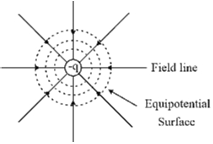
Draw a sketch of equipotential surfaces due to a single charge $(-q)$, depicting the electric field lines due to the charge.
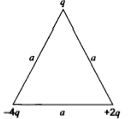
$b.$ Obtain an expression for the work done to dissociate the system of three charges placed at the vertices of an equilateral triangle of side a as shown alongside.
Answer

$a.$ The work done in moving a charge from one point to another on an equipotential surface is zero. If the field is not normal to an equipotential surface, it would have a non zero component along the surface. This would imply that work would have to be done to move a charge on the surface which is contradictory to the definition of equipotential surface. Mathematically
Work done to move a charge dq, on a surface, can be expressed as $d W=d q(\vec{E} \cdot \overrightarrow{d r})$
But $dW = 0$ on an equipotential surface
$\therefore \vec{E} \perp \overrightarrow{d r}$
Equipotential surfaces for a charge $-q$ is shown alongside.
Image

$b.$ Work required to dissociate the system of three charges
$=- \text { P.E. of the system }$
$=-\frac{1}{4 \pi \varepsilon_0}\left[\frac{q \times(-4 q)}{a}+\frac{q \times 2 q}{a}+\frac{(-4 q) \times 2 q}{a}\right]$
$=-\frac{1}{4 \pi \varepsilon_0}\left[-4 q^2+2 q^2-8 q^2\right]=+\frac{10 q^2}{4 \pi \varepsilon_0 a}$
Image

Need a full question paper?

Generate a complete, print-ready paper with questions like this in minutes — across 16+ boards, with answer keys.

Start Generating Free

Similar questions

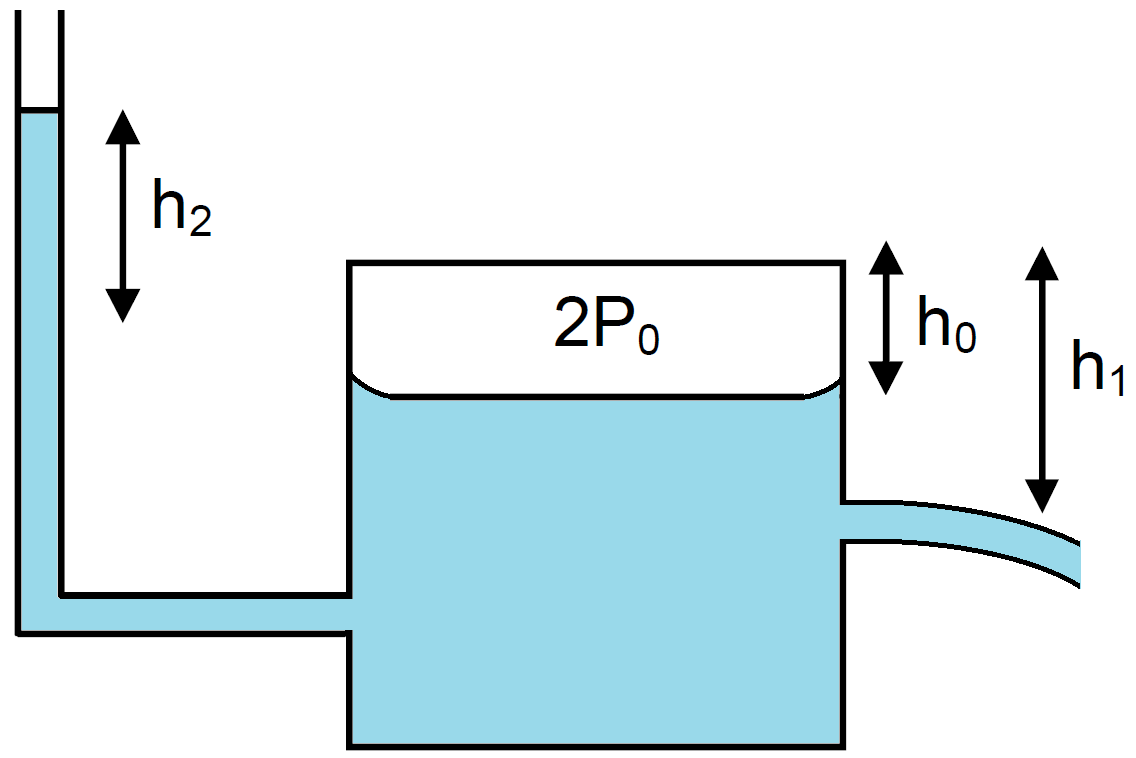
Figure. shows a large closed cylindrical tank containing water. Initially the air trapped above the water surface has a height $h_0$ and pressure $2p_0$ where $p_0$ is the atmospheric pressure. There is a hole in the wall of the tank at a depth $h_1$ below the top from which water comes out. A long vertical tube is connected as shown.
  1. Find the height $h_2$ of the water in the long tube above the top initially.
  2. Find the speed with which water comes out of the hole.
  3. Find the height of the water in the long tube above the top when the water stops coming out of the hole.
Suppose the smaller pulley of the previous problem has its radius 5.0cm and moment of inertia $0.10kg-m^2.$ Find the tension in the part of the string joining the pulleys.
An LC circuit contains a 20mH inductor and a 50μF capacitor with an initial charge of 10mC. The resistance of the circuit is negligible.
Let the instant the circuit is closed be t = 0.
  1. What is the total energy stored initially? Is it conserved during LC oscillations?
  2. What is the natural frequency of the circuit?
  3. At what time is the energy stored
  1. completely electrical (i.e., stored in the capacitor)?
  2. completely magnetic (i.e., stored in the inductor)?
  1. At what times is the total energy shared equally between the inductor and the capacitor?
  2. If a resistor is inserted in the circuit, how much energy is eventually dissipated as heat?
Derive an expression for the gravitational field due to a uniform rod of length L and mass M at a point on its perpendicular bisector at a distance d from the centre.
The densities of wood and benzene at $0^{\circ} \mathrm{C}$ are $880 \mathrm{~kg} \mathrm{~m}^{-3}$ and $900 \mathrm{~kg} \mathrm{~m}^{-3}$ respectively. The coefficients of volume expansion are $1.2 \times 10^{-3}{ }^{\circ} \mathrm{C}^{-1}$ for wood and $1.5 \times 10^{-3}{ }^{\circ} \mathrm{C}^{-1}$ for benzene. At what temperature will a piece of wood just sink in benzene?
The gravitational attraction between electron and proton in a hydrogen atom is weaker than the coulomb attraction by a factor of about $10^{–40}$. An alternative way of looking at this fact is to estimate the radius of the first Bohr orbit of a hydrogen atom if the electron and proton were bound by gravitational attraction. You will find the answer interesting.
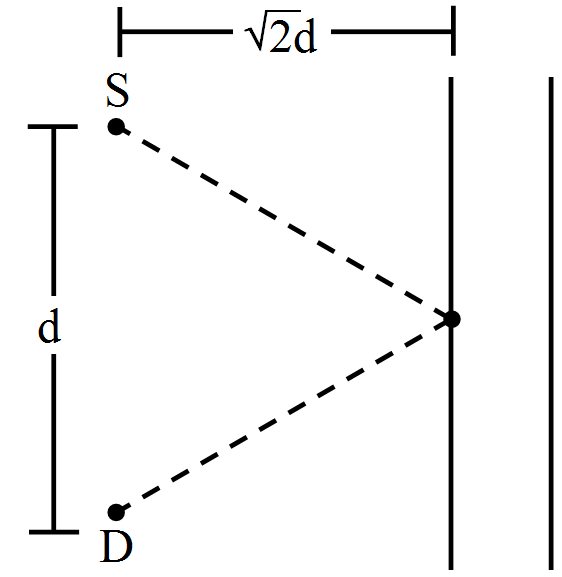
A source S and a detector D are placed at a distance d apart. A big cardboard is placed at a distance $\sqrt{2}\text{d}$ from the source and the detector as shown in figure, The source emits a wave of wavelength $=\frac{\text{d}}{2}$ which is received by the detector after reflection from the cardboard. It is found to be in phase with the direct wave received from the source. By what minimum distance should the cardboard be shifted away so that the reflected wave becomes out of phase with the direct wave?
The radii of curvature of a lens are +20cm and +30cm. The material of the lens has a refracting index 1.6. Find the focal length of the lens.
  1. If it is placed in air.
  2. If it is placed in water $(\mu=1.33).$
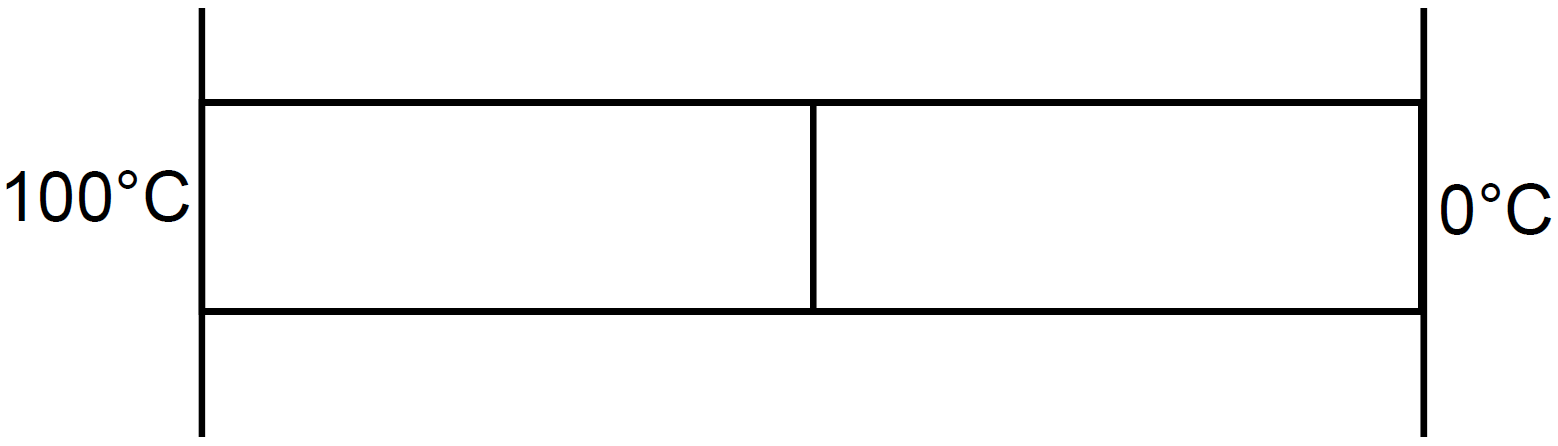
The two rods shown in figure, have identical geometrical dimensions. They are in contact with two heat baths at temperatures $100^\circ C$ and $0^\circ C$. The temperature of the junction is $70^\circ C.$ Find the temperature of the junction if the rods are interchanged.
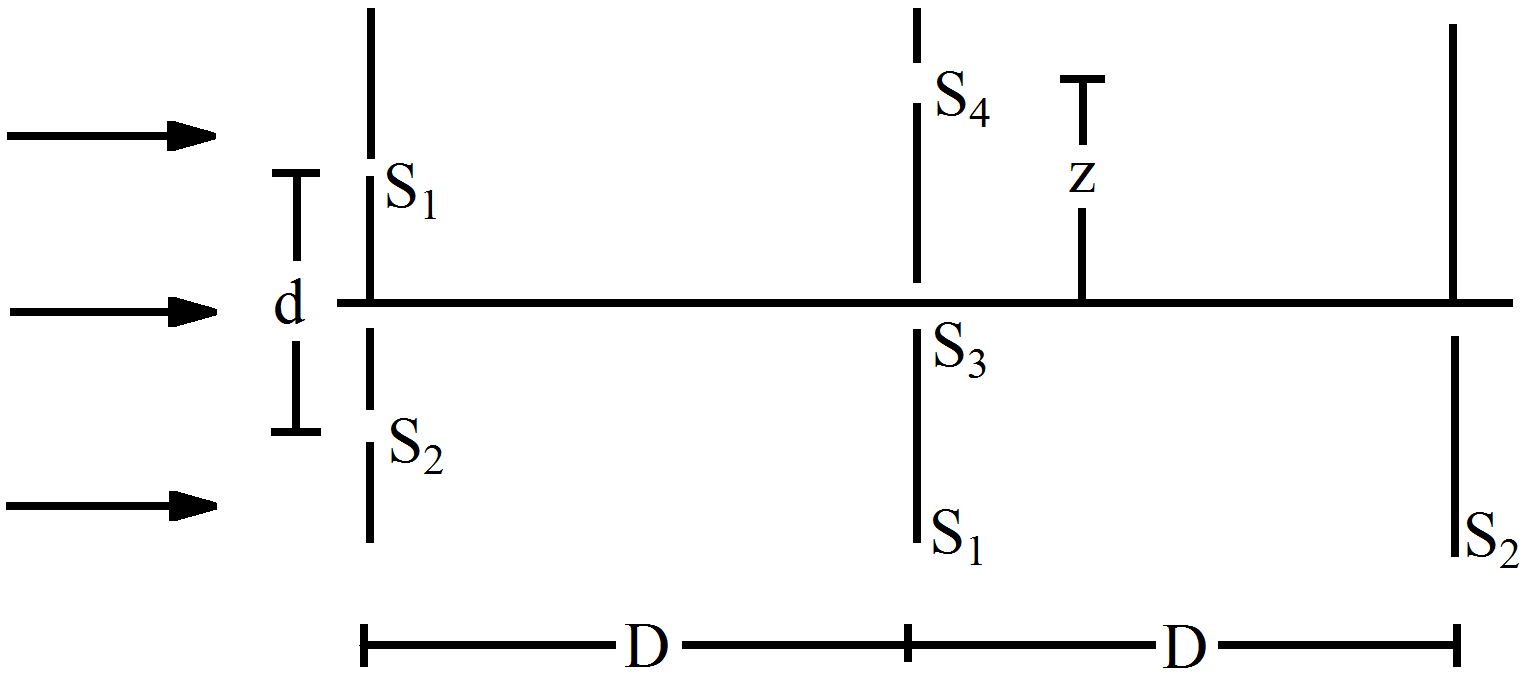
Consider the situation shown in figure (17-E6). The two slits $S_1$ and $S_2 $ p laced symmetrically around the central line are illuminated by a monochromatic light of wavelength $\lambda$. The separation between the slits is d . The light transmitted by the slits falls on a screen $E_1$ placed at a distance $D$ from the slits. The slit $\mathrm{S}_3$ is at the central line and the slit $S_4$ is at a distance $z$ from $S_3$. Another screen $\sum_2$ is placed a further distance $D$ away from $\sum_1$. Find the ratio of the maximum to minimum intensity observed on $\sum_2$, if $z$ is equal to,
  1. $\text{z}=\frac{\lambda\text{D}}{2\text{d}}$
  2. $\frac{\lambda\text{D}}{\text{d}}$
  3. $\frac{\lambda\text{D}}{4\text{d}}$